www.carcc.org NSF ACI-1341935: Advanced Cyberinfrastructre - - - PowerPoint PPT Presentation

carcc org nsf aci 1341935 advanced cyberinfrastructre
SMART_READER_LITE
LIVE PREVIEW

www.carcc.org NSF ACI-1341935: Advanced Cyberinfrastructre - - - PowerPoint PPT Presentation

NSF ACI-1620695: RCN: Advancing Research and Education Through a National Network of Campus Research Computing Infrastructures - The CaRC Consortium PI: Bottum (Clemson), Co-Pis: Tsinoremas (Miami), Neeman (U Oklahoma), Livny (Wisconsin)


slide-1
SLIDE 1

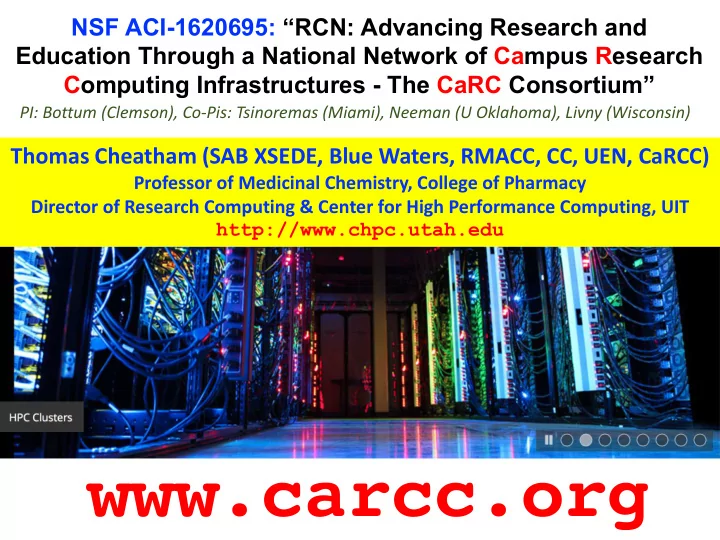
NSF ACI-1620695: “RCN: Advancing Research and Education Through a National Network of Campus Research Computing Infrastructures - The CaRC Consortium”

PI: Bottum (Clemson), Co-Pis: Tsinoremas (Miami), Neeman (U Oklahoma), Livny (Wisconsin)

Thomas Cheatham (SAB XSEDE, Blue Waters, RMACC, CC, UEN, CaRCC)

Professor of Medicinal Chemistry, College of Pharmacy Director of Research Computing & Center for High Performance Computing, UIT http://www.chpc.utah.edu

www.carcc.org

slide-2
SLIDE 2

NSF ACI-1341935: “Advanced Cyberinfrastructre - Research and Educational Facilitation: Campus-Based Computational Research Support” – ACI-REF

slide-3
SLIDE 3

http://aci-ref.github.io/facilitation_best_practices/

+ blog, …

http://aciref.org

slide-4
SLIDE 4

CaRC (CaRC Council) Facilitators ACI-REF A potential vision for bringing communities together… CI Engineers Systems Team (IT-X, LCI) Advanced Networking (DMZ, SDN, GENI?, …) Security / IAM Private Cloud

Student Programs Domain Teams

Shown @ OSG all-hands 2017

slide-5
SLIDE 5

How to scale / grow / serve campuses & share?

  • Many universities wanted to join ACI-REF (yet

we were not ready as we are still learning how to collaborate and scale).

  • Who / where is our “home” or “parent”?
  • What broader activities (beyond Facilitation)?
  • Who else to collaborate with? (CC, CI

Engineers, CI Practitioners, Technical Leads, …)

(RCN → CaRC)

slide-6
SLIDE 6

NSF ACI-1620695: “RCN: Advancing Research and Education Through a National Network

  • f Campus Research Computing Infrastructures - The CaRC Consortium”
slide-7
SLIDE 7

Vision: The vision of the CaRC Consortium is to advance the frontiers of research at academic institutions by supporting on- campus awareness and facilitation services related to computation for researchers, including inter-institutional resource and knowledge sharing among research computing professionals, and continuous innovation in research computing capabilities.

slide-8
SLIDE 8

Purpose: The Consortium is committed to supporting the sustainability of campus efforts through professional and career development for the individuals (“Facilitators” and

  • ther professionals) who enable and collaborate with

researchers to better utilize large-scale, advanced computing resources. The Consortium is further dedicated to extending and enhancing the reach and impact of campus and national research computing infrastructure on research conducted at the campus level (including multi- institution collaborations). The Consortium explores and develops effective strategies and best practices that campuses may use to empower their researchers to become more effective users of advanced research cyberinfrastructure (CI) at the campus, regional, national, and international levels.

slide-9
SLIDE 9

Respondent profile (n=255) – Selected items

Select one: 4.3% CaRC Leadership 6.7% CaRC Council 83.1% Involved in RC, but not a member of CaRC 5.9% Other Years experience in primary role: 16.7% Under 5 years 23.0% 5-10 years 29.4% 11-20 years 19.8% 21-30 years 11.1% Over 30 years Gender: 18% Female 80.4% Male 1.6% Prefer not to answer

Check all that apply: 5.1% Campus executive leadership (Provost, CIO, VPR) 25.9% Campus research computing leadership (VP, Director RC) 25.1% Campus IT services (systems, security, networking, engineering) 36.5% Campus RC facilitators (not part of CaRC or ACI-REF) 24.7% Campus RC/data science instructor 26.7% Campus IT/RC training and workforce development 36.1% XSEDE Campions (campus champion, domain champion, student champion) 7.8% ACI-REF Facilitator 16.9% CASC Leader or member 18.4% XSEDE leader or member Check all that apply: 46.3% Principle Investigator 24.7% Research software developer 18.0% Research team member 2.4% Government research lab

CaRC Survey – 150 Universities responded

slide-10
SLIDE 10

If CaRC Consortium could deliver one thing to you, "a must have," what would it be? (Something that you personally value or that is professionally useful to you. It would motivate you to want this to move forward.)

slide-11
SLIDE 11

What is the biggest barrier preventing

  • r limiting your “must have”?
slide-12
SLIDE 12

Top interests

(not important=0; very important=1; very difficult=0; very easy=1)

Rank by importance:

  • 1. Workforce

development for cyberinfrastructure administrators and staff (mean=.84)

  • 2. Supporting facilitators

(broadly defined) on campus, bridging between research teams and research computing resources (mean=.84)

  • 3. Research computing

expertise sharing among universities (mean=.84)

Rank by difficulty:

  • 1. Influencing state

and federal policies impacting research cyberinfrastructure (mean=.18)

  • 2. Research computing

resource sharing among universities (mean=.26)

  • 3. Effective models for

demonstrating return on investment (ROI) in research computing resources (mean=.26)

slide-13
SLIDE 13

Top interests

(not important=0; very important=1; very difficult=0; very easy=1)

Rank by importance:

  • 1. Workforce

development for cyberinfrastructure administrators and staff (mean=.84)

  • 2. Supporting facilitators

(broadly defined) on campus, bridging between research teams and research computing resources (mean=.84)

  • 3. Research computing

expertise sharing among universities (mean=.84)

Gaps between importance and difficulty:

  • 1. Influencing state and

federal policies impacting research cyberinfrastructure (gap=.59)

  • 2. Workforce

development for cyberinfrastructure administrators and staff (gap=.56)

  • 3. Supporting facilitators

(broadly defined) on campus, bridging between research teams and research computing resources (gap=.54)

Rank by difficulty:

  • 1. Influencing state

and federal policies impacting research cyberinfrastructure (mean=.18)

  • 2. Research computing

resource sharing among universities (mean=.26)

  • 3. Effective models for

demonstrating return on investment (ROI) in research computing resources (mean=.26)

slide-14
SLIDE 14

Comment: Workforce development is very important for all stakeholder groups. The response from campus executive leaders is lower than the rest. Although this difference is not statistically significant, it may still be reflective of an important gap in views

  • n the part of these leaders. IT leadership see workforce development as less challenging than others (sig. at the .05 level).
slide-15
SLIDE 15

Comment: All stakeholders see supporting facilitators as very important and most see it as very hard to do. Executives do not see this as challenging as others do (while the difference is not statistically significant, that may reflect the relative small n for executives (n=13). There are also some bright spots on the visualization on the prior slide to be explored.

slide-16
SLIDE 16

Comment: Campus executive leaders are somewhat less likely to see defining roles and career paths for research computing as important (the difference is not statistically significant, but the “n” is small). This points to the need for increased education and

  • awareness. A substantial number (28.6%) indicate don’t know or not applicable.
slide-17
SLIDE 17

CaRC Consortium inaugural committee / focus areas*

  • CI workforce development – A working group within CaRC

to interface with the many regional and national efforts aimed at advocating for, defining, and developing the CI workforce. Profession? Titles? Roles? (Co-Chairs: Bottum/Hauser)

  • Developing the CaRC facilitator network – A group

charged with figuring out how to coordinate the facilitators within the expanding CC network. (Michaels/Brunson)

  • Expertise and resource sharing – Consulting teams /

skunkworks, human resource sharing (facilitation, systems, …), physical resource sharing. (Sheehan/Knuth)

  • Stakeholder and value proposition – A critical element that

needs to be well-defined for CaRC to succeed, grow and move towards sustainability is to define who are the customers or stakeholders and what do these customers gain in terms of services and deliverables, i.e. what is the value proposition? (Sherman/von Oehsen)

slide-18
SLIDE 18
  • Leading practices in security– Share security tips,

leading practices, technologies/solutions, …

  • Business model / administrative structure – Formation
  • f this will be delayed until the stakeholder / value

proposition discussion matures.

  • Marketing / communications – Development of a WWW

presence, dissemination of survey results, and communication with stakeholders.

CaRC Consortium future committees (*) (*) aka maybe; will soon have leadership retreat

slide-19
SLIDE 19

CaRC Consortium inaugural committee / focus areas* Stakeholder and value proposition

  • Campus Executive Leadership (e.g. Presidents, Chancellors, Provosts, Deans)
  • Campus Information and Research Leadership (e.g. CIOs, VPRs)
  • Campus Research Computing (RC) Leadership (e.g. VP, AVP or Director RC;

Associate CIO)

  • Principal Investigators and Research Team Members
  • Students (in classrooms) and as RC employees
  • Campus Research Computing Facilitators, including CaRC and ACI-REF

Facilitators, RC Software Engineers, XSEDE Campus Champions, …

  • Campus Research, Academic, Enterprise IT Services (systems, security,

networking, engineering)

  • Campus Research Computing/Data Science Instructors
  • Campus IT/Research Cyberinfrastructure Workforce Development Providers
  • Research Funders

Note: Titles, roles, and responsibilities vary across campuses with respect to research and research computing.

slide-20
SLIDE 20
slide-21
SLIDE 21

Overarching CaRC Value Propositions

  • The CaRC Consortium will advance the frontiers of

research through improved access to and use of Research Computing (RC) resources.

  • Members of CaRC will be better able to optimize the

use of RC resources on each campus and across the CaRC Consortium.

  • Members of CaRC will be better able to identify and

share RC leading practices and innovations.

  • Members of CaRC will be better able to access

domain-specific RC expertise in a range of fields and disciplines that exceeds the expertise on any one campus.

  • Through CaRC, individual campuses will be better able

to provide leadership in the RC ecosystem, with an underlying culture of collaboration.

slide-22
SLIDE 22

Campus Executive Leadership (e.g. President, Chancellor, Provost)

  • Membership in the CaRC Consortium helps your campus

maximize the value generated from investments in research and research computing. As a CaRC Consortium member, your campus is well-positioned within the ecosystem of world- class research computing campuses in order to best meet current and future research needs. Campus Information and Research Leadership (e.g. CIO, VPR)*

  • Membership in the CaRC Consortium multiplies the research

computing expertise and resources available to principal investigators and research teams across your campus. The CaRC Consortium is dedicated to helping its members document the impacts of research computing in grants and publications, increase the security compliance capabilities, increase compliance with data management plans, and ensure career paths for research computing talent.

slide-23
SLIDE 23

CI CI Professi ssionalization Work rksh shop Goals

  • Learn from leading practices regarding cyberinfrastructure

(CI) job definitions and career paths

  • Develop a flexible framework to organize CI hiring, career

development, retention and other aspect of HR in the CI ecosystem

  • Apply the framework for research computing and data

work that is:

  • Researcher facing roles
  • Systems facing roles
  • Software/Data facing roles
  • Sponsors/Stakeholder facing roles
  • Anticipate potential complications and disconnects when

implementing the framework across diverse campuses

  • Specify next steps in the utilization of the framework and,

as a result, the further professionalization of CI work

slide-24
SLIDE 24

Me Meeting St Stru ructure

Monday Evening

  • Panel discussion from universities that have recently

created a job family classification for CI, Research Computing, or similar. Tuesday Morning (breakout groups)

  • Defining and organizing roles and responsibilities

Tuesday Afternoon (breakout groups)

  • Talent pipeline: education, experience, competencies
  • Professional development: career opportunities,
  • rganizations

Wednesday Morning

  • What are the hesitations or cautions?
  • What will the flushed out product look like?
  • How will it be used?
  • Breakout report to CASC
slide-25
SLIDE 25

Re Research facing roles

Engaging researchers to co-create and co-learn relevant advanced computing capabilities Provide possible solutions to facilitate and/or transform research Facilitating collaboration and coordination with

  • ther people in the technology/research landscape

Providing regular communications to the campus

  • r external research community

Actively solving problems and enhancing learning with full awareness of the local and larger research computing and data landscape. This includes being agile and proactive.

slide-26
SLIDE 26

Sy Systems facing spectrum

Next focus area (for me): Collaboration of CC, RMACC, CaRCC (and maybe CI Eng)

slide-27
SLIDE 27

So Software/Data facing roles

slide-28
SLIDE 28

CI Leader

Vendors

Alumni

Gov't Agencies

Prof. Assns

Industrial Partners

Institution Board

CI staff

St Stakeholder r Facing Network rk

slide-29
SLIDE 29

St Stakeholder r Facing Network rk

Stakeholder

Education/ Promotion/ Communication Leadership/ Vision Sustainability Stakeholder Management/ Collaborations Benchmarking/ Assessment Community/ Workforce Governance/ Process

slide-30
SLIDE 30

St Stakeholder r Facing Network rk

Institutional Leadership

Education/ Promotion/ Communica tion Leadership/Vision Sustainability

Stakeholder Management /Collaboratio ns

Benchmarking/ Assessment

Community /Workforce

Governance/ Process

slide-31
SLIDE 31

St Stakeholder r Facing Network rk

End User

Education/Promotion/ Communication Leadership/ Vision Sustainabilit y Stakeholder Management/ Collaborations Benchmarking/ Assessment Commun ity/ Workfor ce Governanc e/Process

slide-32
SLIDE 32

Common Th Themes Th That Emerged

  • Co-Creation (partnering with researchers): Research computing and data

professionals are co-creating methods and software models; Collaborative process, very different from delivery of traditional IT and software services

  • Career Paths are incomplete in most organizations; creating challenges for

recruiting, developing and retaining these professionals.

  • Digital: The exponential growth of digital technologies underlies work;

accelerating change in the work due to changes in hardware, software, systems, and the nature of the data itself.

  • Status: Work of research computing & data professionals generally held in high

regard by faculty with whom they work; important status and power differences between these professionals and principle investigators that are part of a larger “two-tier” culture in most university settings.

  • Terminology: Work centered on “cyberinfrastructure for research” and touches
  • n many related domains, including “data science” and “high performance

computing.” This work is distinct from, but connected to the work of “information technology” professionals.

slide-33
SLIDE 33

CaRC is in its early phase of instantiation and is likely malleable What should CaRC do? Who should CaRC support? What is CaRC’s value to you? Is your institution seriously interested in joining? Why not!!! jb@clemson.edu, tec3@utah.edu

slide-34
SLIDE 34
slide-35
SLIDE 35

CaRC is in its early phase of instantiation and is likely malleable What should CaRC do? Who should CaRC support? What is CaRC’s value to you? Is your institution seriously interested in joining? jb@clemson.edu, tec3@utah.edu