The African Cashew initiative (ACi) ACi s Sustainable Supply Chain - - PowerPoint PPT Presentation

the african cashew initiative aci
SMART_READER_LITE
LIVE PREVIEW

The African Cashew initiative (ACi) ACi s Sustainable Supply Chain - - PowerPoint PPT Presentation

The African Cashew initiative (ACi) ACi s Sustainable Supply Chain Model Rita Weidinger, Executive Director World Cashew Convention, Dubai, 5 February 2015 Overview Africas role and its potential in a global cashew sector What is the


slide-1
SLIDE 1

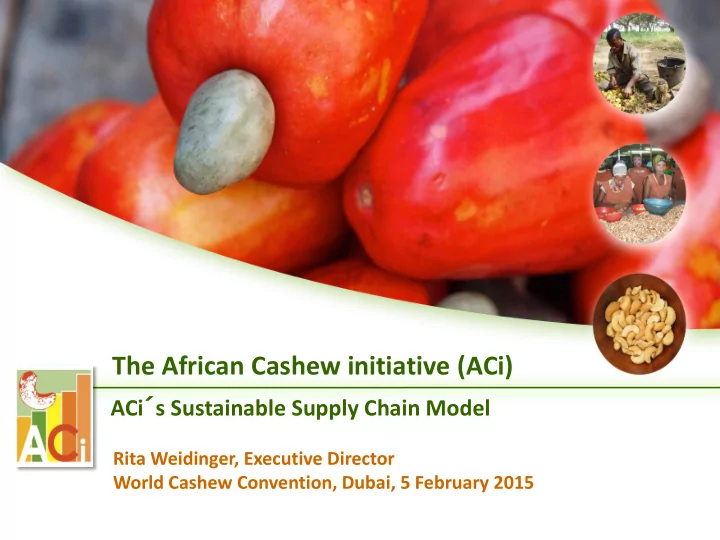
The African Cashew initiative (ACi)

ACi´s Sustainable Supply Chain Model

Rita Weidinger, Executive Director World Cashew Convention, Dubai, 5 February 2015

slide-2
SLIDE 2
  • Africas role and its potential in a global cashew sector
  • What is the African Cashew initative (ACi)
  • ACi Success factors
  • ACi Achievements so far
  • The cashew way forward

Overview

2

slide-3
SLIDE 3

3

Africa´s role and its potential in a global cashew sector

slide-4
SLIDE 4

4

Major consumers Minor consumers Major producers Minor producers

Production

  • Africa produces about 45% of global

cashew production

Processing

  • Less than 10% of African raw cashew

production undergoes further processing in Africa

Consumption

  • More than 90% of global cashew is

consumed outside Africa – the main consumers are North America, India and the EU.

Keeping a balance between global supply and demand, Africa must increase current production level by 20% until 2019

slide-5
SLIDE 5

1 There is some production in Sierra Leone, Liberia, Mali, and likely other

African countries too, but no detailed data available

2 ISS based on reports from DCCD and Vinacas

3 Typical yields observed during the last 1-5 years, according to experts estimations. Source: McKinsey analysis of report by ISS/Fitzpatrick; further ISS/Fitzpatrick updates

Countries in which ACi operates

Producer countries1 The Gambia 8.000 Kenya 10.000 30.000 Burkina Faso 35.000 Senegal 68.000 Mozambique 70.000 Nigeria 90.000 Benin 90.000 Tanzania 100.000 Guinea Bissau 135.000 Cote d‘Ivoire

550.000

Ghana Production volumes 2013/14 (MT) Est. Number

  • f farmers

Thousands

  • Est. area

planted (000 ha) Typical yield 3 (kg/ha) 10 60 60 45 330 75 n/a 1.000 250 200 1.000

500

400 300 400 550 500 300 350 250

800

14 33 57 140 62 175 325 300 213 245 1.000 250

Typical benchmark yields are 1.2 tons/ha in India (Maharastra) or Vietnam (Binh Phuc Province)2, suggesting Africa’s yield gap is >500 kg/ha

Primary countries where cashews are grown

The overview of cashew production shows that yields in Africa vary considerably

slide-6
SLIDE 6

Climate change is expected to increase cashew’s importance as an income source in West-Africa

Current Situation in Côte d’Ivoire and Ghana 2

Green areas indicate best suitability for cashew

Suitability in 2050 in Côte d’Ivoire and Ghana 2

1Source: Roudier, P. et al., The impact of future climate change on West African crop yields : what does the recent literature say? Global Environ. Change (2011),

doi:10.1016/j.gloenvcha.2011.04.007

2Source: “Predicting the impact of climate change on cashew growing regions in Ghana and Ivory Coast”, International Center for Tropical Agriculture on behalf of BMGF, 2010.

slide-7
SLIDE 7

7

Introduction to ACi

slide-8
SLIDE 8

8

Production

‘Increasing raw cashew nut production and quality’

Processing

‘Increasing quantity and quality of African cashew kernel and cashew apple processing’

Supply Chain Linkages

‘Establish and expand sustainable links to the global market place’

Sector

  • rganization

‘Advocate policies that favor cashew production and processing’ ACi vision for 2016: 430.000 farmers increase their family income

ACi tackles these challenges and transforms them into business

  • pportunities for all actors along the value chain
slide-9
SLIDE 9

A Strategic Alliance of Private and Public Partners ensures sustainable and market-driven implementation of activities

9

Funding, Contributing and Implementing Partners (16)

Public Private CSO / NGO

Matching Fund Partners (30+)

10+ National Research Institutions, Universities and Extension Organisation 10+ Buyers, Traders, Processors, Farmers Organisations 10+ National and International NGO’s

Other partners (30+)

slide-10
SLIDE 10

ACi works in five countries along the Cashew Value Chain: From Farm to Fork, A Win - Win Situation for all

10 Budget Size

$97 mio in total

$52 mio in cash $45 mio in-kind

slide-11
SLIDE 11

11

ACi Success factors

slide-12
SLIDE 12

Success factor 1: Developing Local Capacities and multistakeholder Partnerships in the Cashew Sector

12

  • 380,000+ farmers; 2,200+ trainers
  • 58 Master Trainers from 7 West-African countries
  • 5 countries policy advise , Regional networking, Conferences
  • Communication, based on data and facts.
  • Using ICT for Management Information Systems, tracebility, trainings, etc.
slide-13
SLIDE 13

Success Factor 2: Changing power relations in agricultural value chains provide high potential for a more inclusive business model

Producer Processor Buyer trader trader

Potential for increased value addition for farmer based

  • rganisations

Traders play a less significant role, although will not likely be eliminated entirely Processors take increasing initiative to link with farmers

Market Power Past

Market Power Future

  • Bad marketing position for farmers
  • No traceability
  • No incentives for improvement
  • Bad quality
  • No cooperation/suspicion
  • Good marketing position

for farmers

  • Traceability
  • Good quality
  • Cooperation/ joint initiatives
slide-14
SLIDE 14

Success factor 3: For sustainable inclusive business, processors and

  • thers must apply an incentive mechanism for farmers

14

Knowledge/Training Inputs Community warehouse/decentralized cracking Traceability Pre-financing Market information Know how quality and quantity; prices Bulk sales; Speculation Premium Production; Personal needs

Increase price / income for farmers

Competition

Loyalty packages Benefit to farmer

slide-15
SLIDE 15

15

  • ACi internal:
  • Key Cost indicators
  • Return on Investment
  • Advise for Financial Institutions, facilitating $12 mio + for processing
  • Business Development Services for processing industry
  • Sector analysis: e.g.
  • margin distributions, and
  • cost factors for development activities,

e.g. cost per ton processed; costs per farmer training. Success factor 4: Increasing efficiency and viability for processing and farming by reducing costs, increasing ROI and in-country value

slide-16
SLIDE 16

16

ACi Achievements so far

slide-17
SLIDE 17

ACi shows visible and remarkable Achievements until today

17

  • 380,000+ cashew farmers trained;
  • 22% of them women
  • $120 million accumulated incomes
  • Plus $120 net income per farmer
  • Nearly 5,800 jobs created in new cashew

processing industry

  • 75% being women
  • $3.6 million accumulated wage
  • $620 annual max. wage per worker
slide-18
SLIDE 18

ACi shows visible and remarkable achievements until today

18

  • 20 processing facilities receive technical,

financial and managerial assistance

  • These increased capacities from 8,150 MT

in 2008 to 48,200 MT 2014.

  • Processing in Africa increased from 5 % to

10 %.

  • 18 projects were established to

facilitate linkages with farmers

  • 10 new projects in 2015
  • Total investment of $15 million,

reaching 200,000 farmers

slide-19
SLIDE 19

19

The Way Forward

slide-20
SLIDE 20

20

The Cashew Way Forward for Africa depends on…. … Which new actors are joining to build stronger linkages … How fast will investors move into processing in Africa … How innovations in processing equipment improve labour and capital efficiency … How financial institutions and investors will be sharing risks, e.g. participating in equity

… stays engaged

slide-21
SLIDE 21

21

For more information, please visit: ACi Website www.africancashewinitiative.org ACi Facebook Page www.facebook.com/africancashewinitiative ACi on Youtube www.youtube.com/AfricanCashewIn

Thank you for your attention!