CARBON 101: the underlying science of carbon sequestration Torri - - PowerPoint PPT Presentation

carbon 101
SMART_READER_LITE
LIVE PREVIEW

CARBON 101: the underlying science of carbon sequestration Torri - - PowerPoint PPT Presentation

CARBON 101: the underlying science of carbon sequestration Torri Estrada and Jeff Creque, PhD Carbon Cycle Institute Mission: Speed and scale greenhouse gas reductions Key role in growing Community Choice Energy: 21 CCAs serving 11 million


slide-1
SLIDE 1

Torri Estrada and Jeff Creque, PhD Carbon Cycle Institute
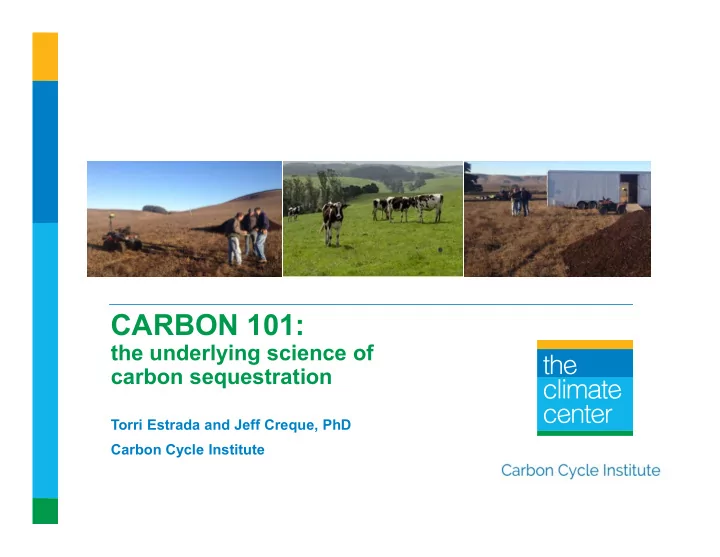
CARBON 101:

the underlying science of carbon sequestration

slide-2
SLIDE 2

Mission: Speed and scale greenhouse gas reductions Key role in growing Community Choice Energy: 21 CCAs serving 11 million Californians- ¼ of state- with 88% clean energy today!

https://theclimatecenter.org/our-work/community-choice/ https://cal-cca.org/cca-impact/

slide-3
SLIDE 3
slide-4
SLIDE 4

https://www.gov.ca.gov/2020/09/23/governor-newsom-announces-california-will-phase-out-gasoline-powered-cars-drastically- reduce-demand-for-fossil-fuel-in-californias-fight-against-climate-change/ Sept. 23 2020 https://calmatters.org/environment/2020/09/california-governor-climate-emergency/ Sept. 11 2020

Governor Newsom, Sept. 11, 2020: “We are in a climate emergency” “We must fast-track goals” “our goals are inadequate”

New Exec Orders: 100% ZEV new car sales by 2035 & protect 30% of land and waters by 2030…. But….

slide-5
SLIDE 5

The nation and the world are looking to California to lead for a climate-safe future

slide-6
SLIDE 6

CLIMATE-SAFE CALIFORNIA Accelerate existing state goals to achieve by 2030:

  • 80% below 1990 GHG levels
  • Net-negative emissions (sequestration greater than

emissions, CA becomes net carbon sink)

Endorse here: www.climatesafeca.org

slide-7
SLIDE 7
  • 1. Accelerate the phase-out of fossil fuel

development, production and use

  • 2. Increase sequestration to 100 MMT/year by

2030 on natural and working lands 3. Invest in community resilience, including clean energy microgrids & storage

  • 4. Fund climate action with $12-20 billion/year

and leverage private sector money

KEY POLICIES REQUIRED BY SCIENCE TO REACH NET-NEGATIVE EMISSIONS BY 2030

www.climatesafeca.org

slide-8
SLIDE 8

Guiding principles for Climate-Safe CA targets, policies and programs 1- Based on the latest science 2- Ensure a just transition for fossil fuel workers 3- Prioritize climate justice and ensure lower- income communities are no longer disproportionately harmed by fossil fuels

Zabin et al Sept 2020 https://laborcenter.berkeley.edu/putting-california-on-the-high-road-a-jobs-and-climate- action-plan-for-2030/

slide-9
SLIDE 9

Our house is on fire. Ask at every level

  • f government: are we doing enough?
slide-10
SLIDE 10

CHALLENGE: 30 ENDORSEMENTS CLIMATE-SAFE CALIFORNIA www.climatesafeca.org

www.theclimatecenter.org/endorsement

  • A public pledge of support for California

to accelerate aggressive, equitable climate policy

  • Inspiring states and countries to greater

action for a climate-safe Earth

slide-11
SLIDE 11

Carbon farming on working land potential sequestration at scale

Marin est cost of roughly $500/acre-- $10.5 billion for 21M acres over 10 years with multiple co-benefits for resilience, water, biodiversity and more

slide-12
SLIDE 12

Torri Estrada Jeff Creque

Carbon 101: the underlying science of carbon sequestration

Director of Rangeland and Agroecosystem Management

  • Co-founder of the Marin Carbon Project
  • Agricultural and rangeland consultant
  • Natural Resources Conservation Service certified nutrient management planning

specialist.

  • PhD, Rangeland Ecology, Utah State University
  • CA State Board of Forestry Certified Professional in Rangeland Management

Executive Director and Director of Policy

  • worked with non-profit, community-based, and public institutions to advance

solutions to social and environmental justice, climate, and environmental issues for 20+ years

  • Formerly program director at Marin Community Foundation managing

environmental grantmaking and MCF’s climate change initiative

  • MS in Environmental Sociology and Policy (emphasis on environmental

justice), University of Michigan

  • Joint BS/BA degree in Environmental Science and Policy, and Ecological

Anthropology, UC Berkeley.