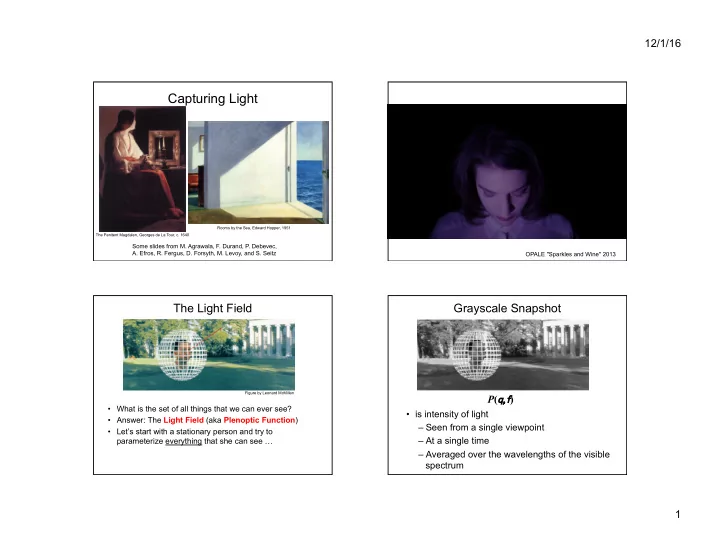
Capturing Light Rooms by the Sea, Edward Hopper, 1951 The Penitent - - PowerPoint PPT Presentation

capturing light
SMART_READER_LITE
LIVE PREVIEW

Capturing Light Rooms by the Sea, Edward Hopper, 1951 The Penitent - - PowerPoint PPT Presentation

12/1/16 Capturing Light Rooms by the Sea, Edward Hopper, 1951 The Penitent Magdalen, Georges de La Tour, c. 1640 Some slides from M. Agrawala, F. Durand, P. Debevec, A. Efros, R. Fergus, D. Forsyth, M. Levoy, and S. Seitz OPALE "Sparkles


slide-1
SLIDE 1

12/1/16 1

Capturing Light

Some slides from M. Agrawala, F. Durand, P. Debevec,

  • A. Efros, R. Fergus, D. Forsyth, M. Levoy, and S. Seitz

Rooms by the Sea, Edward Hopper, 1951 The Penitent Magdalen, Georges de La Tour, c. 1640

OPALE "Sparkles and Wine" 2013

The Light Field

  • What is the set of all things that we can ever see?
  • Answer: The Light Field (aka Plenoptic Function)
  • Let’s start with a stationary person and try to

parameterize everything that she can see …

Figure by Leonard McMillan

Grayscale Snapshot

  • is intensity of light

– Seen from a single viewpoint – At a single time – Averaged over the wavelengths of the visible spectrum

P(q, , f)

slide-2
SLIDE 2

12/1/16 2

Color Snapshot

  • is intensity of light

– Seen from a single viewpoint – At a single time – As a function of wavelength

P(q, , f, , l)

A Movie

  • is intensity of light

– Seen from a single viewpoint – Over time – As a function of wavelength

P(q, , f, , l, t)

Holographic Movie

  • is intensity of light

– Seen from ANY viewpoint – Over time – As a function of wavelength

P(q, , f, , l, t, VX, VY, VZ)

The Light Field

– Can reconstruct every possible view, at every moment, from every position, at every wavelength – Contains every photograph, every movie, everything that anyone has ever seen!

P(q, , f, , l, t, VX, VY, VZ)

slide-3
SLIDE 3

12/1/16 3

Sampling the Light Field

Surface Camera Lighting

Camera

  • A camera is a device for capturing and storing

samples of the Light Field

Building Better Cameras

  • Capture more rays

– Higher density sensor arrays – Color cameras, multi-spectral cameras – Video cameras

Modify Optics: Wide-Angle Imaging

Examples: Disney 55, McCutchen 91, Nalwa 96, Swaminathan & Nayar 99, Cutler et al. 02

Multiple Cameras Catadioptric Imaging

Examples: Rees 70, Charles 87, Nayar 88, Yagi 90, Hong 91, Yamazawa 95, Bogner 95, Nalwa 96, Nayar 97, Chahl & Srinivasan 97

slide-4
SLIDE 4

12/1/16 4

Catadioptric Cameras for 360˚ Imaging Omnidirectional Image

Camera Mirror Subject

Catadioptric Imaging

Camera’s Viewpoint

Catadioptric Imaging

slide-5
SLIDE 5

12/1/16 5

Virtual Viewpoint 2 Virtual Viewpoint 1 Camera’s Viewpoint Mirrors

Catadioptric Imaging

Virtual Viewpoint 2 Virtual Viewpoint 1 Camera’s Viewpoint

Catadioptric Imaging

Circular Viewpoint Locus

Catadioptric Imaging Reconstructing Faces

Camera Mirror Subject

slide-6
SLIDE 6

12/1/16 6

Reconstructing Faces Stereo Views 3D Reconstructions Femto Photography

FemtoFlash UltraFast Detector Computational Optics Serious Sync

A trillion frame per second camera

http://www.youtube.com/watch?v=9xjlck6W020

See UW research on this by

  • Prof. Andreas Velten
slide-7
SLIDE 7

12/1/16 7

The Light Field

  • How to Capture it?
  • What’s it good for?

Ray

  • Ignoring time and color, one sample:
  • 5D

– 3D position – 2D direction

P(q, , f, , VX, VY, VZ)

Slide by Rick Szeliski and Michael Cohen

The Light Field Surface

4D:

2D direction 2D position non-dispersive medium

slide-8
SLIDE 8

12/1/16 8

Light Field - Organization

  • 2D position
  • 2D direction

s

q

Slide by Rick Szeliski and Michael Cohen

Light Field - Organization

  • 2D position
  • 2D position
  • 2 plane parameterization

s u

Slide by Rick Szeliski and Michael Cohen

Light Field - Organization

  • 2D position
  • 2D position
  • 2 plane parameterization

u s t s,t u,v v s,t u,v

Slide by Rick Szeliski and Michael Cohen

Light Field - Organization

  • Hold s, t constant
  • Let u, v vary
  • An image

s,t u,v

Slide by Rick Szeliski and Michael Cohen

slide-9
SLIDE 9

12/1/16 9

Light Field How to Capture Light Fields?

  • One camera + move object (and light

sources)

  • Multiple cameras
  • One camera + multiple microlenses

Light Field - Capture

  • Idea 1

– Move camera carefully over s, t plane – Gantry

s,t u,v

Slide by Rick Szeliski and Michael Cohen

Gantry

  • Lazy Susan

– Manually rotated

  • XY Positioner
  • Lights turn with lazy susan
  • Correctness by

construction

slide-10
SLIDE 10

12/1/16 10

Multi-Camera Arrays

  • Stanford’s 640 × 480

pixels × 30 fps × 128 cameras

  • synchronized timing
  • continuous streaming
  • flexible arrangement

Stanford Tiled Camera Array What’s a Light Field Good For?

  • Synthetic aperture photography

– Seeing through occluding objects

  • Refocusing
  • Changing Depth of Field
  • Synthesizing images from novel

viewpoints

slide-11
SLIDE 11

12/1/16 11

Synthetic Aperture Photography

[Vaish CVPR 2004] 45 cameras aimed at bushes

Synthetic Aperture Photography Synthetic Aperture Photography

slide-12
SLIDE 12

12/1/16 12

Synthetic Aperture Photography

Red point effectively disappears because it is so blurry

Synthetic Aperture Photography

  • If aperture is larger than a foreground occluding object,

then some rays from behind the object are captured

  • Leonardo da Vinci observed that if you hold a needle in

front of your eye, it adds haze but does not completely

  • bscure any part of it (because your eye’s pupil is bigger

than the needle)

Synthetic Aperture Photography ∑ Synthetic Aperture Photography ∑

slide-13
SLIDE 13

12/1/16 13

Synthetic Aperture Photography ∑

  • Another way to think about synthetic aperture

photography

– take the images from all the cameras – rectify them to a common plane in scene (focal plane) – shift them by a certain amount – and add them together

  • Objects that become aligned by the shifting

process

– will be sharply focused – objects in front of that plane are blurred away – objects in back of that plane are blurred away

Synthetic Aperture Photography

One image of people behind bushes Reconstructed synthetic aperture image

slide-14
SLIDE 14

12/1/16 14

How to Capture Light Fields?

  • One camera + move object (and light

sources)

  • Multiple cameras
  • One camera + multiple microlenses

Light Field Photography using a Handheld Light Field Camera

Ren Ng, Marc Levoy, Mathieu Brédif, Gene Duval, Mark Horowitz and Pat Hanrahan

  • Proc. SIGGRAPH 2005

Source: M. Levoy

  • www.lytro.com
  • 30-250mm lens
  • 8.3x optical zoom
  • f/2.0 aperture
  • $280 ($1,600 MSRP)
  • 40 megaray ½” CMOS sensor
  • Maximum image resolution: 2450 × 1634

(4.0 megapixels)

Lytro Illum Light Field Camera Conventional vs. Light Field Camera

Source: M. Levoy

slide-15
SLIDE 15

12/1/16 15

Conventional vs. Light Field Camera

uv-plane st-plane Source: M. Levoy

Conventional vs. Light Field Camera

uv-plane st-plane Source: M. Levoy

Prototype Camera

4000 × 4000 pixels ÷ 292 × 292 lenses = 14 × 14 pixels per lens

Contax medium format camera Kodak 16-megapixel sensor Adaptive Optics microlens array 125µ square-sided microlenses

slide-16
SLIDE 16

12/1/16 16

a b c a b c

(a) illustrates microlenses at depths closer than the focal plane. In these right-side up microlens images, the woman’s cheek appears on the left, as it appears in the macroscopic image. (b) illustrates microlenses at depths further than the focal plane. In these inverted microlens images, the man’s cheek appears on the right, opposite the macroscopic world. This effect is due to inversion of the microlens’ rays as they pass through the world focal plane before arriving at the main lens. (c) illustrates microlenses on edges at the focal plane (the fingers that are clasped together). The microlenses at this depth are constant in color because all the rays arriving at the microlens originate from the same point on the fingers, which reflect light diffusely.

Digitally Stopping-Down

stopping down = summing only the central portion of each microlens

Σ Σ

Source: M. Levoy

Digital Refocusing

refocusing = summing windows extracted from several microlenses

Σ Σ

Source: M. Levoy

Example of Digital Refocusing

Source: M. Levoy

slide-17
SLIDE 17

12/1/16 17

Refocusing Portraits

Extending the Depth of Field

conventional photograph, main lens at f / 22 conventional photograph, main lens at f / 4 light field, main lens at f / 4, after all-focus algorithm [Agarwala 2004]

Digitally Moving the Observer

moving the observer = moving the window we extract from the microlenses

Σ Σ

Source: M. Levoy

Example of Moving the Observer

Source: M. Levoy

slide-18
SLIDE 18

12/1/16 18

Moving Backward and Forward

Source: M. Levoy

Implications

  • Cuts the unwanted link between exposure

(due to the aperture) and depth of field

  • Trades off spatial resolution for ability to

refocus and adjust the perspective

  • Sensor pixels should be made even smaller,

subject to the diffraction limit

36mm × 24mm ÷ 2µ pixels = 216 megapixels 18K × 12K pixels 1800 × 1200 pixels × 10 × 10 rays per pixel

Source: M. Levoy

Other ways to Sample the Plenoptic Function

  • Moving in time:

– Spatio-temporal volume: P(q, , f, t) – Useful to study temporal changes – Long an interest of artists

Claude Monet, Haystacks studies

slide-19
SLIDE 19

12/1/16 19

Space-Time Images

Other ways to slice the plenoptic function:

x y t