Canonical and Civil Law Issues Dr. Diane L. Barr, JD, JCD - - PowerPoint PPT Presentation

canonical and civil law issues
SMART_READER_LITE
LIVE PREVIEW

Canonical and Civil Law Issues Dr. Diane L. Barr, JD, JCD - - PowerPoint PPT Presentation

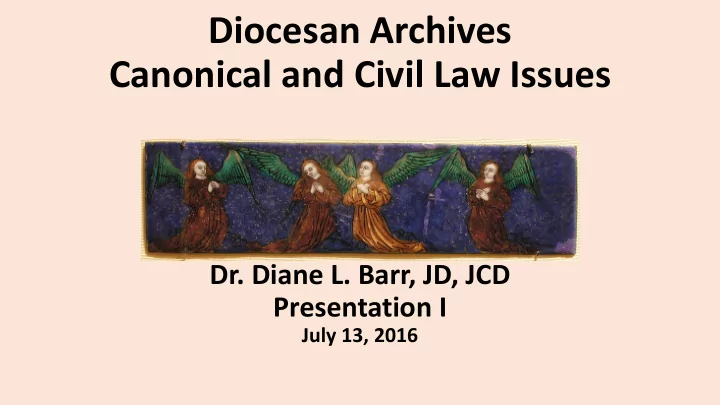
Diocesan Archives Canonical and Civil Law Issues Dr. Diane L. Barr, JD, JCD Presentation I July 13, 2016 Jesus the Law Giver Metropolitan Museum of Art New York City Plan for Todays Presentations Presentation 1 The Archives and

slide-1
SLIDE 1

Diocesan Archives Canonical and Civil Law Issues

  • Dr. Diane L. Barr, JD, JCD

Presentation I

July 13, 2016

slide-2
SLIDE 2

Jesus the Law Giver

Metropolitan Museum of Art New York City

slide-3
SLIDE 3

Plan for Today’s Presentations

  • Presentation 1
  • The Archives and Canon Law
  • Presentation 2
  • The Archives and Legal Discovery
  • Presentation 3
  • Clergy Personnel Policies
  • Questions
slide-4
SLIDE 4

What Is Canon Law?

The canon law governing church records can generally be of two types:

  • Universal law, binding on all

Catholics; and

  • Particular law, relating to territory,

such as diocese or the territory of the Conference of Bishops.

slide-5
SLIDE 5

Diocesan Archives - Canons

  • Bishop’s Responsibility – Canon 491
  • §1. A diocesan bishop is to take care that the acts and

documents of the archives of cathedral, collegiate, parochial, and

  • ther churches in his territory are also diligently preserved and

that inventories or catalogs are made in duplicate, one of which is to be preserved in the archive of the church and the other in the diocesan archive.

  • §2. A diocesan bishop is also to take care that there is an

historical archive in the diocese and that documents having historical value are diligently protected and systematically

  • rdered in it.
  • §3. In order to inspect or remove the acts and documents

mentioned in §§1 and 2, the norms established by the diocesan bishop are to be observed.

slide-6
SLIDE 6

Chancellors and their Role

  • Role is to oversee archives under

canon law – may have this responsibility along with many

  • thers under the current US

method of using Chancellors;

  • Chancellors can be canonists,

lawyers, religious, lay, ordained and be responsible for the entire diocesan curia or simply several things specifically assigned by the Bishop;

slide-7
SLIDE 7

The Chancellor Under Canon Law

  • Can. 482 §1. In every curia a chancellor is to be

appointed whose principal function, unless particular law establishes otherwise, is to take care that acts of the curia are gathered, arranged, and safeguarded in the archive of the curia.

  • §2. If it seems necessary, the chancellor can be given

an assistant whose title is to be vice-chancellor.

  • §3. By reason of being chancellor and vice-chancellor

they are notaries and secretaries of the curia.

slide-8
SLIDE 8

The Chancellor Under Canon Law

  • Can. 483 §1. Besides the chancellor, other

notaries can be appointed whose writing or signature establishes authenticity for any acts, for judicial acts only, or for acts of a certain case or affair only.

  • §2. The chancellor and notaries must be of

unimpaired reputation and above all

  • suspicion. In cases in which the reputation
  • f a priest can be called into question, the

notary must be a priest.

slide-9
SLIDE 9

Chancellor As Notary

  • Can. 484 It is the duty of notaries:
  • 1º to draw up the acts and instruments regarding

decrees, dispositions, obligations, or other things which require their action;

  • 2º to record faithfully in writing what has taken place

and to sign it with a notation of the place, day, month, and year;

  • 3º having observed what is required, to furnish acts or

instruments to one who legitimately requests them from the records and to declare copies of them to be in conformity with the original.

slide-10
SLIDE 10

Diocesan Archives - Canons

Canon 486 §1. All documents which regard the diocese or parishes must be protected with the greatest care. §2. In every curia there is to be erected in a safe place a diocesan archive, or record storage area, in which instruments and written documents which pertain to the spiritual and temporal affairs of the diocese are to be safeguarded after being properly filled and diligently secured. §3. An inventory, or catalog, of the documents which are contained in the archive is to be kept with a brief synopsis of each written document.

slide-11
SLIDE 11

Diocesan Archives - Canons

Canon 487

  • §1. The archive must be locked and only the bishop

and chancellor are to have its key. No one is permitted to enter except with the permission either

  • f the bishop or of both the moderator of the curia

and the chancellor.

  • §2. Interested parties have the right to obtain

personally or through a proxy an authentic written copy or photocopy of documents which by their nature are public and which pertain to their personal status.

slide-12
SLIDE 12

Diocesan Archives - Canons

Canon 488

It is not permitted to remove documents from the archive except for a brief time only and with the consent either

  • f the bishop or of both the

moderator of the curia and the chancellor.

slide-13
SLIDE 13

Diocesan Particular Law

Common Local Policies address:

  • Sacramental Records
  • Financial Records
  • Limits on Spending
  • Human Resource Issues
  • Sacramental Preparation
  • Contractual Issues
  • Other Local or State related Issues
slide-14
SLIDE 14

Role of Diocesan Archivists

  • Role is to archivists are the professionals

who assess, collect, organize, preserve, and provide access to those records created by the diocese or its subordinate agencies or entities.

  • Bring a professional training and

expertise to record management

  • Work collaboratively with Chancellors

and other Diocesan Officials

slide-15
SLIDE 15

Diocesan Archives - Sacramental Records

  • Sacramental Records
  • Governed by Canon law (both

Universal and Particular)

slide-16
SLIDE 16

Diocesan Archives – Sacramental Records

  • Sacramental Records

Policy

  • Records Retention Policy
  • Relationship with the

Mormons Regarding Record Keeping

slide-17
SLIDE 17

Diocesan Archives - Financial Records

  • Financial Records
  • Governed by Federal and

State Law

slide-18
SLIDE 18

Canon Law – Financial Records

Administration

Canon 1283

Before administrators begin their function:

  • 2º they are to prepare and sign an accurate and

clear inventory of immovable property, movable

  • bjects, whether precious or of some cultural

value, or other goods, with their description and appraisal; any inventory already done is to be reviewed;

  • 3º one copy of this inventory is to be preserved in

the archive of the administration and another in the archive of the curia; any change which the patrimony happens to undergo is to be noted in each copy.

slide-19
SLIDE 19

Canon Law – Financial Records

Canon 1284

  • §1. All administrators are bound to fulfill their

function with the diligence of a good householder.

  • §2. Consequently they must: 9º organize

correctly and protect in a suitable and proper archive the documents and records on which the property rights of the Church or the institute are based, and deposit authentic copies of them in the archive of the curia when it can be done conveniently.

slide-20
SLIDE 20

Diocesan Archives – Legal Records

  • Legal Records

(Contracts, Statutes of Limitations)

  • Governed by Federal, State and

Canon law

slide-21
SLIDE 21

Canon Law – Legal Records

Foundations

Canon 1306

  • §1. Foundations, even if made orally, are

to be put in writing.

  • §2. One copy of the charter is to be

preserved safely in the archive of the curia and another copy in the archive of the juridic person to which the foundation belongs.

slide-22
SLIDE 22

Diocesan Archives – Lay Records

Personnel Files for Laity

  • Can include contracts, wage

statements, tax receipts, discipline records, etc.

  • Governed by Federal, State and

sometimes local law (City)

slide-23
SLIDE 23

Diocesan Archives – Clergy Records

  • Personnel Files for Clergy
  • Can include canonical items

such as Profession of Faith, Sacramental Information;

  • Common Personnel

Information;

  • Governed by Federal, State

and sometimes local law

slide-24
SLIDE 24

Diocesan Archives - Correspondence

  • Correspondence
  • Bishops Papers
  • May Include correspondence of

Other Officials (Chancellor, Auxiliary Bishops, Moderator of the Curia, etc.)

  • Governed by Canon Law, Federal

and State law

slide-25
SLIDE 25

Diocesan Archives – Membership Records

  • Membership Records
  • Can include all kinds of lists of

donors, members, parishioners

  • May be more commonly kept in

software programs such as Parishsoft, etc.

  • Governed by Canon law (both

Universal and Particular)

slide-26
SLIDE 26

Diocesan Archives – Secret Archives

Canon 490

  • §1. Only the bishop is to have the key

to the secret archive.

  • §2. When a see is vacant, the secret

archive or safe is not to be opened except in a case of true necessity by the diocesan administrator himself.

  • §3. Documents are not to be removed

from the secret archive or safe.

slide-27
SLIDE 27

Secret Archives

  • Governed by Canon law and Civil law
  • Items to be kept in this Secret Archive

are:

  • Acts of criminal cases that concern

matters of morals;

  • The register of secret marriages;
  • Matrimonial dispensations in the non-

sacramental internal forum;

  • Dispensations from impediments to
  • rders;
slide-28
SLIDE 28

Secret Archives

  • Documents concerning loss of the

clerical state;

  • Decrees of dismissal from religious

institutes; and

  • Documents selected by the bishop

in order to prevent scandal or damage to someone’s good name (including priest personnel files).

slide-29
SLIDE 29

Canon Law and Civil Law

  • Canon Law “canonizes” some

aspects of civil law (contracts, some property law, employment law)

  • Means canon law in these areas

will be unique to the place

  • Exists independently of civil law
slide-30
SLIDE 30

Civil Law View of Canon Law

  • US gives some deference to

church decisions in under Supreme Court interpretations

  • f the First Amendment

(Freedom of Religion and the Establishment Clause) and the Fourteenth Amendment

slide-31
SLIDE 31

Civil Law View of Canon Law

Serbian Orthodox v. Diocese v. Milivojevich held:

  • According to the First

Amendment as described in the Establishment and Free Exercise Clauses, decisions made by the church must be accepted as binding by civil courts.

slide-32
SLIDE 32

Civil Law View of Canon Law

  • Civil courts may only regard

the issue of property, and not the underlying religious doctrine pertaining to church property where the potential for entanglement of the secular courts and religious bodies may occur.

slide-33
SLIDE 33

Civil Law View of Canon Law

  • The Establishment Clause clearly prohibits civil

courts from interpreting canon law to resolve intra-church disputes.

  • Civil courts must defer to hierarchical tribunals

to avoid civil interpretation of, and subsequent entanglement in ecclesiastical law and politics

  • Although courts may examine doctrinal

documents, the review and use of said documents may not place the courts in the position to resolve religious controversy

slide-34
SLIDE 34

Questions?

slide-35
SLIDE 35
slide-36
SLIDE 36