Cannabis Business Recommendations Committee of the Whole June 16, - - PowerPoint PPT Presentation

cannabis business recommendations
SMART_READER_LITE
LIVE PREVIEW

Cannabis Business Recommendations Committee of the Whole June 16, - - PowerPoint PPT Presentation

Cannabis Business Recommendations Committee of the Whole June 16, 2020 City Commission Questions At the February 25, 2020 City Commission Committee of the Whole, City Commissioners asked questions that focused on the following: Equity


slide-1
SLIDE 1

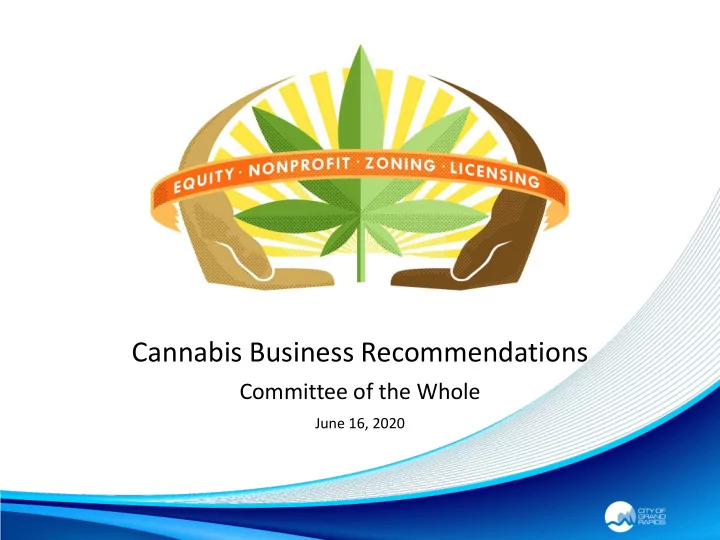
Cannabis Business Recommendations

Committee of the Whole

June 16, 2020
slide-2
SLIDE 2

City Commission Questions

  • At the February 25, 2020 City Commission

Committee of the Whole, City Commissioners asked questions that focused on the following:

  • Equity and Ownership
  • Sensitive Use and Waivers
  • Zoning Process
  • Other
  • Answers to these questions have been provided in

a memorandum to the City Commission

2 Cannabis Business Recommendations

slide-3
SLIDE 3
  • 2008: Michigan Medical Marihuana Act​
  • 2016: Medical Marihuana Facilities Licensing Act​
  • 2018: Michigan Regulation and Taxation
  • f Marijuana Act (MRTMA)​
  • April 2019: City began accepting/processing

medical cannabis applications

  • October 8, 2019: Grand Rapids City

Commission decided to allow recreational cannabis facilities on a deferred timeline

  • November 1, 2019: State of Michigan

began accepting recreational cannabis applications

3 Cannabis Business Recommendations

Background

slide-4
SLIDE 4
  • February 25, 2020:​
  • Planning Commission proposed an amendment to

the Zoning Ordinance to City Commission​

  • City Commission had a robust discussion and did not set

a public hearing on the proposed zoning amendments

  • March 17, 2020:
  • City Commission approved a six-month period, between

April 20th and October 20th, to be more intentional about a social equity program for cannabis facilities

4 Cannabis Business Recommendations

Background

slide-5
SLIDE 5

Cannabis or Marijuana?

  • Cannabis
  • The scientific name for the plant
  • Used in social equity programs to remove historical

stigma and negative connotations

  • Marijuana
  • A term for cannabis of international origin
  • Has historically stigmatized Brown and Black

communities

  • Introduced in the United States in the 1930’s
  • Marihuana Tax Act of 1937
  • Used in legal and zoning frameworks

5 Cannabis Business Recommendations

slide-6
SLIDE 6
  • Created in March 2020
  • An interdepartmental task force:
  • Deputy City Manager Eric DeLong
  • Planning: Kristin Turkelson, Louis Canfield,

Al Romero-Gibu

  • Law: Anita Hitchcock, Amber Beebe, Kristen Rewa,

Joy Fossel

  • Equity and Engagement: Stacy Stout, Ciarra Adkins,

Alvin Hills IV

  • Oversight and Public Accountability: Brandon Davis
  • Economic Development: Jonathan Klooster

6 Cannabis Business Recommendations

Cannabis Justice Work Group

slide-7
SLIDE 7
  • Circle of Concern: This circle represents things

that the City would like to accomplish but has no direct (legal) control or direct influence over. ​

  • Circle of Influence: In this circle, the City does not

have direct control but has influence over matters within it. Much of the work that would be handled by the nonprofit would fall into this

  • realm. The City would be creating the nonprofit

so that more of the matters that fall within the circle of concern can be addressed while maintaining some sort of influence over its goals and objectives. ​

  • Circle of Control: In this circle, the City has

control over the matter and the means by which it is accomplished. Most matters in this circle fall under the City’s regulatory power. Zoning would be an example of something that the City has control over, with the caveat that the City cannot do anything that the state has not empowered it to do by law.

7 Cannabis Business Recommendations

Policymaking Framework

slide-8
SLIDE 8
  • 1. Establish social equity expectations and

voluntary commitments for applicants for all recreational cannabis license types;

  • 2. Utilize strategies that enhance the

growth and development of local, small, and emerging businesses;

  • 3. Supplier diversity;
  • 4. Reduced barriers of entry into the

cannabis industry;

  • 5. Increased opportunities within

Neighborhoods of Focus; and

  • 6. Address low-hanging fruit now and

more complex elements by October 2020

8 Cannabis Business Recommendations

Goals

slide-9
SLIDE 9

Framework

9 Cannabis Business Recommendations

NONPROFIT EQUITY LICENSING ZONING

slide-10
SLIDE 10

Proposed Timeline

Cannabis Business Recommendations 10

slide-11
SLIDE 11

Legal Framework

  • Constitutional requirements
  • Due process, takings/exaction, Commerce clause​
  • Constitutional and statutory limitations on

racial preferences

  • Equal Protection Clause
  • Michigan Constitution Article I, Section 26
  • Elliott-Larsen Civil Rights Act​
  • Limits on use of public funds
  • No loans of credit
  • User fees must be tied to the cost of administration (Bolt)
  • Local Government Labor Regulatory Limitation Act
  • Limits city regulations on employment matters
  • Wages, Fringe benefits, Hiring process

Cannabis Business Recommendations 11

slide-12
SLIDE 12

Legal Framework

  • MRTMA requirements
  • Prohibition on “Unreasonably Impracticable" ordinances
  • "Competitive process" - cities that limit the number of facilities that

may be licensed must have competitive process intended to select the best applicants to operate within the city.

  • $5,000 fee limit.
  • Marijuana Regulatory Agency expanded State Social

Equity Program, effective June 1, 2020:

  • Changed criteria increased number of Disproportionately Impacted

Communities (DIC) - Grand Rapids now qualifies

  • more people can qualify as a State Equity Applicant through (1)

being residents of DIC or (2) having a cannabis conviction or (3) being a medical cannabis caregiver

  • Qualifying applicants can participate in the State’s Social

Equity Program; fee discounts up to 75%

Cannabis Business Recommendations 12

slide-13
SLIDE 13

Legal Framework - Licensing Caps

City Opt In/out Moratorium D.I.C Caps Social Equity / local

  • wnership Plan

Lawsuit Ann Arbor In 06/16/18 (med) No Yes (28 each of Retailers, Microbusiness, Consumption) No No Battle Creek In No Yes (new) No (not all land use types permitted) Yes No Detroit

  • ut (temp)

07/31/20 Yes Yes (75 medical only) Yes Yes Flint In 60d emergency

  • rd.

Yes No (emergency ord. eliminated caps) Jackson In No Yes (new) Yes (2 Class A or B grow, 3 Provisioning or retail, 2 each for Safety Compliance, Secure Transport and Microbusiness) Yes Kalamazoo In No Yes No (not all land use types permitted) Yes No Lansing In None No Yes (28 Retailers, 75 Growers (A,B,C), 4 Microbusiness, 4 Designated Consumption) No Yes Muskegon In No Yes No (all facilities allowed) Yes Muskegon TWP In None No Yes (7 Retailers, No Cap on Growers (A, B, and C)) No Yes Pontiac Out n/a Yes n/a n/a n/a Traverse City Out n/a No n/a n/a n/a

13 Cannabis Business Recommendations

slide-14
SLIDE 14

Summary of Recommendations

The City Manager and Cannabis Justice Work Group recommend: 1. Adopting a Cannabis Social Equity Policy to guide implementation and

  • utcomes

2. Creating a new nonprofit to assist with the achievement of social equity

  • utcomes

3. Adopting a licensing framework to implement social equity outcomes, assign priority for zoning and licensing consideration and establish renewal criteria 4. Adopting fast-track Zoning Ordinance amendments to allow medical and recreational growers, processors, safety compliance, and secure transporters via administrative review first in the near term 5. Adopting subsequent Zoning Ordinance amendments for implementation by October 20, 2020, for recreational retailers, microbusinesses and

  • ther cannabis uses as part of the Deliberative Approach

6. Rescinding City Commission Policy 900-57 regarding park waivers and relying on Planning Commission determinations for Parks; and 7. Adopting subsequent Zoning Ordinance amendments by October 20, 2020, to address separation distances, waivers and sensitive uses and waivers as part of the Deliberative Approach.

14 Cannabis Business Recommendations

slide-15
SLIDE 15

City Administered Policy Equity Applicant Application Advancing Equity

Criteria meant to promote and encourage participation in the cannabis industry by people from communities that have been disproportionately impacted by cannabis prohibition and enforcement.

  • Eligible cannabis conviction
  • Income thresholds
  • Experienced negative housing

consequences due to War on Drugs

  • Experienced negative economic

impact due to War on Drugs (e.g. in business, employment, education) Participation in the Cannabis Social Program in one of the following areas:

  • Local ownership, cannabis business or

real estate

  • Workforce diversity
  • Supplier diversity
  • Business development - Incubator
  • Community Investment Fund

15 Cannabis Business Recommendations

Recommendation 1: Social Equity

slide-16
SLIDE 16

Recommendation 2: Nonprofit

Home Rule City Act (MCL 117.4(o)) allows the city to form a nonprofit corporation

under the Nonprofit Corporation Act if there is a "public purpose."

Why form a nonprofit? Equity serves a Public Purpose. A nonprofit can perform

many of the activities that the city cannot due to its restrictions on use of public funds, budgeting concerns, and relative inexperience in execution of equitable initiatives. A nonprofit would be more flexible: executing equity related initiatives, collaborating with

  • utside private entities that support equity, programming, raising revenue

and spending, providing grants and micro-loans, and enforcing contractual requirements.

Sample desired initiatives or outcomes:

Cannabis Business Recommendations 16

  • Job Creation
  • Local Ownership
  • Minority Contracting Opportunities
  • Business Incubators/Entrepreneurship

Training Opportunities

  • Social Equity Applicant Opportunities
  • Education on addictive substances
  • Money to Neighborhoods of Focus
  • Minority Business Enterprises
  • Management Diversity
  • Supplier Diversity
  • Diverse Workforce/Employee Diversity
  • Lower Barriers for Individuals with

Criminal Records Related to Cannabis

  • Grants and Loan Opportunities
  • Collaboration with other nonprofits

to execute some programming

slide-17
SLIDE 17

Cannabis Business Recommendations 17

City Administered Nonprofit Administered Voluntary Incentives Incentive Requirements​

Race Neutral Geographic Focus Local Ownership Local Ownership Real-estate Ownership Real-estate Ownership Supplier Diversity Supplier Diversity Workforce Diversity Workforce Diversity License Renewals/Various Intervals License Renewals/Various Intervals Voluntary Investment in Community Fund Community Investment Fund + Administration Cannabis & Non-Cannabis Business Incubator Distribute loans and grants Receive Equity Champion Certification Wages Recommendations

Recommendation 2: Nonprofit

slide-18
SLIDE 18

Recommendation 2: Nonprofit

Cannabis Business Recommendations 18

Examples of City formed and/or Affiliated Nonprofits in Grand Rapids

  • Uptown Grand Rapids, Inc. - Represents four neighborhood

business associations in Southeast GR

  • Downtown Grand Rapids, Inc. - Assists in development of GR

urban core in working with businesses utilizing public and private investment funds Example from Our Neighbor to the South

  • Kalamazoo Foundation for Excellence - "A unique innovation

by the City of Kalamazoo and private donors to address systemic challenges to the prosperity of the City." - An incorporated supporting organization to the City of

  • Kalamazoo. Resident Agent = the City Attorney
slide-19
SLIDE 19
  • Mandatory for all cannabis-related businesses
  • Vehicle to authorize criteria for equity applicants (EA),

framework for applications advancing equity (AAE), and related polices and incentives

  • Each application would earn points based on equity

commitments, initially used to

  • Assign license applications and administratively reviewed

zoning applications to tiers considered during specified windows of time

  • Establish order of consideration of Planning Commission

reviewed zoning applications

Cannabis Business Recommendations 19

Recommendation 3: Licensing

slide-20
SLIDE 20

Recommendation 3: Licensing

  • Initial license applications:
  • 50% Fee discount and high priority processing for Equity Applicants
  • Priority processing for Applications Advancing Equity
  • Good for 1 year to establish track record of meeting commitments
  • Renewal licenses - multi-year licenses to licensees with

established track record of good operation, which includes embedding equity (EA & AAE)

  • 1 year – standard license, meets ordinance minimum
  • 2 year – established operators, meets additional standards
  • 3 year – established operators, meets highest standards
  • Beyond the ordinance amendment, a City Commission

policy will be proposed to establish the social equity program, and an administrative policy will implement it

Cannabis Business Recommendations 20

slide-21
SLIDE 21

Recommendations 4 and 5: Zoning

  • “Fast-track” Approach
  • Allow medical and recreational growers (GR), processors (PR),

safety compliance (SC) and secure transporters (ST) via administrative review.

  • Preserve current separation distances
  • Preserve waiver process and criteria
  • No public comment, specific to the non-retail operations,

were made during the 7 public hearings held for approved facilities

  • No significant change in the number of eligible parcels (exception:

STs in TCC zone and SCs in CC zone)

  • Deliberative Approach
  • Allow recreational retailers and microbusinesses
  • Modify or eliminate sensitive uses
  • Modify or eliminate separation distances
  • Modify or eliminate waiver process and criteria
  • Consider other cannabis uses

Cannabis Business Recommendations 21

slide-22
SLIDE 22
  • Can we include adult-use retailers in “fast-track”

Ordinance?

  • Planning Commission (PC) provided ZO

recommendations to permit cannabis Retailers so the City Commission has ability to consider Retailers

  • CJWG does not recommend moving forward with

cannabis Retailers until deliberative track because:

  • Use should be a SLU as current land use approvals were

explicitly granted for a medical provisioning center and significant public interest

  • Need to resolve other land use considerations – sensitive uses,

separation distance requirements and waiver process

  • 6 approved provisioning centers required waivers

22 Cannabis Business Recommendations

Recommendations 4 and 5: Zoning

slide-23
SLIDE 23

Recommendations 6 and 7: Waivers

  • Separation distances are required between defined

sensitive uses and certain medical cannabis facilities. The Planning Commission has the authority to approve a waiver between certain sensitive use separation distances and cannabis facilities (Section 5.9.19(E)(2)

  • f Article 9, CH 61, Title V).​
  • General concerns have been expressed about the

current waiver criteria and the application of that criteria by the Planning Commission

  • City staff recommends a two-step process to address

concerns

Cannabis Business Recommendations 23

slide-24
SLIDE 24

Step 1 (Fast-Track Approach)

  • Leave sensitive use waiver process and criteria as-is

until deliberative approach

  • None of the existing non-retail medical cannabis facilities

required waivers, so leaving the waiver process and criteria as- is will not prevent approved medical facilities to convert to recreational

  • Exception: rescind City Commission Park Waiver

Policy (No. 900-57) by resolution

  • Continue to rely on Planning Commission Special

Land Use review

  • The last medical application in the queue was

considered by the Planning Commission

  • n 6/11

24 Cannabis Business Recommendations

Recommendations 6 and 7: Waivers

slide-25
SLIDE 25

Step 2 (Deliberative Approach)

  • Eliminate or modify sensitive use waiver process

and criteria in deliberative phase (requires Zoning Ordinance amendment)

  • Eliminating waivers would result in a required 1000’

separation between most cannabis facilities and public parks, religious institutions, substance use disorder facilities, residential zone districts, schools and childcare facilities

  • If waivers are eliminated, we should consider whether approved

medical facility waivers can “transfer” to allow facility to convert to a recreational facility

  • If waivers are eliminated, the effective date should be set to a

date that will not affect current applicants or existing land use rights

  • Modifications to the waiver criteria were recommended by the

Planning Commission

25 Cannabis Business Recommendations

Recommendations 6 and 7: Waivers

slide-26
SLIDE 26

Proposed Timeline

Cannabis Business Recommendations 26

slide-27
SLIDE 27

Questions?

Cannabis Business Recommendations