Canadian VAT Issues for U.S. Sellers: Goods & Services Tax and - - PowerPoint PPT Presentation

canadian vat issues for u s sellers goods services tax
SMART_READER_LITE
LIVE PREVIEW

Canadian VAT Issues for U.S. Sellers: Goods & Services Tax and - - PowerPoint PPT Presentation

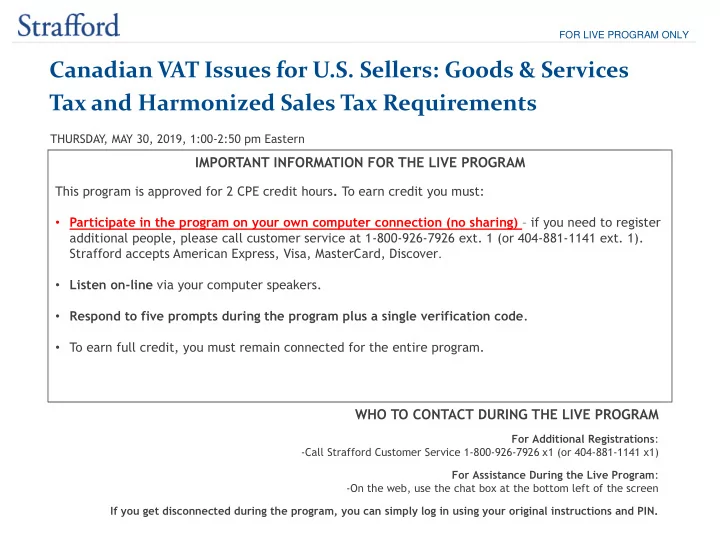
FOR LIVE PROGRAM ONLY Canadian VAT Issues for U.S. Sellers: Goods & Services Tax and Harmonized Sales Tax Requirements THURSDAY , MAY 30, 2019, 1:00-2:50 pm Eastern IMPORTANT INFORMATION FOR THE LIVE PROGRAM This program is approved for 2


slide-1
SLIDE 1

WHO TO CONTACT DURING THE LIVE PROGRAM

For Additional Registrations:

  • Call Strafford Customer Service 1-800-926-7926 x1 (or 404-881-1141 x1)

For Assistance During the Live Program:

  • On the web, use the chat box at the bottom left of the screen

If you get disconnected during the program, you can simply log in using your original instructions and PIN.

IMPORTANT INFORMATION FOR THE LIVE PROGRAM

This program is approved for 2 CPE credit hours. To earn credit you must:

  • Participate in the program on your own computer connection (no sharing) – if you need to register

additional people, please call customer service at 1-800-926-7926 ext. 1 (or 404-881-1141 ext. 1). Strafford accepts American Express, Visa, MasterCard, Discover.

  • Listen on-line via your computer speakers.
  • Respond to five prompts during the program plus a single verification code.
  • To earn full credit, you must remain connected for the entire program.

Canadian VAT Issues for U.S. Sellers: Goods & Services Tax and Harmonized Sales Tax Requirements

THURSDAY , MAY 30, 2019, 1:00-2:50 pm Eastern

FOR LIVE PROGRAM ONLY

slide-2
SLIDE 2

Tips for Optimal Quality

FOR LIVE PROGRAM ONLY

Sound Quality When listening via your computer speakers, please note that the quality

  • f your sound will vary depending on the speed and quality of your internet

connection. If the sound quality is not satisfactory, please e-mail sound@straffordpub.com immediately so we can address the problem.

slide-3
SLIDE 3

May 30, 2019

Canadian VAT Issues for U.S. Sellers

Cyndee Todgham Cherniak, Founder LexSage, Toronto, ON cyndee@lexsage.com Brian Litvin, Principal Litvin Muir , Toronto, ON info@litvinmuir.com

slide-4
SLIDE 4

Notice

ANY TAX ADVICE IN THIS COMMUNICATION IS NOT INTENDED OR WRITTEN BY THE SPEAKERS’ FIRMS TO BE USED, AND CANNOT BE USED, BY A CLIENT OR ANY OTHER PERSON OR ENTITY FOR THE PURPOSE OF (i) AVOIDING PENALTIES THAT MAY BE IMPOSED ON ANY TAXPAYER OR (ii) PROMOTING, MARKETING OR RECOMMENDING TO ANOTHER PARTY ANY MATTERS ADDRESSED HEREIN.

You (and your employees, representatives, or agents) may disclose to any and all persons, without limitation, the tax treatment or tax structure, or both, of any transaction described in the associated materials we provide to you, including, but not limited to, any tax opinions, memoranda, or other tax analyses contained in those materials. The information contained herein is of a general nature and based on authorities that are subject to change. Applicability of the information to specific situations should be determined through consultation with your tax adviser.

slide-5
SLIDE 5

FOR: STRAFFORD PUBLISHING BY: CYNDEE TODGHAM CHERNIAK (@CYNDEELAW) BRIAN LITVIN, LITVIN MUIR DATE: MAY 30, 2019 Canadian VAT Issues for US Sellers: Goods and Services Tax and Harmonized Sales Tax Requirements

slide-6
SLIDE 6

6

Part I. Structure of Canada’s federal and provincial sales tax/VAT system

∞ A. Goods and Services Tax

∞ Applies in every province and territory ∞ 5%

∞ B. Harmonized Sales Tax

∞ Applies only in Ontario, Nova Scotia, New Brunswick, Newfoundland/Labrador, Prince Edward Island ∞ 6-10% depending on province

∞ C. Quebec Sales Tax

∞ Applies only in Quebec

∞ D. Provincial Sales Tax

∞ Applies in British Columbia, Saskatchewan, Manitoba

Knowledge

slide-7
SLIDE 7

7

Part I: Canadian Sales Taxes Rate Chart (as at May 30, 2019)

Province/ Territory GST/HST Rate PST Rate GST Included in Prov Rate Combined Rate British Columbia 5% 7% No 12% Alberta 5% 0% No 5% Saskatchewan 5% 6% No 11% Manitoba 5% 8% (July 1 = 7%) No 13% (July 1 =12%) Ontario 13% N/A No 13% Quebec 5% 9.975% Yes 14.975% Nova Scotia, New Brunswick, Newfoundland, PEI 15% N/A No 15% Territories 5% N/A No 5% Insight

slide-8
SLIDE 8

8

Part II: Registration Requirements

∞ Persons carrying on business in Canada must register for GST/HST purposes ∞ Persons carrying on business in Quebec must register for QST under the Quebec Sales Tax Act (separate registration than Federal GST/HST) ∞ Persons selling into British Columbia, Saskatchewan and/or Manitoba must register for PST under the separate systems

∞ Some services are not taxable in PST provinces ∞ Some intangible property (e.g., computer programs) is taxable

Value

slide-9
SLIDE 9

9

Part II.A. Small Supplier Exception

∞ If a person make supplies that are less than $CDN 30,000 a year, then the person is not required to register ∞ For non-resident persons, the test is $CDN 30,000 in world-wide sales (not sale in Canada) ∞ Small suppliers do not charge, collect and remit GST/HST ∞ Quebec has a similar small supplier exception

Practical Advice

slide-10
SLIDE 10

10

Part II.B. Security Requirements

∞ Non-residents must post security ∞ Usually amount of security is 50% of anticipated net tax (GST or GST/HST) depending on the province ∞ Can post a bond or cash

Experience

slide-11
SLIDE 11

11

Part III. NEXUS Requirement

∞ For income tax purposes, a non-resident must pay Canadian income tax if the NR has a permanent establishment in Canada ∞ For GST/HST/QST purposes, a non-resident must register for GST/HST and QST (for Quebec) if it is carrying on business in Canada/Quebec. ∞ Carrying on business is covered by written policies

Justice

slide-12
SLIDE 12

12

Part IV: Basic Rules as to GST/HST Tax Status

∞ Real property that is in Canada is subject to GST/GST ∞ TPP delivered in Canada is subject to GST/HST ∞ TPP delivered outside Canada is not subject to GST/HST ∞ Services delivered in part in Canada are subject to GST/HST ∞ Services delivered wholly outside Canada are not subject to GST/HST ∞ Services in respect of real property or TPP located in Canada are subject to GST/HST ∞ Intangible property that can be used in Canada is subject to GST/HST ∞ Intangible property that cannot be used in Canada is not subject to GST/HST

Strategies

slide-13
SLIDE 13

13

Part IV: Special Import Rules

∞ There are 4 categories of GST/HST supplies:

∞ Taxable supplies ∞ Zero rated supplies (GST/HST rate is 0%) ∞ Exempt supplies (no GST/HST is exigible) ∞ Non-Taxable supplies (limited list)

∞ There are 2 categories of GST/HST imposition rules:

∞ Domestic Supplies ∞ Imported Taxable Supplies ∞ TPP that is imported is subject to GST/HST at the border before release ∞ Importers must self assess GST/HST on imported services and intangible property

Strategies

slide-14
SLIDE 14

14

Part IV: Special Rules for Non- Canadian E-Commerce Resellers

∞ Quebec imposes QST on digital/streaming services ∞ Saskatchewan imposes PST on digital/streaming services (“E-commerce Services”) ∞ Alberta, British Columbia & the Territories do not currently impose sales tax on E-commerce Services ∞ Issue: whether E-commerce Services are subject to GST/HST if supplied by non-resident ∞ General rule: ∞ Non-residents are not required to register for GST/HST if they supply E-commerce Services to Canadian customers ∞ Canadian customers must self assess GST/HST as imported taxable supply of E-commerce Services

Strategies

slide-15
SLIDE 15

15

Part IV: Special Rules for Non- Canadian E-Commerce Resellers

Strategies

Type of Product Type of Vendor Monetary Threshold Payment of Collection Mechanism

Digital Products or services purchased

  • nline (music, e-books,

Netflix) Non-residents If <$2 Vendor does not register/customer does not pay If >$2 Vendor does not register/customer pays to Canada Domestic/ Residents If small supplier Vendor does not register/customer does not pay If not small supplier Vendor registers and customer pays Physical products being imported into Canada after being purchased

  • nline

Non-Resident If <$20* & shipped by post No GST/HST is paid If <$20* & shipped by post CBSA collects GST/HST at border If <$20* shipped by courier CBSA collects GST/HST at border If imported by customer CBSA collects GST/HST at border

* Threshold increases under USMCA

slide-16
SLIDE 16
slide-17
SLIDE 17

17

Part V. Calculating GST/HST/PST

∞ Determining the correct tax rate to charge on the supply of property or service is subject to the Place of Supply rules ∞ Sale of Goods – generally made in province where legal delivery takes place.

∞ Deemed Supply – if supplier either:

– ships TPP to province that is specified in contract for carriage of the property OR – transfers possession to a common carrier that supplier retained on behalf of recipient to ship property to province

Strategies

slide-18
SLIDE 18

18

Part V. Calculating GST/HST/PST (Cont.)

∞ Real Property – supply is in the province in which the property is situated ∞ Intangible Personal Property – general rule is based on where the rights may be used

Strategies

slide-19
SLIDE 19

19

Part V. Calculating GST/HST/PST (Cont.)

∞ Services – there are specific place of supply rules for certain types of services, such as (partial list):

∞ Personal Services ∞ Services in relation to TPP ∞ Services in relation to real property ∞ Computer related services ∞ Premium telephone services

∞ Services not specified- there are general rules

∞ Rule 1 – Recipient’s address in Canada obtained – province of address ∞ Rule 2 – Recipient’s address in Canada not obtained –where service is performed primarily (>50%) ∞ Rule 3 – Recipient’s address in Canada not obtained – service performed equally in more than one participating province, supply is made in province supplier is most connected.

Strategies

slide-20
SLIDE 20

20

Part V.A. General Calculations

∞ Supplier in Ontario sells and delivers product to customer in Ontario – charges 13% HST ∞ Supplier in Ontario sells product to retailer in Manitoba – charges 5% GST ∞ Supplier in British Columbia sells to retailer in British Columbia– charges 5% GST ∞ Retailer in British Columbia sells to customer – charges 5% GST plus 7% PST

Experience

slide-21
SLIDE 21

21

Part V.B. Charging GST/HST on Discount Sales

∞ Various treatments depending on type of discount:

∞ Reimbursable fixed $ amount coupons – supplier charges tax

  • n full value of sale and then deducts the coupon value

∞ Non-Reimbursable Coupon – supplier has choice to charge tax on discounted value or value before discount ∞ Reimbursable percentage off / BOGO – treated as reduction in consideration, tax on discounted value ∞ Manufacturers Rebates or similar – manufacturer can choose to include tax or not. If includes tax must provide written notification with rebate to that effect ∞ Volume rebates are treated as price adjustments. Supplier can choose to include tax in VR. Must provide credit note detailing rebate. Analysis

slide-22
SLIDE 22

22

Part V.B. Charging GST/HST on Discount Sales

∞ Early Settlement discount – does not include tax. Tax charged on full value of invoice. ∞ Example: Sale price $100 Tax - 5% 5 Invoice Total $105 Early settlement discount: 2%/30 days - $2.10 Tax to remit / ITC to recipient = $5 ∞ Exception to “early settlement rule” – price on invoice is net of early discount.

∞ Example: Invoice states pay $108 by March 23 thereafter $118

Analysis

slide-23
SLIDE 23

23

Part VI. Remittance process and input tax credits

∞ GST Registrants are required to remit returns for particular reporting periods. ∞ mandatory to remit returns, whether tax is payable, a refund is requested or it is a NIL return ∞ Reporting Periods are based on revenue from taxable supplies of property and services made in Canada ∞ Does not include:

∞ Non Canadian supplies of property or service ∞ Zero-rated exports ∞ Exempt supplies

Strategies

slide-24
SLIDE 24

24

Part VI. Remittance process and input tax credits (Cont.)

∞ REPORTING PERIODS ∞ Reporting periods are determined based on annual turnover per the following table:

Strategies

Annual Taxable Supplies Threshold Amounts Assigned Reporting Period Optional Reporting Period CAD $1,500,000 or less Annual Monthly, Quarterly More than CAD $1,500,000 up to CAD $6,000,000 Quarterly Monthly More than CAD $6,000,000 Monthly Nil

slide-25
SLIDE 25

25

Part VI. Remittance process and input tax credits (Cont.)

  • Currency for Returns – must be completed in Canadian

Dollars

  • Filing Dates:
  • Monthly and Quarterly Filers – one month after last date of

reporting period

  • Annual Filers – three months after last date of reporting period

Strategies

slide-26
SLIDE 26

26

Part VI. Remittance process and input tax credits (Cont.)

∞ Annual Taxable Supplies > $1,500,000 – file electronically ∞ Annual Taxable Supplies < $1,500,000 – file electronically or by mail ∞ Quarterly Instalments - Annual filers whose net tax for the previous fiscal year > $3000, and expected current fiscal year net tax >$3,000 are required to make quarterly instalment payments ∞ Amount per instalment – ¼ of previous years net tax ∞ Due one month after the end of each fiscal quarter – so for a December Y/E: Due dates are April, July, October and January ∞ If instalments aren’t paid subject to penalties and interest

Strategies

slide-27
SLIDE 27

27

Part VI. Remittance process and input tax credits (Cont.)

INPUT TAX CREDITS ∞ a credit that GST/HST registrants can claim for GST/HST paid or payable ∞ for property or services they acquired, imported into Canada ∞ Available if for use, consumption, or supply in the course

  • f their commercial activities.

∞ ITC’s allow businesses/suppliers to recover tax paid ∞ Not available to businesses/suppliers who are involved in “exempt” activities

Strategies

slide-28
SLIDE 28

28

Part VI. Remittance process and input tax credits (Cont.)

INPUT TAX CREDITS (CONT.) ∞ Must be a registrant to claim ITC’s ∞ Registrant – registered or required to be registered ∞ Timing of registration is VERY important (best before incurring costs that attract GST/HST) ∞ In certain situations retroactive registration can be achieved to recoup pre registration ITC’s ∞ Exception to “registrant” requirement for non-resident non-registered suppliers

∞ S180 allows flow-through of ITC for tax paid on importation by non-registered non-resident, to Canadian recipient

Strategies

slide-29
SLIDE 29

29

Part VI. Remittance process and input tax credits (Cont.)

INPUT TAX CREDITS (CONT.) ∞ There are a few costs for which ITCs are limited or can’t be claimed ∞ ITCs are recovered by being set off against taxes billed on sales for remittance purposes, the net amount is remitted ∞ ITCs relate to GST/HST. ITRs (Input Tax Refunds) is the terminology for describing input taxes in so far as QST is concerned.

Strategies

slide-30
SLIDE 30

30

Part VI. A. Documentation Rules

∞ There are certain documentary requirements for a taxpayer to be able to validly claim an ITC ∞ CRA has been denying ITCs because of insufficient documentary requirements ∞ Common documentary problem areas:

∞ Recipient – not properly named on invoice (or agent) ∞ Seller’s GST/HST/Business number missing Strategies

slide-31
SLIDE 31

Documentary Requirements Table Information required Total sale under $30 Total sale of $30 to $149.99 Total sale of $150 or more Suppliers Business or trading name yes yes yes Invoice Date or, the date on which the GST/HST is paid or payable yes yes yes The total amount paid or payable yes yes yes GST/HST charged or statement that the amount includes the GST/HST no yes yes Supplier’s business number no yes yes The buyer's name or trading name or the name of the buyer's duly authorized agent or representative no no yes A brief description of the property or services no no yes The terms of payment no no yes *An intermediary is a registrant who, under an agreement with you, makes a supply on your behalf, or causes

  • r facilitates the making of the supply by you.

Documentary Requirements

slide-32
SLIDE 32

32

Part VI. A. Documentation Rules : GST Example - Simplified

∞ Assume that the following transactions occurred during a retailers reporting period: ∞ Purchases inventory - $500,000 plus 5% GST $25,000 – pays supplier $525,000 ∞ Pays rental and other overhead expenses - $100,000 plus 5% GST $5,000 – total paid $105,000 ∞ Pays payroll (does not attract GST) - $200,000 ∞ Sells merchandise $1,300,000 plus 5% GST $65,000, so collects $1,365,000 from customers

Strategies

slide-33
SLIDE 33

33

Part VI. A. Documentation Rules : GST Example - Simplified

∞ On Retailers GST Return

Strategies GST Collected on Sales $65,000 Input Tax Credits (All) ($30,000) Net Payment/(Refund) $35,000

slide-34
SLIDE 34
slide-35
SLIDE 35

35

Part VII. Accounting Records Requests

∞ You must maintain records for 6 years ∞ When you register for GST/HST purposes, you must sign a “Books and Records” form and agree to make records available for audit ∞ Recently, the CRA has asked a non-resident registrant to provide a complete electronic copy of their accounting records (including sales outside Canada) ∞ CRA also asked for suppliers list and complete customer list

Strategies

slide-36
SLIDE 36

36

Part VII. Accounting Records Requests

∞ If you file a refund request (either a refund return or a refund application), you will likely be audited ∞ The Refund Integrity Unit will ask for support for refund requested

Strategies

slide-37
SLIDE 37

37

Part VIII. Audits of Non-Resident Sellers

∞ The Canada Revenue Agency will audit non-resident sellers ∞ If books and records are not located in Canada, the non- resident must pay for the CRA to come to them (travel, accommodation, per diem for food) ∞ Non-resident registrants (like Canadian registrants) cannot control length of audit ∞ Registrants cannot control number of visits by the auditor ∞ CRA conducts mandatory and selective/random audits

Experience

slide-38
SLIDE 38

38

Part IX. Audits

Top 10 +1 Audit Issues for Non-Residents

1. Failure to collect GST/HST as required 2. Did not register at the right time/failure to collect GST/HST 3. Charging the wrong tax rate 4. Failure to file GST/HST returns on time 5. Record GST/HST/QST in incorrect currency (should be in CDN$) 6. Incorrectly claiming ITCs for provincial sales taxes 7. Remitting tax to the wrong jurisdiction 8. Documentation Requirements for ITCs 9. Wrong party claiming ITCs

  • 10. Failure to claim ITCs on imported goods & GST paid to customs brokers
  • 11. Using incorrect value for duty/origin/tariff classification and not paying

enough GST to CBSA

Strategies

slide-39
SLIDE 39

39

Part IX. Tips and Strategies

∞ Incorporate a Canadian subsidiary ∞ Benefits:

∞ Isolate scope of audit (CRA cannot look at parent company sales) ∞ Do not have to post security ∞ Faster registration (income tax number assigned immediately and director can open GST/HST number by telephone) ∞ If books and records are in Canada, you do not have to pay for the CRA to audit

∞ No need for resident directors if incorporate in Alberta, British Columbia or Nova Scotia ∞ GST/HST returns can be filed online and taxes paid

  • nline

Strategies

slide-40
SLIDE 40

40

Part IX. Tips and Strategies

∞ Common Mistake: The wrong party claims the ITCs ∞ Example:

∞ USCo sells to Canadian customers ∞ USCo incorporates a Canadian subsidiary (CanCo) to act as the importer of record and recover GST paid at the border ∞ CanCo imports the goods and claims the ITCs ∞ ITCs are denied ∞ Why: Because CanCo is not the seller to the Canadian customer

Strategies

slide-41
SLIDE 41

41

Example: Does not work properly

USCo

Canadian Customer

Sale of goods

CanCo

Importer of Record Pays 5% GST at border Claims ITCs Problem: no sale b/t CanCo & customer

slide-42
SLIDE 42

42

Example: Proper Structure to claim ITCs

USCo

Canadian Customer CanCo

Importer of Record Pays 5% GST at border Claims ITCs Sale of goods by USCo to CanCo Supply by CanCo to customer in Canada, CanCo collects GST/HST

slide-43
SLIDE 43

43

Part IX. Tips and Strategies

∞ Register early – before importing into Canada ∞ Place of Supply – be sure to charge correct tax ∞ Proper documentation processes in place ∞ Bookkeeping system can track taxes billed and taxes paid ∞ Ensure GST/HST is charged to correct entity ∞ GST/HST on leases – pay attention

Strategies

slide-44
SLIDE 44

Cyndee Todgham Cherniak

cyndee@lexsage.com Mobile: (416) 389-8999 Twitter: @CyndeeLaw The Gooderham "Flatiron" Building 49 Wellington Street East , Suite 501 Toronto, Ontario M5E 1C9 Phone: 416-307-4168/416-389-8999 Main Office: 647-290-4249 Fax: 416-760-8999

Contact 44

slide-45
SLIDE 45

45 brian@litvinmuir.com Mobile: (647) 886 - 2789

1950 Highway Seven, Suite 2200 Toronto, Ontario L4K 1W5 Phone: (416) 619 - 7764 Fax: (416) 352 - 5583