Basic Concept of GST 12-06-2019 GOODS & SERVICE TAX (GST) - - PDF document

basic concept of gst 12 06 2019
SMART_READER_LITE
LIVE PREVIEW

Basic Concept of GST 12-06-2019 GOODS & SERVICE TAX (GST) - - PDF document

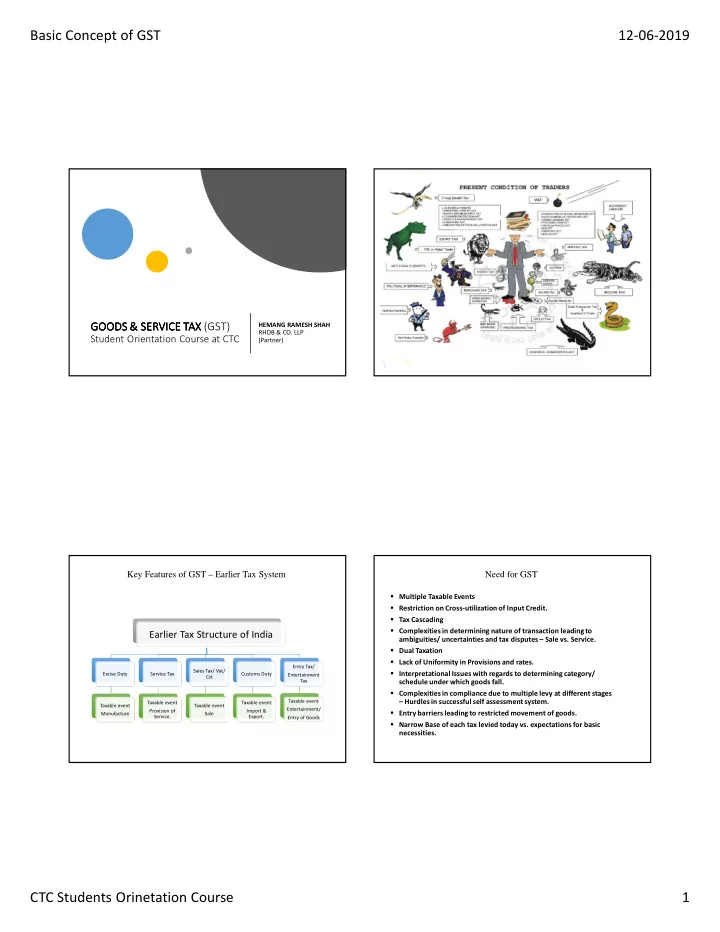
Basic Concept of GST 12-06-2019 GOODS & SERVICE TAX (GST) GOODS & SERVICE TAX GOODS & SERVICE TAX GOODS & SERVICE TAX HEMANG RAMESH SHAH RHDB & CO. LLP Student Orientation Course at CTC (Partner) Key Features of GST


slide-1
SLIDE 1

Basic Concept of GST 12-06-2019 CTC Students Orinetation Course 1

GOODS & SERVICE TAX GOODS & SERVICE TAX GOODS & SERVICE TAX GOODS & SERVICE TAX (GST)

Student Orientation Course at CTC

HEMANG RAMESH SHAH RHDB & CO. LLP (Partner)

Key Features of GST – Earlier Tax System

Earlier Tax Structure of India

Excise Duty Taxable event Manufacture. Service Tax Taxable event Provision of Service. Sales Tax/ Vat/ Cst Taxable event Sale Customs Duty Taxable event Import & Export. Entry Tax/ Entertainment Tax Taxable event Entertainment/ Entry of Goods

Need for GST

  • Multiple Taxable Events
  • Restriction on Cross-utilization of Input Credit.
  • Tax Cascading
  • Complexities in determining nature of transaction leading to

ambiguities/ uncertainties and tax disputes – Sale vs. Service.

  • Dual Taxation
  • Lack of Uniformity in Provisions and rates.
  • Interpretational Issues with regards to determining category/

schedule under which goods fall.

  • Complexities in compliance due to multiple levy at different stages

– Hurdles in successful self assessment system.

  • Entry barriers leading to restricted movement of goods.
  • Narrow Base of each tax levied today vs. expectations for basic

necessities.

slide-2
SLIDE 2

Basic Concept of GST 12-06-2019 CTC Students Orinetation Course 2

Key Features of GST - Benefits

  • Business Decisions delinked from tax
  • Reduction in Cascading effect of taxes.
  • Uniformity in tax laws.
  • Transparency in tax system.
  • Simplified procedures and single compliance.
  • Broadening tax base.
  • Less Rate tables.
  • Promotion of economic efficiency and sustainable long term

economic growth.

  • Reduces litigation.
  • Reduces administrative costs to government.
  • Increases voluntary Compliance.

BASICS of GST

 GST is a tax on goods and services with comprehensive and continuous chain

  • f setoff benefits from the Producer’s point and Service provider’s point up to

the retailer level.  GST is destination based consumption tax. It is essentially a tax only on value addition at each stage and supplier at each stage are permitted to setoff through a tax credit mechanism, which would eliminate the burden of all cascading effects, whereby eleminating burden of different taxes such as Service tax, VAT, Excise, Octroi, etc.  Under GST structure, all different stages of production and distribution can be interpreted as a mere pass through and tax essentially sticks on final consumption within the taxing jurisdiction.  Previously, a manufacturer needs to pay tax when a finished product moves

  • ut from the factory, and it is again taxed at the retail outlet when sold. The

taxes are levied at the multiple stages such as Excise, Central sales tax, State Sales Tax, Octroi, etc., which has been replaced by GST as central and State levy.  All goods and services, barring a few exceptions, have been brought into the GST base. There are no distinction between goods and services.  Basic features of law such as chargeability, definition of taxable event and taxable person, measure of levy including valuation provisions, basis of classification etc. are uniform across these statutes as far as practicable.  For movement

  • f

supply from

  • ne

state to another, alongwith discontinuation of CST, a new statute known as IGST have come into exsistenace for inter-state transfer of the Goods and Services.  By removing the cascading effect of taxes (CST, additional customs duty, surcharges, luxury Tax, Entertainment Tax, etc. ),CGST & SGST will be charged

  • n same price .

Supply includes : (a) All forms of supply of goods and/or services such as sale, transfer, barter, exchange, license, rental, lease or disposal made

  • r agreed to be made for a consideration by a person in the

course or furtherance of business, (b) Importation of services, whether or not for a consideration and whether or not in the course or furtherance of business, and (c) Supply made or agreed to be made without a consideration

slide-3
SLIDE 3

Basic Concept of GST 12-06-2019 CTC Students Orinetation Course 3

Meaning & Scope of Supply

Inward Supply

“Inward Supply” in relation to a person, shall mean receipt of goods and/or services whether by purchase, acquisition or any other means with or without consideration.

Outward Supply

“Outward Supply” in relation to a taxable person, means supply of goods or services or both, whether by sale, transfer, barter, exchange, license, rental, lease or disposal or any other mode, made or agreed to be made by such person in the course or furtherance of business.

Continuous Supply

Means a supply of goods / services which is provided, or agreed to be provided, continuously or on recurrent basis, under a contract, for a period exceeding three months with periodic payment obligations and includes supply of such services as the Government may, subject to such conditions, by notification, specify (For goods supply to be throgh wire, cable, pipeline or other conduit and invoice are made on periodic or regular basis).

When it is not a ‘Supply’

 Activities and transactions specified in Schedule III: – Services by an employee to the employer in the course of or in relation to his employment; – Services of funeral, burial, crematorium or mortuary including transportation of the deceased. – Sale of land or building other than under construction flats – Actionable claims, other than lottery, betting and Gambling – High Sea sales, Out to Out sales, Bonded ware house  Such activities or transactions undertaken by the Central Government, a State Government or any local authority in which they are engaged as public authorities, as may be notified by the Government on the recommendations of the Council

Composite Supply

A supply made by a taxable person to a recipient comprising two or more taxable supplies of goods or services, or any combination thereof, which are naturally bundled and supplied in conjunction with each other in the

  • rdinary course of trade, one of which is a principal supply;

Illustration

Where goods are packed and transported with insurance, the supply of goods, packing materials, transport and insurance is a composite supply and supply of goods is the principal supply.

Principal Supply

Means: The supply of goods or services which constitutes the predominant element of a composite supply and to which any other supply forming part of that composite supply is ancillary and does not constitute, for the recipient an aim in itself, but a means for better enjoyment of the principal supply.

slide-4
SLIDE 4

Basic Concept of GST 12-06-2019 CTC Students Orinetation Course 4

Mixed Supply

Means : Two or more individual supplies of goods or services, or any combination thereof, made in conjunction with each other by a taxable person for a single price where such supply does not constitute a composite supply;

Illustration

A supply of a package consisting of canned foods, sweets, chocolates, cakes, dry fruits, aerated drink and fruit juices when supplied for a single price is a mixed supply. Each of these items can be supplied separately and is not dependent on any other. It shall not be a mixed supply if these items are supplied separately.

Taxability : Mixed Supply

The tax liability on a mixed supply comprising two or more supplies shall be treated as supply of that particular supply which attracts the highest rate of tax .

Exempt Supply / Non GST Supply

 Supply of any goods and/or services which are NOT TAXABLE under this Act  Supply of goods and/or services under this Act which attract NIL rate of tax or which may be exempt from tax (Non-Taxable Supply)

Zero Rated Supply

Means export of goods or services or both; or supply of goods or services or both to a Special Economic Zone developer or a Special Economic Zone unit (eligible for ITC)

slide-5
SLIDE 5

Basic Concept of GST 12-06-2019 CTC Students Orinetation Course 5

According to the law, the point of taxation means the point in time when goods have been deemed to be supplied or services have been deemed to be provided. The point of taxation enables us to determine the rate of tax, value, and due dates for payment of taxes. The liability to pay GST will arise only when time of supply has been determined for goods and services. There are separate provisions for time

  • f supply for goods and time of supply for services. The liability to pay GST
  • n supply shall arise at the time of supply as determined by GST provisions

How to Determine Time of Supply

The time of supply of goods shall be the earlier of the following dates:

the date of issuing invoice (or the last day by which invoice should

have been issued) i.e. a. Immediately on removal of goods where supply involves movement, b. Delievry of goods or making available The time of supply of Service shall be the earlier of the following dates: a. Date of issue of invioce, b. Receipt of payment / advance (From 13/20/2107) c. Provision of service

Exception If the supplier of taxable service receives an amount up to INR 1000 in excess of invoice amount, the time of supply for the extra amount shall be the date of issue of invoice (at the option of the supplier).

For both the above clauses, the supply shall be assumed to have been made to the extent it is covered by the invoice or the payment (as the case may be). For the second clause, the date of receipt of payment shall be the earlier

  • f:

the date on which the dealer enters the payment in their books

OR

the date on which the payment is credited to their bank account

Illustartion

If the date of invoice is 15th August 2017, and date of receipt of payment is 10th September 2017. The date when the supplier recorded the receipt in his books is 11th September 2017. Thus, the time of supply will be 15th August 2017.

How to Determine Place of Supply

‘Place of Supply’ under GST is an important factor, it defines whether

the transaction will be counted as intra-state (i.e within the same state) or inter-state (i.e. between two states) and accordingly the chargeability of tax, i.e levy of SGST, CGST & IGST will be determined. While determining the levy of taxes based on place of supply, two things are considered: Location of Supplier: It is the registered place of business of the supplier Place Of Supply: As per Section 10, 11, 12, 13 & 14 of IGST Act

slide-6
SLIDE 6

Basic Concept of GST 12-06-2019 CTC Students Orinetation Course 6

Determiniing Place of Supply under GST

Let us first understand why an accurate determination of place of supply is important for businesses. The reasons for this are listed below:  Wrong classification of supply between interstate or intra- state and vice- versa may lead to hardship to the taxpayer as per section 19 of IGST Act and section 70 of CGST Act.  Where wrong taxes have been paid on the basis of the wrong classification, refund will have to be claimed by the taxpayer.  The taxpayer will have to pay the correct tax along with interest for delay on the basis of revised/correct classification.  Also, correct determination of place of supply will help us in knowing the incidence of tax. As if place of supply is determined as a place outside India, then tax will not have to be paid on that transaction.

NEED FOR PLACE OF SUPPLY Place of consumption Supply is Local, Export

  • r Import

CGST+SGST Or IGST Supply is Inter or Intra state

INTRA STATE

Location of Supplier Place of Supply

Same State /UT

INTER STATE SUPPLY

Supply Domestic

Different State Different UT State & UT

To or by SEZ Import crossing C/F

Export T/T not Intra State & not covered elsewhere Supplier in India POS O/S

Location of Supplier Place of Supply

&

slide-7
SLIDE 7

Basic Concept of GST 12-06-2019 CTC Students Orinetation Course 7

Let’s understand this with the help of two examples Example 1: Determining Place of Supply for Intra-State Supply of Goods Let us assume there is a supplier of craft products, Kloud Kreations Pvt. Ltd with the registered office in Bangalore, Karnataka. It supplies goods to schools in Manipal, Karnataka. Here, since the supplier as well as the recipient are located in same state i.e Karnataka, it will be counted as ‘Intra-State Supply Of Goods’ and hence SGST and CGST will be levied. Example 2: Determining Place of Supply for Inter-State Supply of Goods Let us assume the supplier of craft products, Kloud Kreations Pvt. Ltd has their registered office in Bangalore, Karnataka and the recipient i.e Delhi Public School is located in Jaipur, Rajasthan. Here, since the supplier and the recipient are located in different states i.e Karnataka and Rajasthan, it will be counted as ‘Inter-State Supply Of Goods’ and hence IGST will be levied. There are specific provisions for determination

  • f place of supply of goods which depend on:

The place of supply of goods: where the supply involves movement of goods The place of supply of goods: where the supply involves no movement of goods The place of supply of goods: in case of export and import of goods

How to Determine the Place Of Supply Of Services

GST is destination based tax i.e consumption tax, which means tax will be levied where goods and services are consumed and will accrue to that state. Under GST, there are three layers of Tax IGST, CGST and SGST and based on the “place of supply’’ so determined, the respective tax will be levied. IGST is levied where transaction is inter-state, and CGST and SGST are levied where the transaction is intra-state.

For understanding

Place of Supply for Services the following two concepts are very important namely:

  • location of the recipient of services
  • location of the supplier of services
slide-8
SLIDE 8

Basic Concept of GST 12-06-2019 CTC Students Orinetation Course 8

Let’s understand these two concepts in detail as they will form the base for determining the place of supply in case of supply of services:

The transactions in terms of supply of services can be broadly categorized as below:

  • 1. Domestic Transactions

These are the transactions where both the parties i.e the supplier as well as recipient of service are in India. Domestic transactions can be further categorized as below:

  • Inter-State (i.e between two different states)
  • Intra-State (i.e within the same state)

General Rule for Domestic Transactions In general, the place of supply for services will be the location of the service recipient (the recipient needs to be a registered person). In cases, where service is provided to an unregistered person, the place of supply will be the:

  • location of the service recipient (if the address is available on record)
  • location of service provider (if location of recipient is not available)
  • 2. International Transactions

These are the transactions where either of the service recipient or the provider is outside India. Transactions in which both the recipient as well as provider are outside India are not covered here. General Rule for International Transactions The place of supply, for services treated as international transactions, will be:

  • the location of service recipient
  • the place of supply shall be location of the supplier, in case where the

location of service recipient is not available

slide-9
SLIDE 9

Basic Concept of GST 12-06-2019 CTC Students Orinetation Course 9 Domestic place of supply of Services Domestic place of supply of Services Domestic place of supply of Services Domestic place of supply of Services

Basic Rule: Supply made to Other than person Address on record exists No address Location of supplier Registered person Location of such person

Domestic place of supply of Services Domestic place of supply of Services Domestic place of supply of Services Domestic place of supply of Services

IP

  • Including architect, surveyor, estate agent, grant of right, etc
  • Carrying out or co-ordination of construction work

Lodging Accom.

  • Hotel, guest house, inn, home stay, club, campsite,
  • Including house boat or any other vessel
  • Prov. If property located o/s India, POS location of recipient

Accom.

  • rganizin

g

  • Marriage, Reception or matters related,
  • Official, social, cultural, religious or business function including service

thereto Admissi

  • n
  • Cultural, artistic, sporting, scientific, educational, entertainment event,
  • Amusement park,
  • Other place & service ancillary
  • POS location of such property, place, boat, vessel located or

intended to be located

Domestic place of supply of Services Domestic place of supply of Services Domestic place of supply of Services Domestic place of supply of Services

Issues IP, Vessel, Boat Goa SR Mumbai SP Chennai IP, Vessel, Boat UK SR Chennai SP Delhi POS Goa POS Chennai

Domestic place of supply of Services Domestic place of supply of Services Domestic place of supply of Services Domestic place of supply of Services

Restaurant & Catering Personal grooming, fitness, beauty treatment Health service including cosmetic & plastic surgery

  • POS where service actually performed

Yoga ?

slide-10
SLIDE 10

Basic Concept of GST 12-06-2019 CTC Students Orinetation Course 10 Domestic place of supply of Services Domestic place of supply of Services Domestic place of supply of Services Domestic place of supply of Services

Training & Performance appraisal Registered person Location of such person Other than registered Location where service actually performed

Domestic place of supply of Services Domestic place of supply of Services Domestic place of supply of Services Domestic place of supply of Services

Organising events Other than Registered person Place where event held Event held O/S India Location of recipient Registered person Location of such person

  • Event in more than one state / UT than proportionate or may

prescribe

Domestic place of supply of Services Domestic place of supply of Services Domestic place of supply of Services Domestic place of supply of Services

Transportation of goods including mail or courier Other than Registered person Goods handed

  • ver for their

transportation Registered person Location of such person

Domestic place of supply of Services Domestic place of supply of Services Domestic place of supply of Services Domestic place of supply of Services

Passenger Transportation Other than Registered person Place where embarks Embarkation not known, Basic rule 2 Registered person Location of such person

  • Return journey treated as separate supply
slide-11
SLIDE 11

Basic Concept of GST 12-06-2019 CTC Students Orinetation Course 11 Domestic place of supply of Services Domestic place of supply of Services Domestic place of supply of Services Domestic place of supply of Services

  • POS first schedule point of departure of conveyance

Vessel Aircraft Train Motor Vehicle conveyance conveyance conveyance conveyance

Domestic place of supply of Services Domestic place of supply of Services Domestic place of supply of Services Domestic place of supply of Services

Telecommunication, Broadcasting, Cable & DTH Post paid mobile, internet, DTH Agent, distributor Any person to subscriber Fixed line, Lease line, Dish Post paid mobile, internet Any other case

  • Prepaid recharge made through internet banking or e mode, location of

recipient of service on record of supplier Billing add. Of recipient on record Location where installed Location of agent, distributor Place where payment recd. Address on record, else location of supplier

Domestic place of supply of Services Domestic place of supply of Services Domestic place of supply of Services Domestic place of supply of Services

  • All follow KYC norms, hence Location of recipient always available

Location of recipient on record. Else location of supplier Stock Broking Banking Other Financial

Domestic place of supply of Services Domestic place of supply of Services Domestic place of supply of Services Domestic place of supply of Services

Insurance Other than Registered person Location or recipient of service on record Registered person Location of such person

slide-12
SLIDE 12

Basic Concept of GST 12-06-2019 CTC Students Orinetation Course 12

Domestic place of supply of Services Domestic place of supply of Services Domestic place of supply of Services Domestic place of supply of Services

Advertise ment CG SG Statutory Body Local Authority

  • As per contract or agreement than in proportion to amount attributable to

dissemination in respective state or UT.

  • In absence of contract or agreement as may be prescribed

meant for state

  • r UT

Domestic place of supply of Services Domestic place of supply of Services Domestic place of supply of Services Domestic place of supply of Services

Supply in territorial water Sec 9 of IGST Location of Supplier : Coastal state / UT nearest to base line Place of Supply : Coastal state / UT nearest to base line

Cross border place of supply of Services Cross border place of supply of Services Cross border place of supply of Services Cross border place of supply of Services

Particulars Import Export Location of Supplier Outside India Location of Recipient India Outside Place of Supply India Outside

  • Location of

Location of Location of Location of SP or SR outside India SP or SR outside India SP or SR outside India SP or SR outside India Inter State (RCM) Inter State Tax = 0 On Fx.

Cross border place of supply of Services Cross border place of supply of Services Cross border place of supply of Services Cross border place of supply of Services

  • Sr. No.

Situation POS

2 Basic Rule Location of SR, Address NA, Location of SP 3 Performance Based : On Goods On Individual Where goods made physically available Location where supplier physically performs 4 Immovable Property Property located or Intended to be located 5 Admission or Organisation of event Place where event actually held 6 Service supplied in more than

  • ne location for 3, 4 & 5

Taxable territory, if performed in taxable as well as other than taxable territory. 7 Supplied in more than one state or UT for 3, 4 & 5 Proportionate as contract or agreement, else such basis as may be prescribed 8 Banking, NBFC, FI, Intermediary, hiring means of transport Location of SP

slide-13
SLIDE 13

Basic Concept of GST 12-06-2019 CTC Students Orinetation Course 13

Cross border place of supply of Services Cross border place of supply of Services Cross border place of supply of Services Cross border place of supply of Services

  • Sr. No.

Situation POS

9 Transportation of Goods (other than Mail or Courier) Destination of goods 10 Passenger Transportation Passenger embarks on conveyance 11 On board conveyance during the course of passenger transport First schedule departure of conveyance 12 Online information and database access or retrieval Location of recipient of service

Time of Supply under Reverse Charge

Reverse charge means the liability to pay tax is by the recipient of goods/services instead of the supplier. In case of reverse charge, the time of supply shall be the earliest of the following dates:

  • the date of payment

OR

  • the date immediately after sixty (60) days from the date of issue of invoice

by the supplier (30 days for goods) If it is not possible to determine the time of supply using the above rules, then the time of supply shall be the date of entry in the books of account of the receiver of service. For the first clause, the date of payment shall be earlier of:

  • the date on which the recipient entered the payment in his books

OR

  • the date on which the payment is debited from his bank accounts

When Supplier is Located Outside India

In case of ‘associated enterprises’, where the supplier of service is located outside India, the time of supply shall be:

  • the date of entry in the books of account of the receiver

OR

  • the date of payment, whichever is earlier

Let’s understand this with an example. Assuming for a transaction: If for some reason the time of supply could not be determined supply using the above clauses, then it would be 18th July 2018 i.e., date of entry in books.

Time of supply for vouchers

In the case of supply of vouchers, the time of supply is determined as:

  • the date of issue of voucher, if the supply can be identified at that point

OR

  • the date of redemption of voucher, in all other cases

When the time of supply cannot be determined, then it will be:

  • the date on which a periodical return has to be filed

OR

  • the date on which the CGST/SGST is paid, in any other case

In the GST regime, the tax collection event will be the earliest of the dates as given above. The various events like issuing an invoice or making a payment in case of supply of goods/ services or completion of event, in case of supply of service triggering the tax levy, confirms that the government wants to ensure the tax is collected at the earliest point of time. This will be altogether a new concept for the current VAT and central excise taxpayers.

slide-14
SLIDE 14

Basic Concept of GST 12-06-2019 CTC Students Orinetation Course 14

Valuation of supply under GST

GST will be charged on the ‘transaction value’. Transaction value is the price actually paid (or payable) for the supply of goods/services between unrelated parties (i.e., price is the sole consideration). The value of supply under GST shall include:

  • Any taxes, duties, cess, fees and charges levied under any act, except GST.

GST Compensation Cess will be excluded if charged separately by the supplier.

  • Any amount that the supplier is liable to pay which has been

incurred by the recipient and is not included in the price.

  • The value will include all incidental expenses in relation to sale such as

packing, commission etc.

  • Subsidies linked to supply, except Government subsidies will be included.
  • Interest/late fee/penalty for delayed payment of consideration will be

included.

Discounts given after supply will be allowed only if:

it is mentioned in the agreement entered into before sale input tax credit proportionate to the discount has been reversed by the recipient of the supply and it can be clearly tracked to relevant tax invoice. To continue with our example, XYZ is a wholesaler selling tools like drills, polishers, spades etc. XYZ now sells the power drill to a trader TDR for INR 4,000 offering a 1% discount. XYZ incurs INR 150 packing charges, with general credit policy of 60 Days. To encourage prompt payment, XYZ offers additional 0.5% discount.

Discount of 0.5% is not deducted in the invoice because it will be given at the time of payment. However, since this discount was known at the time of supply, and can be linked to this specific invoice, and the discount amount can be reduced from the transaction value. For this, XYZ Ltd. will issue a credit note to TDR for INR 20 (0.5% of INR 4,000 = INR 20+ GST@ 18% on INR 20 = INR 3.60), and this must be linked to the relevant tax invoice. Here, discount has been given after supply. But it was agreed upon at the time of supply and can be traced to the relevant invoice. So it will be allowed to be deducted from the transaction value.

When Discount is Given AFTER Supply AND it is NOT KNOWN at the Time of Supply

XYZ is facing serious liquidity problems and requests WHL to pay within 2 days. It offers additional 1% discount. WHL agrees and pays.

slide-15
SLIDE 15

Basic Concept of GST 12-06-2019 CTC Students Orinetation Course 15

Input Tax Credit :

When you buy a product/service from a registered dealer you pay taxes on purchase, while making sales, tax is collected and periodically the same is adjusted with the tax you already paid at time of purchase and balance liability of tax (tax on sales (minus) tax on purchase) is to be paid to the government. This mechanism is called utilisation

  • f input tax credit (tax on purchase adjustment against tax liability on output i.e.

sales). Following are some of the conditions that need to be addressed for availing ITC: 1. Lapsed of Input credit : Registered person will not be entitled to take eligible ITC in respect of any supply after the filling of Annual return or filling of next financual year september return.

  • 2. Generally accepted accounting principles should be followed:

The amount of credit under GST law will be calculated in accordance with generally accepted accounting principles. Further rules in this regard are yet to be notified.

  • 3. ITC is attributable to the purpose of business only:

In case goods and/or services supplied are used by the taxable person partly for the purpose of any business and partly for any other purpose, the ITC shall be restricted to the extent of the input tax as is attributable to the purpose of business.

  • 4. ITC is attributable to taxable supply:

There can be a business scenario when the goods and /or service are used by the registered taxable person partly for effecting taxable supplies and partly for the purpose of non-taxable supplies. In such cases, input credit attributable to exempt/ non-taxable supply will not be

  • available. However, the amount of input tax on zero-rated supplies will be available

as credit.

  • 5. Proper tax invoice must be furnished:

Businesses registered under GST will not be provided the credit of any input tax in respect of any supply of goods and/or services unless:

  • the business is in possession of a tax invoice, debit note, supplementary invoice
  • r such other taxpaying document as may be required under the notified GST

law

  • the business has actually received mentioned goods and/ or services
  • GST charged in respect of such supply has been actually paid to the credit of

government against such supply

  • The business has furnished the proper return under GST law.

Also, where the goods against an invoice are received in lots or installments, the registered taxable person shall be entitled to the credit upon receipt of last lot or installment.

slide-16
SLIDE 16

Basic Concept of GST 12-06-2019 CTC Students Orinetation Course 16

PRE PRE PRE PRE-

  • REQUISITE FOR REGISTRATION

REQUISITE FOR REGISTRATION REQUISITE FOR REGISTRATION REQUISITE FOR REGISTRATION

EXCEPT FOR NON EXCEPT FOR NON EXCEPT FOR NON EXCEPT FOR NON RESIDENT RESIDENT RESIDENT RESIDENT

Aggregate T/O to include T/O on own account and made on behalf of all principal. Supply by job worker on behalf of principal, not to be treated in T/O of job worker. Special category state means state as per 279A(4)(g) of Constitution. Supplier means person supplying and shall include agent acting on behalf of supplier

PERSON LIABLE FOR REGISTRATION

Supplier Making taxable supply In state or UT or both Aggregate T/O in F.Y. Exceeds threshold limit. Person Holding registration Under existing law Transfer or succession

  • f business

As Going Concern Amalgamation, Demerger Through court

  • rder

SCHEDULE V SCHEDULE V SCHEDULE V SCHEDULE V

Person liable to apply for all states Person liable to apply for all states Person liable to apply for all states Person liable to apply for all states where he is liable where he is liable where he is liable where he is liable. . . .

slide-17
SLIDE 17

Basic Concept of GST 12-06-2019 CTC Students Orinetation Course 17

THRESHOLD BASED THRESHOLD BASED THRESHOLD BASED THRESHOLD BASED

State covered under Article 279A(4)(g)

Every Supplier making Taxable Supply Aggregate Turnover More than 20 Lacs

Others

Every Supplier making Taxable Supply Aggregate Turnover More than 20 Lacs (For Goods it has been raised to 40)

Supplier means person supplying goods & service and Supplier means person supplying goods & service and Supplier means person supplying goods & service and Supplier means person supplying goods & service and includes includes includes includes an agent acting on behalf of supplier an agent acting on behalf of supplier an agent acting on behalf of supplier an agent acting on behalf of supplier

Without Threshold

Interstate Supply Casual Taxable Person Reverse Charge

E Commerce Operator

  • n specified

Service Non Resident TDS TCS Agent supplying Goods / Services ISD Person supplying through E commerce E- Commerce Operator Online Information & Database

GST Returns

A return is a document that a taxpayer is required to file as per the law with the tax administrative authorities. Under the GST law, a normal taxpayer will be required to furnish three returns monthly and one annual return. Similarly, there are separate returns for a taxpayer registered under the composition scheme, taxpayer registered as an Input Service Distributor, a person liable to deduct

  • r collect the tax (TDS/TCS).

What are the types of GST Returns?

Here is a list of all the returns to be filed under the GST Law along with the due dates.

Any regular business:

As per the CGST Act ( Note : subject to change by Notifications/orders)

slide-18
SLIDE 18

Basic Concept of GST 12-06-2019 CTC Students Orinetation Course 18

Return Form Particulars Interval Due Date GSTR-1 Details of outward supplies of taxable goods and/or services effected Monthly* 10th of the next month GSTR-2 Details of inward supplies of taxable goods and/or services effected claiming input tax credit. Monthly* 15th of the next month GSTR-3 Monthly return on the basis of finalization of details of outward supplies and inward supplies along with the payment of amount of tax. Monthly* 20th of the next month GSTR-9 Annual Return Annually 31st December of next financial year GSTR-3B (Other than Composition Dealer) Provisional return for the months

  • f July 2017 to March 2018

Monthly 20th of the next month

A dealer opting for composition scheme :

A composition dealer will enjoy the benefits of lesser returns & compliance along with payment of taxes at nominal rates. A composition dealer will file only 2 returns:

Return Form Particulars Interval Due Date

GSTR-4 Return for compounding taxable person Quarterly 18th of the month succeeding quarter** GSTR 9A Annual Return Yearly 31st December of next financial year

Returns to be filed by specific registered dealers:

Return Form Particulars Interval Due Date GSTR-5 Return for Non-Resident foreign taxable person Monthly 20th of the next month*** GSTR-6 Return for Input Service Distributor Monthly 13th of the next month GSTR-7 Return for authorities deducting tax at source. Monthly 10th of the next month GSTR-8 Details of supplies effected through e- commerce operator and the amount of tax collected Monthly 10th of the next month GSTR-10 Final Return

  • Once. When registration is

cancelled or surrendered Within three months of the date of cancellation or date of cancellation order, whichever is later. GSTR-11 Details of inward supplies to be furnished by a person having UIN and claiming refund Monthly 28th of the month following the month for which statement is filed

slide-19
SLIDE 19

Basic Concept of GST 12-06-2019 CTC Students Orinetation Course 19

ELIGIBILTY

Section 44 of CSGT Read with rule 89 of CGST Every Registered Person To Furnish AR for FY On or Before 31/12 In prescribed format

Except: ISD, TDS/TCS, CTP, NRP Removal of Difficulty Order 03/18 for 17-18 Due date 30/06/19

Financial Year for 2017-18, will start from July or April ?

  • As per Instruction 19 of GSTR-9 information from July to

March is to be provided

Anomality between Section & Rule from 01/02/2019

  • Input Service Distributor,
  • Only TDS/TCS deductor,
  • Casual Taxable person,
  • Non Resident Taxable person

Section 44

  • Input Service Distributor,
  • Only TDS/TCS deductor,
  • Casual Taxable person,
  • Non Resident Taxable person,
  • CG, SG or LB whose accounts are audited by

CAG (from 01/02/2019)

Rule 89

Every Registered person is required to file annual return

  • ther than :

Applicability and Different types of Annual Return

Registered Person Regular Annual Return in form GSTR-9 If aggregate turnover exceeds 2 Crore, than Reconciliation statement of tax already paid and payable as per audited accounts in Form GSTR 9C Composition Annual Return in form GSTR- 9A E-Commerce Operator Annual Return in form GSTR- 9B

RHDB & CO LLP Hemang Ramesh Shah (Partner)

Thanks