Can one invasion lead to another? Niche space and the future of - - PowerPoint PPT Presentation

can one invasion lead to another niche space and the
SMART_READER_LITE
LIVE PREVIEW

Can one invasion lead to another? Niche space and the future of - - PowerPoint PPT Presentation

Can one invasion lead to another? Niche space and the future of Nature Precedings : doi:10.1038/npre.2009.3842.1 : Posted 8 Oct 2009 Southwestern U.S. riparian zones Lindsay Reynolds and David Cooper Colorado State University 3 August 2009


slide-1
SLIDE 1

Lindsay Reynolds and David Cooper Colorado State University 3 August 2009

Can one invasion lead to another? Niche space and the future of Southwestern U.S. riparian zones

Nature Precedings : doi:10.1038/npre.2009.3842.1 : Posted 8 Oct 2009

slide-2
SLIDE 2

Tamarisk and Russian olive

Friedman et al. 2005. Biological Invasions, 7:747-751

Nature Precedings : doi:10.1038/npre.2009.3842.1 : Posted 8 Oct 2009

slide-3
SLIDE 3

Tamarisk and Russian olive

Tamarix ramosissima Ledebour,

  • T. chinensis Loureiro,
  • T. pentandra Karst,

and hybrids of these taxa Elaeagnus angustifolia L. (Russian olive)

Nature Precedings : doi:10.1038/npre.2009.3842.1 : Posted 8 Oct 2009

slide-4
SLIDE 4

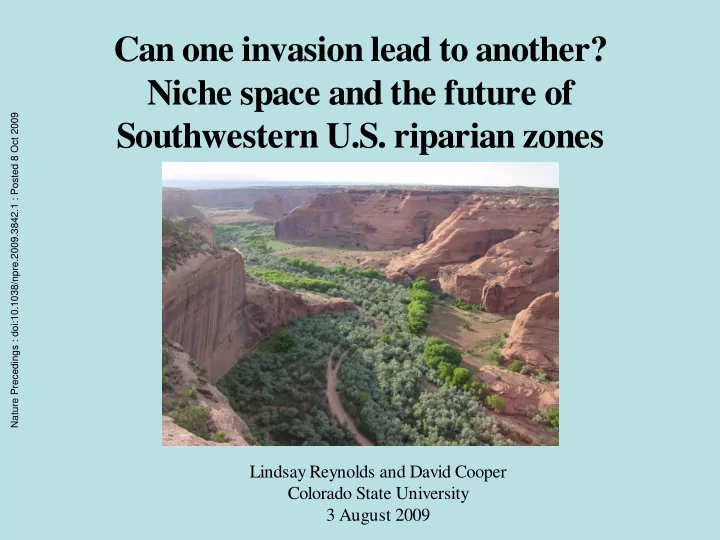
Canyon de Chelly National Monument, Arizona

Nature Precedings : doi:10.1038/npre.2009.3842.1 : Posted 8 Oct 2009

slide-5
SLIDE 5

1942 Ansel Adams

Flood plain changes 1930s-2007

2005

*Native cottonwood, exotic tamarisk and Russian olive riparian forest

Nature Precedings : doi:10.1038/npre.2009.3842.1 : Posted 8 Oct 2009

slide-6
SLIDE 6

Research goals: mechanisms of invasion

(1) Empty niche exploitation? Does Russian olive have a broader niche than cottonwood and tamarisk? (3) Facilitation? Can cottonwood and tamarisk facilitate Russian olive invasion by providing shaded habitat?

Nature Precedings : doi:10.1038/npre.2009.3842.1 : Posted 8 Oct 2009

slide-7
SLIDE 7

Methods

  • Test light and water requirements for tamarisk, Russian olive and

cottonwood

  • Fine scale: Controlled experiment
  • Landscape scale: Canyon de Chelly field survey
  • Regional scale: Regional survey

Nature Precedings : doi:10.1038/npre.2009.3842.1 : Posted 8 Oct 2009

slide-8
SLIDE 8

Fine scale: Methods

  • Controlled experiment
  • Shade
  • 0%, 90%, 99%
  • Water
  • Saturated soil (flooded)
  • High monsoon rain
  • Average rain
  • Low rain
  • Species
  • Russian olive, tamarisk, cottonwood

Nature Precedings : doi:10.1038/npre.2009.3842.1 : Posted 8 Oct 2009

slide-9
SLIDE 9

Fine scale: results

Nature Precedings : doi:10.1038/npre.2009.3842.1 : Posted 8 Oct 2009

slide-10
SLIDE 10

Landscape scale: Canyon de Chelly

Transects: Random location

Nature Precedings : doi:10.1038/npre.2009.3842.1 : Posted 8 Oct 2009

slide-11
SLIDE 11

Regional scale: Sites

Nature Precedings : doi:10.1038/npre.2009.3842.1 : Posted 8 Oct 2009

slide-12
SLIDE 12

Canyon de Chelly and regional field surveys

Full sun No sun

Nature Precedings : doi:10.1038/npre.2009.3842.1 : Posted 8 Oct 2009

slide-13
SLIDE 13

Stable oxygen isotope analysis

Nature Precedings : doi:10.1038/npre.2009.3842.1 : Posted 8 Oct 2009

slide-14
SLIDE 14

II – Canyon de Chelly results

Nature Precedings : doi:10.1038/npre.2009.3842.1 : Posted 8 Oct 2009

slide-15
SLIDE 15

Continued invasion of Russian olive

Nature Precedings : doi:10.1038/npre.2009.3842.1 : Posted 8 Oct 2009

slide-16
SLIDE 16

1942 Ansel Adams 2005

1) Empty niche exploitation?

  • Yes - Russian olive has a broader niche than tamarisk

and cottonwood 2) Facilitation?

  • No.

Summary

Nature Precedings : doi:10.1038/npre.2009.3842.1 : Posted 8 Oct 2009

slide-17
SLIDE 17

Acknowledgements

  • The National Parks Service and

PRIMES (NSF award #DGE- 0221595003) for funding.

  • My advisor David Cooper and

committee members, Tom Hobbs, Cynthia Brown, Tom Stohlgren and Ellen Wohl

  • Field and technical assistance

and the Canyon de Chelly Staff

PRIMES

Nature Precedings : doi:10.1038/npre.2009.3842.1 : Posted 8 Oct 2009