Can Kl This Talk Covers arXiv:1711.05300: Chacko, CK, Najjari, - - PowerPoint PPT Presentation

can k l this talk covers
SMART_READER_LITE
LIVE PREVIEW

Can Kl This Talk Covers arXiv:1711.05300: Chacko, CK, Najjari, - - PowerPoint PPT Presentation

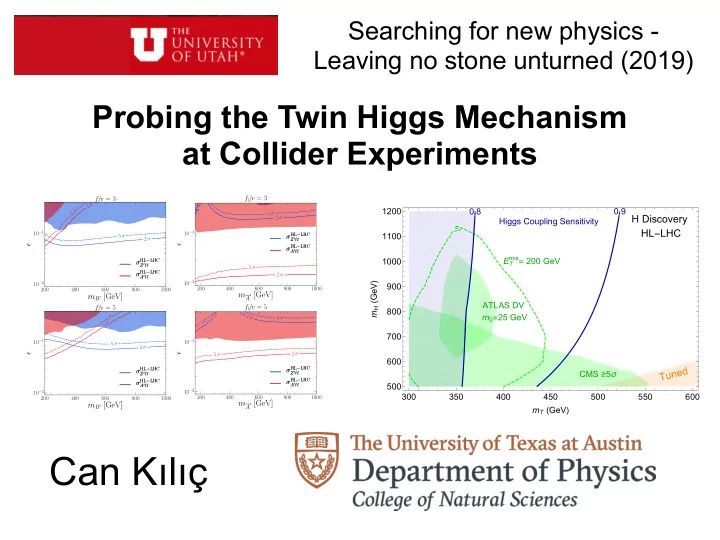
Searching for new physics - Leaving no stone unturned (2019) Probing the Twin Higgs Mechanism at Collider Experiments f 1 / v = 3 f/ v = 3 2 2 0.9 H Discovery 1200 0.8 5 5 5 2 Higgs Coupling Sensitivity HL - LHC 10


slide-1
SLIDE 1

Can Kılıç

Probing the Twin Higgs Mechanism at Collider Experiments

0.8 0.9 H Discovery

HL-LHC

CMS ≥5σ ATLAS DV m0=25 GeV ET

mis= 200 GeV

Higgs Coupling Sensitivity

Tuned

300 350 400 450 500 550 600 500 600 700 800 900 1000 1100 1200 mT (GeV) mH (GeV)

Searching for new physics - Leaving no stone unturned (2019)

200 400 600 800 1000

mB [GeV]

102 101

2
  • 5
2 5
  • f/

v = 3 HLLHC

Z

HLLHC

A

HLLHC

Z

HLLHC

A 200 400 600 800 1000

mA

[GeV] 102 101

2 2
  • 5
5 2 5

f1/ v = 3 HLLHC

Z

HLLHC

A

HLLHC

Z

HLLHC

A 200 400 600 800 1000

mB [GeV]

102 101

2 5 2 5

f/ v = 5 HLLHC

Z

HLLHC

A

HLLHC

Z

HLLHC

A 200 400 600 800 1000

mA

[GeV] 102 101

2 2
  • 5
5 2 5

f1/ v = 5 HLLHC

Z

HLLHC

A

HLLHC

Z

HLLHC

A
slide-2
SLIDE 2

This Talk Covers

arXiv:1711.05300: Chacko, CK, Najjari, Verhaaren arXiv: 1812.08173: CK, Najjari, Verhaaren arXiv: 1904.11990: Chacko, CK, Najjari, Verhaaren

See also:

arXiv: 1506.06141: Curtin, Verhaaren arXiv: 1811.05977: Bishara, Verhaaren arXiv: 1904.10468: Batell, Verhaaren

slide-3
SLIDE 3

Naturalness of the electroweak breaking sector has been a major motivation for TeV scale physics. So far, null results only → “Little hierarchy problem” Neutral naturalness: Discovery at colliders is challenging. Next step: If we discover new degrees of freedom, how can we probe their connection to the naturalness puzzle? Adopt Twin Higgs Mechanism as a simple benchmark case.

Probing Naturalness

slide-4
SLIDE 4

MODEL DETAILS

slide-5
SLIDE 5

In MTH, twin matter content is identical to SM. In FTH, twin matter only contains 3rd generation.

Mirror TH vs Fraternal TH

SM sector Twin sector Color x EW Color’ x EW’ 3 matter generations Twin matter Two scalar doublets (hypercharge mixing)

Chacko, Goh, Harnik hep-ph/0506256 Craig, Katz, Strassler, Sundrum 1501.05310

slide-6
SLIDE 6

Basics of the Model

H = @ HA HB 1 A

Symmetry structure: Z2 (A⟷B) for the entire Lagrangian, scalar sector has SU(4) global symmetry, with SU(2)A x SU(2)B subgroup gauged. Symmetry breaking results in 1 heavy scalar (H), 1 physical light scalar (h), and massive W/Z/W’/Z’ The two physical scalars can mix → minimal portal

slide-7
SLIDE 7

Soft Breaking

Exact Z2 symmetry is ruled out experimentally (h couplings SM-like). Introduce soft breaking: divergences still under control.

V = − µ2 ⇣ H†

AHA + H† BHB

⌘ + λ ⇣ H†

AHA + H† BHB

⌘2 + m2 ⇣ H†

AHA − H† BHB

⌘ + δ ⇣ H†

AHA

⌘2 + ⇣ H†

BHB

⌘2 SU(4) and Z2

Z2 only Symmetric setup means few parameters, possible to

  • verdetermine the system through measurements.
slide-8
SLIDE 8

Scalar spectrum and couplings

@ h− h+ 1 A = @ cos θ sin θ − sin θ cos θ 1 A @ h σ 1 A

Couplings to SM states:

gh−SM = gSM cos(ϑ − θ), gh+SM = gSM sin(ϑ − θ).

m+ m− ≥ cot ϑ = vB vEW = mT mt

Start with:

vEW ≡ √ 2f sin ϑ, vB ≡ √ 2f cos ϑ

Mass eigenstates: Consistency condition

  • n scalar potential
slide-9
SLIDE 9

MIRROR TWIN HIGGS

DISCOVERY OF A SCALAR OR VECTOR(S)

h H

slide-10
SLIDE 10

Probe into scalar sector. mh, v fix 2 out of 4 parameters in the potential. h couplings to SM fermions suppressed by cos(𝜄), can be determined by precision Higgs measurements.

Discovery of Heavy Higgs

0.6 0.7 0.8 0.9 0.95 0.99

σ (pp → h) Γ (h → SM) SM

300 400 500 600 700 800 900 1000 300 400 500 600 700 800 900 1000 mT (GeV) m+ (GeV)

HL-LHC

slide-11
SLIDE 11

If Z2 symmetry is softly broken, the same mixing angle also appears in h couplings to twin states. Once H mass measured, potential is fully determined, rate is predicted. In the SU(4) limit, H→VSMVSM (and hh) is not suppressed, good discovery channel.

Parameters vs. Observables

mT= 500 GeV mT= 800 GeV 400 500 600 700 800 900 1000 0.01 0.05 0.10 0.50 1 m+ (GeV) BR

B-sector tt WW ZZ hh

slide-12
SLIDE 12

Large part of LHC discovery region for H in tension with existing Higgs coupling constraints.

H Discovery Prospects at the LHC

Higgs Coupling Sensitivity

0.8 0.9 0.99 CMS ≥5σ ATLAS ≥2σ CMS ≥2σ

σ(pp→H)Γ(H→ZZ→4l) L=3000 fb-1

s =33 TeV s =100 TeV s =14 TeV 400 600 800 1000 1200 1400 600 800 1000 1200 1400 mT (GeV) M+ (GeV)

slide-13
SLIDE 13

ILC (1 TeV) and CLIC (1.5 TeV) as benchmarks Higgs couplings can be probed to 1% W-fusion dominates production H→hh→4b decay mode has best S/B

Future Lepton Colliders

e− e+ νe H νe W − W + e− e+ Z H Z e− e+ e− H e+ Z Z

slide-14
SLIDE 14

H→hh→4b Search

Demand 3 b-tagged jets with pT>20 GeV, |𝜃|<2.5 Reconstruct two pairs with 75 GeV< mjj < 135 GeV

σ → Γ → →bbbb) ≥ σ ≥ σ

99 1000

σ(ee→H veve)Γ(H→hh→bbbb) s =1 TeV L=3000 fb-1 ≥5σ ≥2σ

Higgs Coupling Sensitivity

0.8 0.9 0.99 300 400 500 600 700 800 900 1000 500 600 700 800 900 1000 mT (GeV) M+ (GeV)

σ(ee→H veve)Γ(H→hh→bbbb) s =1.5 TeV L=1500 fb-1 ≥5σ ≥2σ

Higgs Coupling Sensitivity

0.8 0.9 0.99 300 400 500 600 700 800 900 1000 500 600 700 800 900 1000 mT (GeV) M+ (GeV)

slide-15
SLIDE 15

Assume that dominant uncertainty arises from Higgs coupling measurements.

Checking the Prediction

0.2 0.3 0.4 0.5

σ(ee→H veve)Γ(H→hh→bbbb) s =1 TeV L=3000 fb-1

500 600 700 800 900 500 600 700 800 900 mT (GeV) m+ (GeV) 0.1 0.2 0.3 0.4 0.5

σ(ee→H veve)Γ(H→hh→bbbb) s =1.5 TeV L=1500 fb-1

500 600 700 800 900 500 600 700 800 900 mT (GeV) m+ (GeV)

slide-16
SLIDE 16

Hypercharge Portal

The following term is dimension 4 and consistent with the Z2 symmetry: However, a massless twin photon ruled out (mixing at 1 loop). Case 1) Explicit mass term (Proca) Model parameters relevant for vectors : f, 𝜁, mB’. Two observable masses and rates.

✏ 2B0

µνBµν

m2

B0

2 B0

µB0µ,

slide-17
SLIDE 17

2x2HDM

Case 2) Two (twin) Higgs doublets. Additional physical scalars in our sector can be made heavy. Freedom to choose degree of alignment in the twin sector. Maximal alignment in gives massless dark photon. Choose maximal misalignment as benchmark. Model parameters relevant for vectors: f1, f2, 𝜁. Two

  • bservable masses and rates as before.

|H

0†

1 H 2|2

(H

0†

1 H 1)(H

0†

2 H 2)

,

slide-18
SLIDE 18

Spectrum and Limits - Proca mass

Define A’ (Z’) to be the lighter (heavier) mass eigenstate. In the limit of large mB’ , Z’ = B’. A’ decouples from SM.

200 400 600 800 1000

mB [GeV]

200 400 600 800 1000

mV [GeV] ✏ = 0.1

f/ v 3 5 mZ mA mZ

300 400 500 600 700 800 900 1000

mZ [GeV]

102 103 104

(pp ! Z) [fb] ✏=0.1

f/ v=3 f/ v=5 13 TeV 100 TeV

200 250 300 350

mA [GeV]

101 102 103 104 105

(pp ! A) [fb] ✏=0.1

f/ v=3 f/ v=5 13 TeV 100 TeV

slide-19
SLIDE 19

Spectrum and Limits - 2x2HDM

For a particular ratio of vev’s, the Z’ becomes W’3, which is

  • rthogonal to the B’ and decouples from the SM.

Unlike the Proca mass case, the A’ remains coupled at large values of mB’. Bounds are stronger than the other case.

200 400 600 800 1000

mA

[GeV]

200 400 600 800 1000 1200

mV [GeV] ✏ = 0.1

f1/ v 3 5 mZ mA mZ

400 600 800 1000

mZ [GeV]

101 100 101 102 103

(pp ! Z) [fb] ✏=0.1

f1/ v=3 f1/ v=5 13 TeV 100 TeV

150 200 250 300 350

mA [GeV]

102 103 104 105 106

(pp ! A) [fb] ✏=0.1

f1/ v=3 f1/ v=5 13 TeV 100 TeV

slide-20
SLIDE 20

Constraints

Resonant production, Z coupling deviations LEP: Z coupling to electrons decreases, invisible decay channels added. For invisible width, first effect dominates, no significant bound. Z partial width to electrons gives bound. Bound from S and T parameters. Direct searches for dilepton resonances basically dominate over the constraints listed above. ∆ΓInv = −2.2 ± 1.6 MeV.

Γ

  • Z → e+e−

= 83.91 ± 0.12 MeV

slide-21
SLIDE 21

Future Reach - HL-LHC

Proca (left): Z’ drives sensitivity at high mass while A’ decouples. Possible to discover both, test theory. 2x2HDM (right): A’ drives sensitivity at high mass (Z’ couplings generically smaller). Z’ discovery ruled out by constraints.

200 400 600 800 1000

mB [GeV]

102 101

2 5

  • 2

5

  • f/

v = 3 HLLHC

Z

HLLHC

A

HLLHC

Z

HLLHC

A

200 400 600 800 1000

mA

[GeV]

102 101

2

  • 2
  • 5

5 2 5

f1/ v = 3 HLLHC

Z

HLLHC

A

HLLHC

Z

HLLHC

A

200 400 600 800 1000

mB [GeV]

102 101

2 5

  • 2
  • 5
  • f/

v = 5 HLLHC

Z

HLLHC

A

HLLHC

Z

HLLHC

A

200 400 600 800 1000

mA

[GeV]

102 101

2 2

  • 5
  • 5

2 5

f1/ v = 5 HLLHC

Z

HLLHC

A

HLLHC

Z

HLLHC

A

slide-22
SLIDE 22

Future Reach - 100 TeV

As before, discovery of both vectors possible in Proca mass case, but not in 2x2HDM

200 400 600 800 1000

mB [GeV]

102 101

2

  • 5

2 5

  • f/

v = 3 FCC

Z

FCC

A

FCC

Z

FCC

A

200 400 600 800 1000

mA

[GeV]

102 101

2 2 5

  • 5

2

  • 5

f1/ v = 3 FCC

Z

FCC

A

FCC

Z

FCC

A

200 400 600 800 1000

mB [GeV]

102 101

2 5 2 5

f/ v = 5 FCC

Z

FCC

A

FCC

Z

FCC

A

200 400 600 800 1000

mA

[GeV]

102 101

2 2 5 5

  • 2
  • 5

f1/ v = 5 FCC

Z

FCC

A

FCC

Z

FCC

A

slide-23
SLIDE 23

FRATERNAL TWIN HIGGS

DISCOVERY THROUGH DISPLACED VERTICES

h H

slide-24
SLIDE 24

Only third generation quarks: m > 𝚳QCD’ Lightest hadrons are glueballs. 12 glueball states, lightest one is 0++

(SM/Twin) top loops induce ggh vertices as usual.

G0 can mix with the Higgs - leads to DV. Lattice: m0 ~ 6.8 𝚳QCD’ (range of interest: 15-30 GeV)

Removing the Lighter Quarks

slide-25
SLIDE 25

G0 can decay through mixing with the Higgs. with and Width depends strongly on m0 and mT.

Glueball Properties

Γ(G0 ! SM) = ✓ 1 12π2  y2 M 2

  • vEW

m2

h m2

◆2 4παB

s FS 0++

2 ΓSM

h→SM(m2 0)

  • e 4παB

s FS 0++ = 4παB s h0|Tr G(B) µν G(B)µν|0++i ⇡ 2.3m3

[Juknevich (2010)] [Curtin, Verhaaren (2015)]

 y2 M 2

  • = tan ϑ

2v2

EW

sin(ϑ θ).

slide-26
SLIDE 26

G0 Decay Length

  • 4
  • 3
  • 2
  • 1

1 2 3 4 5

  • 4
  • 3
  • 2
  • 1

1 2 3 4 5 mH=1000 GeV mH=500 GeV

Log10 cτ Meter

5 10 15 20 25 30 35 40 300 400 500 600 700 800 900 1000 m0 (GeV) MT (GeV)

The other glueballs are much longer-lived.

slide-27
SLIDE 27

Searches for DV in muon system set the “sweet spot” for the decay length → glueball mass window. Searches in tracker promising for heavier glueballs.

Light Higgs Bounds

10 11 12 13

300 350 400 450 500 550 600 650 500 600 700 800 900 1000 1100 1200 mT GeV mH GeV

14

15 16

300 350 400 450 500 550 600 650 500 600 700 800 900 1000 1100 1200 mT GeV mH GeV

recast of ATLAS [1811.07370]

slide-28
SLIDE 28

Light Higgs Bounds - HL-LHC

recast of Coccaro et al. [1605.02742]

10 20 21 22 23 24 25

Tuned Unphysical

300 400 500 600 700 800 900 1000 500 600 700 800 900 1000 1100 1200 mT GeV mH GeV

slide-29
SLIDE 29

Direct searches: H →gBgB BR is small, but high multiplicity

  • helps. Triggering is main challenge. No exclusion for FTH

beyond existing bounds. H → (h→bb)(h→gBgB) provides visible energy, can trigger with single DV. H → hh has good BR (~1/7).

Heavy Higgs Bounds

H G0 G0 b b h h

slide-30
SLIDE 30

Heavy Higgs Bounds

Prompt b-jets pT >25 GeV, |η| < 3 DV nTracks ≥ 5 with pT Track >1 GeV, mDV > 10 GeV Event Emis

T

> 130 GeV

Recast of [1710.04901] (ATLAS) MET > 250 in final selection

1 3 5 10 σGF+VBF(H)→hh→bb+ET

mis+ DV

m0=20 GeV 14 TeV 3000 fb-1 T u n e d 350 400 450 500 550 600 650 700 500 600 700 800 900 1000 1100 1200 mT (GeV) MH (GeV) 1 3 5 10 σGF+VBF(H)→hh→bb+ET

mis+ DV

m0=25 GeV 14 TeV 3000 fb-1 T u n e d 350 400 450 500 550 600 650 700 500 600 700 800 900 1000 1100 1200 mT (GeV) MH (GeV) 1 3 5 10 σGF+VBF(H)→hh→bb+ET

mis+ DV

m0=30 GeV 14 TeV 3000 fb-1 T u n e d 350 400 450 500 550 600 650 700 500 600 700 800 900 1000 1100 1200 mT (GeV) MH (GeV)

complementary to sensitive region of h →DV searches!

slide-31
SLIDE 31

Heavy Higgs Bounds

Recast of [1710.04901] (ATLAS)

Sensitivity can be expanded by lowering MET cut. This can be compensated by stronger cut on nTracks.

σGF+VBF(H)→hh→bb+ET

mis+ DV

m0=20 GeV 14 TeV 3000 fb-1 10 Signal Events 130 180 200 230 250 ET

mis Cut in GeV

T u n e d 300 400 500 600 700 500 600 700 800 900 1000 1100 1200 mT (GeV) MH (GeV) σGF+VBF(H)→hh→bb+ET

mis+ DV

m0=25 GeV 14 TeV 3000 fb-1 10 Signal Events 130 180 200 230 250 ET

mis Cut in GeV

T u n e d 300 400 500 600 700 500 600 700 800 900 1000 1100 1200 mT (GeV) MH (GeV) σGF+VBF(H)→hh→bb+ET

mis+ DV

m0=30 GeV 14 TeV 3000 fb-1 10 Signal Events

130 180 200 230 250 ET

mis Cut in GeV

T u n e d 300 400 500 600 700 500 600 700 800 900 1000 1100 1200 mT (GeV) MH (GeV)

slide-32
SLIDE 32

Glueball mass and lifetime measurement would allow extending consistency checks for the Twin Higgs mechanism to the fermion sector. Glueball mass gives handle on mT and UV scale. Combining with measurements of prompt H channels leads to one nontrivial consistency check (SU(4) as well as Z2). Challenges: Precision in glueball mass measurement (HCAL), theory fudge factors (improve through lattice?)

Post-Discovery

slide-33
SLIDE 33

Summary

Neutral naturalness is an increasingly appealing paradigm. The Twin Higgs mechanism has a small number of parameters. Multiple measurements can test consistency relations. Opportunities: h coupling measurements, H mass and rate, optionally dilepton resonances and displaced vertices from glueballs in h and H→hh channels.

0.8 0.9 H Discovery

HL-LHC

CMS ≥5σ ATLAS DV m0=25 GeV ET

mis= 200 GeV

Higgs Coupling Sensitivity

Tuned

300 350 400 450 500 550 600 500 600 700 800 900 1000 1100 1200 mT (GeV) mH (GeV)

200 400 600 800 1000

mB [GeV]

102 101

2
  • 5
2 5
  • f/

v = 3 HLLHC

Z

HLLHC

A

HLLHC

Z

HLLHC

A 200 400 600 800 1000

mA

[GeV] 102 101

2 2
  • 5
5 2 5

f1/ v = 3 HLLHC

Z

HLLHC

A

HLLHC

Z

HLLHC

A 200 400 600 800 1000

mB [GeV]

102 101

2 5 2 5

f/ v = 5 HLLHC

Z

HLLHC

A

HLLHC

Z

HLLHC

A 200 400 600 800 1000

mA

[GeV] 102 101

2 2
  • 5
5 2 5

f1/ v = 5 HLLHC

Z

HLLHC

A

HLLHC

Z

HLLHC

A
slide-34
SLIDE 34

Backup Slides

slide-35
SLIDE 35

Hard Breaking of the Z2

mT=500 GeV mT=800 GeV

MTH FTH yb/3 FTH 3 yb

400 500 600 700 800 900 1000 0.01 0.05 0.10 0.50 1 m+ (GeV) ΓBR

Inv(H)

For mH>mT, MTH predictions are accurate.

slide-36
SLIDE 36

A’/Z’ Branching Fractions (Proca mass)

400 600 800 1000

mZ [GeV]

104 103 102 101 100

BR(Z ! XX) f/ v= 3, ✏=0.1

f f W W qq(all) Ah (1flavor) WW Zh 140 160 180 200 220 240

mA [GeV]

104 103 102 101 100

BR(A ! XX) f/ v= 3, ✏=0.1

f f qq(all) (1flavor) WW 500 600 700 800 900 1000

mZ [GeV]

104 103 102 101 100

BR(Z ! XX) f/ v= 5, ✏=0.1

f f W W qq(all) Ah (1flavor) WW Zh 150 200 250 300 350

mA [GeV]

104 103 102 101 100

BR(A ! XX) f/ v= 5, ✏=0.1

f f qq(all) (1flavor) WW Zh

slide-37
SLIDE 37

400 600 800 1000

mZ [GeV]

105 104 103 102 101 100

BR(Z ! XX) f1/ v= 3, ✏=0.1

f f qq(all) Ah (1flavor) WW Zh 120 140 160 180 200

mA [GeV]

105 104 103 102 101 100

BR(A ! XX) f1/ v= 3, ✏=0.1

f f qq(all) (1flavor) WW

500 600 700 800 900 1000

mZ [GeV]

105 104 103 102 101 100

BR(Z ! XX) f1/ v= 5, ✏=0.1

f f qq(all) Ah (1flavor) WW Zh 150 200 250 300 350

mA [GeV]

105 104 103 102 101 100

BR(A ! XX) f1/ v= 5, ✏=0.1

f f qq(all) (1flavor) WW Zh

A’/Z’ Branching Fractions (2x2HDM)

slide-38
SLIDE 38

Hypercharge Portal Constraints

200 400 600 800 1000

mB [GeV]

0.0 0.1 0.2 0.3 0.4

f/ v = 3 EWPT ΓZee Z A EWPT ΓZee Z A

200 400 600 800 1000

mA

[GeV]

0.0 0.1 0.2 0.3 0.4

f1/ v = 3 EWPT ΓZee Z A EWPT ΓZee Z A

200 400 600 800 1000

mB [GeV]

0.0 0.1 0.2 0.3 0.4

f/ v = 5 EWPT ΓZee Z A EWPT ΓZee Z A

200 400 600 800 1000

mA

[GeV]

0.0 0.1 0.2 0.3 0.4

f1/ v = 5 EWPT ΓZee Z A EWPT ΓZee Z A