CAMHPRO State Peer Certification SB 614 Update & Input Meeting - - PowerPoint PPT Presentation

camhpro state peer certification sb 614
SMART_READER_LITE
LIVE PREVIEW

CAMHPRO State Peer Certification SB 614 Update & Input Meeting - - PowerPoint PPT Presentation

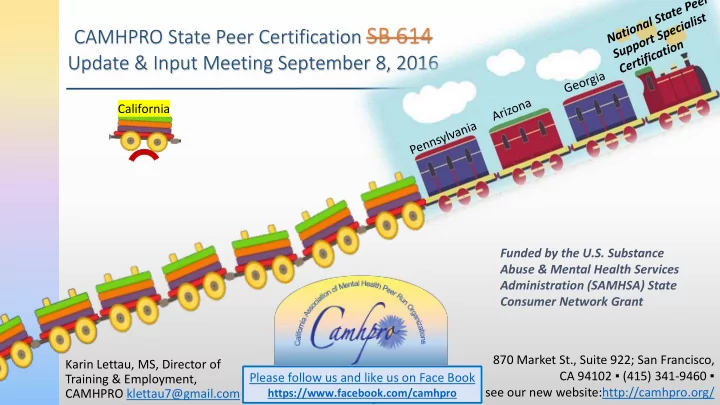
CAMHPRO State Peer Certification SB 614 Update & Input Meeting September 8, 2016 California Funded by the U.S. Substance Abuse & Mental Health Services Administration (SAMHSA) State Consumer Network Grant 870 Market St., Suite 922;


slide-1
SLIDE 1

Karin Lettau, MS, Director of Training & Employment, CAMHPRO klettau7@gmail.com Please follow us and like us on Face Book

https://www.facebook.com/camhpro

870 Market St., Suite 922; San Francisco, CA 94102 ▪ (415) 341-9460 ▪ see our new website:http://camhpro.org/

CAMHPRO State Peer Certification SB 614 Update & Input Meeting September 8, 2016

California Funded by the U.S. Substance Abuse & Mental Health Services Administration (SAMHSA) State Consumer Network Grant

slide-2
SLIDE 2

CAMHPRO’s Mission

2

  • The California Association of Mental Health Peer-

Run Organizations (CAMHPRO) non-profit consumer-run statewide organization

  • Members are consumer-run organizations and

programs, and individuals.

  • Empower, support, and ensure the rights of

consumers, eliminate stigma, and advance self- determination and choice.

Poll 1-4

slide-3
SLIDE 3

Agenda

  • Bottom Line
  • Regroup & Refocus
  • Identify options
  • What leverage do we have?
  • Honor Stakeholders’ 17 Recommendations

3

slide-4
SLIDE 4

The Case for Certification

  • Defines the service of peer

support.

  • Provides formal validation of the

role of peer support.

  • Assures that practitioners

receive standardized training and demonstrate competency.

  • Standardizes the quality of

services provided by Peer Support Specialists that employers can rely on.

  • Certification is portable to any

CA county.

  • Provides a scope of practice that

service recipients can benefit from.

  • Can be utilized as a basis for the

ability to bill Medi-Cal for services provided.

4

slide-5
SLIDE 5

Peer Support Guiding Values:

  • Core belief systems and worldview
  • People can and do recover from

psychiatric difficulties

  • To help others is to also help one’s self
  • Choice, empowerment, and responsibility
  • Acceptance and respect for diversity
  • Reciprocity, mutuality in relationships
  • Social action

5

slide-6
SLIDE 6

Bottom Line

  • Known as California State Peer, Transition Age, Parent &

Family Support Certification Program, Senate Bill 614 (Leno-D) is now dead.

  • The shell, 'SB 614', was used for a new bill that has nothing to do

with what we worked for.

  • Gratefully, Senator Leno and bill sponsor, the County Behavioral

Health Directors Association (CBHDA) refused to move the bill forward with the California Department of Health Care Services (DHCS) 'technical amendments' that undermined the intent of the bill and the essence of genuine peer support services.

6

slide-7
SLIDE 7

Now what? …Peer Support… and Regroup

  • Collectively craft new proposal for the next

legislative session in Jan. 2017.

  • Identify options when choosing the agencies

to implement State Certification.

  • We will need all of your support & active

involvement to get a legislative proposal ready by Jan, 2017, reflecting the 17 recommendations made by over 700 California stakeholders.

  • What else? What are more options?

7

slide-8
SLIDE 8

How Can We Gain Formal State Validation and Billing for Peer Specialist Services?

We have to ask

  • urselves the right

questions to bring forth creative answers.

8

slide-9
SLIDE 9

What Leverage Do We Have?

  • DHCS is applying for Section 223

Demonstration Project

  • Hillary’s* proposed MH policy on peer

support

  • Updated 2016 Peer Specialist Training &

Certification Programs: National Overview

  • What funding leverage do we have?

*CAMHPRO does not endorse any political candidates.

9

slide-10
SLIDE 10

Section 223 Demonstration Project

  • A 2014 law established a demonstration program in eight states,

under which new benefits would be available to health centers certified by the federal government as Certified Community Behavioral Health Clinics (CCBHCs).

  • To be a CCBHC, a clinic must provide a range of physical and

mental health services, including emergency psychiatric care, treatment for mental health and substance use disorders, and peer support.

  • In return, the clinic can receive reimbursement at rates similar to

those received by federally-qualified health centers.

10

slide-11
SLIDE 11

Section 223 Demonstration Project

  • 24 States received grant (Oct. 2015)

to develop a plan

  • CA is one of the 24 states awarded a

planning grant

  • Planning Grant Phase Oct, 2015-Oct,

2016

  • Certify clinics
  • Establish PPS (prospective payment system)
  • Solicit input from consumers,

providers and stakeholders

  • Heidi has just recently gotten on a CCBH

stakeholder group

  • Submit an application by Oct. 2016 to

be part of Demonstration

  • 8 States to be selected to be part of

the project by Dec. 31, 2016.

  • Demonstration runs Jan. 2017 to
  • Jan. 2019:
  • Federal Medicaid Matching $ to

States to Medicaid (Medi-CAL) enrollees equivalent to the Federally Qualified Health Centers (FQHC) rates.

  • Evaluate-Final report to Congress
  • Dec. 2021

11

slide-12
SLIDE 12

223: Improving Quality and Access

  • Federally defined criteria for certifying clinics that

require coordinated, comprehensive, and quality care

  • Common data collection and reporting on quality

measures on screening, integration, treatment, and

  • utcomes
  • Payment systems that reimburse providers for the

prospective cost of delivering services

Slide 12

slide-13
SLIDE 13

Certified Community Behavioral Health Clinics (CCBHCs) Criteria

Slide 13

  • 1. Staffing: staffing linguistic, culture and numbers

based on community needs assessments

  • 2. Availability & accessibility: maximum waiting

times for services, expanding operating hours

  • 3. Care coordination: required agreements with

community agencies

  • 4. Scope of services: comprehensive, integrated,

across the life-span

  • 5. Quality measures: 21 measures collected at the

clinic and state levels

  • 6. Organizational authority: Requires consumer and

family voice

slide-14
SLIDE 14

223 Scope of Services

CCBHCs directly provide services in green*** Additional required services are provided directly or through formal relationships with Designated Collaborating Organizations (DCOs) Referrals (R) are to providers

  • utside the CCBHC and DCOs

*** “unless there is an existing state-sanctioned, certified, or licensed system or network for the provision of crisis behavioral health services that dictates otherwise.”

Services are provided by CCBHCs directly and through formal relationships with DCOs Treatment Planning Psychiatric Rehab Services DCO Crisis Services*** Screening, Assessment, Diagnosis & Risk Assessment Outpatient Mental Health & Substance Use Services Outpatient Primary Care Screening & Monitoring DCO Community- Based Mental Health Care for Veterans DCO Targeted Case Management DCO Peer, Family Support & Counselor Services DCO R

Slide 14

slide-15
SLIDE 15

2016 Updated Report on National Peer Specialist Certification

  • Peer Specialist Training & Certification Programs: National Overview 2016
  • Kaufman, L., Kuhn, W., & Stevens Manser, S. 2016. Peer Specialist Training and

Certification Programs: A National Overview. Texas Institute for Excellence in Mental Health, School of Social Work, University of Texas at Austin.

  • https://camphro.files.wordpress.com/2016/07/peer-specialist-training-and-certification-programs-

national-overview-2016-update.pdf

  • Also a handout
  • Identify from other states
  • their certifying bodies
  • other mechanisms to allow for billing

15

slide-16
SLIDE 16

Report & Map of Peer Specialist Training and Certification Programs by State

  • As of July 2016, 41

states and the District

  • f Columbia have

established programs to train and certify peer specialists and 2 states are in the process of developing and/or implementing a program. [New Mexico also has a Certification Program]

16

https://camphro.files.wordpress.com/20 16/07/peer-specialist-training-and- certification-programs-national-

  • verview-2016-update.pdf

CA is the only State without a State Certification Program applying for the 223 Demonstration Project

slide-17
SLIDE 17

17

Peer Specialist Training & Certification Programs: National Overview 2016Kaufman, L.,

Kuhn, W., & Stevens Manser, S. 2016. Peer Specialist Training and Certification Programs: A National Overview. Texas Institute for Excellence in Mental Health, School of Social Work, University of Texas at Austin.

This map is challenging . Need to distinguish between different billing mechanisms. All methods are lumped

  • together. CA is listed.

A handful of CA counties allow PS to bill under the Rehab Option, an existing clinical code Karin will do another analysis of what other States are doing. Others?

slide-18
SLIDE 18

Hillary’s* Agenda for Mental Health Services

  • “Promote the use of peer support
  • specialists. Peer support specialists have been shown to

provide needed, cost-effective services… Hillary will support initiatives to include peers in clinical care teams in primary care settings, mental health specialty care settings, hospitals, and Accountable Care

  • Organizations. She will encourage all 50 states to reimburse peer

services in state Medicaid programs, which 30 states do currently, and continue providing the Consumer and Consumer Supporter Technical Assistance Center grants.”

  • https://www.hillaryclinton.com/briefing/factsheets/2016/08/29/hillary-

clintons-comprehensive-agenda-on-mental-health/

*CAMHPRO does not endorse any political candidates.

18

slide-19
SLIDE 19

Hillary* for Expansion of 223 Demonstration Project

  • “Support the creation of high-quality, comprehensive

community health centers in every state.

  • …Hillary will invest $5 billion over the next ten years to scale up

this 223 demonstration project and help bring it to every state in America. This will vastly expand community-based treatment, by enabling thousands of health centers across the country (i.e., FQHCs, CMHCs, etc.) to upgrade to an integrated center.” *CAMHPRO does not endorse any political candidates.

19

slide-20
SLIDE 20

Funding Options

  • OSHPD Remaining Workforce Education &

Training (WET) Funds

  • $7 million remains slotted for Consumer/Family WET

programming

  • Advisory Committees have not met in at least 9

months

  • SAMHSA Grants?
  • Other grant opportunities?
  • Other billing mechanisms?
  • What else?

20

slide-21
SLIDE 21

Original Peer Certification Movement in California

  • Originally evaluated by California Network (CNMHC)
  • Working Well Together (WWT) (2008-2014)

Training and Technical Assistance Collaborative:

  • CNMHC, then in 2012, CAMHPRO-PEERS - California Association of

Mental Health Peer Run Organizations – Peers Envisioning and Engaging in Recovery Services

  • NAMI California - National Alliance on Mental Illness - California
  • UACF - United Advocates for Children and Families
  • CiMH - California Institute for Mental Health

21

slide-22
SLIDE 22

CA Stakeholder Process & Involvement

Used multiple methods of gathering input, including four research reports

  • Written surveys
  • Focus groups
  • Comment and question sessions

in face-to-face meetings

  • Webinars
  • 4 Specialized workgroups &

monthly teleconferences

  • 165 people attended five regional

stakeholder meetings

  • 223 people attended the Statewide

Summit in May, 2013.

  • Vetted the recommendations at this

meeting utilizing a modified consensus model.

  • On-going monthly teleconferences
  • Member list has over 700 people

22

Resulted in 17 Stakeholder Recommendations for CA Peer/Family Specialist Certification, mostly reflected in SB 614

slide-23
SLIDE 23

CA 58 Counties = 58 Different Peer Standards

  • Many agencies/colleges offer “certificates” for completion of

trainings/courses to become MH peer/family providers

  • These are NOT state recognized
  • Most counties employ/contract for peer, parent/family support specialist

providers

  • But Most Counties…
  • require no training or require no training standardized to the role of

peer/family/parent support specialist

  • if training exists it is mostly provided by clinicians/trainers not familiar with

peer practices

  • have no practice guidelines
  • have no appropriate supervision requirements
  • don’t allow peer providers to bill under existing codes (rehab…)

23

slide-24
SLIDE 24

Stakeholder Recommendation—Certifying Body Composition

  • Establish Certifying Body
  • NOT Dept. of Health Care Services
  • Agency plus collaborative cluster of state
  • rganizations representing youth, consumer, family
  • f adult, parents of child, etc.
  • Completely separate from training entities

24

slide-25
SLIDE 25

Stakeholder Recommendation: Certifying Body Function

For each category of peer support specialist: youth, adult, family of adult, parent of child/youth, Certifying Body develops

  • Formal Definitions, Scope of Practice, Values & Ethics
  • Core competencies and standardized training content
  • Trainer and training entity qualifications
  • Standards for supervision of peer support specialists
  • Certification exam
  • Certifies training entities throughout the state for trainings that

meet competencies, to retain cultural & regional diversity

  • Administers exam

25

slide-26
SLIDE 26

Stakeholder Recommendation: Education & Experience

  • State Certification Training
  • 80 hours of training by accredited programs with testing
  • Plus 25 optional hours for specialty emphasis
  • whole health, forensics, co-occurring, foster care, etc.
  • Continuing Education for re-certification
  • Experience
  • Lived experience with mental health challenges or family
  • 6 months as full time peer specialist intern, work or volunteer

26

slide-27
SLIDE 27

Stakeholder Recommendation--Supervision

Policy that outlines key qualifications necessary for the Supervision of Peer Support Specialists

  • Prefer supervisors have lived experience & expertise in peer support
  • Define specific qualities and skills required for the supervision of Peer

Specialists, that align with the values and philosophy of peer support

  • Consider federal billing requirements regarding qualified supervision for

the future

  • Research other State Certification supervision requirements to determine

what is acceptable

27

slide-28
SLIDE 28

Stakeholder Recommendations-Training to County Administrations

  • Plan for extensive & expansive training to County BH

Administrations and Staff on

  • Values, philosophy and efficacy of peer support services
  • County and Organizational cultures that welcome peer

support specialists fully onto teams

  • Definitions of the unique service components of peer

support, separate & distinct from other disciplines and services

28

slide-29
SLIDE 29

Defi fining Peer Support as a Distinct Practice

  • A relationship of mutual learning
  • Key principles are hope, equality,

respect, personal responsibility and self-determination

  • Therapeutic interactions between

people who have a shared lived experience

  • Key distinctions are: WHO does it and

HOW the service is done.

  • Peer Providers may also provide any
  • ther allowable mental health

service to their scope of practice.

  • A relationship without the

constraints of the traditional expert/patient or expert/family member role

  • Peer Support is differentiated from
  • ther mental health services such

as: rehabilitation, targeted case management or collateral.

29

slide-30
SLIDE 30

Key CA Peer Specialist Vetted Documents

  • Four Research & Stakeholder Recommendations Reports, links:
  • https://camhpro.org/peer-certification-sb614/
  • Definitions
  • Values & Code of Ethics
  • Informational Brief
  • Scope of Practice
  • 17 Recommendations
  • National Medicaid Peer Specialist Matrix
  • Consumer, Family Member & Parent or Caregiver Peer Specialist Training

Crosswalk

  • Draft Core Content Areas & Competencies

30

slide-31
SLIDE 31

Offic icial National & State Certifications

  • Over 40 States have State

Certified Peer Specialists protocol

  • 2 States in process of developing

State protocol for certifying peers

  • Billing Medicaid for Peer Services

is the primary impetus

  • U.S. Veterans Administration

Certifies Peer Specialists

  • Employs over 1,000 Peer

Specialists (5 grades)

  • The International Association of

Peer Specialists (INAPS) develops competencies for international Peer Certification

  • SAMHSA drafted 62 Competencies

for Peer Support workers in behavioral health (2015)

  • CA could be the first state in the

nation to adopt certification for peer providers across the life span.

  • Over 30 states have unique peer

support Medicaid billing codes

31

slide-32
SLIDE 32

CMS Guidelines Allow Peer Specialist Billing

  • In 2007, the Centers for Medi-Care and Medi-Caid Services (CMS)

disseminated a set of guidelines for states to establish Peer Providers and Peer Services as a unique Medi-CAL billable services.

  • Guidelines minimally require a State Plan to:
  • 1. Train and Certify Peer Providers
  • 2. Address the supervision of Peer Providers
  • 3. Ensure care coordination in the context of a comprehensive and

individualized plan of care with goals.

32

slide-33
SLIDE 33

California Medi-Caid (MEDI-CAL) Billing Practices

  • Current State Medi-Cal Plan allows

billing under rehabilitation, targeted case management and collaterals provided by “Other Qualified Providers”, which includes Peer Specialists.

  • Each County Mental Health Director has

discretion to use more strict guidelines than required by the State Plan.

  • Only a few counties currently allow

peer specialists to bill under existing codes.

  • Even counties allowing peers to bill under

existing codes, lose at least 25% of billing ability because some peer services provided are not billable under current codes

  • Free-standing Peer or Family Run agencies

cannot bill currently

  • SB 614 would have created a distinct peer

specialist provider and service type for these unique services, adding Medi-Cal reimbursement to counties for peer services already being provided

  • It would have been up to the Dept. Health

Care Services (DHCS) to create new billing

33

slide-34
SLIDE 34

Example: Georgia Certified Specialists bill

  • Structured activities that promote socialization, recovery, wellness, self-

advocacy, development of natural supports, and maintenance of community living skills.

  • Activities provided between and among individuals who have common issues

and needs, are consumer motivated, initiated and/or managed, and assist individuals in living as independently as possible.

  • Peer Support (H0038),Psych rehab (H2017), Community support (H2015), ACT

(H0039),

  • Health and Wellness Supports, (H0025)—Whole Health
  • Supporting the individual in building skills that enable whole health improvements

34

slide-35
SLIDE 35

Michigan Certified Specialists bill

  • “Because of their life experience, Peer Support Specialists provide

expertise that professional disciplines cannot replicate.”

  • Service Codes:
  • Assertive Community Treatment (ACT) H0039
  • Peer-Directed and -Operated Support Services, H0023, H0038, H0046
  • H0023: Drop-in center
  • Used 1915 b(3) waiver
  • Administered by Michigan Department of Community Health,

Behavioral Health

  • Has Parent Specialists too

35

slide-36
SLIDE 36

Oregon Certified Peer Specialists bill

“Peer Delivered Services” means an array of agency or community-based services and supports provided by peers, and peer support specialists, to individuals or family members with similar lived experience, that are designed to support the needs of individuals and families as applicable.

  • H2021 Community-Based Wraparound
  • H2027 Psycho-educational Services
  • H0038 Self-Help/Peer Support
  • Peer Specialists are a PROVIDER type in Oregon
  • Use lottery funds, have Block grants and SAMHSA Access to Recovery Grant
  • Credentialing: Oregon Health Authority (OHA) through the Office of Equity and

Inclusion with the collaboration of the Addictions and Mental Health Division.

36

slide-37
SLIDE 37

Supporters of Bill as amended Aug., 2015 Included:

  • County Behavioral Health Directors

Association of California (sponsor)

  • Association of California Health Care

Districts

  • CA Association of Mental Health Peer-

Run Organizations

  • CA Association of Social Rehabilitation

Agencies

  • CA Mental Health Oversight &

Accountability Commission

  • CA Council of Community Mental Health

Agencies

  • CA State Association of Counties
  • Disability Rights California
  • National Alliance on Mental Illness

California

  • Pacific Clinics
  • Peers Envisioning and Engaging in

Recovery Services (PEERS)

  • REMHDCO
  • Sacramento County Board of

Supervisors

  • SEIU California
  • Steinberg Institute
  • Western Center on Law and Poverty
  • United Advocates for Children &

Families

37

slide-38
SLIDE 38

Our State System

CA BH Directors Association (CBHDA) State Legislature: Senate & Assembly Governor State Health & Human Svcs (CHHS) OSHPD Heath Planning & Dev.

  • Dept. of Public

Health (CDPH) Office of Health Equity (OHE)

  • Dept. of Health

Care Services (DHCS) CA MH Planning Council (CMHPC) Mental Health & Substance Use Services CA Health Facilities Financing Authority MH Services Oversight & Accountability Commission (MHSOAC)

slide-39
SLIDE 39

How Can We Advocate for State Peer Certification?

  • Budget for, or ask your agency to budget discretionary funds and

time for advocacy activities

  • Attend State and County meetings and speak up
  • Participate on workgroups to support activities/legislation
  • Letters to editors of publications
  • Meet with legislators and government officials
  • Attend CAMHPRO Day at the Capitol in May
  • Organize a local rally or sit-in
  • Form a Coalition; Educate continuously
  • Social Media: Facebook, Twitter…

39

slide-40
SLIDE 40

Advocacy Toolbox

  • Public comment, written comment online, committee/board

membership

  • Link to ‘How-tos’ on CAMHPRO website
  • How to Write Op-Eds and Letters to the Editor
  • How to write fact sheets and action alerts
  • How to Visit a Policymaker
  • How to Organize a Rally
  • Action Plan Template Sample

40

slide-41
SLIDE 41

Advocacy Avenues

Individual Agency or Group County Regional State Letter, email to,

  • r meeting with

lawmaker, gov’t

  • fficial, or to

Editor

  Unless

contracts prohibits Often prohibited CBHDA Rally, Sit-in

   

Info & input webinars

    

Media, social media

 

41

slide-42
SLIDE 42

CAMHPRO Trainings & Technical Assistance

42

ABC’s of Advocacy Webinar Series

  • Web A: Advocacy Basics aired on August 24, 10:30 AM
  • Recording and materials at: https://camhpro.org/abcs-of-advocacy/
  • Web B: Best Community Planning Practices aired on August 31, 10:30 AM
  • Recording and materials at: https://camhpro.org/abcs-of-advocacy/
  • Web C: Community Planning; How to Work it on September 14, 10:30 AM
  • Register here: https://attendee.gotowebinar.com/register/4812485805325354754

Other Advocacy Webinars; State Advocacy:

  • Where'd the Bills Go? October 12, 2016
  • Register here: https://attendee.gotowebinar.com/register/1240330857130501889

Local Onsite Advocacy Workshop

  • "Practicing the ABC’s of Advocacy in Mental Health" (5 hours including Lunch) per request
  • “Finding Your Voice” Onsite Workshops (3 hrs) per request or appointment

Follow-Up Support Technical Assistance

slide-43
SLIDE 43

Advocacy Alerts: Upcoming Meetings

  • Mental Health Services Oversight & Accountability Commission

(MHSOAC) Criminal Justice/Mental Health Subcommittee Meeting

  • Wednesday September 21, 2016, 9:00AM - 12:00PM
  • LA Area Chamber of Commerce, 350 South Bixel Street Los Angeles, CA
  • MHSOAC Commission Meeting http://www.mhsoac.ca.gov/
  • Thursday, September 22, 2016, 9:00am-3:30pm
  • CA African American Museum, 600 State Drive Los Angeles, CA 90037
  • CA Mental Health Planning Council (CMHPC)

http://www.dhcs.ca.gov/services/MH/Pages/CMHPC-PlanningCouncilWelcome.aspx

  • Oct. 19-21, 2016
  • Lake Natoma Inn, 702 Gold Lake Drive, Folsom CA 95630

43

slide-44
SLIDE 44

Thank you for your commitment and actio ion!

Next Peer Certification Update Webinar

2nd Thursday, October 13, 2016 at noon If you are registered you will be reminded. If you are not registered please do so at link below

  • Registration

URL: https://attendee.gotowebinar.com/register/65 29515036756175362

44