Caching (part 2) byte block size result address (hex) exercise 3 - - PowerPoint PPT Presentation

caching part 2
SMART_READER_LITE
LIVE PREVIEW

Caching (part 2) byte block size result address (hex) exercise 3 - - PowerPoint PPT Presentation

Caching (part 2) byte block size result address (hex) exercise 3 tag index ofgset exercise: how many accesses are hits? tag bits (block) ofgset bits (set) index bits 00000001 (01) sets bit addresses up into tag/index/ofgset? how is


slide-1
SLIDE 1

Caching (part 2)

1

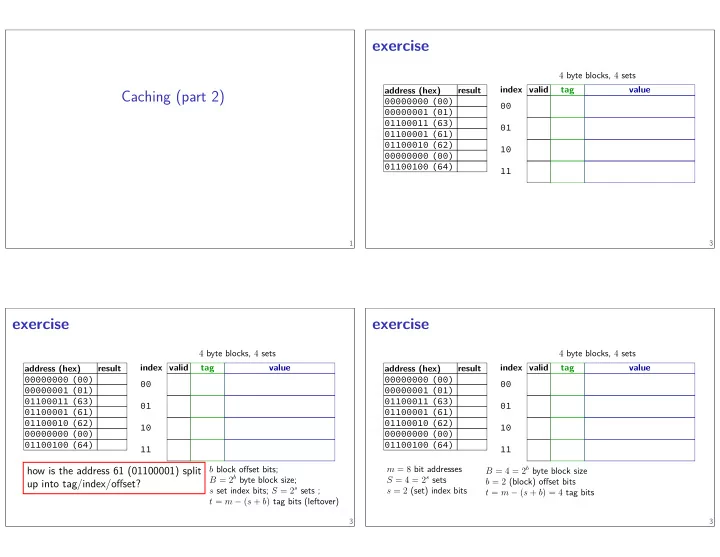
exercise

address (hex) result 00000000 (00) 00000001 (01) 01100011 (63) 01100001 (61) 01100010 (62) 00000000 (00) 01100100 (64) index valid tag value 00 01 10 11 4 byte blocks, 4 sets

how is the address 61 (01100001) split up into tag/index/ofgset?

block ofgset bits; byte block size; set index bits; sets ; tag bits (leftover) bit addresses sets (set) index bits byte block size (block) ofgset bits tag bits

exercise: how many accesses are hits? tag index ofgset

3

exercise

address (hex) result 00000000 (00) 00000001 (01) 01100011 (63) 01100001 (61) 01100010 (62) 00000000 (00) 01100100 (64) index valid tag value 00 01 10 11 4 byte blocks, 4 sets

how is the address 61 (01100001) split up into tag/index/ofgset?

b block ofgset bits; B = 2b byte block size; s set index bits; S = 2s sets ; t = m − (s + b) tag bits (leftover) bit addresses sets (set) index bits byte block size (block) ofgset bits tag bits

exercise: how many accesses are hits? tag index ofgset

3

exercise

address (hex) result 00000000 (00) 00000001 (01) 01100011 (63) 01100001 (61) 01100010 (62) 00000000 (00) 01100100 (64) index valid tag value 00 01 10 11 4 byte blocks, 4 sets

how is the address 61 (01100001) split up into tag/index/ofgset?

block ofgset bits; byte block size; set index bits; sets ; tag bits (leftover) m = 8 bit addresses S = 4 = 2s sets s = 2 (set) index bits B = 4 = 2b byte block size b = 2 (block) ofgset bits t = m − (s + b) = 4 tag bits

exercise: how many accesses are hits? tag index ofgset

3

slide-2
SLIDE 2

exercise

address (hex) result 00000000 (00) 00000001 (01) 01100011 (63) 01100001 (61) 01100010 (62) 00000000 (00) 01100100 (64) index valid tag value 00 01 10 11 4 byte blocks, 4 sets

how is the address 61 (01100001) split up into tag/index/ofgset?

block ofgset bits; byte block size; set index bits; sets ; tag bits (leftover) m = 8 bit addresses S = 4 = 2s sets s = 2 (set) index bits B = 4 = 2b byte block size b = 2 (block) ofgset bits t = m − (s + b) = 4 tag bits

exercise: how many accesses are hits? tag index ofgset

3

exercise

address (hex) result 00000000 (00) 00000001 (01) 01100011 (63) 01100001 (61) 01100010 (62) 00000000 (00) 01100100 (64) index valid tag value 00 01 10 11 4 byte blocks, 4 sets

how is the address 61 (01100001) split up into tag/index/ofgset?

block ofgset bits; byte block size; set index bits; sets ; tag bits (leftover) bit addresses sets (set) index bits byte block size (block) ofgset bits tag bits

exercise: how many accesses are hits? tag index ofgset

3

example access pattern (1)

address (hex) result 00000000 (00) miss 00000001 (01) hit 01100011 (63) miss 01100001 (61) miss 01100010 (62) hit 00000000 (00) miss 01100100 (64) miss index valid tag value 00 1 00000 mem[0x00] mem[0x01] 01 1 01100 mem[0x62] mem[0x63] 10 1 01100 mem[0x64] mem[0x65] 11 2 byte blocks, 4 sets m = 8 bit addresses S = 4 = 2s sets s = 2 (set) index bits B = 2 = 2b byte block size b = 1 (block) ofgset bits t = m − (s + b) = 5 tag bits

tag index ofgset miss caused by confmict

4

adding associativity

index valid tag value valid tag value 1 2-way set associative, 2 byte blocks, 2 sets

multiple places to put values with same index avoid confmict misses

address (hex) result 00000000 (00) miss 00000001 (01) hit 01100011 (63) miss 01100001 (61) miss 01100010 (62) hit 00000000 (00) hit 01100100 (64) miss

tag indexofgset needs to replace block in set 0! set 0 set 1 way 0 way 1

bit addresses sets (set) index bits byte block size (block) ofgset bits tag bits

5

slide-3
SLIDE 3

adding associativity

index valid tag value valid tag value 1 2-way set associative, 2 byte blocks, 2 sets

multiple places to put values with same index avoid confmict misses

address (hex) result 00000000 (00) miss 00000001 (01) hit 01100011 (63) miss 01100001 (61) miss 01100010 (62) hit 00000000 (00) hit 01100100 (64) miss

tag indexofgset needs to replace block in set 0! set 0 set 1 way 0 way 1

bit addresses sets (set) index bits byte block size (block) ofgset bits tag bits

5

adding associativity

index valid tag value valid tag value 1 2-way set associative, 2 byte blocks, 2 sets

multiple places to put values with same index avoid confmict misses

address (hex) result 00000000 (00) miss 00000001 (01) hit 01100011 (63) miss 01100001 (61) miss 01100010 (62) hit 00000000 (00) hit 01100100 (64) miss

tag indexofgset needs to replace block in set 0! set 0 set 1 way 0 way 1

bit addresses sets (set) index bits byte block size (block) ofgset bits tag bits

5

adding associativity

index valid tag value valid tag value 1 2-way set associative, 2 byte blocks, 2 sets

multiple places to put values with same index avoid confmict misses

address (hex) result 00000000 (00) miss 00000001 (01) hit 01100011 (63) miss 01100001 (61) miss 01100010 (62) hit 00000000 (00) hit 01100100 (64) miss

tag indexofgset needs to replace block in set 0! set 0 set 1 way 0 way 1

m = 8 bit addresses S = 2 = 2s sets s = 1 (set) index bits B = 2 = 2b byte block size b = 1 (block) ofgset bits t = m − (s + b) = 6 tag bits

5

adding associativity

index valid tag value valid tag value 1 000000 mem[0x00] mem[0x01] 1 2-way set associative, 2 byte blocks, 2 sets

multiple places to put values with same index avoid confmict misses

address (hex) result 00000000 (00) miss 00000001 (01) hit 01100011 (63) miss 01100001 (61) miss 01100010 (62) hit 00000000 (00) hit 01100100 (64) miss

tag indexofgset needs to replace block in set 0! set 0 set 1 way 0 way 1

bit addresses sets (set) index bits byte block size (block) ofgset bits tag bits

5

slide-4
SLIDE 4

adding associativity

index valid tag value valid tag value 1 000000 mem[0x00] mem[0x01] 1 2-way set associative, 2 byte blocks, 2 sets

multiple places to put values with same index avoid confmict misses

address (hex) result 00000000 (00) miss 00000001 (01) hit 01100011 (63) miss 01100001 (61) miss 01100010 (62) hit 00000000 (00) hit 01100100 (64) miss

tag indexofgset needs to replace block in set 0! set 0 set 1 way 0 way 1

bit addresses sets (set) index bits byte block size (block) ofgset bits tag bits

5

adding associativity

index valid tag value valid tag value 1 000000 mem[0x00] mem[0x01] 1 1 011000 mem[0x62] mem[0x63] 2-way set associative, 2 byte blocks, 2 sets

multiple places to put values with same index avoid confmict misses

address (hex) result 00000000 (00) miss 00000001 (01) hit 01100011 (63) miss 01100001 (61) miss 01100010 (62) hit 00000000 (00) hit 01100100 (64) miss

tag indexofgset needs to replace block in set 0! set 0 set 1 way 0 way 1

bit addresses sets (set) index bits byte block size (block) ofgset bits tag bits

5

adding associativity

index valid tag value valid tag value 1 000000 mem[0x00] mem[0x01] 1 011000 mem[0x60] mem[0x61] 1 1 011000 mem[0x62] mem[0x63] 2-way set associative, 2 byte blocks, 2 sets

multiple places to put values with same index avoid confmict misses

address (hex) result 00000000 (00) miss 00000001 (01) hit 01100011 (63) miss 01100001 (61) miss 01100010 (62) hit 00000000 (00) hit 01100100 (64) miss

tag indexofgset needs to replace block in set 0! set 0 set 1 way 0 way 1

bit addresses sets (set) index bits byte block size (block) ofgset bits tag bits

5

adding associativity

index valid tag value valid tag value 1 000000 mem[0x00] mem[0x01] 1 011000 mem[0x60] mem[0x61] 1 1 011000 mem[0x62] mem[0x63] 2-way set associative, 2 byte blocks, 2 sets

multiple places to put values with same index avoid confmict misses

address (hex) result 00000000 (00) miss 00000001 (01) hit 01100011 (63) miss 01100001 (61) miss 01100010 (62) hit 00000000 (00) hit 01100100 (64) miss

tag indexofgset needs to replace block in set 0! set 0 set 1 way 0 way 1

bit addresses sets (set) index bits byte block size (block) ofgset bits tag bits

5

slide-5
SLIDE 5

adding associativity

index valid tag value valid tag value 1 000000 mem[0x00] mem[0x01] 1 011000 mem[0x60] mem[0x61] 1 1 011000 mem[0x62] mem[0x63] 2-way set associative, 2 byte blocks, 2 sets

multiple places to put values with same index avoid confmict misses

address (hex) result 00000000 (00) miss 00000001 (01) hit 01100011 (63) miss 01100001 (61) miss 01100010 (62) hit 00000000 (00) hit 01100100 (64) miss

tag indexofgset needs to replace block in set 0! set 0 set 1 way 0 way 1

bit addresses sets (set) index bits byte block size (block) ofgset bits tag bits

5

adding associativity

index valid tag value valid tag value 1 000000 mem[0x00] mem[0x01] 1 011000 mem[0x60] mem[0x61] 1 1 011000 mem[0x62] mem[0x63] 2-way set associative, 2 byte blocks, 2 sets

multiple places to put values with same index avoid confmict misses

address (hex) result 00000000 (00) miss 00000001 (01) hit 01100011 (63) miss 01100001 (61) miss 01100010 (62) hit 00000000 (00) hit 01100100 (64) miss

tag indexofgset needs to replace block in set 0! set 0 set 1 way 0 way 1

bit addresses sets (set) index bits byte block size (block) ofgset bits tag bits

5

adding associativity

index valid tag value valid tag value 1 000000 mem[0x00] mem[0x01] 1 011000 mem[0x60] mem[0x61] 1 1 011000 mem[0x62] mem[0x63] 2-way set associative, 2 byte blocks, 2 sets

multiple places to put values with same index avoid confmict misses

address (hex) result 00000000 (00) miss 00000001 (01) hit 01100011 (63) miss 01100001 (61) miss 01100010 (62) hit 00000000 (00) hit 01100100 (64) miss

tag indexofgset needs to replace block in set 0! set 0 set 1 way 0 way 1

bit addresses sets (set) index bits byte block size (block) ofgset bits tag bits

5

cache operation (associative)

valid tag data valid tag data 1 10 00 11 1 00 AA BB 1 11 B4 B5 1 01 33 44

100 11 1

index = = tag

AND AND OR

is hit? (1)

  • fgset

data (B5)

6

slide-6
SLIDE 6

cache operation (associative)

valid tag data valid tag data 1 10 00 11 1 00 AA BB 1 11 B4 B5 1 01 33 44

100 11 1

index = = tag

AND AND OR

is hit? (1)

  • fgset

data (B5)

6

cache operation (associative)

valid tag data valid tag data 1 10 00 11 1 00 AA BB 1 11 B4 B5 1 01 33 44

100 11 1

index = = tag

AND AND OR

is hit? (1)

  • fgset

data (B5)

6

associative lookup possibilities

none of the blocks for the index are valid none of the valid blocks for the index match the tag

something else is stored there

  • ne of the blocks for the index is valid and matches the tag

7

associativity terminology

direct-mapped — one block per set E-way set associative — E blocks per set

E ways in the cache

fully associative — one set total (everything in one set)

8

slide-7
SLIDE 7

Tag-Index-Ofgset formulas (complete)

m memory addreses bits (Y86-64: 64) E number of blocks per set (“ways”) S = 2s number of sets s (set) index bits B = 2b block size b (block) ofgset bits t = m − (s + b) tag bits C = B × S × E cache size (excluding metadata)

9

Tag-Index-Ofgset exercise

m memory addreses bits (Y86-64: 64) E number of blocks per set (“ways”) S = 2s number of sets s (set) index bits B = 2b block size b (block) ofgset bits t = m − (s + b) tag bits C = B × S × E cache size (excluding metadata)

My desktop:

L1 Data Cache: 32 KB, 8 blocks/set, 64 byte blocks L2 Cache: 256 KB, 4 blocks/set, 64 byte blocks L3 Cache: 8 MB, 16 blocks/set, 64 byte blocks Divide the address 0x34567 into tag, index, ofgset for each cache.

10

T-I-O exercise: L1

quantity value for L1 block size (given) B = 64Byte B = 2b (b: block ofgset bits) block ofgset bits blocks/set (given) cache size (given) KB ( : number of sets) number of sets KB Byte ( : set index bits) set index bits

11

T-I-O exercise: L1

quantity value for L1 block size (given) B = 64Byte B = 2b (b: block ofgset bits) block ofgset bits b = 6 blocks/set (given) cache size (given) KB ( : number of sets) number of sets KB Byte ( : set index bits) set index bits

11

slide-8
SLIDE 8

T-I-O exercise: L1

quantity value for L1 block size (given) B = 64Byte B = 2b (b: block ofgset bits) block ofgset bits b = 6 blocks/set (given) E = 8 cache size (given) C = 32KB = E × B × S ( : number of sets) number of sets KB Byte ( : set index bits) set index bits

11

T-I-O exercise: L1

quantity value for L1 block size (given) B = 64Byte B = 2b (b: block ofgset bits) block ofgset bits b = 6 blocks/set (given) E = 8 cache size (given) C = 32KB = E × B × S S = C B × E (S: number of sets) number of sets KB Byte ( : set index bits) set index bits

11

T-I-O exercise: L1

quantity value for L1 block size (given) B = 64Byte B = 2b (b: block ofgset bits) block ofgset bits b = 6 blocks/set (given) E = 8 cache size (given) C = 32KB = E × B × S S = C B × E (S: number of sets) number of sets S = 32KB 64Byte × 8 = 64 ( : set index bits) set index bits

11

T-I-O exercise: L1

quantity value for L1 block size (given) B = 64Byte B = 2b (b: block ofgset bits) block ofgset bits b = 6 blocks/set (given) E = 8 cache size (given) C = 32KB = E × B × S S = C B × E (S: number of sets) number of sets S = 32KB 64Byte × 8 = 64 S = 2s (s: set index bits) set index bits s = log2(64) = 6

11

slide-9
SLIDE 9

T-I-O results

L1 L2 L3 sets 64 1024 8192 block ofgset bits 6 6 6 set index bits 6 10 13 tag bits (the rest)

12

T-I-O: splitting

L1 L2 L3 block ofgset bits 6 6 6 set index bits 6 10 13 tag bits (the rest)

0x34567: 3 4 5 6 7 0011 0100 0101 0110 0111 bits 0-5 (all ofgsets): 100111 = 0x27

13

T-I-O: splitting

L1 L2 L3 block ofgset bits 6 6 6 set index bits 6 10 13 tag bits (the rest)

0x34567: 3 4 5 6 7 0011 0100 0101 0110 0111 bits 0-5 (all ofgsets): 100111 = 0x27

13

T-I-O: splitting

L1 L2 L3 block ofgset bits 6 6 6 set index bits 6 10 13 tag bits (the rest)

0x34567: 3 4 5 6 7 0011 0100 0101 0110 0111 bits 0-5 (all ofgsets): 100111 = 0x27 L1:

bits 6-11 (L1 set): 01 0101 = 0x15 bits 12- (L1 tag): 0x34

13

slide-10
SLIDE 10

T-I-O: splitting

L1 L2 L3 block ofgset bits 6 6 6 set index bits 6 10 13 tag bits (the rest)

0x34567: 3 4 5 6 7 0011 0100 0101 0110 0111 bits 0-5 (all ofgsets): 100111 = 0x27 L1:

bits 6-11 (L1 set): 01 0101 = 0x15 bits 12- (L1 tag): 0x34

13

T-I-O: splitting

L1 L2 L3 block ofgset bits 6 6 6 set index bits 6 10 13 tag bits (the rest)

0x34567: 3 4 5 6 7 0011 0100 0101 0110 0111 bits 0-5 (all ofgsets): 100111 = 0x27 L2:

bits 6-15 (set for L2): 01 0001 0101 = 0x115 bits 16-: 0x3

13

T-I-O: splitting

L1 L2 L3 block ofgset bits 6 6 6 set index bits 6 10 13 tag bits (the rest)

0x34567: 3 4 5 6 7 0011 0100 0101 0110 0111 bits 0-5 (all ofgsets): 100111 = 0x27 L2:

bits 6-15 (set for L2): 01 0001 0101 = 0x115 bits 16-: 0x3

13

T-I-O: splitting

L1 L2 L3 block ofgset bits 6 6 6 set index bits 6 10 13 tag bits (the rest)

0x34567: 3 4 5 6 7 0011 0100 0101 0110 0111 bits 0-5 (all ofgsets): 100111 = 0x27 L3:

bits 6-18 (set for L3): 0 1101 0001 0101 = 0xD15 bits 18-: 0x0

13

slide-11
SLIDE 11

cache miss types

compulsory (or cold) — fjrst time accessing something

doesn’t matter how big/fmexible the cache is

confmict — sets aren’t big/fmexible enough

a fully-associtive (1-set) cache of the same size would have done better

capacity — cache was not big enough

14

replacement policies

index valid tag value valid tag value LRU 1

000000 mem[0x00] mem[0x01]

1

011000 mem[0x60] mem[0x61]

1 1 1

011000 mem[0x62] mem[0x63]

1 2-way set associative, 2 byte blocks, 2 sets address (hex) result 00000000 (00) miss 00000001 (01) hit 01100011 (63) miss 01100001 (61) miss 01100010 (62) hit 00000000 (00) hit 01100100 (64) miss

how to decide where to insert 0x64? track which block was read least recently updated on every access

15

replacement policies

index valid tag value valid tag value LRU 1

000000 mem[0x00] mem[0x01]

1

011000 mem[0x60] mem[0x61]

1 1 1

011000 mem[0x62] mem[0x63]

1 2-way set associative, 2 byte blocks, 2 sets address (hex) result 00000000 (00) miss 00000001 (01) hit 01100011 (63) miss 01100001 (61) miss 01100010 (62) hit 00000000 (00) hit 01100100 (64) miss

how to decide where to insert 0x64? track which block was read least recently updated on every access

15

example replacement policies

least recently used and approximations

take advantage of temporal locality exact: ⌈log2(E!)⌉ bits per set for E-way cache good approximations: E to 2E bits

fjrst-in, fjrst-out

counter per set — where to replace next

(pseudo-)random

no extra information!

16

slide-12
SLIDE 12

exercise

address (hex) hit? 00000000 (00) 00000001 (01) 00001010 (0A) 00100001 (21) 00001100 (0C) 00000011 (02) 00100011 (23) index V tag value V tag value LRU 1 4 byte blocks, 2 sets

how is the address 21 (00100001) split up into tag/index/ofgset?

block ofgset bits; byte block size; set index bits; sets; tag bits (leftover)

tag index ofgset exercise: how many accesses are hits? what is the fjnal state of the cache?

17

exercise

address (hex) hit? 00000000 (00) 00000001 (01) 00001010 (0A) 00100001 (21) 00001100 (0C) 00000011 (02) 00100011 (23) index V tag value V tag value LRU 1 4 byte blocks, 2 sets

how is the address 21 (00100001) split up into tag/index/ofgset?

b block ofgset bits; B = 2b byte block size; s set index bits; S = 2s sets; t = m − (s + b) tag bits (leftover)

tag index ofgset exercise: how many accesses are hits? what is the fjnal state of the cache?

17

exercise

address (hex) hit? 00000000 (00) 00000001 (01) 00001010 (0A) 00100001 (21) 00001100 (0C) 00000011 (02) 00100011 (23) index V tag value V tag value LRU 1 4 byte blocks, 2 sets

how is the address 21 (00100001) split up into tag/index/ofgset?

block ofgset bits; byte block size; set index bits; sets; tag bits (leftover)

tag index ofgset exercise: how many accesses are hits? what is the fjnal state of the cache?

17

exercise

address (hex) hit? 00000000 (00) 00000001 (01) 00001010 (0A) 00100001 (21) 00001100 (0C) 00000011 (02) 00100011 (23) index V tag value V tag value LRU 1 4 byte blocks, 2 sets

how is the address 21 (00100001) split up into tag/index/ofgset?

block ofgset bits; byte block size; set index bits; sets; tag bits (leftover)

tag index ofgset exercise: how many accesses are hits? what is the fjnal state of the cache?

17

slide-13
SLIDE 13

exercise

address (hex) hit? 00000000 (00) miss 00000001 (01) 00001010 (0A) 00100001 (21) 00001100 (0C) 00000011 (02) 00100011 (23) index V tag value V tag value LRU 1 00000

M[0x00] M[0x01] M[0x02] M[0x03]

way 1

1 4 byte blocks, 2 sets

how is the address 21 (00100001) split up into tag/index/ofgset?

block ofgset bits; byte block size; set index bits; sets; tag bits (leftover)

tag index ofgset exercise: how many accesses are hits? what is the fjnal state of the cache?

17

exercise

address (hex) hit? 00000000 (00) miss 00000001 (01) hit 00001010 (0A) miss 00100001 (21) 00001100 (0C) 00000011 (02) 00100011 (23) index V tag value V tag value LRU 1 00000

M[0x00] M[0x01] M[0x02] M[0x03]

1 00001

M[0x08] M[0x09] M[0x0A] M[0x0B]

way 0

1 4 byte blocks, 2 sets

how is the address 21 (00100001) split up into tag/index/ofgset?

block ofgset bits; byte block size; set index bits; sets; tag bits (leftover)

tag index ofgset exercise: how many accesses are hits? what is the fjnal state of the cache?

17

exercise

address (hex) hit? 00000000 (00) miss 00000001 (01) hit 00001010 (0A) miss 00100001 (21) miss 00001100 (0C) miss 00000011 (02) 00100011 (23) index V tag value V tag value LRU 1 00100

M[0x20] M[0x21] M[0x22] M[0x23]

1 00001

M[0x08] M[0x09] M[0x0A] M[0x0B]

way 1

1 4 byte blocks, 2 sets

how is the address 21 (00100001) split up into tag/index/ofgset?

block ofgset bits; byte block size; set index bits; sets; tag bits (leftover)

tag index ofgset exercise: how many accesses are hits? what is the fjnal state of the cache?

17

exercise

address (hex) hit? 00000000 (00) miss 00000001 (01) hit 00001010 (0A) miss 00100001 (21) miss 00001100 (0C) miss 00000011 (02) miss 00100011 (23) index V tag value V tag value LRU 1 00100

M[0x20] M[0x21] M[0x22] M[0x23]

1 00000

M[0x00] M[0x01] M[0x02] M[0x03]

way 0

1 1 00000

M[0x0C] M[0x0D] M[0x0E] M[0x0F]

way 1

4 byte blocks, 2 sets

how is the address 21 (00100001) split up into tag/index/ofgset?

block ofgset bits; byte block size; set index bits; sets; tag bits (leftover)

tag index ofgset exercise: how many accesses are hits? what is the fjnal state of the cache?

17

slide-14
SLIDE 14

exercise

address (hex) hit? 00000000 (00) miss 00000001 (01) hit 00001010 (0A) miss 00100001 (21) miss 00001100 (0C) miss 00000011 (02) miss 00100011 (23) hit index V tag value V tag value LRU 1 00100

M[0x20] M[0x21] M[0x22] M[0x23]

1 00000

M[0x00] M[0x01] M[0x02] M[0x03]

way 1

1 1 00000

M[0x0C] M[0x0D] M[0x0E] M[0x0F]

way 1

4 byte blocks, 2 sets

how is the address 21 (00100001) split up into tag/index/ofgset?

block ofgset bits; byte block size; set index bits; sets; tag bits (leftover)

tag index ofgset exercise: how many accesses are hits? what is the fjnal state of the cache?

17

write-through v. write-back

CPU Cache

  • ption 1: write-through

RAM ABCD: FF … 11CD: 42 ABCD: FF … write 10 to 0xABCD 1 write 10 to 0xABCD 2 read from 0x11CD (confmicts) 2 write 10 to ABCD 3 … when replaced — send value to memory read from 0x11CD 4 … read new value to store in cache

18

write-through v. write-back

CPU Cache

  • ption 1: write-through

RAM ABCD: 10 … 11CD: 42 ABCD: 10 … write 10 to 0xABCD 1 write 10 to 0xABCD 2 read from 0x11CD (confmicts) 2 write 10 to ABCD 3 … when replaced — send value to memory read from 0x11CD 4 … read new value to store in cache

18

write-through v. write-back

CPU Cache

  • ption 2: write-back

RAM ABCD: 10 (dirty) … 11CD: 42 ABCD: FF … write 10 to 0xABCD 1 write 10 to 0xABCD 2 read from 0x11CD (confmicts) 2 write 10 to ABCD 3 … when replaced — send value to memory read from 0x11CD 4 … read new value to store in cache

18

slide-15
SLIDE 15

write-through v. write-back

CPU Cache

  • ption 2: write-back

RAM ABCD: 10 (dirty) … 11CD: 42 ABCD: 10 … write 10 to 0xABCD 1 write 10 to 0xABCD 2 read from 0x11CD (confmicts) 2 write 10 to ABCD 3 … when replaced — send value to memory read from 0x11CD 4 … read new value to store in cache

18

write-through v. write-back

CPU Cache RAM ABCD: 10 (dirty) … 11CD: 42 ABCD: 10 … write 10 to 0xABCD 1 write 10 to 0xABCD 2 read from 0x11CD (confmicts) 2 write 10 to ABCD 3 … when replaced — send value to memory read from 0x11CD 4 … read new value to store in cache

18

writeback policy

index valid tag value dirty valid tag value dirty LRU 1

000000

mem[0x00] mem[0x01]

1

011000

mem[0x60]* mem[0x61]*

1 1 1 1

011000

mem[0x62] mem[0x63]

2-way set associative, 4 byte blocks, 2 sets

changed value! 1 = dirty (difgerent than memory) needs to be written if evicted

19

allocate on write?

processor writes less than whole cache block block not yet in cache two options: write-allocate

fetch rest of cache block, replace written part

write-no-allocate

send write through to memory guess: not read soon?

20

slide-16
SLIDE 16

write-allocate

index valid tag value dirty valid tag value dirty LRU 1

000000

mem[0x00] mem[0x01]

1

011000

mem[0x60]* mem[0x61]* 1

1 1 1

011000

mem[0x62] mem[0x63]

2-way set associative, LRU, writeback

writing 0xFF into address 0x04? index 0, tag 000001

21

write-allocate

index valid tag value dirty valid tag value dirty LRU 1

000000

mem[0x00] mem[0x01]

1

011000

mem[0x60]* mem[0x61]* 1

1 1 1

011000

mem[0x62] mem[0x63]

2-way set associative, LRU, writeback

writing 0xFF into address 0x04? index 0, tag 000001 step 1: fjnd least recently used block

21

write-allocate

index valid tag value dirty valid tag value dirty LRU 1

000000

mem[0x00] mem[0x01]

1

011000

mem[0x60]* mem[0x61]* 1

1 1 1

011000

mem[0x62] mem[0x63]

2-way set associative, LRU, writeback

writing 0xFF into address 0x04? index 0, tag 000001 step 1: fjnd least recently used block step 2: possibly writeback old block

21

write-allocate

index valid tag value dirty valid tag value dirty LRU 1

000000

mem[0x00] mem[0x01]

1

011000

0xFF mem[0x05]

1 1 1

011000

mem[0x62] mem[0x63]

2-way set associative, LRU, writeback

writing 0xFF into address 0x04? index 0, tag 000001 step 1: fjnd least recently used block step 2: possibly writeback old block step 3a: read in new block – to get mem[0x05] step 3b: update LRU information

21

slide-17
SLIDE 17

write-no-allocate

index valid tag value dirty valid tag value dirty LRU 1

000000

mem[0x00] mem[0x01]

1

011000

mem[0x60]* mem[0x61]* 1

1 1 1

011000

mem[0x62] mem[0x63]

2-way set associative, LRU, writeback

writing 0xFF into address 0x04? step 1: is it in cache yet? step 2: no, just send it to memory

22

fast writes

CPU Cache RAM write 10 to 0xABCD write 20 to 0x1234 0xABCD: 10 0x1234: 20 write bufger write appears to complete immediately when placed in bufger memory can be much slower

23