C3.1 AND/OR Graphs The heuristics we will consider can all be - - PowerPoint PPT Presentation

c3 1 and or graphs
SMART_READER_LITE
LIVE PREVIEW

C3.1 AND/OR Graphs The heuristics we will consider can all be - - PowerPoint PPT Presentation

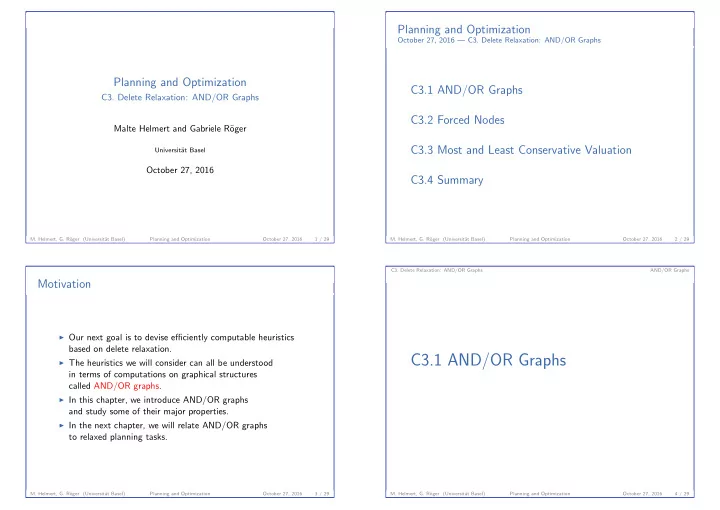
Planning and Optimization October 27, 2016 C3. Delete Relaxation: AND/OR Graphs Planning and Optimization C3.1 AND/OR Graphs C3. Delete Relaxation: AND/OR Graphs C3.2 Forced Nodes Malte Helmert and Gabriele R oger C3.3 Most and Least


slide-1
SLIDE 1

Planning and Optimization

  • C3. Delete Relaxation: AND/OR Graphs

Malte Helmert and Gabriele R¨

  • ger

Universit¨ at Basel

October 27, 2016

  • M. Helmert, G. R¨
  • ger (Universit¨

at Basel) Planning and Optimization October 27, 2016 1 / 29

Planning and Optimization

October 27, 2016 — C3. Delete Relaxation: AND/OR Graphs

C3.1 AND/OR Graphs C3.2 Forced Nodes C3.3 Most and Least Conservative Valuation C3.4 Summary

  • M. Helmert, G. R¨
  • ger (Universit¨

at Basel) Planning and Optimization October 27, 2016 2 / 29

Motivation

◮ Our next goal is to devise efficiently computable heuristics

based on delete relaxation.

◮ The heuristics we will consider can all be understood

in terms of computations on graphical structures called AND/OR graphs.

◮ In this chapter, we introduce AND/OR graphs

and study some of their major properties.

◮ In the next chapter, we will relate AND/OR graphs

to relaxed planning tasks.

  • M. Helmert, G. R¨
  • ger (Universit¨

at Basel) Planning and Optimization October 27, 2016 3 / 29

  • C3. Delete Relaxation: AND/OR Graphs

AND/OR Graphs

C3.1 AND/OR Graphs

  • M. Helmert, G. R¨
  • ger (Universit¨

at Basel) Planning and Optimization October 27, 2016 4 / 29

slide-2
SLIDE 2
  • C3. Delete Relaxation: AND/OR Graphs

AND/OR Graphs

AND/OR Graphs

Definition (AND/OR Graph) An AND/OR graph N, A, type is a directed graph N, A with a node label function type : N → {∧, ∨} partitioning nodes into

◮ AND nodes (type(v) = ∧) and ◮ OR nodes (type(v) = ∨).

We write succ(n) for the successors of node n ∈ N, i.e., succ(n) = {n′ ∈ N | n, n′ ∈ A}. Note: We draw AND nodes as squares and OR nodes as circles.

  • M. Helmert, G. R¨
  • ger (Universit¨

at Basel) Planning and Optimization October 27, 2016 5 / 29

  • C3. Delete Relaxation: AND/OR Graphs

AND/OR Graphs

AND/OR Graph Example

  • M. Helmert, G. R¨
  • ger (Universit¨

at Basel) Planning and Optimization October 27, 2016 6 / 29

  • C3. Delete Relaxation: AND/OR Graphs

AND/OR Graphs

AND/OR Graph Valuations

Definition (Consistent Valuations of AND/OR Graphs) Let G be an AND/OR graph with nodes N. A valuation or truth assignment of G is a valuation α : N → {T, F}, treating the nodes as propositional variables. We say that α is consistent if

◮ for all AND nodes n ∈ N: α |

= n iff α | =

n′∈succ(n) n′. ◮ for all OR nodes n ∈ N: α |

= n iff α | =

n′∈succ(n) n′.

Note that

n′∈∅ n′ = ⊤ and n′∈∅ n′ = ⊥.

  • M. Helmert, G. R¨
  • ger (Universit¨

at Basel) Planning and Optimization October 27, 2016 7 / 29

  • C3. Delete Relaxation: AND/OR Graphs

AND/OR Graphs

Example: A Consistent Valuation

F F F F T T F T F

  • M. Helmert, G. R¨
  • ger (Universit¨

at Basel) Planning and Optimization October 27, 2016 8 / 29

slide-3
SLIDE 3
  • C3. Delete Relaxation: AND/OR Graphs

AND/OR Graphs

Example: Another Consistent Valuation

T T F F T T F T F

  • M. Helmert, G. R¨
  • ger (Universit¨

at Basel) Planning and Optimization October 27, 2016 9 / 29

  • C3. Delete Relaxation: AND/OR Graphs

AND/OR Graphs

Example: An Inconsistent Valuation

F F T T T F T T T

  • M. Helmert, G. R¨
  • ger (Universit¨

at Basel) Planning and Optimization October 27, 2016 10 / 29

  • C3. Delete Relaxation: AND/OR Graphs

Forced Nodes

C3.2 Forced Nodes

  • M. Helmert, G. R¨
  • ger (Universit¨

at Basel) Planning and Optimization October 27, 2016 11 / 29

  • C3. Delete Relaxation: AND/OR Graphs

Forced Nodes

How Do We Find Consistent Valuations?

If we want to use valuations of AND/OR graphs algorithmically, a number of questions arise:

◮ Do consistent valuations exist for every AND/OR graph? ◮ Are they unique? ◮ If not, how are different consistent valuations related? ◮ Can consistent valuations be computed efficiently?

  • M. Helmert, G. R¨
  • ger (Universit¨

at Basel) Planning and Optimization October 27, 2016 12 / 29

slide-4
SLIDE 4
  • C3. Delete Relaxation: AND/OR Graphs

Forced Nodes

Some Partial Answers

◮ We already know from our previous example

that consistent valuations are in general not unique.

◮ We will now study two special kinds of valuations:

◮ the most conservative valuation ◮ the least conservative valuation

◮ We show that these two valuations are always consistent

and can be computed efficiently.

◮ We also show that all consistent valuations

lie “in between” these two valuations.

◮ In particular, an AND/OR graph has a unique consistent

valuation iff its most and least conservative valuation coincide.

  • M. Helmert, G. R¨
  • ger (Universit¨

at Basel) Planning and Optimization October 27, 2016 13 / 29

  • C3. Delete Relaxation: AND/OR Graphs

Forced Nodes

Forced True Nodes

Definition (Forced True Nodes) Let G be an AND/OR graph. The set of nodes of G that are forced true is defined by finite application of the following rules:

◮ If n is an AND node where all successors

are forced true, then n is forced true.

◮ If n is an OR node where at least one successor

is forced true, then n is forced true.

  • M. Helmert, G. R¨
  • ger (Universit¨

at Basel) Planning and Optimization October 27, 2016 14 / 29

  • C3. Delete Relaxation: AND/OR Graphs

Forced Nodes

Forced False Nodes

Definition (Forced False Nodes) Let G be an AND/OR graph. The set of nodes of G that are forced false is defined by finite application of the following rules:

◮ If n is an AND node where at least one successor

is forced false, then n is forced false.

◮ If n is an OR node where all successors

are forced false, then n is forced false.

  • M. Helmert, G. R¨
  • ger (Universit¨

at Basel) Planning and Optimization October 27, 2016 15 / 29

  • C3. Delete Relaxation: AND/OR Graphs

Forced Nodes

Example: Forced Nodes

T

(2)

T (3) F (2) T (1) F (1)

  • M. Helmert, G. R¨
  • ger (Universit¨

at Basel) Planning and Optimization October 27, 2016 16 / 29

slide-5
SLIDE 5
  • C3. Delete Relaxation: AND/OR Graphs

Forced Nodes

Remarks on Forced Nodes

Notes:

◮ Forced nodes are well-defined because the rules

defining them are monotonic.

◮ They can be computed in linear time in the size of the graph. ◮ There exists at least one forced true node

iff the graph has an AND node without successors.

◮ There exists at least one forced false node

iff the graph has an OR node without successors.

  • M. Helmert, G. R¨
  • ger (Universit¨

at Basel) Planning and Optimization October 27, 2016 17 / 29

  • C3. Delete Relaxation: AND/OR Graphs

Forced Nodes

Forced Nodes and Consistent Valuations

Theorem Let G be an AND/OR graph with nodes N. Let NT ⊆ N be the forced true nodes of G, and let NF ⊆ N be the forced false nodes of G. Let α : N → {T, F} be a consistent valuation of G. Then:

◮ α(n) = T for all n ∈ NT ◮ α(n) = F for all n ∈ NF

This property explains why they are called forced nodes.

  • M. Helmert, G. R¨
  • ger (Universit¨

at Basel) Planning and Optimization October 27, 2016 18 / 29

  • C3. Delete Relaxation: AND/OR Graphs

Forced Nodes

Forced Nodes and Consistent Valuations: Proof (1)

Proof. We prove the property of forced true nodes. The property of forced false nodes can be proved analogously. Proof by contradiction: assume that there is a consistent valuation α and a forced true node n ∈ NT with α(n) = T, i.e., α(n) = F. Let NT = {n1, . . . , nk}, where the nodes are ordered in a way that matches a possible sequence of rule applications: i.e., the i-th rule application derives that ni is forced true. Let ni be the first node in the order with α(ni) = F. Hence, α(nj) = T for all j < i. . . .

  • M. Helmert, G. R¨
  • ger (Universit¨

at Basel) Planning and Optimization October 27, 2016 19 / 29

  • C3. Delete Relaxation: AND/OR Graphs

Forced Nodes

Forced Nodes and Consistent Valuations: Proof (2)

Proof (continued). Case 1: ni is an AND node. In the i-th rule application, ni is shown as forced true, so all its successors must have been shown as forced true in an earlier rule application. Hence all nodes in succ(ni) are of the form nj with j < i. By the choice of ni, we have α(nj) = T for all these nodes. We conclude α | = ni and α | =

n′∈succ(ni) n′,

which shows that α is not consistent: a contradiction. . . .

  • M. Helmert, G. R¨
  • ger (Universit¨

at Basel) Planning and Optimization October 27, 2016 20 / 29

slide-6
SLIDE 6
  • C3. Delete Relaxation: AND/OR Graphs

Forced Nodes

Forced Nodes and Consistent Valuations: Proof (3)

Proof (continued). Case 2: ni is an OR node. In the i-th rule application, ni is shown as forced true, so at least one successor must have been shown as forced true in an earlier rule application. Hence at least one node in succ(ni) is of the form nj with j < i. By the choice of ni, we have α(nj) = T for such nodes. We conclude α | = ni and α | =

n′∈succ(ni) n′,

which shows that α is not consistent: a contradiction.

  • M. Helmert, G. R¨
  • ger (Universit¨

at Basel) Planning and Optimization October 27, 2016 21 / 29

  • C3. Delete Relaxation: AND/OR Graphs

Most and Least Conservative Valuation

C3.3 Most and Least Conservative Valuation

  • M. Helmert, G. R¨
  • ger (Universit¨

at Basel) Planning and Optimization October 27, 2016 22 / 29

  • C3. Delete Relaxation: AND/OR Graphs

Most and Least Conservative Valuation

Most and Least Conservative Valuation

Definition (Most and Least Conservative Valuation) Let G be an AND/OR graph with nodes N. The most conservative valuation αG

mcv : N → {T, F} and

the least conservative valuation αG

lcv : N → {T, F}

  • f G are defined as:

αG

mcv(n) =

  • T

if n is forced true F

  • therwise

αG

lcv(n) =

  • F

if n is forced false T

  • therwise
  • M. Helmert, G. R¨
  • ger (Universit¨

at Basel) Planning and Optimization October 27, 2016 23 / 29

  • C3. Delete Relaxation: AND/OR Graphs

Most and Least Conservative Valuation

Most/Least Conservative Valuations are Consistent

Theorem Let G be an AND/OR graph. Then:

1 αG

mcv is consistent.

2 αG

lcv is consistent.

3 For all consistent valuations α of G,

  • n(αG

mcv) ⊆ on(α) ⊆ on(αG lcv).

It follows that:

◮ Consistent valuations always exist

and can be efficiently computed.

◮ All consistent valuations lie between

the most and least conservative one.

◮ There is a unique consistent valuation iff αG mcv = αG lcv,

  • r equivalently iff each node is forced true or forced false.
  • M. Helmert, G. R¨
  • ger (Universit¨

at Basel) Planning and Optimization October 27, 2016 24 / 29

slide-7
SLIDE 7
  • C3. Delete Relaxation: AND/OR Graphs

Most and Least Conservative Valuation

MCV/LCV are Consistent: Proof (1)

Proof. We prove part 1. Part 2 is analogous, and part 3 follows directly from the previous result and the definitions of αG

mcv and αG lcv.

To prove part 1, we must show that αG

mcv satisfies the consistency

condition for every node n. Consider any node n. . . .

  • M. Helmert, G. R¨
  • ger (Universit¨

at Basel) Planning and Optimization October 27, 2016 25 / 29

  • C3. Delete Relaxation: AND/OR Graphs

Most and Least Conservative Valuation

MCV/LCV are Consistent: Proof (2)

Proof (continued). Case 1a: n is an AND node and n is forced true. All successors of n are forced true. (Otherwise n would not be forced true.) Then αG

mcv maps n and all its successors to T,

satisfying the consistency condition for n. Case 1b: n is an AND node and n is not forced true. At least one successor n′ of n is not forced true. (Otherwise n would be forced true.) Then αG

mcv maps n and n′ to false,

satisfying the consistency condition for n. . . .

  • M. Helmert, G. R¨
  • ger (Universit¨

at Basel) Planning and Optimization October 27, 2016 26 / 29

  • C3. Delete Relaxation: AND/OR Graphs

Most and Least Conservative Valuation

MCV/LCV are Consistent: Proof (3)

Proof (continued). Case 2a: n is an OR node and n is forced true. At least one successor n′ of n is forced true. (Otherwise n would not be forced true.) Then αG

mcv maps n and n′ to true,

satisfying the consistency condition for n. Case 2b: n is an OR node and n is not forced true. No successor of n is forced true. (Otherwise n would be forced true.) Then αG

mcv maps n and all its successors to F,

satisfying the consistency condition for n.

  • M. Helmert, G. R¨
  • ger (Universit¨

at Basel) Planning and Optimization October 27, 2016 27 / 29

  • C3. Delete Relaxation: AND/OR Graphs

Summary

C3.4 Summary

  • M. Helmert, G. R¨
  • ger (Universit¨

at Basel) Planning and Optimization October 27, 2016 28 / 29

slide-8
SLIDE 8
  • C3. Delete Relaxation: AND/OR Graphs

Summary

◮ AND/OR graphs are directed graphs

with AND nodes and OR nodes.

◮ We can assign truth values to AND/OR graph nodes. ◮ Such valuations are called consistent if they match

the intuitive meaning of “AND” and “OR”.

◮ Consistent valuations always exist. ◮ Consistent valuations can be computed efficiently. ◮ All consistent valuations fall between two extremes:

◮ the most conservative valuation, where only nodes

that are forced to be true are true

◮ the least conservative valuation, where all nodes

that are not forced to be false are true

  • M. Helmert, G. R¨
  • ger (Universit¨

at Basel) Planning and Optimization October 27, 2016 29 / 29