C LIMATE CONNECTIONS TO MARINE ECOSYSTEMS - FROM THE A MAZON TO T HE - - PowerPoint PPT Presentation

c limate connections to marine ecosystems
SMART_READER_LITE
LIVE PREVIEW

C LIMATE CONNECTIONS TO MARINE ECOSYSTEMS - FROM THE A MAZON TO T HE - - PowerPoint PPT Presentation

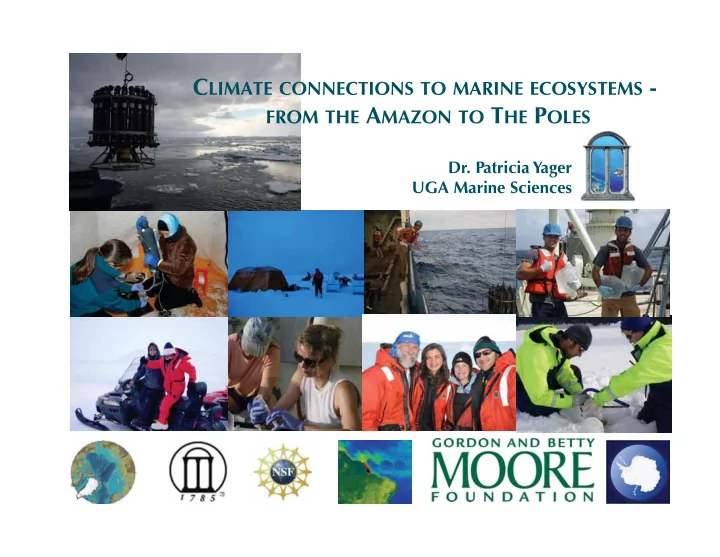
C LIMATE CONNECTIONS TO MARINE ECOSYSTEMS - FROM THE A MAZON TO T HE P OLES Dr. Patricia Yager UGA Marine Sciences Climate and the marine biosphere Temperature Light availabilty Nutrients pH SeaWIFS Aris Multimedia

slide-1
SLIDE 1
  • Dr. Patricia Yager

UGA Marine Sciences

CLIMATE CONNECTIONS TO MARINE ECOSYSTEMS -

FROM THE AMAZON TO THE POLES

slide-2
SLIDE 2

Aris Multimedia Entertainment, Inc. 1994

Climate and the marine biosphere

SeaWIFS

  • Temperature
  • Light availabilty
  • Nutrients
  • pH

Aris Multimedia Entertainment, Inc. 1994

slide-3
SLIDE 3

Aris Multimedia Entertainment, Inc. 1994

Climate and the marine biosphere

SeaWIFS

  • Temperature
  • Light availabilty
  • Nutrients
  • pH

Climate-active gases ( CH4, N20, DMS, CO2 ) Ocean color effects on albedo

Aris Multimedia Entertainment, Inc. 1994

Climate-active gases ( CH4, N20, DMS, CO2 ) Ocean color effects on albedo

Ecosystem changes

slide-4
SLIDE 4

See: Garay&Yager Pumping Carbon activity

http://www.polartrec.com/resources/ activity/pumping-carbon

slide-5
SLIDE 5

Barrow, Alaska (71°17’N, 156°47’W) Amundsen Sea Polynya (72-74°S, 111-115°W) Amazon River Continuum (0-12°N, 45-59°W)

slide-6
SLIDE 6

Why is the Amazon plume taking up so much CO2 from the atmosphere? Is this sink climate sensitive?

NASA

NASA SeaWIFS

slide-7
SLIDE 7

Why is the Amundsen Sea polynya taking up so much CO2 from the atmosphere? Is this sink climate sensitive?

  • D. Munroe
slide-8
SLIDE 8

How will the loss of sea ice and other climate changes affect the coastal Arctic carbon cycle and food web?

  • W. Kimmerer

NSIDC

slide-9
SLIDE 9

Microbial control on the productivity of Barrow's coastal waters - Will the battle for nitrogen intensify under climate change?

Patricia Yager Debbie Bronk Marc Frischer University of Georgia Virginia Inst. Mar Sci Skidaway Inst. Oceanogr.

slide-10
SLIDE 10

Arctic Marine Food Web

http://www.arcodiv.org/

priweb.org

slide-11
SLIDE 11

Sept 2011

EPA/NASA

slide-12
SLIDE 12

How will the loss of sea ice affect the food web? Hypothesis: Reduced benthic? Increased pelagic?

Nutrients required!

  • W. Kimmerer
slide-13
SLIDE 13

2006 2007 PP 07 - 06 Length of Growing season 07 - 06 Arrigo et al. 2008

slide-14
SLIDE 14

Nutrients come from the Bering Sea

  • r from upwelling near the

shelf break

[Courtesy Tom Weingartner]

slide-15
SLIDE 15

Yager et al. 2001

slide-16
SLIDE 16

Arctic Marine Food Web

http://www.arcodiv.org/

?

slide-17
SLIDE 17

Nybakken

slide-18
SLIDE 18

Food Web

Detritus

(POM + DOM)

Decomposers (bacteria etc)

Nutrients, CO2

Microbial food web

Don’t forget to recycle!

Nybakken

slide-19
SLIDE 19

Adds to the classical herbivorous food web

Bacteria in food webs Decomposers Prey for protozoans Infected by viruses

slide-20
SLIDE 20
  • E. coli

Aren’t bacteria bad?

faculty.mc3.edu/ jearl/ML/ml-7.htm

slide-21
SLIDE 21

Smallest marine organisms: 0.5 μm in diameter (although largest marine bacterium is 750 μm) Three lifestyles: planktonic, attached, symbiotic 2 million per drop (milliliter) of coastal seawater Decomposers Significant metabolic diversity Low morphological diversity

No – most are needed for healthy ecosystems…

slide-22
SLIDE 22

Focus on bacteria as heterotrophs or “decomposers” But also perhaps nutrient consumers????

slide-23
SLIDE 23

Marine life responds to physical change

Late ice retreat Early bloom Benthic production Early ice retreat Late bloom Pelagic production

slide-24
SLIDE 24

NO3 Phyto Bacteria DOM Light Standard “model”

slide-25
SLIDE 25

NO3 Phyto Bacteria DOM Light Riverine DOM Future scenario?

slide-26
SLIDE 26

NO3 Phyto Bacteria DOM Dark Winter ? Riverine DOM Future scenario?

slide-27
SLIDE 27

Hypothesis: Climate change will enhance the competition for N in the coastal Arctic as it reduces sea ice and increases terrestrial organic inputs, without affecting the annual light cycle. These changes will reduce the flux of C to the benthos, and the efficiency of the biological pump.

slide-28
SLIDE 28

Small Phyto- Large Phytoplankton Micro Zoo- Meso Zoo- Higher Trophic Sinking Particles Nutrients Bacteria Meso Zoo-

Seals Whales Birds Squid Fish Humans

Courtesy T. Connelly

slide-29
SLIDE 29

Small Phytoplankton Large Phyto- Micro Zooplankton Meso Zoo- Fish Birds Sinking Particles Nutrients Bacteria