C. K. Li 25th Fusion Energy Conference St Petersburg, Russia 13 -18 - - PowerPoint PPT Presentation

c k li
SMART_READER_LITE
LIVE PREVIEW

C. K. Li 25th Fusion Energy Conference St Petersburg, Russia 13 -18 - - PowerPoint PPT Presentation

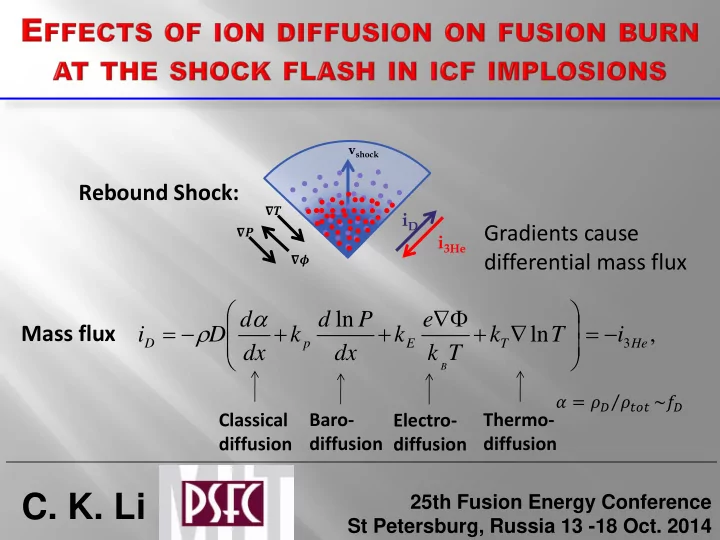
v shock Rebound Shock: i D Gradients cause i 3He differential mass flux d d ln P e Mass flux i D k k k ln T i , D


slide-1
SLIDE 1

, ln ln

3He T E p D

i T k T k e k dx P d k dx d D i

B

                   

Classical diffusion Baro- diffusion Electro- diffusion Thermo- diffusion

𝛽 = 𝜍𝐸 𝜍𝑢𝑝𝑢 ~𝑔

𝐸

Rebound Shock:

𝛂𝑸 𝛂𝝔

iD

Gradients cause differential mass flux

i3He

vshock 𝛂𝑼

Mass flux

  • C. K. Li

25th Fusion Energy Conference St Petersburg, Russia 13 -18 Oct. 2014

slide-2
SLIDE 2

► Ratios of T3Hed to D3Hep reaction yields, and DDp to DTn reaction yields quantitatively illustrate the fusion yield anomaly in directly driven, exploding–pusher ICF implosions. ► In contrast to the case of acceleration driven isothermal atmosphere during compression burn, shock driven ion diffusions cause specie separation at shock flash. ► Barodiffusion and electrodiffusion are likely the dominant effects. ► More detailed future work will focus on quantitative study

  • f each individual effect.

Measurements of 4 nuclear fusion products provide important information about the effects of ion diffusion

  • n the separation of fusion fuel species

Summary

This is an ongoing experiment project

slide-3
SLIDE 3
  • R. Betti
  • D. Meyerhofer
  • J. Soures
  • P. Amendt
  • C. Bellei
  • D. Casey
  • S. Wilks

Collaborators

  • J. Frenje
  • M. Gatu Johnson
  • H. Rinderknecht
  • M. Rosenberg
  • F. Séguin
  • H. Sio
  • A. Zylstra
  • R. Petrasso
slide-4
SLIDE 4

4

  • 1. Lasers or x-rays irradiate and heat the outer surface of the capsule
  • 4. Nuclear production

period (~100ps)

  • 2. Ablation of the outer surface material accelerates the

inner part of the capsule inwards

  • 3. As capsule compresses,

temperature and density increase

Ablation is used to generate the extreme pressures required to compress a capsule to ignition conditions

Neutron Alpha

DT gas DT gas DT ice

Ablator Hot-spot ignition requires a core temperature >10 keV and a fuel-areal density exceeding ~300 mg/cm2

slide-5
SLIDE 5

5

𝜖𝜍 𝜖𝑢 + 𝛂 𝜍𝐰 = 0

𝜍

𝜖𝑤 𝜖𝑢 + 𝐰 ∙ 𝛂 v

v = 𝛂𝐊 × 𝐂 -𝛂𝑄 +

𝜍 𝑛F 𝑛 𝑜𝑓2 𝜖𝐊 𝜖𝑢 = E

E + v × 𝐂 -

1 𝑓𝑜 𝐊 × 𝐂 + 1 𝑓𝑜 𝛂𝑄𝑓 − 𝐊

𝜍 = 𝑜𝑗𝑛𝑗 + 𝑜𝑓𝑛𝑓 P = P𝑗 + Pe v =

1 𝜍 𝑜𝑗𝑛𝑗𝐰𝑗 + 𝑜𝑓𝑛𝑓𝐰𝑓

J J =𝑓𝑜 𝐰𝑗 − 𝐰𝑓

Single-fluid model Averaged quantities over all species

Mainline ICF simulations are made with average-ion hydrodynamic codes 𝜍 = 𝑜𝑗𝑛𝑗 + 𝑜𝑓𝑛𝑓 P = P𝑗 + Pe v =

1 𝜍 𝑜𝑗𝑛𝑗𝐰𝑗 + 𝑜𝑓𝑛𝑓𝐰𝑓

J J =𝑓𝑜 𝐰𝑗 − 𝐰𝑓 𝜍 = 𝑜𝑗𝑛𝑗 + 𝑜𝑓𝑛𝑓 P = P𝑗 + Pe v =

1 𝜍 𝑜𝑗𝑛𝑗𝐰𝑗 + 𝑜𝑓𝑛𝑓𝐰𝑓

J J =𝑓𝑜 𝐰𝑗 − 𝐰𝑓

slide-6
SLIDE 6

Time Radius

Shock burn

Compression burn

Fuel-shell interface

500-800 ps

6

slide-7
SLIDE 7

7

  • C. Bellei et al, Phys. Plasmas 20, 012701 (2013)
slide-8
SLIDE 8

J R. Rygg et al., Phys. Plasmas (2008)

  • P. A. Amendt et al., Phys. Rev. Lett. 109 225001 (2010)

The effects of ion diffusion have been proposed to cause separation

  • f fuel species, leading to this

imbalance

The observed ICF fusion yield anomaly has been related to the imbalance of fuel species densities in the burn region

2 2

) 3 ( ~

D D n n

f f Y Y  

For the hydrodynamic equivalent mixtures, the scaled yields are

) 1 ( ) 3 ( ~

2 D D D p p

f f f Y Y   

slide-9
SLIDE 9

Observation of self-generated radial electric fields in an imploded capsule has been made

0.8 ns 1.2 ns 1.4 ns 1.6 ns 1.9 ns 2.1ns

1015 1010 105

  • 105
  • 1010
  • 1015

E (V/m)

Data Simulation t = 1.9 ns Pe ne Pe t = 0.8 ns Pe ne Pe

LILAC simulations by J. Delettrez

  • C. K. Li et al., PRL 100 225001 (2008)
slide-10
SLIDE 10

Recent work by Amendt et al delineates the effects

  • f ion diffusion in plasmas of imploded capsule

             dx T d k T k eE k dx P d k P k D i

T B E p

ln ln ln

1 

Mass diffusivity flux

Classical diffusion Barotropic diffusion Electro diffusion Thermal diffusion

Classical diffusion coefficient k : Barodiffusion coefficient kp : Electrodiffusion coefficient kE : Thermaldiffusion coefficient kT :      

                      1 1

2 1 2 2 1 1

m m m Z m Z kE

          

 

   

       

  

1 / 1 1 / 1 1 1 1 / 1

2 1 2 1 2 1 2 1 2 2 1 1

                       m m Z m k Zm m m Z Z Z m m Z Z k k k k k

E p T

   

T T m m Z Z f T ZT T T Z m m k

e e e

/ , / , , , 1 1 1

2 1 2 1 2 2 1

  

                          

          

                      

2 2 1 1 1 1 2 2 1 1 1 2

1 1 1 1 1 1 1 m Z Z m Z Z m Z m Z Z Z k p      

  • P. A. Amendt et al., PRL. 109 225001 (2010)

PRL, accepted (2012)
slide-11
SLIDE 11

11

Shock phase characterized by high temperature, moderate density, large λii, kinetic effects

from H. Robey

ρgas = 0.3 mg/cm3 Mshock ~ 10-50

1000 600 200 400 800 16 18 20 22 Time (ns)

Radius (µm) λii ~ 100 μm Mshock ~ 10-50 ρgas = 0.4 mg/cm3 OMEGA exploding pusher simulation Radius (µm)

D3He

SiO2[2.3μm]

λii ~ 100 μm

from A. Zylstra (HYADES)

NIF hot-spot ignition simulation

Rev 5 implosion

DT ice

CH [60μm]

DT vapor

slide-12
SLIDE 12

12

Key measurements:

  • DD and D3He yields
  • Burn-averaged Ti
  • DD and D3He burn histories
  • DD and D3He burn profiles
  • Fuel ρR (ion density)
  • X-ray self-emission images (R)
  • Scattered light

Implosion Compact proton spectrometers

slide-13
SLIDE 13

The first spectra of 4 nuclear reactions are simultaneously measured from a single capsule implosion that filled with DT3He gas

0.E+00 5.E+10

3 6 9 12 15 18 Energy (MeV) Yield / MeV

D-D p D-T alpha (X0.002) T-3He d (X50) D-3He p Shot 14972

15 atm DT3He 2.5 mm SiO2

slide-14
SLIDE 14

The YT3HeD/YDHep and YDDn/YDT yield ratios are deviated from the predictions, qualitatively indicating the fuel stratification

0.01 0.02 0.03 5 10 15 20

T3HeD/D3Hep DDp/DT

slide-15
SLIDE 15
  • D. T. Casey et al, Phys. Rev. Lett. 108, 075002 (2012).
  • 1.E-17

1.E-03 2.E-03 3.E-03 4.E-03 5.E-03 6.E-03 5 10 15 YDDp/YDT Temperature [keV]

LILAC simulation

x10-3 5 4 3 1 YDD/YDT 2 6

data

0.E+00 2.E-03 4.E-03 6.E-03 8.E-03 5 10 15 YTT /YDT Temperature [keV]

Expected

x10-3

8 6 4 2 YTT /YDT

data LILAC simulation

While DD yields relative to the DT yield are lower than expected, TT reaction yields are higher than expected (assuming a constant density ratio ft /fd)

slide-16
SLIDE 16

16

Hong Sio et al., to be submitted (2014)

slide-17
SLIDE 17

17

Séguin et al., RSI (2004), PoP (2006)

Radius (µm) Radius (µm) DD-p or D3He-p image

3-MeV DD-p & 15-MeV D3He-p

Penumbra Tracks/cm2

Exploding pusher proton tracks / cm2 0E+0 1E+4 2E+4 3E+4 50 100 150

D3He DD

3x10⁴ 2x10⁴ 1x10⁴

Reactions (µm-3)

2.3 mg/cm3 (Hydro-like) 0E+0 1E+4 2E+4 3E+4 50 100 150

D3He DD

3x10⁴ 2x10⁴ 1x10⁴

Reactions (µm-3)

0.4 mg/cm3 (Kinetic-like)

Average Radial Burn Profiles

slide-18
SLIDE 18

18

w/ Diffusion (Yieldx100) 100 Radius [mm] These results further demonstrate that ion diffusion is substantial in the long-λii implosio Simulations by P. Amendt, LLNL

Measured brightness profiles

D3He-p

Simulated brightness profiles

DD D3He Hydro

  • nly

0.E+00 1.E+06 2.E+06

50 100

Particles / μm2

Radius (µm)

Proton fluence [1/Area]

1x10⁶ 2x10⁶

0.4 mg/cm3 (kinetic regime)

slide-19
SLIDE 19

► Ratios of T3Hed to D3Hep reaction yields, and DDp to DTn reaction yields quantitatively illustrate the fusion yield anomaly in directly driven, exploding–pusher ICF implosions. ► In contrast to the case of acceleration driven isothermal atmosphere during compression burn, shock driven ion diffusions cause specie separation at shock flash. ► Barodiffusion and electrodiffusion are likely the dominant effects. ► More detailed future work will focus on quantitative study

  • f each individual effect.

Measurements of 4 nuclear fusion products provide important information about the effects of ion diffusion

  • n the separation of fusion fuel species

Summary

This is an ongoing experiment project