SLIDE 1 Lecture ¡34 ¡
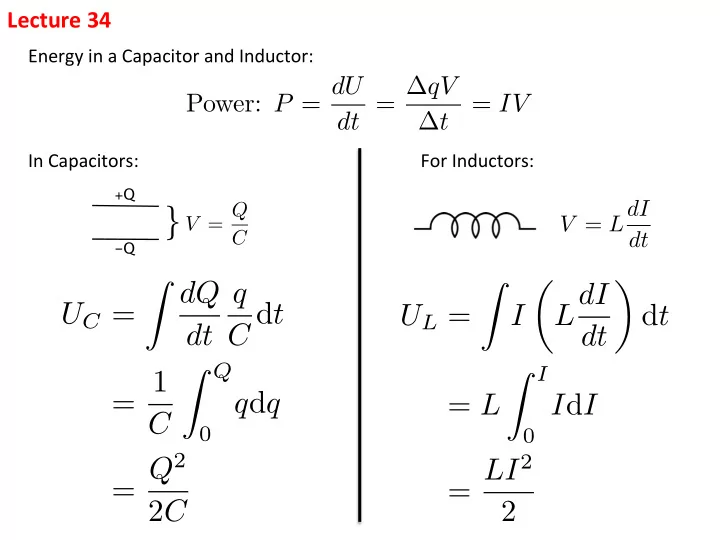
Energy ¡in ¡a ¡Capacitor ¡and ¡Inductor: ¡ In ¡Capacitors: ¡
UC = Z dQ dt q C dt = 1 C Z Q qdq = Q2 2C
For ¡Inductors: ¡
V = Q C
V = LdI dt
UL = Z I ✓ LdI dt ◆ dt = L Z I IdI = LI2 2
+Q
}
Power: P = dU dt = ∆qV ∆t = IV
SLIDE 2
Mechanical ¡Analogy: ¡Mass ¡Spring ¡System ¡
F = ma = md2x dt2 KE = 1 2mv2 1 2C q2 1 2LI2 PE = 1 2kx2
Corresponds ¡to: ¡
LC ¡circuits ¡oscillate ¡much ¡in ¡the ¡same ¡way ¡a ¡mass ¡spring ¡system ¡oscillates ¡
SLIDE 3
L C
LC ¡Circuit ¡
Basic ¡Equa?ons: ¡
VL + VC = 0
LdI dt + q C = 0
Loop ¡Equa?on: ¡ Power ¡Equa?on: ¡ Conserva?on ¡of ¡ Energy: ¡
0 = I ✓ LdI dt ◆ + dq dt q C
P = I × loop eqn. = IVL + IVC = 0
UC,max = UC + UL = UL,max
UL + UC = const.
SLIDE 4
Solving ¡the ¡Loop ¡Equa?on ¡– ¡Analogy ¡to ¡Mass-‑Spring ¡System ¡
md2x dt2 = −kx
Solu?on: ¡
x = A cos ωt dx dt = −Aω sin ωt d2x dt2 = −Aω2 cos ωt = −ω2x
Comment: ¡
General ¡Solu?on: ¡
x = xmax cos(ωt + δ)
(δ ¡is ¡the ¡ini?al ¡phase ¡angle ¡of ¡the ¡oscilla?on) ¡ OJen ¡set ¡δ ¡= ¡0, ¡where ¡at ¡t ¡= ¡0, ¡the ¡ini?al ¡ ¡ condi?on ¡is ¡chosen ¡to ¡be ¡x ¡= ¡xmax ¡
SLIDE 5 LC ¡Circuit ¡Analogy ¡
q = qmax cos ωt
Q I
t t
T/4 T/2 3T/4 T
+ - +
dt = −qmaxω sin ωt = −Imax sin ωt
q charge on left plate. at t = 0, q = qmax cos (ω0) = qmax I current in coil. At t = T 4 , I = −Imax sin ✓ωT 4 ◆ = −Imax sin ✓2π 4 ◆ = Imax
SLIDE 6
Check: ¡
LHS = 1 2L (Imax sin ωt)2 + 1 2C (qmax cos ωt)2
u0 = 1 2LI2
max
= 1 2Lω2q2
max
= 1 2L 1 LC q2
max
u0 = 1 2C q2
max
LHS = u0 sin2 ωt + u0 cos2 ωt = u0
sin2 ωt + cos2 ωt = 1
where ¡
UL + UC = U0
SLIDE 7 RLC ¡Circuit ¡– ¡Loop ¡Equa?on ¡
−LdI dt − q C − IR = 0
Power Eqn. = I × (loop eqn)
− d dt L 2 I2 + q2 2C
+LI dI dt + q C dq dt + I2R = 0
PL + PC + PR = 0
Always ¡ posi?ve ¡
Each ¡term ¡can ¡be ¡posi?ve ¡
¡ PL ¡+ ¡PC ¡stays ¡nega?ve ¡
Graph ¡of ¡Q ¡and ¡I ¡of ¡Dampened ¡Oscilla?on: ¡