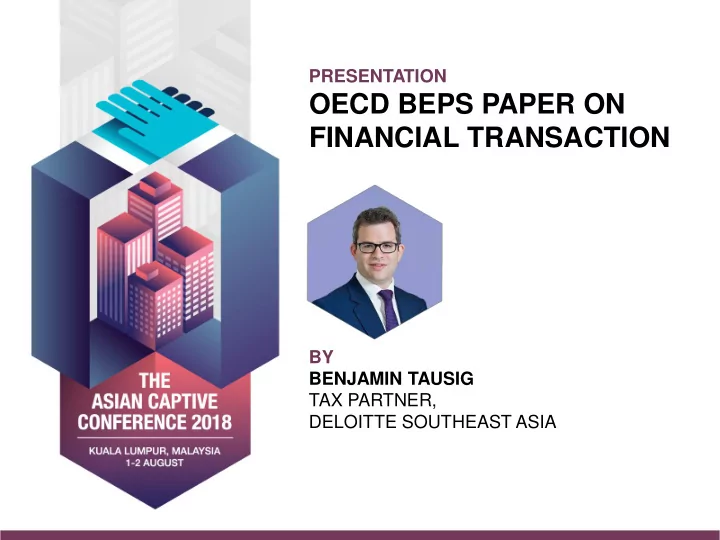
BY BENJAMIN TAUSIG TAX PARTNER, DELOITTE SOUTHEAST ASIA OECD BEPS - - PowerPoint PPT Presentation

by benjamin tausig tax partner deloitte southeast asia
SMART_READER_LITE
LIVE PREVIEW

BY BENJAMIN TAUSIG TAX PARTNER, DELOITTE SOUTHEAST ASIA OECD BEPS - - PowerPoint PPT Presentation

PRESENTATION OECD BEPS PAPER ON FINANCIAL TRANSACTION BY BENJAMIN TAUSIG TAX PARTNER, DELOITTE SOUTHEAST ASIA OECD BEPS PAPER ON FINANCIAL TRANSACTIONS Background On 3 July 2018, the Organisation for Economic Co-operation and Development


slide-1
SLIDE 1

PRESENTATION

OECD BEPS PAPER ON FINANCIAL TRANSACTION

BY BENJAMIN TAUSIG TAX PARTNER, DELOITTE SOUTHEAST ASIA

slide-2
SLIDE 2

OECD BEPS PAPER ON FINANCIAL TRANSACTIONS

Background

  • On 3 July 2018, the Organisation for

Economic Co-operation and Development (OECD) released the first public discussion draft on the transfer pricing aspects of financial transactions (the Discussion Draft).

  • A non-consensus document where the

OECD is asking for input from commentators in a number of areas

slide-3
SLIDE 3

OECD BEPS PAPER ON FINANCIAL TRANSACTIONS

Divided into four main areas:

  • Interaction with the Guidance in section

D.1 of OECD Transfer Pricing Guidelines

  • Treasury functions, including
  • Intra-group funding
  • Cash pooling
  • Hedging
  • Captives
  • Guarantees
slide-4
SLIDE 4

WHAT IS INSURANCE

  • Starts by providing an overview of

insurance through a reference to Part IV of the Report on the Attribution of Profits to Permanent Establishments

  • List some of the key features, including,

inter alia:

  • Presence of diversification and pooling of risks
  • Improvement of the economic capital of the

group as a result of the diversification

  • Evidence of external insurance market for the

covered risks

  • Existence
  • f

requisite skills (including underwriting skills) at the insurer, and

  • The possibility of losses
slide-5
SLIDE 5

WHAT IS INSURANCE

  • Goes
  • n

to address some

  • f

the commercial reasons for establishing a captive, including cost mitigation and gaining access to reinsurance markets.

  • Acknowledges that the potential to insure

against certain risks that are difficult or impossible to obtain coverage for in the

  • market. However, it goes on to state that

“where such risks are insured by a captive insurer this may raise questions as to whether an arm’s length price can be determined and the commercial rationality

  • f such an arrangement.”
slide-6
SLIDE 6

WHAT IS INSURANCE

  • Draft

makes it clear that fronting arrangements, whereby a third party insurer receives the premium from the MNE’s local entities and reinsures the risk to the captive in return for a fronting fee, are controlled transactions and that the premium received by the captive should be appropriately transfer priced.

slide-7
SLIDE 7

CAPTIVES – THE RISK OF RECHARACTERISATION?

  • Before looking to establishing an arm’s

length price, the Draft states that it is necessary to understand whether the arrangements are truly insurance and whether the captive has assumed and is capable of controlling the insurance risk contractually transferred to it.

  • Explicitly states that the paragraphs in the

OECD TPG that concern the analysis of risk apply to insurance businesses in the same way as they apply to other businesses.

slide-8
SLIDE 8

CAPTIVES – THE RISK OF RECHARACTERISATION?

  • Provides two examples where the captive

might not be carrying out insurance:

  • Financial capacity to assume risk and pay

claims

  • Risk diversification, as the Draft questions

whether a captive insurer within an MNE has the scale to achieve significant risk diversification

  • Little further discussion as to when a

captive may not be carrying out insurance business and the Draft asks for views from commentators

slide-9
SLIDE 9

CAPTIVES – PRICING OF PREMIUMS?

  • The Draft notes the potential to use third

party pricing evidence for pricing premiums, although it highlights the need for a detailed analysis that is required to determine the need for and quantification

  • f comparability adjustments – e.g. volume

differences.

  • Suggests that an actuarial analysis would

be more appropriate. It breaks this down into two elements:

  • A combined ratio designed to ensure that the

captive covers anticipated losses, underwriting and administrative costs; and

  • An investment return based on the return of

capital.

slide-10
SLIDE 10

CAPTIVES – PRICING OF PREMIUMS?

  • The Draft goes on to suggest that a captive

may need to make adjustments to both the capital level it holds compared to commercial insurers due to the capital constraints for a regulated insurer

  • Similarly it highlights the need to consider

the rate of investment return achieved by the captive to the extent it is investing in related party investments.

slide-11
SLIDE 11

CAPTIVES – PRICING OF PREMIUMS?

  • The Draft also considers two further

specific scenarios:

  • Group synergies – similar to the discussion on

cash pooling, where the members of the MNE come together to pool insurance risks through the captive to reduce the overall premiums, the Draft suggests that the benefit of the lower premiums should be shared amongst the insured companies.

slide-12
SLIDE 12

CAPTIVES – PRICING OF PREMIUMS?

  • Agency sales – the Draft addresses the scenario

where an agent in the MNE group sells highly profitable insurance on behalf of a captive together with its own products (e.g. extended warranty insurance / mobile phone insurance). The Draft follows HMRC’s logic in the Dixon’s case that “the ability to achieve the very high level of profit on the sale of the insurance policies arises from the advantage of customer contact at the point of sale” and thus the captive should earn the benchmarked return for insurers insuring similar risks with the residual profit allocated to the agent.

slide-13
SLIDE 13

THANK YOU

BENJAMIN TAUSIG TAX PARTNER, DELOITTE SOUTHEAST ASIA BTAUSIG@DELOITTE.COM

DISCLAIMER: This presentation should not be regarded as

  • ffering a complete explanation of the matters referred to and is

subject to changes in law. It is not intended to be a substitute for detailed research or the exercise of professional judgment. The

  • rganising committee of the Asian Captive Conference cannot

accept any responsibility for loss occasional to any person acting

  • r refraining from action as a result of any material in this
  • presentation. The republication, reproduction or commercial use
  • f any part of this presentation in any manner whatsoever,

including electronically, without the prior written permission from Committee is strictly prohibited.