
SLIDE 1
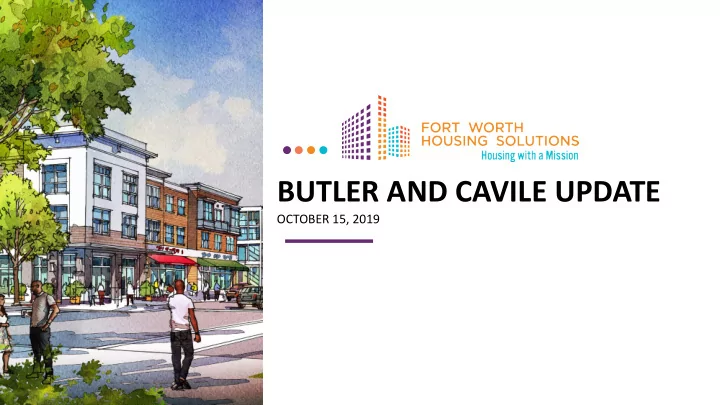
BUTLER AND CAVILE UPDATE
OCTOBER 15, 2019
BUTLER AND CAVILE UPDATE OCTOBER 15, 2019 WHAT IS ASSET - - PowerPoint PPT Presentation
BUTLER AND CAVILE UPDATE OCTOBER 15, 2019 WHAT IS ASSET REPOSITIONING? HUD funding has not kept pace with the capital needs of public housing units Now estimated at over $30 billion nationally HUD has placed greater emphasis on
BUTLER AND CAVILE UPDATE
OCTOBER 15, 2019
WHAT IS ASSET REPOSITIONING?
needs of public housing units
repositioning assets away from Public Housing and toward the Section 8 platform
2
BUTLER PLACE UPDATE
Poverty Deconcentration and Affordable Housing Preservation
BUTLER PLACE
downtown
4
RAD AND TRANSFER OF ASSISTANCE
term Section 8 Housing Assistance Payment (HAP) Contracts
residents, and helps to increase the number of affordable units in Fort Worth
assistance to a new geographic site(s), allowing them to:
different sites across the city
their replacement units
5
Original PH Site:100 Units
Transfer 20 units
RAD TOA Example
RESULTS
6
remaining closings expected in 2020
new affordable housing units since 2017
relocated to their replacement units in mixed-income communities in high
2020
CAVILE PLACE/STOP SIX UPDATE
A Choice Neighborhood Initiative
THE STOP SIX STORY
area being the sixth stop on the Interurban streetcar line to Dallas
neighborhood through the first half of the 20th century
disinvestment, and stigma
housing community, needing $42 million in repairs
8
CHOICE NEIGHBORHOODS
comprehensively revitalizing neighborhoods
planning and action activities, and implementation
Million over 6 years to leverage private/ public commitments
9
ALIGNS WITH THE RACE AND CULTURE RECOMMENDATIONS
minority area (S-MMA) neighborhood
engagement, college/ career centers
providers
renters, homebuyer assistance
safe spaces for pedestrians and bicycles
10
Neighborhood
COMPONENTS
11
approach for revitalizing neighborhoods
primary components:
types
Senior Options
homeownership
sufficiency
Education
Wellness
Engagement
businesses
WHAT MAKES A NEIGHBORHOOD OF CHOICE?
CHOICE IS NOT BUSINESS AS USUAL
from the traditional approach to housing development
investments to address the needs of a distressed community
federal funds
and regional assets
12
COMMUNITY-DRIVEN PLANNING
Improvement Program
Neighborhood 2019 Implementation Grant NOFA
Listening Sessions, and Design Workshops
13
UPDATED TRANSFORMATION PLAN
The Housing Plan
mixed-income/mixed-use phases including nearly 1,000 new units
while adding workforce, market, and permanent supportive housing units
spreading investments throughout the neighborhood
The Neighborhood Plan
relationships in the neighborhood
development of a neighborhood
infrastructure throughout the neighborhood
Neighborhood Hub at the heart
The People Plan
the 252 Cavile households, along with 48 households from the Cavile Place waiting list
supportive services in education, workforce development and healthcare
creates Individual Development Plans to create roadmaps and track resident progress 14
NEIGHBORHOOD PLAN- GOALS AND GUIDING PRINCIPLES
15
The Neighborhood Plan works within the following goals and guiding principles identified through community engagement during the planning process:
restaurants, and retail, to return vacant land to productive uses.
service, new and improved sidewalks and new bike lanes.
gardens, multi-use trails, linear and pocket parks, and sports fields.
neighborhood character.
reuse of vacant sites and demolition of vacant houses.
construction, improving street lighting and working with the police department to increase the visibility of police in the neighborhood.
NEIGHBORHOOD PLAN- OVERVIEW
16
assets and investments
neighborhood hub
sidewalks
where private market will invest
and brand
NEIGHBORHOOD HUB AND ENVISION CENTER
17
Improvement in the application to HUD
residents, potentially including:
Substation
management
Neighborhood Hub
HOUSING PLAN- GOALS AND GUIDING PRINCIPLES
18
The Housing Strategy provides a comprehensive approach, plan and phasing sequence to revitalize the housing in the neighborhood, and addresses the following goals and guiding principles identified during community engagement throughout the planning process:
income housing that accommodates families and is compact and pedestrian- friendly with an interconnected network of streets and defensible public
assisted units indistinguishable from market rate, affordable and workforce housing and ensure adequate off -street parking.
neighborhood, and incorporates traditional elements like porches, masonry, and design details.
HUD-assisted replacement units across multiple sites, and developing new mixed-income housing that blends with the density and character of the surrounding neighborhood
and building grouping
HOUSING PLAN- OVERVIEW
19
Protection Vouchers; will demolish Cavile Place
development locations throughout the neighborhood
wishes to return to replacement housing units
and workforce housing (for between 30-80% of AMI)
family and senior options
neighborhood nodes
Future Rosedale and Amanda Intersection Future Stop Six Neighborhood Street
SAN ANTONIO- BEFORE AND AFTER EXAMPLE
20
BEFORE AFTER
STOP SIX- BEFORE AND AFTER
21
BEFORE AFTER
PEOPLE PLAN- GOALS AND GUIDING PRINCIPLES
22
The needs assessment activities informed the overall People Vision, which serves as the guide for strategies designed to achieve the People Goals:
comprehensive family-centered support, and high quality/accessible health services to youth and families
comprehensive family-centered support, and educational career services
PEOPLE PLAN- OVERVIEW
23
Five Pillars of Our People Plan
children) will receive tailored supportive services
residents with partner supportive service providers in areas such as:
Engagement
monitored throughout the life of the grant to assess resident progress
TRANSFORMATIVE OUTCOMES
24
CATEGORY CAVILE TODAY SAMPLE CNI OUTCOMES EDUCATION 34% of residents over 18 do not have a High School Diploma/GED 100% of target youth graduated from high school in 2018-2019
Foote Homes Neighborhood, Memphis, TN (2015)
HEALTH 65% of adults have a primary care doctor 97% of adults have a primary care doctor
Beecher Terrace Neighborhood, Louisville, KY (2016)
EMPLOYMENT $8,984 average annual household income $19,000 increase in residents’ average earned annual income
Foote Homes Neighborhood, Memphis, TN (2015)
STOP SIX CRIME 3.5 times more crime occurs here compared to the city of Fort Worth 49% decrease in residential crime after 5 years
East Liberty, Pittsburgh, PA (2014)
STOP SIX HOME VALUE $48,300 - 65,800 is the median home value range 200% increase in home values
East Liberty, Pittsburgh, PA (2014)
OUR DREAM TEAM
Lead Applicant: Fort Worth Housing Solutions Housing Lead: McCormack Baron Salazar Housing Lead Oversight: Fort Worth Housing Solutions Neighborhood Lead: City of Fort Worth Public Safety Partner: Fort Worth PD People Lead: Urban Strategies, Inc. Education Lead: Fort Worth ISD People Lead Oversight and Service Coordination: Fort Worth Housing Solutions Choice Neighborhood Consultant: CVR Associates, Inc. Co-Lead: City of Fort Worth
Stakeholders
Businesses Cavile Residents Places of Worship Funders Stop Six Residents Community Partners Elected Officials
TOTAL IMPLEMENTATION PLAN INVESTMENT $288 Million
Includes $24.5M in Choice Funds
$20 Million
Includes $5.25M in Choice Funds
$29 Million
Includes $3.15M in Choice Funds
Total CNI-Related Investment- $339 Million
*Values reflect estimates as of 10/13/19
26
+$2.1M of Choice Funds for Grant Administration and Evaluation
ESTIMATED SOURCES AND USES-HOUSING AND COMMERCIAL
$
*Values reflect estimates as of 10/13/2019 FWHS Predevelopment Investments Relocation and Demolition $ 4,961,880
27
Development Sources CNI $ 24,500,000 First Mortgage/Equity $ 168,588,877 City of Fort Worth
(Subordinate Debt / Fee Waivers)
$ 11,060,000 City of Fort Worth
(Public Improvements)
$ 25,000,000 FWHS
(Master Planning, Acquisition, Legal)
$ 6,594,993 PSH Foundation Matching Funds $ 1,250,000 Subordinate Debt/Grants/FWHS $ 50,935,731 Total $ 287,929,601 Development Uses Construction Hard Costs
($165,990 Per residential unit) ($9,942,650 Commercial and Mgmt. Spaces)
$ 174,272,750 Soft Costs
(Architectural, Engineering, Financing, Legal, Professional and Other Fees, Reserves, FF&E)
$ 65,329,000 Site Preparation and Remediation $ 8,278,188 Offsite Public Improvements $ 28,886,112 Fees $ 4,568,558 Master Planning, Acquisition and Legal $ 6,594,993 Total $ 287,929,601
ESTIMATED SOURCES AND USES- NEIGHBORHOOD $
*Values reflect estimates as of 10/13/2019
28
Uses CCI Neighborhood HUB and Bikeshare $29,325,000 Total $29,325,000 Sources CNI $ 3,150,000 City of Fort Worth $14,000,000 Philanthropic Contributions $12,175,000 Total $29,325,000
ESTIMATED SOURCES AND USES- PEOPLE $
*Values reflect estimates as of 10/13/2019
Sources CNI $5,250,000 Grants/Philanthropic Contributions $14,750,000 Total $20,000,000 Uses Workforce $4,200,000 Education $3,200,000 Healthcare $2,200,000 Case Management $10,400,000 Total $20,000,000
29
30
SAMPLE CITY INVESTMENTS FOR CNI GRANTEES
Housing Neighborhood $24 M $11 M
Population: 879,170
$13 M $38 M
Population: 401,800
$19 M $66 M
Population: 318,069
$22 M $93 M
Population: 619,493
Tulsa, OK: $51 Million
Housing Neighborhood
Baltimore, MD: $115 Million
Housing Neighborhood Housing Neighborhood
Columbus, OH: $35 Million
COORDINATED PUBLIC INVESTMENTS
31
Fort Worth ISD
have already started making targeted investments in the Stop Six Neighborhood that align with our initiative
demonstrate a commitment and partnership to the neighborhood
Texas DPS
School District
High School and Young Men’s Leadership Academy
Basketball Gym, which will bring people into the neighborhood
Safety
East Rosedale Street
walkability, and flow of traffic
INITIAL TIMELINE
Update
Application(s)
Housing and Neighborhood projects
activities
2019 2020 2021
2025
32
THANK YOU!