Bumper Cars Bumper Cars yourself to the center of the merry - - PDF document

bumper cars bumper cars
SMART_READER_LITE
LIVE PREVIEW

Bumper Cars Bumper Cars yourself to the center of the merry - - PDF document

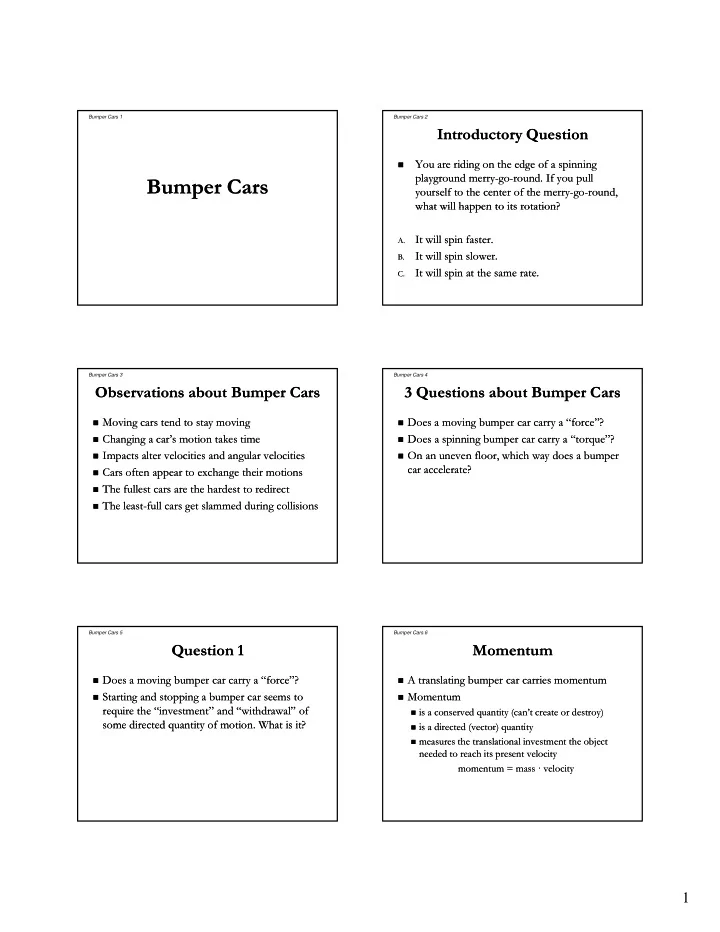
Bumper Cars 1 Bumper Cars 2 Introductory Question Introductory Question You are riding on the edge of a spinning You are riding on the edge of a spinning playground merry- playground merry -go go- -round. If you pull round. If you


slide-1
SLIDE 1

1

Bumper Cars 1

Bumper Cars Bumper Cars

Bumper Cars 2

Introductory Question Introductory Question

  • You are riding on the edge of a spinning

You are riding on the edge of a spinning playground merry playground merry-

  • go

go-

  • round. If you pull
  • round. If you pull

yourself to the center of the merry yourself to the center of the merry-

  • go

go-

  • round,

round, what will happen to its rotation? what will happen to its rotation? what will happen to its rotation? what will happen to its rotation?

A. A.

It will spin faster. It will spin faster.

B. B.

It will spin slower. It will spin slower.

C. C.

It will spin at the same rate. It will spin at the same rate.

Bumper Cars 3

Observations about Bumper Cars Observations about Bumper Cars

  • Moving cars tend to stay moving

Moving cars tend to stay moving

  • Changing a car’s motion takes time

Changing a car’s motion takes time

  • Impacts alter velocities and angular velocities

Impacts alter velocities and angular velocities

Cars often appear to exchange their motions

Cars often appear to exchange their motions

The fullest cars are the hardest to redirect

The fullest cars are the hardest to redirect

The least

The least-

  • full cars get slammed during collisions

full cars get slammed during collisions

Bumper Cars 4

3 Questions about Bumper Cars 3 Questions about Bumper Cars

Does a moving bumper car carry a “force”?

Does a moving bumper car carry a “force”?

Does a spinning bumper car carry a “torque”?

Does a spinning bumper car carry a “torque”?

On an uneven floor, which way does a bumper

On an uneven floor, which way does a bumper l ? l ? car accelerate? car accelerate?

Bumper Cars 5

Question 1 Question 1

  • Does a moving bumper car carry a “force”?

Does a moving bumper car carry a “force”?

  • Starting and stopping a bumper car seems to

Starting and stopping a bumper car seems to require the “investment” and “withdrawal” of require the “investment” and “withdrawal” of some some directed directed q antity of motion What is it? q antity of motion What is it? some some directed directed quantity of motion. What is it? quantity of motion. What is it?

Bumper Cars 6

Momentum Momentum

A translating bumper car carries momentum

A translating bumper car carries momentum

Momentum

Momentum

is a conserved quantity (can’t create or destroy)

is a conserved quantity (can’t create or destroy) i di d ( ) i i di d ( ) i

is a directed (vector) quantity

is a directed (vector) quantity

measures the translational investment the object

measures the translational investment the object needed to reach its present velocity needed to reach its present velocity momentum = mass · velocity momentum = mass · velocity

slide-2
SLIDE 2

2

Bumper Cars 7

Exchanging Momentum Exchanging Momentum

  • Bumper cars exchange momentum via impulses

Bumper cars exchange momentum via impulses

  • An impulse is

An impulse is

the only way to transfer momentum

the only way to transfer momentum di d ( ) i di d ( ) i

a directed (vector) quantity

a directed (vector) quantity

impulse = force · time impulse = force · time

When car

When car1 gives an impulse to car gives an impulse to car2

2, car

, car2

2 gives an

gives an equal but oppositely directed impulse to car equal but oppositely directed impulse to car1. .

Bumper Cars 8

Head Head-

  • On Collisions

On Collisions

Bumper cars exchange momentum via impulses

Bumper cars exchange momentum via impulses

The total momentum never changes

The total momentum never changes

Car with the least mass changes velocity most

Car with the least mass changes velocity most

The littlest riders get creamed

The littlest riders get creamed

Bumper Cars 9

Clicker Question Clicker Question

You pound on a nail with two different mallets,

You pound on a nail with two different mallets,

  • ne softer than the other. Their masses are equal
  • ne softer than the other. Their masses are equal

and you swing them equally fast. Compared to and you swing them equally fast. Compared to the the harder mallet harder mallet, the momentum transferred by , the momentum transferred by the the softer mallet softer mallet to the nail is to the nail is

A.

  • A. the same and it exerts the same force.

the same and it exerts the same force.

B.

  • B. the same, but it exerts a smaller force.

the same, but it exerts a smaller force.

C.

  • C. less, but it exerts the same force.

less, but it exerts the same force.

D.

  • D. less and it exerts a smaller force.

less and it exerts a smaller force.

Bumper Cars 10

Question 2 Question 2

Does a spinning bumper car carry a “torque”?

Does a spinning bumper car carry a “torque”?

Spinning and un

Spinning and un-

  • spinning a bumper car seems

spinning a bumper car seems to require the “investment” and “withdrawal” of to require the “investment” and “withdrawal” of some some directed directed q antity of rotational motion q antity of rotational motion some some directed directed quantity of rotational motion. quantity of rotational motion. What is it? What is it?

Bumper Cars 11

Angular Momentum Angular Momentum

A spinning car carries angular momentum

A spinning car carries angular momentum

Angular momentum

Angular momentum

is a conserved quantity (can’t create or destroy)

is a conserved quantity (can’t create or destroy) i di d ( ) i i di d ( ) i

is a directed (vector) quantity

is a directed (vector) quantity

measures the rotational investment the object

measures the rotational investment the object needed to reach its present angular velocity needed to reach its present angular velocity angular momentum = rotational mass· angular velocity angular momentum = rotational mass· angular velocity

Bumper Cars 12 Newton’s Third Law

Newton’s Third Law

  • f Rotational Motion
  • f Rotational Motion

For every torque that one object exerts on a

For every torque that one object exerts on a second object, there is an equal but oppositely second object, there is an equal but oppositely directed torque that the second object exerts on directed torque that the second object exerts on the first object the first object the first object. the first object.

slide-3
SLIDE 3

3

Bumper Cars 13

Exchanging Angular Momentum Exchanging Angular Momentum

Bumper cars exchange angular momentum

Bumper cars exchange angular momentum via angular impulses via angular impulses

An angular impulse is

An angular impulse is

the only way to transfer angular momentum

the only way to transfer angular momentum the only way to transfer angular momentum the only way to transfer angular momentum

a directed (vector) quantity

a directed (vector) quantity angular impulse = torque· time angular impulse = torque· time

When car

When car1 gives an angular impulse to car gives an angular impulse to car2

2, car

, car2

2

gives an equal but oppositely directed angular gives an equal but oppositely directed angular impulse to car impulse to car1. .

Bumper Cars 14

Glancing Collisions Glancing Collisions

Bumper cars exchange angular momentum

Bumper cars exchange angular momentum via angular impulses via angular impulses

Total angular momentum about a specific

Total angular momentum about a specific inertial point in space remains nchanged inertial point in space remains nchanged inertial point in space remains unchanged inertial point in space remains unchanged

Bumper car with the smallest rotational mass

Bumper car with the smallest rotational mass about that point changes angular velocity most about that point changes angular velocity most

The littlest riders tend to get spun wildly

The littlest riders tend to get spun wildly

Bumper Cars 15

Rotational Mass can Change Rotational Mass can Change

  • Mass can’t change, so the only way an object’s

Mass can’t change, so the only way an object’s velocity can change is if its momentum changes velocity can change is if its momentum changes

  • Rotational mass can change, so an object that

Rotational mass can change, so an object that changes shape can change its ang lar velocity changes shape can change its ang lar velocity changes shape can change its angular velocity changes shape can change its angular velocity without changing its angular momentum without changing its angular momentum

Bumper Cars 16

Introductory Question Introductory Question (revisited)

(revisited)

  • You are riding on the edge of a spinning

You are riding on the edge of a spinning playground merry playground merry-

  • go

go-

  • round. If you pull
  • round. If you pull

yourself to the center of the merry yourself to the center of the merry-

  • go

go-

  • round,

round, what will happen to its rotation? what will happen to its rotation? what will happen to its rotation? what will happen to its rotation?

A. A.

It will spin faster. It will spin faster.

B. B.

It will spin slower. It will spin slower.

C. C.

It will spin at the same rate. It will spin at the same rate.

Bumper Cars 17

Question 3 Question 3

On an uneven floor, which way does a bumper

On an uneven floor, which way does a bumper car accelerate? car accelerate?

Bumper Cars 18

Potential Energy, Acceleration, Potential Energy, Acceleration, and Force and Force

An object accelerates in the direction that

An object accelerates in the direction that reduces its total potential energy as rapidly as reduces its total potential energy as rapidly as possible possible

Forces and potential energies are related!

Forces and potential energies are related!

Forces and potential energies are related!

Forces and potential energies are related!

A car on an uneven floor accelerates in whatever

A car on an uneven floor accelerates in whatever direction reduces its total potential energy as direction reduces its total potential energy as rapidly as possible rapidly as possible

slide-4
SLIDE 4

4

Bumper Cars 19

Summary about Bumper Cars Summary about Bumper Cars

During collisions, bumper cars exchange

During collisions, bumper cars exchange

momentum via impulses

momentum via impulses

angular momentum via angular impulses

angular momentum via angular impulses

C lli i h l ff C lli i h l ff

Collisions have less effect on

Collisions have less effect on

cars with large masses

cars with large masses

cars with large rotational masses

cars with large rotational masses