
SLIDE 1
Building Technologies Accelerator BTA a pathway towards - - PowerPoint PPT Presentation
Building Technologies Accelerator BTA a pathway towards exploitation of the full potential of GHG reductions in the built environment Holger Wallbaum The BTA network has far-reaching ambitions to accelerate the commercialisation potential
Holger Wallbaum
The BTA network has far-reaching ambitions to accelerate the commercialisation potential for low carbon products and services in the built environment
HSB Riksbyggen Poplar Harca Siemens building technologies Picatec Hubber Duravit BASF Based on its attractive knowledge innovation network and through its open innovation model, BTA provides opportunities for rapidly expanding the network in the coming years.
The Livinglab network will be an outstanding platform for open innovation
The dissemination of new and sustainable building technologies into the market remains slow while the potential to reduce the climate impact of new and old buildings remains high
Refurbishment of existing building stock is a key challenge
First, we allow for innovation instead of conservative optimisation. Second, we facilitate the Livinglabs platform for business and society.
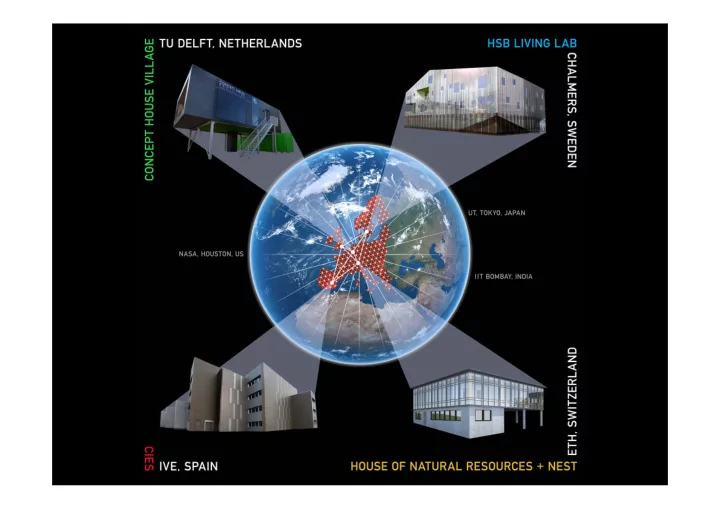
The BTA Livinglabs network provides an unprecented European scale with global commercial impact
The BTA approach is holistic and inclusive, combining market knowledge, insight studies in existing residential and commercial buildings, with the Livinglabs network
Human behaviour has a clear effect on the performance of buildings and building technologies and therefore on related business cases
Delft concept: Humans living in buildings do not necessarily behave as one would like or expect
The BTA will reduce the CO2eq emission by 0.5 million ton within the flagship period. The CO2eq reduction will continue after 2018 along with the dissemination of the flagship outcomes. Prototyping and open innovation
Masters and Phd level projects
Support and input to theJourney
Development of common
Interdisciplinary conference and
Technology pool database Social media communication BTA dissemination event
The University of Tokyo wish to contribute with their zero energy Livinglab – Japanese market
The first year of BTA 2014 contains activities that measure the proof of concept and provide evidence for the Climate-kic Board that BTA will gain commercial success Prototyping calls – to raise
Three thematic focus areas –
The new CHIBB Concept House, TU Delft
Development of the BTA business plan with
Establish management and governance A stage gate approach 2014 detailed report outlining success and
The first year of BTA will establish governance and process and make important first strides towards KPI achievement
Larry Toups, NASA, will work with us on innovations for space habitation which can be used on Earth, eg Velcro and aerogel
Commercialisation potential in US, India and Japan – Larry Toups (NASA), professor B.K. Chakravarthy IIT-Bombay and professor Ryozo Ooka, University of Tokyo
Sensor and visualisation system E-quarium Value creation in housing
Innovative and demonstrated
2nd skin concept for refurbishment Thermal gain facade system for
David Keyson’s user-centred innovation provides economic incentive through savings
Knight Frank will provide trusted leadership in enabling the full commercialisation potential of the Livinglab network
Food for thought: The Netherlands building corporations recently committed to a 6.5 billion Euro investment in making homes energy neutral