Building a Volunteer Base & Level One The Positional Leader - - PDF document

building a volunteer base
SMART_READER_LITE
LIVE PREVIEW

Building a Volunteer Base & Level One The Positional Leader - - PDF document

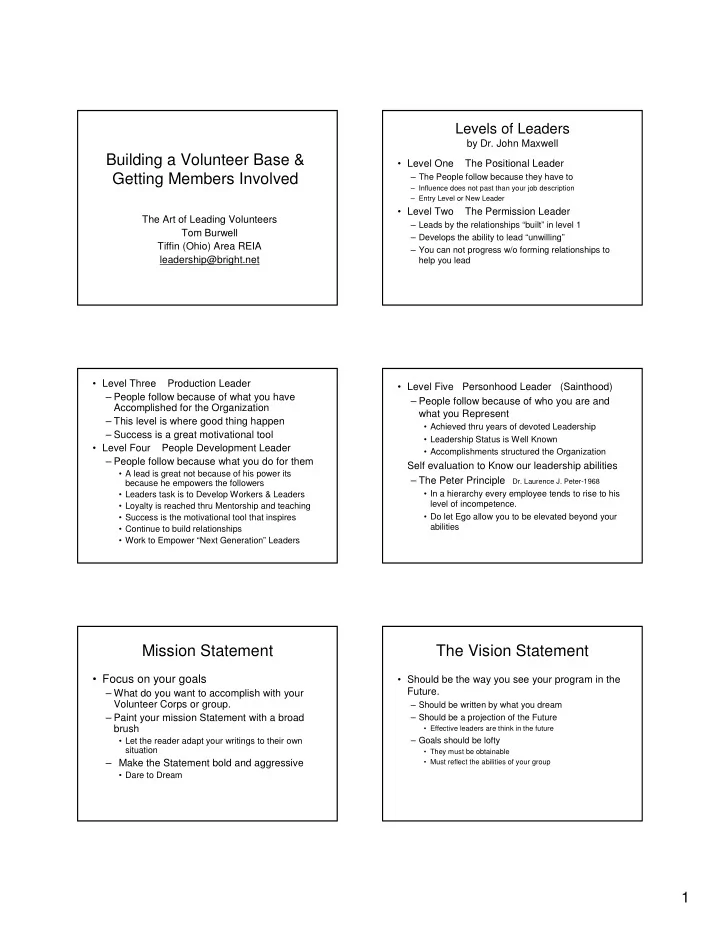
Levels of Leaders by Dr. John Maxwell Building a Volunteer Base & Level One The Positional Leader Getting Members Involved The People follow because they have to Influence does not past than your job description Entry


slide-1
SLIDE 1

1

Building a Volunteer Base & Getting Members Involved

The Art of Leading Volunteers Tom Burwell Tiffin (Ohio) Area REIA leadership@bright.net

Levels of Leaders

by Dr. John Maxwell

  • Level One The Positional Leader

– The People follow because they have to

– Influence does not past than your job description – Entry Level or New Leader

  • Level Two The Permission Leader

– Leads by the relationships “built” in level 1 – Develops the ability to lead “unwilling” – You can not progress w/o forming relationships to help you lead

  • Level Three Production Leader

– People follow because of what you have Accomplished for the Organization – This level is where good thing happen – Success is a great motivational tool

  • Level Four People Development Leader

– People follow because what you do for them

  • A lead is great not because of his power its

because he empowers the followers

  • Leaders task is to Develop Workers & Leaders
  • Loyalty is reached thru Mentorship and teaching
  • Success is the motivational tool that inspires
  • Continue to build relationships
  • Work to Empower “Next Generation” Leaders
  • Level Five Personhood Leader (Sainthood)

– People follow because of who you are and what you Represent

  • Achieved thru years of devoted Leadership
  • Leadership Status is Well Known
  • Accomplishments structured the Organization

Self evaluation to Know our leadership abilities – The Peter Principle

  • Dr. Laurence J. Peter-1968
  • In a hierarchy every employee tends to rise to his

level of incompetence.

  • Do let Ego allow you to be elevated beyond your

abilities

Mission Statement

  • Focus on your goals

– What do you want to accomplish with your Volunteer Corps or group. – Paint your mission Statement with a broad brush

  • Let the reader adapt your writings to their own

situation

– Make the Statement bold and aggressive

  • Dare to Dream

The Vision Statement

  • Should be the way you see your program in the

Future.

– Should be written by what you dream – Should be a projection of the Future

  • Effective leaders are think in the future

– Goals should be lofty

  • They must be obtainable
  • Must reflect the abilities of your group
slide-2
SLIDE 2

2

Both Mission and Vision Statements

  • Must inspire enthusiasm
  • They should be your board’s mind eye in what

you foresee for your group

  • The Think Tank Approach

– 1. Brain-storm ideas without comment or judgment – 2. Record ideas, then evaluate their merits – 3. Prepare “Briefs” for presentation – 4. Prove or Disprove thesis – 5. Chose from ideas to write your statements Must be adjusted to address successes

Planning the Road Map for Success

  • Set goals and objectives

– Management by Objectives (MBO)

  • MBO aims to increase organizational

performance by aligning goals and subordinate

  • bjectives throughout the organization.
  • Ideally, employees get strong input to

identifying their objectives, time lines for completion, etc. MBO includes ongoing tracking and feedback in the process to reach

  • bjectives.

Leading Volunteers

Why do volunteers leave?

  • Mismatch between the volunteer’s experience and their

expectations

  • Uncertainty and ambiguity about their role
  • Underutilized talents/dissatisfaction with tasks
  • Lack of recognition
  • Poor relationships
  • Unsatisfactory working conditions
  • Low morale
  • Poor communication

Leading Volunteers

Why do volunteers stay?

  • Match between their needs & tasks
  • Good orientation/training
  • Connection to the mission
  • Challenging work/ Responsibility
  • Recognition
  • Support/ Development of networks
  • Good communication

Leading Volunteers

Leading volunteers is successful when you:

  • Accurately assess need
  • Recruit “qualified” individuals and make the right “match”
  • Provide orientation and training
  • Set expectations, supervise and evaluate performance
  • Communicate regularly and openly
  • Recognize and reward
  • Make volunteers feel a part of the organizational

“community”

What traits in a leader attracts Volunteers

  • Be Welcoming

– Know peoples names

  • Be Appreciative
  • Sacrifice

– Allow others to have credit for your hard work

  • Listen
  • Be Inspiring
  • Be Attractive
  • Be Creative

– Innovative Ideas

slide-3
SLIDE 3

3

Traits that attract Volunteers

  • Be Willing to change your mind

– We have a Rule to Agree

  • Have Fun everyday
  • Be Creative

– Innovative Ideas

  • Compile Teams that Work

– Don’t waste your best on the worst – Focus Talented People to Maximize Results

  • Let Go.

– Have the courage to not take the credit

  • Set and Reach Goals
  • Cultivate find a more challenging task

– Insure Success & Notoriety

  • When the warm feeling of success happens
  • People feel noted and want to achieve more of the

same good feelings

  • Success brings more enthusiasm & Self-
  • Confidence. The Volunteer enjoys the act

– Keep Expand horizons. Empower the Vol. – Learn Thru Doing

  • See the inter-workings of the Organization
  • Watch good leaders use their vision Success
  • Be part of the team a share the Success.
  • As the volunteer Grows continue to Feed & Water

– Start the second phase of Volunteerism

  • Leadership- Everyone Says they are not Leaders
  • Emulating good leadership is essential
  • Teach about the different levels of Leadership.

– The leader does necessary pruning

  • Volunteer has nearly Blossomed

– They will be encouraging others to Volunteer – They will be inspiring the other Volunteers – They learn the Group’s routine, & systems – The Questions move from “How Do We?” to “What If” or “Why Don’t We”

Reasons to Volunteer

  • Learn and Develop Leadership Skills
  • Teach your skills to Others
  • Gain Work Experience
  • Build Self-confidence and Self-esteem
  • Improve your Health
  • Make important Networking Contacts
  • A sense of Value and that of being Needed
  • Return the Help the organization gave you
  • Make a difference in someone’s Life

The Bad Committee Story

  • Everybody, Somebody, Anybody & Nobody
  • There was a Job to do. Everybody was asked to

do it. But Everybody was sure that Somebody would do it, Anybody could have done it but No Body Did it. Somebody got angry because it was Everybody job.

  • Everybody thought Anybody could do it, But

Nobody realized that Everybody wouldn’t do it. It ended up that Everybody blamed Somebody when Nobody did what Any Body could have done.

Social Responsibility

  • We live in a “Show Me The Money” world.

– Volunteerism is a thing of the past. – 1995 Four US Presidents ask for Volunteers – Mr. Bush asked for “1000 Points of Light” – Lewis Farrakhan “Million Man March” – Disaster aids Recruiting Volunteers.

  • The total number of Volunteers did not

increase thru all the Publicity

slide-4
SLIDE 4

4

Social Responsibility

  • Is not Financial Success

– It is the feeling of helping w/ an organizations goals.

  • Is the accomplishments of the group

before your own.

Great Organizations Remember

  • That people are not your most valuable

resource, but the right people are.

  • The right person has more to do with

character traits and innate capabilities than specific knowledge, background or skills.

  • Manage the who first, then the what.
  • Put the best people on the biggest
  • pportunities, not the biggest problems.

Great Organizations Remember

  • Vibrant Management Teams consist of

people who can debate vigorously, yet unify behind made decisions.

  • Avoid a genius leader with a thousand
  • helpers. There is no next generation
  • If you need to make a change in the a

volunteer position, do it quickly.

The Leaders “C” Level

–Competent

  • Considerate

–Committed

  • Compassion

–Character

  • Consistency

–Caring

  • Control

–Courage

  • Concern

–Courtesy

  • Charisma

–Challenging

  • Creative

Vision

  • Good leaders get themselves into the

future and then leads others there

  • Good leaders are ready for change

– Change is enviable, – Growth is optional----John Maxwell

  • Great Leader must have a servant-leader

philosophy

  • The leader must be prepared to serve
  • Compelling modesty

Avoid Micro-management

  • A good leader sets up expectations for

the job to be done.

  • A leader enables the Volunteers to

Succeed

  • Keep informed on the projects progress
  • If the leader then dips into the
  • perations of the task, it is micro-

management

slide-5
SLIDE 5

5

Define Why You Need Volunteers

  • To enhance the services that you provide?
  • To strengthen your community

involvement?

  • To enrich your exposure to certain

publics?

  • Is there a genuine need for volunteers?

Recruit Carefully

  • Target possible volunteers who are truly

interested in your project.

  • Understand the characteristics of your

current leadership team and recruit volunteers who will mirror this team.

  • Be honest about the work load and time

commitment.

  • Ask for help, but don’t plead.
  • Solicit volunteers one on one

Screen, Interview and Place Cautiously

  • Screening and interviewing potential

volunteers facilitates commitment to the

  • rganization.
  • Interviewing shows that both the project

and their time are taken seriously.

  • Screening gives opportunity to match

qualifications and skills.

Design Valuable Volunteer Opportunities

  • Design training that facilitates learning and

development to the volunteer

  • Lay out responsibility of each job
  • Design volunteer tasks that are

challenging and motivating.

  • Ensure that the volunteers know the goals

and objectives of the organization.

Bring Them On Board With Training

  • Comprehensive orientation and training

gives volunteers a feeling of belonging and status.

  • Shows that the organization values them

and their contributions

  • Provide orientation that discusses the

mission and philosophy of the

  • rganization.

Recognize, Recognize, Recognize

  • Recognition shows the volunteer that their

work is valued.

  • Recognition provides further motivation for

the volunteer.

  • Recognition should be both formal and

informal.

  • Public and private recognition should be

utilized.

slide-6
SLIDE 6

6

Follow-up Effectively

  • A successful volunteer needs continual

follow-up and evaluation.

  • Effective follow-up provides feedback to

volunteer which in turn improves service.

  • Evaluating the volunteer work allows for
  • n-going training.

Firing A Volunteer

  • Not dealing with a problem volunteer can

cause great damage to your organization.

  • 3 Areas of Concern

–Performance Problems –Conduct Issues –Economic needs

Steps for Releasing a Volunteer

  • Schedule a meeting with the volunteer
  • Have a 3rd person involved-preferably of

the same gender as the volunteer.

  • State the reasons for the dismissal

preferably in writing.

  • Focus your comments on the person’s
  • performance. Avoid personal issues.

Steps for Releasing a Volunteer

  • Do everything to stay calm. Say what

needs to be said and nothing more.

  • Document the event and have the 3rd

person sign it.

  • Damage control might be necessary, but

attempt to maintain confidentiality.

  • Find the replacement and put into position

You can accomplish anything in life, provided that you do not mind who gets the credit.

  • ----Harry S. Truman

Tom Burwell 5245 East US 224 Tiffin, Ohio 44883 419-618-2264 leadership@bright.net