
SLIDE 1
BUHARINOMICS & 2016 BUDGET
Oluseun Onigbinde, Lead Partner, BudgIT
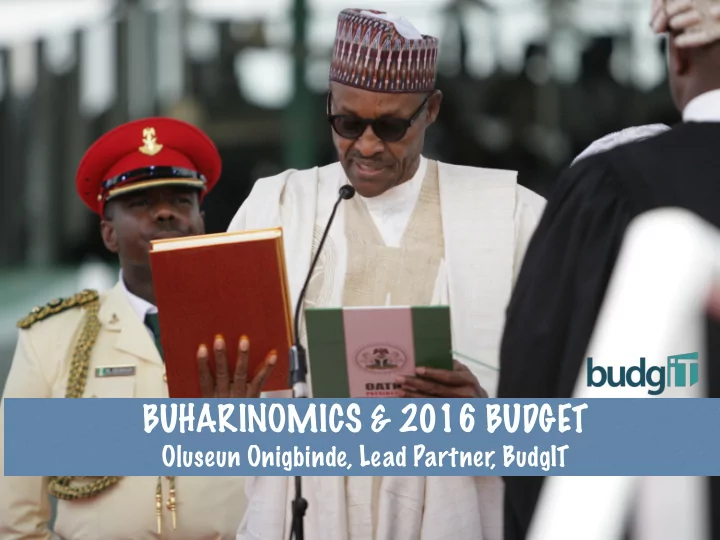
BUHARINOMICS & 2016 BUDGET Oluseun Onigbinde, Lead Partner, - - PowerPoint PPT Presentation
BUHARINOMICS & 2016 BUDGET Oluseun Onigbinde, Lead Partner, BudgIT With depleted foreign reserves, falling oil prices, leakages and debts the Nigerian economy is in deep trouble and will require careful management to bring it round..
BUHARINOMICS & 2016 BUDGET
Oluseun Onigbinde, Lead Partner, BudgIT
economy is in deep trouble and will require careful management to bring it round..”
May 29, 2015
While it is agreed that Nigeria’s growth has not been inclusive cold data showed that growth has been slowing down 6.23% 2.84% Q3 2014 Q3 2015
government revenue
Nigeria’s debt stock keeps rising and also the cost of servicing. Deficit hits a projected record high of N2.2tn
Nigeria’s debt service to revenue projected to reach 34% in 2016
3250 6500 9750 13000 2010 Q1 2011 Q1 2012 Q1 2013 Q1 2014 Q1 2015 Q1
Nigeria Debt Stock (NGN Millions)
Inflation is on a mild rise and already beyond CBN target band
Inflation figure YoY as at December 2015; currently at a 3-year high
2.5 5 7.5 10 Jan-13 May-13 Sep-13 Jan-14 May-14 Sep-14 Jan-15 May-15 Sep-15
The country’s external reserves dipped from $43.5bn (£30bn) in January 2014 to $28.3bn, a ten-year low.
Nigeria’s external reserves need $27bn to cover six month imports
15 30 45 60 2008 2009 2010 2011 2012 2013 2014 2015 2016
28.3 29.9 34.2 42.8 43.8 32.6 32.3 42.3 53
External Reserves (USD Billions)
Falling government revenue
Oil contribution to matrix slows down
With oil prices tumbling, Nigeria’s revenue has taken hit on every angle. As at September 2015 , FG Retained earnings still had a N1.12tn gap.
300 600 900 1200 Jan-10 Oct-10 Jul-11 Apr-12 Jan-13 Oct-13 Jul-14 Apr-15
Gross Monthly FAAC (NGN millions)
Collapse in Asset Class
Nigeria’s stock market has been facing decline since the Buhari bounce in early April 2015 signifying capital flight from portfolio investors
“Nigeria lost N1.2tn in the first eight trading days in 2016. The third largest exchange loss in the world after China and Saudi Arabia”
The Cable NG
Competitiveness
The Nigerian economy despite the incentives for local market investment faces acute inability to compete globally. Despite liquidity in the domestic market, asset creation at the private sector is not rising fast. Nigeria economy is not still competitive enough.
NIGERIA’S COMPETITIVENESS RANKINGS
the Proposed 2016 Budget What is the Policy Direction of the Nigerian Government?
The current Nigerian government seems to be in a hurry to expand debt, unwilling to apply austerity, diversify revenues & also has interest in social intervention programmes
Buharinomics so far
Loot Recovery Unwilling to remove fuel subsidies Not ready to devalue the currency The Treasury Single Account with N2tn balance Setting up Efficiency Unit Improved Transparency at NNPC N600bn capital fund for Works, Power, Housing & Transport Diversification - firm leadership at FIRS, Customs & Solid Minerals N500bn social Intervention Fund Raise liquidity for banking sector-specific investments Propose record deficit at N2.2tn
2016 Budget: Is the “ungolden” era of oil over? This 2016 budget is not based on oil. Oil related revenue accounts for 13%
How will 2016 Budget be funded?
N3.86tn
N820bn N1.64tn FG share of oil related revenue
projection tumbles from N1.64tn in 2015 to N820bn in 2016
Oil Non-oil Independent Revenue N820bn N1.45tn N1.5tn
How feasible is Revenue?
$28 Oil Price keeps tumbling down per barrel and how feasible is 2.2m barrels per day? Independent Revenue
N1.5tn
$38 Independent Revenue presents the biggest
by the Treasury Single Account FX policy is hurting non-oil export as Customs revenue dips from N977bn in 2014 to N903bn in 2015
N977bn
The Deficit, which is equivalent to 2.16% of Nigeria’s GDP
The Staggering Deficit
N2.2tn N1.04tn 2016 2015
Expenditure
Recurrent Expenditure 70%
Capital Expenditure 30%
The N6.08tn Expenditure
N351.37bn N1.475tn N1.87tn N1.23tn N370bn N775bn STATUTORY TRANSFERS TOTAL DEBT SERVICE MDAs RECURRENT MDAs CAPITAL OTHER CAPITAL OTHER RECURRENT
The N6.08tn Expenditure
KEY MINISTERIAL ALLOCATIONS Social Spending of N500bn is the highest component in the budget. However, the “Super” Ministry
huge share of the budget. Education and Health budgets are huge but are mainly for personnel costs - doctors & teachers
The N6.08tn Expenditure
KEY CAPITAL ALLOCATIONS Key capital allocations jumps are for Works and Housing, Transport, Defence and Interior. Capital allocations to social sectors such as education & health did not rise, showing government lack of concern to boost infrastructure in such sectors.
Health Budget in 2016 90% for Recurrent Budget 4.2% of the Budget
The National Health Care Development Agency which will manage 45% of the fund, to be disbursed through each state and the FCT Primary Health Care Development Board for the provision of essential drugs, vaccines and consummates. The National Health Insurance Scheme which will manage 50% of the fund for the of basic minimum package of health facilities The Federal Ministry of Health will manage 5% of the fund for the provision of basic minimum package of health facilities.
How is the 1% of CRF for the National Health Act mean to be spent ?
The N6.08tn Expenditure
2016 KEY BUDGET PRIORITIES & OPPORTUNITIES
N90bn investment
proposed spending up to N50bn
7 ,068 Units stated in the budget up to N44.5bn
Every Ministry still wants to buy software and computers. Total proposed spending at N22bn 7 . N500bn The Federal Government to embark on massive social spending including school feeding programs
Massive expansion on roads to gulp N224bn
Defence Infrastructure with huge capital spending at NSA & Defence Ministry.