Buffer overflows (a security interlude) IA32 Linux Memory - - PowerPoint PPT Presentation

buffer overflows a security interlude
SMART_READER_LITE
LIVE PREVIEW

Buffer overflows (a security interlude) IA32 Linux Memory - - PowerPoint PPT Presentation

11/20/15 Buffer overflows (a security interlude) IA32 Linux Memory Layout ... FF ... How address space layout, the stack discipline, and C's lack of Stack


slide-1
SLIDE 1

11/20/15 1

Buffer ¡overflows ¡(a ¡security ¡interlude)

How ¡address ¡space ¡layout, ¡the ¡stack ¡discipline, ¡and ¡C's ¡lack ¡of ¡ bounds-­‑checking ¡left ¡us ¡with ¡a ¡huge ¡problem.

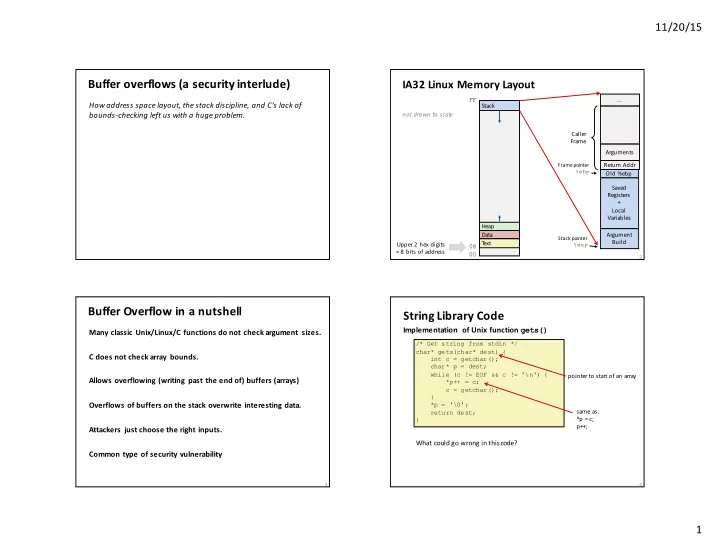
IA32 ¡Linux ¡Memory ¡Layout

2

Upper ¡2 ¡hex ¡digits ¡ = ¡8 ¡bits ¡of ¡address FF 00 Stack T ext Data Heap 08 not ¡drawn ¡to ¡scale Return ¡Addr Saved Registers + Local Variables Argument Build Old ¡%ebp Arguments Caller Frame

Frame ¡pointer %ebp Stack ¡pointer %esp

... ...

Buffer ¡Overflow ¡in ¡a ¡nutshell

Many ¡classic ¡Unix/Linux/C ¡functions ¡do ¡not ¡check ¡argument ¡ sizes. C ¡does ¡not ¡check ¡array ¡ bounds. Allows ¡overflowing ¡(writing ¡ past ¡the ¡end ¡of) ¡buffers ¡(arrays) Overflows ¡of ¡buffers ¡on ¡the ¡stack ¡overwrite ¡interesting ¡data. Attackers ¡ just ¡choose ¡the ¡right ¡inputs. Common ¡type ¡of ¡security ¡vulnerability

3

String ¡Library ¡Code

Implementation ¡ of ¡Unix ¡function ¡gets()

What ¡could ¡go ¡wrong ¡in ¡this ¡code?

/* Get string from stdin */ char* gets(char* dest) { int c = getchar(); char* p = dest; while (c != EOF && c != '\n') { *p++ = c; c = getchar(); } *p = '\0'; return dest; }

4

pointer ¡to ¡start ¡of ¡an ¡array same ¡as: *p ¡= ¡c; p++;

slide-2
SLIDE 2

11/20/15 2

String ¡Library ¡Code

Implementation ¡ of ¡Unix ¡function ¡gets()

No ¡way ¡to ¡specify ¡limit ¡on ¡number ¡of ¡characters ¡to ¡read

Similar ¡ problems ¡with ¡other ¡Unix ¡functions

strcpy: ¡Copies ¡string ¡of ¡arbitrary ¡length scanf, ¡fscanf, ¡sscanf, ¡when ¡given ¡%s conversion ¡specification

/* Get string from stdin */ char* gets(char* dest) { int c = getchar(); char* p = dest; while (c != EOF && c != '\n') { *p++ = c; c = getchar(); } *p = '\0'; return dest; }

5

Vulnerable ¡Buffer ¡Code

int main() { printf("Type a string:"); echo(); return 0; } /* Echo Line */ void echo() { char buf[4]; /* Way too small! */ gets(buf); puts(buf); } unix>./bufdemo Type a string:1234567 1234567 unix>./bufdemo Type a string:12345678 Segmentation Fault unix>./bufdemo Type a string:123456789ABC Segmentation Fault 6

Buffer ¡Overflow ¡Disassembly

080484f0 <echo>: 80484f0: 55 push %ebp 80484f1: 89 e5 mov %esp,%ebp 80484f3: 53 push %ebx 80484f4: 8d 5d f8 lea 0xfffffff8(%ebp),%ebx 80484f7: 83 ec 14 sub $0x14,%esp 80484fa: 89 1c 24 mov %ebx,(%esp) 80484fd: e8 ae ff ff ff call 80484b0 <gets> 8048502: 89 1c 24 mov %ebx,(%esp) 8048505: e8 8a fe ff ff call 8048394 <puts@plt> 804850a: 83 c4 14 add $0x14,%esp 804850d: 5b pop %ebx 804850e: c9 leave 804850f: c3 ret 80485f2: e8 f9 fe ff ff call 80484f0 <echo> 80485f7: 8b 5d fc mov 0xfffffffc(%ebp),%ebx 80485fa: c9 leave 80485fb: 31 c0 xor %eax,%eax 80485fd: c3 ret

7

echo ¡code caller ¡code

Buffer ¡Overflow ¡Stack

echo: pushl %ebp # Save %ebp on stack movl %esp, %ebp pushl %ebx # Save %ebx leal

  • 8(%ebp),%ebx

# Compute buf as %ebp-8 subl $20, %esp # Allocate stack space movl %ebx, (%esp) # Push buf addr on stack call gets # Call gets . . . /* Echo Line */ void echo() { char buf[4]; /* Way too small! */ gets(buf); puts(buf); } 8

Return ¡Address Saved ¡%ebp %ebp Stack ¡ Frame for ¡main [3] [2] [1] [0] buf Before ¡call ¡to ¡gets Saved ¡%ebx buf

slide-3
SLIDE 3

11/20/15 3

Buffer ¡Overflow ¡Stack ¡Example

9

80485f2:call 80484f0 <echo> 80485f7:mov 0xfffffffc(%ebp),%ebx # Return Point 0xffffc638 buf 0xffffc658 Return ¡Address Saved ¡%ebp Stack ¡ Frame for ¡main [3] [2] [1] [0] Stack ¡ Frame for ¡main xx xx xx xx buf ff ff c6 58 08 04 85 f7 Before ¡call ¡to ¡gets Before ¡call ¡to ¡gets Saved ¡%ebx Saved ¡%ebx buf 0xffffc630

Buffer ¡Overflow ¡Example ¡#1

10

Overflow ¡ buf, ¡and ¡corrupt ¡saved ¡%ebx, but ¡no ¡problem, ¡why?

What ¡happens ¡if ¡input ¡has ¡one ¡more ¡byte? 0xffffc638 0xffffc658 Stack ¡ Frame for ¡main 34 33 32 31 buf Input ¡“1234567” 00 37 36 35 buf Stack ¡ Frame for ¡main xx xx xx xx Before ¡call ¡to ¡gets Saved ¡%ebx 58 c6 ff ff f7 85 04 08 0xffffc638 0xffffc658 0xffffc630 0xffffc630

(Saved ¡%ebp) (Return ¡address)

ff ff c6 58 08 04 85 f7 ff ff c6 58 08 04 85 f7

Buffer ¡Overflow ¡Example ¡#2

11

Frame pointer ¡corrupted

. . . 804850a: 83 c4 14 add $0x14,%esp # deallocate space 804850d: 5b pop %ebx # restore %ebx 804850e: c9 leave # movl %ebp, %esp; popl %ebp 804850f: c3 ret # Return

0xffffc638 0xffffc658 Stack ¡ Frame for ¡main 34 33 32 31 buf 58 c6 ff 00 f7 85 04 08 Input ¡“12345678” 38 37 36 35 buf Stack ¡ Frame for ¡main xx xx xx xx Before ¡call ¡to ¡gets Saved ¡%ebx 58 c6 ff ff f7 85 04 08 0xffffc638 0xffffc658 0xffffc630 0xffffc630

(Saved ¡%ebp) (Return ¡address)

ff ff c6 08 04 85 f7 ff ff c6 58 08 04 85 f7

Buffer ¡Overflow ¡Example ¡#3

12

Return ¡address ¡corrupted

080485f2: call 80484f0 <echo> 080485f7: mov 0xfffffffc(%ebp),%ebx # Return Point

0xffffc638 0xffffc658 Stack ¡ Frame for ¡main 34 33 32 31 buf 43 42 41 39 f7 85 04 00 Input ¡“123456789ABC” 38 37 36 35 buf Stack ¡ Frame for ¡main xx xx xx xx Before ¡call ¡to ¡gets Saved ¡%ebx 58 c6 ff ff f7 85 04 08 0xffffc638 0xffffc658 0xffffc630 0xffffc630

Hmmm, ¡what ¡can ¡you ¡do ¡with ¡it? (Saved ¡%ebp) (Return ¡address)

ff ff c6 58 08 04 85 f7 08 04 85

slide-4
SLIDE 4

11/20/15 4

Malicious ¡Use ¡of ¡Buffer ¡Overflow

13

Input ¡string ¡contains ¡byte ¡representation ¡of ¡executable ¡code Overwrite ¡return ¡address ¡A ¡with ¡address ¡of ¡buffer ¡(need ¡to ¡know ¡B) When ¡bar() executes ret, ¡will ¡jump ¡to ¡exploit ¡code ¡(instead ¡of ¡A)

int bar() { char buf[64]; gets(buf); ... return ...; } void foo(){ bar(); ... } Stack ¡ after ¡ call ¡to ¡gets() B ¡(was ¡A) return ¡ address A foo stack ¡frame bar stack ¡frame B exploit code pad data ¡written by ¡gets()

Exploiting ¡Buffer ¡Overflows

Buffer ¡overflow ¡bugs ¡allow ¡remote ¡ machines ¡to ¡execute ¡ arbitrary ¡ code ¡on ¡victim ¡ machines. 1988: ¡Internet ¡worm

Early ¡versions ¡of ¡the ¡finger ¡server ¡daemon ¡(fingerd) ¡used ¡gets() to ¡read ¡ the ¡argument ¡sent ¡by ¡the ¡client: finger somebody@cs.wellesley.edu Attack ¡buffer ¡overflow ¡by ¡sending ¡phony ¡argument: finger “exploit-code padding new-return-address”

... 2015: ¡"Ghost" ¡any ¡many ¡ more...

Standard ¡C ¡library ¡function ¡gethostname() exploitable ¡buffer ¡overflow

14

commandline facebook of ¡the ¡80s!

Avoiding ¡Overflow ¡Vulnerability

Use ¡library ¡ routines ¡that ¡ limit ¡string ¡lengths

fgets instead ¡of ¡gets (second ¡argument ¡to ¡fgets sets ¡limit) strncpy instead ¡of ¡strcpy Don’t ¡use ¡scanf with ¡%sconversion ¡specification Use ¡fgets to ¡read ¡the ¡string Or ¡use ¡%ns where ¡nis ¡a ¡suitable ¡integer

Other ¡ideas?

/* Echo Line */ void echo() { char buf[4]; /* Way too small! */ fgets(buf, 4, stdin); puts(buf); }

15

System-­‑Level ¡Protections

Randomized ¡stack ¡offsets

At ¡start ¡of ¡program, ¡allocate ¡random ¡amount ¡of ¡ space ¡on ¡stack Makes ¡it ¡difficult ¡for ¡exploit ¡to ¡predict ¡beginning ¡

  • f ¡inserted ¡code

Techniques ¡to ¡detect stack ¡corruption Nonexecutable code ¡segments

Allow ¡code ¡to ¡execute ¡only ¡from ¡“text” ¡segment Do ¡NOT ¡execute ¡code ¡in ¡stack, ¡data, ¡or ¡heap Hardware ¡support ¡needed

16

FF 00 Stack T ext Data Heap 08 not ¡drawn ¡to ¡scale