
SLIDE 1
BRONX SPECIAL DISTRICTS UPDATE OPEN HOUSE | MAY 20, 2019
BRONX SPECIAL NATURAL AREA DISTRICT UPDATE
Bronx Open House Horace Mann School
May 20, 2019
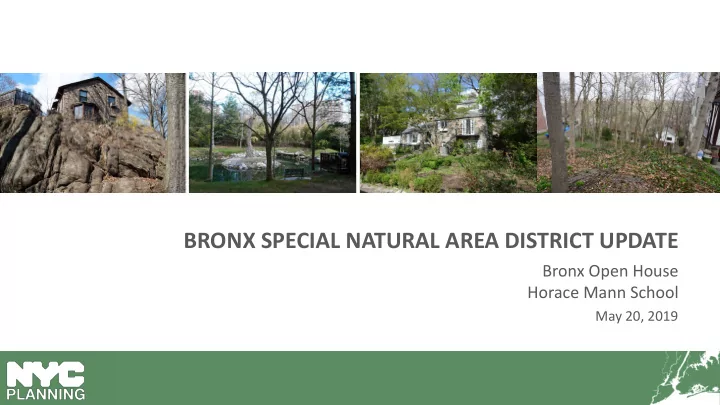
BRONX SPECIAL NATURAL AREA DISTRICT UPDATE Bronx Open House Horace - - PowerPoint PPT Presentation
BRONX SPECIAL NATURAL AREA DISTRICT UPDATE Bronx Open House Horace Mann School May 20, 2019 BRONX SPECIAL DISTRICTS UPDATE OPEN HOUSE | MAY 20, 2019 Presentation outline Project Summary, Process & Principles Background & Context
BRONX SPECIAL DISTRICTS UPDATE OPEN HOUSE | MAY 20, 2019
May 20, 2019
BRONX SPECIAL DISTRICTS UPDATE OPEN HOUSE | MAY 20, 2019
2
BRONX SPECIAL DISTRICTS UPDATE OPEN HOUSE | MAY 20, 2019
Lack a clear, consistent and holistic approach to natural resource protection One size fits all - small or large property treated the same Lacks oversight on large natural resources Result in unpredictable outcomes Based on outdated ecological science Burdensome for small property owners
3
Issues with the Current Rules: 1 2 3 4 5 6
BRONX SPECIAL DISTRICTS UPDATE OPEN HOUSE | MAY 20, 2019
4
With over 40 years of experience working with the Special Districts rules, DCP has established best practices Technology improvements allow accurate mapping of natural features Why now?
PREDICTABILITY EFFICIENCY CODIFY & ENHANCE CURRENT PRACTICES PROPOSAL CURRENT SPECIAL DISTRICT GOALS ENHANCED PROTECTION
BRONX SPECIAL DISTRICTS UPDATE OPEN HOUSE | MAY 20, 2019
5
To create the proposal, DCP worked with stakeholders and conducted significant research
Ongoing interagency coordination: DOB, DPR, DEP, NAC, NYSDEC, DOT, FDNY Ongoing Community Board Outreach Open Houses and Civic Group Meetings
Bronx Working Group Members (9 meetings):
Community Board 8 Working Group (6 meetings)
BRONX SPECIAL DISTRICTS UPDATE OPEN HOUSE | MAY 20, 2019
6
Commission (CPC) focuses on sites that have a greater impact on natural resources and the public realm
right rules for the development of homes on small lots that protect significant natural features
DCP and Working Groups developed the following principles to guide the proposal:
BRONX SPECIAL DISTRICTS UPDATE OPEN HOUSE | MAY 20, 2019
7
BRONX SPECIAL DISTRICTS UPDATE OPEN HOUSE | MAY 20, 2019
Riverdale Historic District | 1990
8
Special District | 1975
Special South Richmond Development District | 1975 Special Hillsides Preservation District | 1987 Staten Island Special Natural Area District (NA-1) | 1974
Fieldston Historic District | 2006
SI Implemented in the BX in 1975 - Guide development to preserve natural features (aquatic, botanic, topographic & geologic)
practices from Hillsides Preservation District
SNAD
BRONX SPECIAL DISTRICTS UPDATE OPEN HOUSE | MAY 20, 2019
Source: Pluto data 14 V2, Number does not include mapped parks
Total Number Of Tax Lo Lots By Zoning District
946 Lots i in S SNAD AD: B Build ildin ing g Type pe
ZONING and DEVELOPMENT
VAN CORTLANDT PARK
Special District Boundary
Wave Hill Seton Park Riverdale Park Riverdale Park Raoul Wallenberg Forest Henry Hudson Parkway
83 percent of SNAD is single- and two-family homes
9
R1 zoned for single family
BRONX SPECIAL DISTRICTS UPDATE OPEN HOUSE | MAY 20, 2019
10
Protect and enhance important natural habitats and recreational assets by better guiding development in consideration of natural features Geologic Topographic Botanic
Preservation of rock
the public realm Preservation of steep slopes
Aquatic
Buffers around aquatic resources Preservation of
Preserve recreational open space
BRONX SPECIAL DISTRICTS UPDATE OPEN HOUSE | MAY 20, 2019
Fieldston R Road Indep epen enden ence A e Ave
11
Enhance and protect the neighborhood character of the districts Fieldston R Road
Front yard plantings Low retaining walls Preservation of rock outcrops
Sy Sycamo more A Ave
Minimal hard surfaces Minimal hard surfaces
BRONX SPECIAL DISTRICTS UPDATE OPEN HOUSE | MAY 20, 2019
12
Updated understanding of ecological science focuses on three lenses: botanic, topographic and geologic, and aquatic features. Each component plays an important role on its own, while being inter-connected and inter-dependent for their health and wellbeing. NATURAL COMMUNITIES SOIL & TOPOGRAPHY WATERSHEDS & DRAINAGE Botanic Features: Canopy and Understory Topographic and Geologic Features: Serpentine, Rock Outcrops and Erratic Boulders Aquatic Features: Wetlands, Ponds and Streams
BRONX SPECIAL DISTRICTS UPDATE OPEN HOUSE | MAY 20, 2019
The Bronx has a rich diversity of protected natural areas, creating a connected habitat for local wildlife and migrating species
13
Riverdale Van Cortlandt Inwood Hill BRONX
BRONX SPECIAL DISTRICTS UPDATE OPEN HOUSE | MAY 20, 2019
14 Other Tree Canopy Maintained Lawn/Shrubs Bare Soil Water Buildings Roads Other Paved Surfaces Freshwater Aquatic Vegetation Forested Wetland Upland Forest Upland Grass/Shrubs National Wetland Inventory NYS DEC Freshwater Wetlands
Data sources:
Area Conservancy (2010 LiDAR)
restoration Plan
Leverage current mapping technology for enhanced understanding of ecological connectivity, and prioritize preservation of important features
BRONX SPECIAL DISTRICTS UPDATE OPEN HOUSE | MAY 20, 2019
15
BRONX SPECIAL DISTRICTS UPDATE OPEN HOUSE | MAY 20, 2019
16
Site b by S Site Each site is looked at independently of one another rather than considering the ecological whole of the area Feature b by F Feature Each individual natural feature is protected independently, with the option to modify the rules through CPC review Mo Modif dific icatio ions Most applicants seek to modify the rules, but the regulations don’t specify limits to modifications. Holis listic ic Natural resources are analyzed by mapping natural features across the community Compreh ehensive All natural features are protected by emphasizing the preservation of natural features that cannot be replaced and are in the public realm Stric ict The proposed rules will define limits to modifications
EXIS ISTIN ING PROPOS OSED
BRONX SPECIAL DISTRICTS UPDATE OPEN HOUSE | MAY 20, 2019
17
Riverdale-Fieldston Subdistrict Hillsides Subdistrict South Richmond Subdistrict Shore Acres Subdistrict
1 2 3 4
PROPOSED Special Natural Area District (NA-2) | 1975 Special Hillsides Preservation District (SHPD) | 1987 Special Natural Area District (NA-1) | 1974 Special Natural Area District (NA-3) | 1977 Special South Richmond Development District (SSRDD) | 1975
4 SUBDISTRICTS Special Natural Resources District
ZONING MAP AND ZONING TEXT AMENDMENT
*The regulations currently applicable to Fort Totten, Queens (NA-4) are independent from the rest of the Special Natural Area District and will remain unchanged in the proposal.
EXISTING
BRONX SPECIAL DISTRICTS UPDATE OPEN HOUSE | MAY 20, 2019
Lot coverage based on ecological area & slope R1 Districts range from 12.5% to 25% 25% lot coverage for large institutions and CF uses Maximum lot coverage regulated by average percent of slope of site.
18
larger steep slope? How steep is the slope?
~35%
coverage if building is located on flatter portion of site
Lot coverage is the area of the site covered by a building. It affects the amount of site disturbance and natural features, including slopes, plantings, and open space.
EXISTING PROPOSED
Improved outcomes: Allows for greater site planning flexibility to preserve natural features and guarantees adequate space for planted areas. Updated Stronger Rules
BRONX SPECIAL DISTRICTS UPDATE OPEN HOUSE | MAY 20, 2019
Hard surface area max lot coverage and intensity of use R1 Districts range from 40% to 50% No rules for regulating hard surface area
19
facilitate permeability that contributes to the ecosystem health
and other paved areas such as a patio, deck or pool Hard surface areas are all areas of the site covered by a building and any hard surfaces. It affects the amount of site disturbance and runoff, and affects natural features, including slopes and plantings.
Building Footprint = Lot Coverage Driveway Walking path Pool Deck
EXISTING PROPOSED
Improved outcomes: Provides additional site controls beyond the building footprint, creates open space, supports better storm-water management, and guarantees adequate space for planted areas. New Rules
BRONX SPECIAL DISTRICTS UPDATE OPEN HOUSE | MAY 20, 2019
20
EXISTING PROPOSED
Limit grading and height
Building footprint based
maximum lot coverage by CPC modification
encroachment will improve storm water management
determined by what slope you are impacting on the site
Improved outcomes: Updated rules will ensure consistent and predictable
Encourage tucked in garage for upward sloping sites
Average percent of slope excludes steep slopes > 25% Grading rules only apply to Tier II sites No retaining wall height limits All slope categories considered to determine lot coverage Grading rules apply to all sites Retaining wall maximum heights established Updated Rules Updated Stronger Rules
BRONX SPECIAL DISTRICTS UPDATE OPEN HOUSE | MAY 20, 2019
21
provide incentive to protect old growth trees
required parking or driveways. Trees removal beyond these areas requires CPC authorization
EXISTING PROPOSED
micro habitats
neighborhoods Tree Requirements: 1 tree per 1,000 sf OR 51% of existing tree credits (whichever is greater) Tree Requirements: 1 tree per 1,000 sf AND 3 tree credits for every 750 sf Improved outcomes: Give greater value to existing (preserved) trees, support native species and trees planted in groups, require more trees to achieve clearer and more consistent outcomes.
Proposed Tree Requirement (numbers and credits) Required front yard tree planting for wider lots Preserve trees in the rear 15 feet
Updated Rules Updated Stronger Rules
BRONX SPECIAL DISTRICTS UPDATE OPEN HOUSE | MAY 20, 2019
22
to allow driveways, private roads or required parking. Very strict requirement that can be modified by CPC with no parameters
EXISTING PROPOSED
sensitive areas with more planting – ‘biodiversity points’
No clear requirements in SNAD Biodiversity requirements: 4 points for most Residential uses and 2 points for CF uses 6 points for Resource Adjacent Area Improved outcomes: Clear planting requirements that will enhance the biodiversity and ecological health of the community.
Biodiversity requirement (grasses, shrubs, etc.) Biodiversity requirement (grasses, shrubs, etc.)
New Rules
BRONX SPECIAL DISTRICTS UPDATE OPEN HOUSE | MAY 20, 2019
23
EXISTING PROPOSED
disturbance through CPC authorization, however, there is no limit
disturbance greater than 400 SF will require CPC authorization Improved outcomes: Less disturbance of visible outcrops; preservation of neighborhood character. No parameters on amount of disturbance No disturbance of rock outcrop in front yard Limit rock outcrop disturbance to 50% in front and rear portions of lot Allow erratic boulders to be moved to the front Updated Rules Updated Stronger Rules
BRONX SPECIAL DISTRICTS UPDATE OPEN HOUSE | MAY 20, 2019
24
certified by the CPC but too general to force preservation of natural features
to ensure appropriate lot layout to protect natural features. CPC must find certain conditions are met including providing habitat preservation area:
units in Resource Adjacent Area
Improved outcomes: Setting clear expectations for appropriate development on large and sensitive sites and avoids the creation of unbuildable lots. Allows coordination with LPC.
EXISTING PROPOSED
Updated Rules Updated Stronger Rules
BRONX SPECIAL DISTRICTS UPDATE OPEN HOUSE | MAY 20, 2019
25
Resource Adjacent
BRONX SPECIAL DISTRICTS UPDATE OPEN HOUSE | MAY 20, 2019
Preserve 10% of lot area with habitat 60% of site has Habitat 10% of site has Habitat Preserve 25% of lot area with habitat
26
by site negotiations through CPC review
EXISTING PROPOSED
site assessment
shared recreation opportunities for generations to come A “habitat area” is an area that includes forests, wetlands, grasslands, shrublands or other natural cover that provides shelter, resources, and opportunities for reproduction for wildlife Require habitat preservation on sites ≥ 1 acre with existing habitat: up to 25% of a residential or 35% of CF site No preservation required. No thresholds for CPC modification. There are approx. 80 sites in the Bronx that would require the habitat preservation areas
New Rules
BRONX SPECIAL DISTRICTS UPDATE OPEN HOUSE | MAY 20, 2019
27
PROPOSED
25% Preservation Area 15% Open Space
35% Preservation Area
Community Facility Residential Require habitat preservation on sites ≥ 1 acre with existing habitat up to 25% of a residential site or 35% of CF site New Rules
Improved o
courages c clustering o
and protect ction o
most significa cant natural f features; E Establishes i initial e expect ctations f for a applica cants a and provides p predict ctability o
sites.
BRONX SPECIAL DISTRICTS UPDATE OPEN HOUSE | MAY 20, 2019
28
Plan Site Review - Authorization Proposed Minimum Requirements Example: Community Facility Preservation Area: 35% Open Space: 15%
Because the applicant is over 1 acre, they are required to receive a CPC approval for any new development Applicant will need a Plan Site Review Authorization DCP works with applicant to determine habitat preservation area through a site assessment protocol In this case, applicant has future work proposed…
Initial Application
BRONX SPECIAL DISTRICTS UPDATE OPEN HOUSE | MAY 20, 2019
29
New Option
Defined envelope: Designated Development Areas – ‘Preliminary Plan Site’
Because applicant has future plans, they work with DCP staff to establish a campus plan Establishing campus plan requires the entire scope of future work to be established Establish open space and habitat preservation areas Establish Designated Development Areas for future work - defined as either a
Establishment of the campus plan will require an Authorization in addition to any current approvals being sought One environmental review for future development plans
Campus Plan
Establishment of a Development Plan “Campus Plan”- Authorization Flexible envelope: Designated Development Areas – ‘Conceptual Plan Site’
BRONX SPECIAL DISTRICTS UPDATE OPEN HOUSE | MAY 20, 2019
30
New Option
Each development will be analyzed to ensure compliance with the Special District rules Any future approvals would be defined by the campus plan approval
Future Approval
Defined envelope: Designated Development Areas – ‘Preliminary Plan Site’ Certification Flexible envelope: Designated Development Areas – ‘Conceptual Plan Site’ Authorization
BRONX SPECIAL DISTRICTS UPDATE OPEN HOUSE | MAY 20, 2019
31
PROPOSAL
for natural resource preservation and impact the public realm; includes CB referral
Establishment of a Development Plan “Campus Plan”- Authorization Designated Development Areas – ‘Preliminary Plan Site’ Certification Designated Development Areas – ‘Conceptual Plan Site’ Authorization Proposed Minimum Requirements Example: Community Facility Preservation Area: 35% Open Space: 15%
Improved outcomes: Campus pus P Plans ns a allow for be better l long ng-term pl planni nning ng. Ins nstitutions ns a and nd communi unity bo both h be bene nefit: T The he communi unity be bene nefits f from pr providi ding i input nput i in n the he l long ng-term pl planni nning pr process w whi hile the he i ins nstitution be n bene nefits f from s sing ngle c compr prehens nsive e environmental r review, s streamlined a d appr pprovals, a and nd up up-front publ public e eng ngagement. New Option
BRONX SPECIAL DISTRICTS UPDATE OPEN HOUSE | MAY 20, 2019
32
BRONX SPECIAL DISTRICTS UPDATE OPEN HOUSE | MAY 20, 2019
EXISTING
CPC review is site by site and feature by feature Lack of consistent rules for extent of modification Same level of review for small and large sites
33
PROPOSED
Improved outcomes: Homeowner friendly regulations for most small properties that provide clear standards to preserve natural features. Large/sensitive sites will require CPC review. Holistic: Broader ecological strategy Comprehensive: Prioritize review of large & sensitive sites Clear consistent rules: Allows small sites to meet rules and file directly with DOB
Small Sites DCP Review Sites
Sites >1 acre File directly to DOB
5 out of 7 yearly applications (~70 percent) were
Today the average application takes 13 months to go through the process 4 out of 7 yearly applications (~60%) would apply directly to DOB where they would show compliance 3 out of 7 applications (~40%) would apply to DCP for Plan Site Review approval Applications that would go directly to DOB would save approximately 7 months Large and sensitive sites would still require CPC review and CB referral
Development with Private Road Resource Adjacent (≥4 lots or buildings) Historic District new construction and subdivisions Rock outcrops with >400 sf disturbance
BRONX SPECIAL DISTRICTS UPDATE OPEN HOUSE | MAY 20, 2019
34
EXISTING DOB plan examiner review is dependent
DCP does not enforce zoning rules DOB enforces zoning rules Enforcement occurs the same way across all NYC zoning regulations:
inspected by DOB
driven – complaints to DOB from community PROPOSED Enforcement will be more effective because:
Project Advocate program; Homeowner's night in each borough every week
BRONX SPECIAL DISTRICTS UPDATE OPEN HOUSE | MAY 20, 2019
35
BRONX SPECIAL DISTRICTS UPDATE OPEN HOUSE | MAY 20, 2019
36
BRONX SPECIAL DISTRICTS UPDATE OPEN HOUSE | MAY 20, 2019 Side Yard 100’ 100’ 120’ Garage Existing house 20’ 30’ Rear Yard
37
Enlargement in R1-2, Base Protection Area, SNAD
ASSESS EXISTING CONDITIONS
Existing: Would require a CPC discretionary review for enlargement Proposed:
Site meets criteria for filing directly with DOB
You can submit drawings directly to DOB as part of its application requirements rather, than filing through DCP and then DOB
Base Protection Area
BRONX SPECIAL DISTRICTS UPDATE OPEN HOUSE | MAY 20, 2019 Rear Yard 100’ 100’ 120’ 20’ 30’ Front Yard Planted Garden Garage Existing house
38
Enlargement in R1-2, Base Protection Area, SNAD
Base Protection Area
PROPOSED
ASSESS PROPOSAL
12 trees on site - 1 proposed to be removed | 41 tree credits on site (after tree removed) 1 tree per 1,000 sf of lot area: 11,000 sf / 1,000 sf = 11 trees min. (NEW) 3 tree credits per 750 sf of lot area: (11,000 sf / 750) x 3 = 44 tree credits min 41 tree credits on site < 44 tree credits required Plant two new trees with enlargement [Current rules would require no additional trees] 4 biodiversity points will be required Owners opts to expand existing garden to 1,100 square feet to achieve 4 biodiversity points [Current rules would require no garden]
BRONX SPECIAL DISTRICTS UPDATE OPEN HOUSE | MAY 20, 2019
39
Proposed update to the Special Districts would result in a modernized and streamlined approach to balance natural resource preservation with neighborhood development.