Briefing for Transportation Finance Panel Nov 23, 2015 Economic - - PowerPoint PPT Presentation

briefing
SMART_READER_LITE
LIVE PREVIEW

Briefing for Transportation Finance Panel Nov 23, 2015 Economic - - PowerPoint PPT Presentation

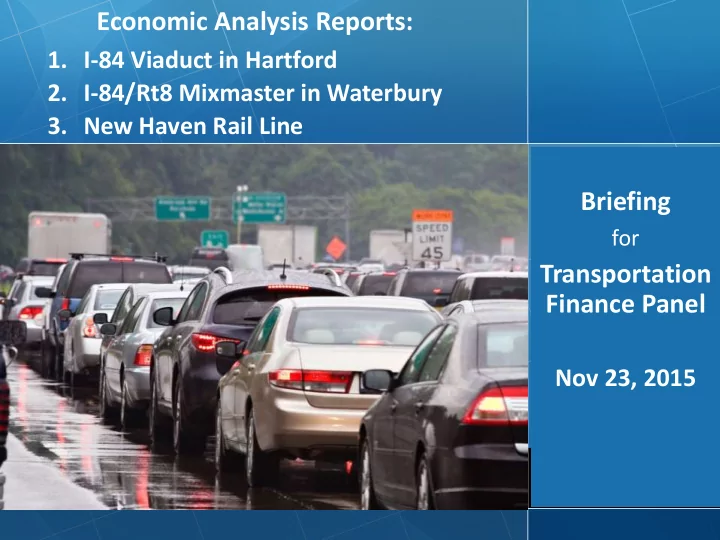
Economic Analysis Reports: 1. I-84 Viaduct in Hartford 2. I-84/Rt8 Mixmaster in Waterbury 3. New Haven Rail Line Briefing for Transportation Finance Panel Nov 23, 2015 Economic Analyses 1 & 2 1. I-84 Viaduct in Hartford 2. I-84/Rt8


slide-1
SLIDE 1

Briefing

for

Transportation Finance Panel

Nov 23, 2015

Economic Analysis Reports:

  • 1. I-84 Viaduct in Hartford
  • 2. I-84/Rt8 Mixmaster in Waterbury
  • 3. New Haven Rail Line
slide-2
SLIDE 2

Economic Analyses 1 & 2

  • 1. I-84 Viaduct in Hartford
  • 2. I-84/Rt8 Mixmaster in Waterbury

Largest projects in Let’s Go CT & primarily ‘preservation’ projects Both projects are ‘must do’ projects near the end of their life

  • expectancy. Both are too important to let deteriorate to unsafe &

unusable conditions. Purpose of Analyses: intended to measure value of the ‘facilities’ & the economic impacts of disinvestment.

2

slide-3
SLIDE 3

I-84: Hartford Viaduct & Waterbury Mixmaster

3

cost: $5.3 billion

cost:

$7.2 billion

slide-4
SLIDE 4

4

Deterioration & Closure

(worst case or ‘disinvestment’)

Assumptions:

  • Minor capital projects &

increased O&M keep Viaduct

  • pen for another decade.
  • Viaduct closed in 2026.
  • From 2026-2050, no traffic is

allowed to use the Viaduct.

  • Traffic forced to alternate

highways & local streets.

  • More congestion, more wasted

time, longer travel distances.

Full Replacement

(assumes lowered highway alternative)

Assumptions:

  • Larger capital project keeps the

current facilities open until 2030.

  • New facility opens in 2030.
  • Compared to the “worst case” or

closure scenario the facility remains open for full study

  • period. No diversions or detours
  • New facility designed to reduce

congestion & accidents

Deterioration & Closure vs Full Replacement

same comparative analysis for both Viaduct & Mixmaster
slide-5
SLIDE 5

I-84 Viaduct in Hartford

slide-6
SLIDE 6

I-84 Viaduct in Hartford

6

  • ¾ mile elevated highway
  • built in 1965 (50-yr design life)
  • large traffic volume (175,000 daily)
  • highly congested
  • must reconstruct or replace

1960s design:

 resulted in operational & accident problems

(acc. rate = 4X state average)

 divided & disrupted the city, neighborhoods, & street grid

slide-7
SLIDE 7

Benefit/Cost Analysis:

comparing user & societal benefits to project costs

Hartford Viaduct:

slide-8
SLIDE 8

Benefit/Cost Analysis:

Long-term Costs & Benefits

8

Replacement

  • Vs. Closure

“Present Value” (1)

  • f Benefits & Costs
  • A. Project Benefits (2)

$9.2 Billion

  • B. Project Costs

$3.4 Billion

  • C. Net Benefits

$5.8 Billion

  • D. Benefit/Cost Ratio

2.68

  • 1. Future costs & benefits are discounted to present value
  • 2. Benefits are primarily ‘user’ benefits like travel time savings, lower accident costs, &

improved travel time reliability. Hartford Viaduct:

slide-9
SLIDE 9

BCA: Personal vs Business Travel

Benefits Only (in $2015)

9

Trip Purpose Vehicle

Operating Costs

Travel Time

& Other Costs

Present Value Total

Personal & Commute $0.51 billion $6.06 billion $6.56 billion Business & Freight $0.20 billion $2.46 billion $2.65 billion Total Benefits $0.71 billion $8.52 billion $9.22 billion

(1) All future benefits discounted to present value or current

Hartford Viaduct: About 28% of benefits go to business & industry.

slide-10
SLIDE 10

Economic Impact Analysis:

Measuring the impact of the project

  • n economic growth in CT

Hartford Viaduct:

slide-11
SLIDE 11

Economic Impact Analysis (EIA) Long-Term Economic Growth

Cumulative increase from 2020 - 2050

11

Type of impact on CT economy Contribution to: Cumulative impact

  • f replacement vs closure

Business Sales (Output)

$10.2 Billion

Gross State Product $6.1 Billion Wage Income $4.2 Billion

Hartford Viaduct:

Values in each column are not additive. GSP & Wages are components of Business Sales

slide-12
SLIDE 12

EIA: Short-Term Construction Impacts

12

Type of impact on CT economy Contribution to: Cumulative impact from construction

Business Sales (Output)

$7.3 Billion

Gross State Product $4.1 Billion Wage Income $3.1 Billion

Hartford Viaduct:

slide-13
SLIDE 13

EIA: Short & Long-Term Job Impacts

13

Type of Job Number of Jobs

Construction Jobs

(for duration of construction )

4,300 – 7,500 jobs

each construction year

Permanent Jobs

(for each year during the 30-year analysis period thru 2050)

2,200 – 3,400 jobs

each year

Hartford Viaduct:

slide-14
SLIDE 14

I-84 Mixmaster in Waterbury

slide-15
SLIDE 15

15

I-84 Mixmaster in Waterbury

major interchange of I-84 & Route 8 Built in 1960s:

  • CT’s only ‘double-

decked’ highway

  • 130,000+ vehicles daily
  • must reconstruct or replace
  • about $7 billion to replace
slide-16
SLIDE 16

Benefit/Cost Analysis:

comparing user & societal benefits to project costs

Waterbury Mixmaster:

slide-17
SLIDE 17

BCA: Long-term Costs & Benefits

Waterbury Mixmaster

17

Replacement versus Closure “Present Value” (1)

  • f Benefits & Costs
  • A. Project Benefits (2)

$8.2 Billion

  • B. Project Costs

$4.7 Billion

  • C. Net Benefits

$3.5 Billion

  • D. Benefit/Cost Ratio

1.75

  • 1. Future costs & benefits are discounted to present value
  • 2. Benefits are primarily ‘user’ benefits like travel time savings, lower accident costs, &

improved travel time reliability. Waterbury Mixmaster:

slide-18
SLIDE 18

18

Trip Purpose Vehicle Operating Costs Travel Time & Other Costs Total

Personal & Commute $0.20 billion $5.52 billion $5.71 billion Business & Freight $0.10 billion $2.40 billion $2.50 billion

Total Benefits $0.31 billion $7.92 billion $8.22 billion

(1) All future benefits discounted to present value or current

Waterbury Mixmaster: About 30% of benefits go to business & industry.

BCA: Personal vs Business Travel

Benefits Only (in $2015)

slide-19
SLIDE 19

Economic Impact Analysis:

Measuring the impact of the project

  • n economic growth in CT

Waterbury Mixmaster:

slide-20
SLIDE 20

EIA: Long-Term Economic Growth

Cumulative increase from 2020 - 2050

20

Type of impact on CT economy Contribution to: Cumulative impact of replacement vs closure

Business Sales (Output)

$8.8 Billion

Gross State Product $5.1 Billion Wage Income $3.6 Billion

Waterbury Mixmaster:

Values in each column are not additive. GSP & Wages are components of Business Sales

slide-21
SLIDE 21

EIA: Short-Term Construction Impacts

21

Type of impact on CT economy Contribution to: Cumulative impact from construction

Business Sales (Output)

$10.4 Billion

Gross State Product $5.8 Billion Wage Income $4.5 Billion

Waterbury Mixmaster:

Values in each column are not additive. GSP & Wages are components of Business Sales

slide-22
SLIDE 22

EIA: Short & Long-Term Job Impacts

22

Type of Job Number of Jobs

Construction Jobs

(for duration of construction )

6,100 – 11,000 jobs

each construction year

Permanent Jobs

(for each year during the 30-year analysis period thru 2050)

2,100 – 2,800 jobs

each year

Waterbury Mixmaster:

slide-23
SLIDE 23

Hartford Viaduct & Waterbury Mixmaster

Side-by-Side Comparison

23

Economic analyses demonstrate positive economic returns for both of these ‘must do’ projects.

  • Replacing these critical but aging structures is essential to CT’s economy
  • Yields large benefits to users who depend on I-84
  • Supports economic growth and avoids economic losses that would result

from letting them deteriorate to unsafe & unusable condition.

slide-24
SLIDE 24

24

Replacement versus Closure “Present Value” (1)

Viaduct Mixmaster Project Benefits

$9.2 Billion $8.2 Billion

Benefit/Cost Ratio

2.68 1.75

BCA: Benefits to Users vs Cost

Large benefits to users & good B/C ratios

slide-25
SLIDE 25

EIA: Impacts to CT’s Economy

25

Contribution to: Viaduct Mixmaster Combined Impact

Business Sales (Output)

$10.2 Billion $8.8 Billion $19.0 Billion

Potential Losses to CT’s Economy if structures are allowed to deteriorate (versus being replaced)

Combined economic impact of $19 billion

slide-26
SLIDE 26

New Haven Line

Economic analysis of more frequent & faster service

slide-27
SLIDE 27

New Haven Rail Line

Serves a critical economic function

  • links CT directly to NYC
  • reliable & convenient rail service within CT in

severely congested highway corridor.

  • 80,000 daily riders

Ownership & operation

  • NHL commuter service operates 75 miles from

New Haven to NYC

  • CT owns 49 miles (New Haven to NY)
  • Metro North (MNRR) operates NHL for CT
slide-28
SLIDE 28

New Haven Rail Line (NHL)

Infrastructure Preservation

Most of the line is 4 tracks (but frequent repairs limit use to 2-3)

  • Rail preservation program in Let’s Go CT will restore the NHL

infrastructure to a good state of repair (full use of 4 tracks)

  • preservation costs not included in this service expansion analysis

Service Improvement Proposal

Let’s Go CT includes $2 billion for ‘improved’ service on NHL

Goals:

  • more frequent service
  • faster service (especially express trains)
slide-29
SLIDE 29

New Haven Rail Line (NHL)

Improved Service Concept

(2+2 track configuration)

local trains (outside tracks) express trains (inside tracks) local trains (outside tracks) express trains (inside tracks)

center island platforms

  • Use full 4-track capacity
  • Express trains travel unimpeded by locals,

but stop only at major stations

 Reduced travel times  More frequent service

  • Local trains stop at all or most stations

 Greatly increased frequency of service

slide-30
SLIDE 30

Base Case Existing Service Levels Build Case 2+2 Service Improvement Rail

Current rail service configuration, with future growth assumptions Restored 4-track capability plus Reconfiguration for 2+2 service

Highway Current capital program minor

capacity improvements with future traffic growth assumptions Current capital program, same as baseline, but expect to see congestion relief from diversion to faster & more frequent rail

New Haven Line:

Improved service vs. Existing service levels

slide-31
SLIDE 31
  • 1. “Existing” Rail & Bus Users:
  • Travel time savings for existing rail and bus users
  • Reliability improvements for existing rail users
  • 2. “New” Rail Users: (many diverted from highways)
  • Travel time savings
  • 3. Highway Users:
  • Travel time, reliability, & vehicle operating cost
  • benefits to drivers who remain on the road & do not divert to rail
  • Safety, logistics, and environmental benefits

Types of ‘Users’ & ‘User Benefits’

slide-32
SLIDE 32

Highway impacts:

  • Improved rail service will attract some drivers out of

their cars & into trains

  • Diversion of drivers to rail is expected to reduce

highway delays by:

 about 5 million hours annually.

Highway User Benefits

slide-33
SLIDE 33

Benefit/Cost Analysis:

comparing user & societal benefits to project costs

New Haven Line Service Improvements:

slide-34
SLIDE 34

Benefit/Cost Analysis: Long-term Costs & Benefits

New Haven Line 2+2 Service Improvements

Service Improvements versus existing service “Present Value” (1)

  • f Benefits & Costs
  • A. Project Benefits (2)

$9.7 Billion

  • B. Project Costs

$3.9 Billion

  • C. Net Benefits

$5.8 Billion

  • D. Benefit/Cost Ratio

2.51

  • 1. Future costs & benefits are discounted to present value
  • 2. Benefits are primarily ‘user’ benefits like travel time savings, lower accident costs, &

improved travel time reliability.

slide-35
SLIDE 35

35

Trip Purpose Vehicle Operating Costs Travel Time & Other Costs Total Benefits (1) ‘Existing’ Rail Users

  • $5.37 billion

$5.37 billion ‘New’ Rail Users

  • $0.95 billion

$0.95 billion Highway Users $1.10 billion $2.29 billion $3.39 billion Total Benefits $1.10 billion $8.63 billion $9.71 billion

(1) All future benefits discounted to present value or current

New Haven Line:

BCA: by type of user

Benefits Only (in $2015)

About 35% of benefits go highway users.

slide-36
SLIDE 36

Economic Impact Analysis:

Measuring the impact of the project

  • n economic growth in CT

New Haven Line Service Improvements:

slide-37
SLIDE 37

Economic Impact Analysis (EIA)

Long-Term Economic Growth

Cumulative increase from 2020 - 2040

Type of impact on CT economy Cumulative impact from new 2+2 service Additional Business Sales (Output)

$6.2 Billion

Additional Gross State Product

$3.9 Billion

Additional Wage Income

$2.8 Billion

slide-38
SLIDE 38

Economic Impact Analysis (EIA)

Short-Term or “Construction” Impacts

Type of impact on CT economy Cumulative impact from construction Additional Business Sales (Output)

$9.1 Billion

Additional Gross State Product

$6.3 Billion

Additional Wage Income

$4.9 Billion

slide-39
SLIDE 39

EIA: Short & Long-Term Job Impacts

39

Type of Job Number of Jobs

Construction Jobs

(for duration of construction )

2,300 – 5,900 jobs

each construction year

Permanent Jobs

(for each year during the 25-year analysis period thru 2040)

1,700 – 3,100 jobs

each year

slide-40
SLIDE 40

SUMMARY & CONCLUSIONS

  • New Haven Rail Line serves a critical economic function
  • Investing the New Haven Line is a good economic strategy as well as

a sound transportation policy

  • Reconfiguring tracks & services to operate on 2 express & 2 local

tracks yields a strong economic return $2 billion state investment:

– Returns $2.50 for every $1.00 invested (B/C ratio = 2.51)

  • Over $9 billion in benefits to highway users as well as rail users

– Grows CT economy by $6.2 billion in business sales & output