Brief History of IPE at UCSF Early findings from a longitudinal - - PDF document

brief history of ipe at ucsf
SMART_READER_LITE
LIVE PREVIEW

Brief History of IPE at UCSF Early findings from a longitudinal - - PDF document

B10ii: Early Findings from a Longitudinal Mixed-methods Study of the Development and Implementation of Interprofessional Education: A Californian Perspective Laura Bekes Brief History of IPE at UCSF Early findings from a longitudinal


slide-1
SLIDE 1

B10ii: Early Findings from a Longitudinal Mixed-methods Study of the Development and Implementation of Interprofessional Education: A Californian Perspective Laura Bekes

Collaborating Across Borders IV: Transformative Change from the Classroom to Practice June 12 – 14, 2013 | Vancouver, BC

Early findings from a longitudinal mixed-methods study of the development and implementation of interprofessional education: A Californian perspective

Laura Bekes, Tina Brock, Karen Hamblett, Susan Hyde, Lisa Kroon, Gail Persily, Kimberly Topp, Maria Wamsley, and Scott Reeves University of California, San Francisco

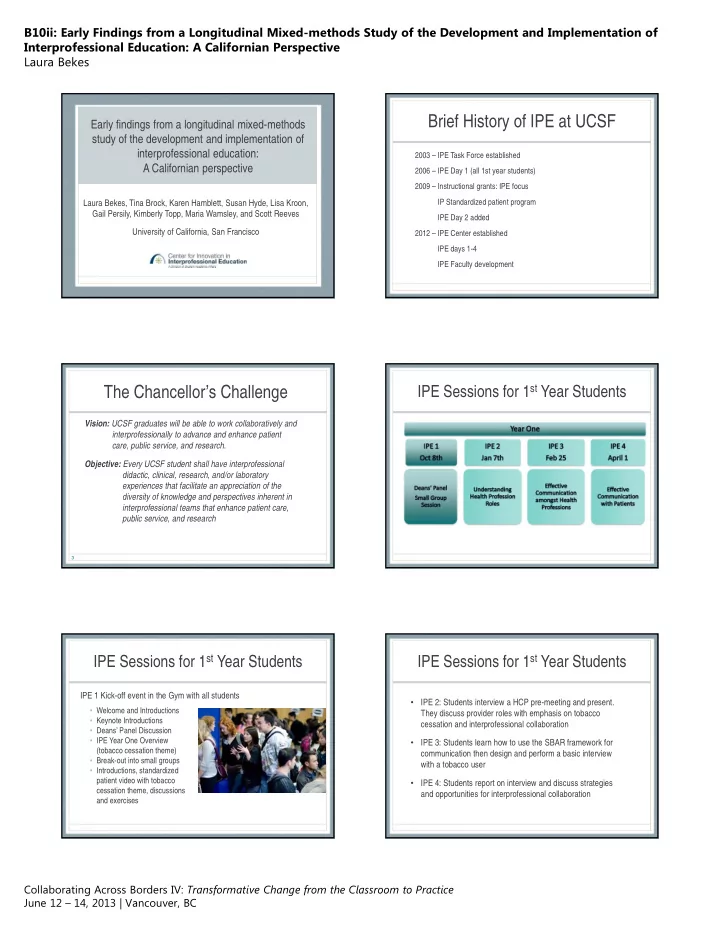
Brief History of IPE at UCSF

2003 – IPE Task Force established 2006 – IPE Day 1 (all 1st year students) 2009 – Instructional grants: IPE focus IP Standardized patient program IPE Day 2 added 2012 – IPE Center established IPE days 1-4 IPE Faculty development

3

The Chancellor’s Challenge

Vision: UCSF graduates will be able to work collaboratively and interprofessionally to advance and enhance patient care, public service, and research. Objective: Every UCSF student shall have interprofessional didactic, clinical, research, and/or laboratory experiences that facilitate an appreciation of the diversity of knowledge and perspectives inherent in interprofessional teams that enhance patient care, public service, and research

IPE Sessions for 1st Year Students IPE Sessions for 1st Year Students

  • Welcome and Introductions
  • Keynote Introductions
  • Deans’ Panel Discussion
  • IPE Year One Overview

(tobacco cessation theme)

  • Break-out into small groups
  • Introductions, standardized

patient video with tobacco cessation theme, discussions and exercises

IPE 1 Kick-off event in the Gym with all students

IPE Sessions for 1st Year Students

  • IPE 2: Students interview a HCP pre-meeting and present.

They discuss provider roles with emphasis on tobacco cessation and interprofessional collaboration

  • IPE 3: Students learn how to use the SBAR framework for

communication then design and perform a basic interview with a tobacco user

  • IPE 4: Students report on interview and discuss strategies

and opportunities for interprofessional collaboration

slide-2
SLIDE 2

B10ii: Early Findings from a Longitudinal Mixed-methods Study of the Development and Implementation of Interprofessional Education: A Californian Perspective Laura Bekes

Collaborating Across Borders IV: Transformative Change from the Classroom to Practice June 12 – 14, 2013 | Vancouver, BC

Focus

Mixed-methods formative and summative evaluation

  • Curriculum effectiveness
  • Curriculum improvement
  • Lessons for the field

Data Collection

  • Pre/post surveys (n=313)
  • University of West England Scale
  • Interdisciplinary Education Perceptions Scale
  • Session evaluation surveys (n=454, 450, 448, 430)
  • Student focus groups (n=43)
  • Facilitator feedback surveys (n=59, 50, 41, 33)

Findings

  • After IPE1, 99% of students agreed or strongly agreed that they

understand the concepts and impetus for IPE and why it is important

  • IPE1: 76% of students met at least 5 of the 6 learning objectives
  • IPE2: 59% of students met all 3 learning objectives (31% met 2 of 3)
  • IPE3: 72% of students met all 3 learning objectives (23% met 2 of 3)
  • IPE4: 80% of students met at least 3 of the 4 learning objectives

1% 6% 6% 40% 34% 13% 0% 20% 40% 60%

Decreased a lot Decreased a little No change ‐ IPP is of little value No change ‐ IPP is of high value Increased a little Increased a lot

How, if at all, has your perception of the value of interprofesional practice changed as a result of today's (IPE3) workshop?

(n=421)

Changes in Validated Scale Scores

Subscales Normalized Mean Change Baseline Follow‐up IEPS Competency & Autonomy (n=311) 45.4 46.0 + 0.6 Perception of Actual Cooperation (n=309) 76.3 75.0 ‐ 1.3 Perceived Need for Cooperation (n=311) 89.9 87.0 ‐ 2.9 *** UWE Interprofessional Relationships (n=306) 76.0 78.9 + 2.9 *** Interprofessional Interaction (n=308) 46.1 48.7 + 2.6 *** Communication & Teamwork (n=305) 59.6 61.0 + 1.4 ** Interprofessional Learning (n=307) 86.2 84.5 ‐ 1.7 **

***p<.001, **p<.01, *p<.05

Student Feedback on the Curriculum

  • Include an intentional social component for building rapport

and providing unstructured time to ask questions

  • Offer a number of interprofessional activities such as
  • Service learning opportunities
  • Lunchtime lectures
  • Interprofessional shadowing
  • Augment and enhance the course content and reconsider the

mode by which that content is provided

slide-3
SLIDE 3

B10ii: Early Findings from a Longitudinal Mixed-methods Study of the Development and Implementation of Interprofessional Education: A Californian Perspective Laura Bekes

Collaborating Across Borders IV: Transformative Change from the Classroom to Practice June 12 – 14, 2013 | Vancouver, BC

Facilitator Feedback on the Curriculum

  • Make explicit links between IPE content and patient safety
  • Challenge students to elevate the conversation on

interprofessional practice and training

  • Include concrete examples of situations in which IPE works

and doesn’t work, and address what to do when IPE isn’t working

Discussion

  • Students value interprofessionalism want to engage in

meaningful IPE experiences that provide opportunities for:

  • Developing hard and soft skills
  • Observing and participating in concrete examples of teamwork

and collaborative care

  • Small changes in students’ validated subscale scores
  • May need a finer instrument to measure meaningful changes

in attitudes, perceptions and behaviors

Next Steps

  • Further analyze quantitative and qualitative data
  • Refine IPE Days curriculum
  • Review evaluation and assessment tools

Questions?

Laura Bekes Research & Evaluation Coordinator UCSF Center for Innovation in Interprofessional Education laura.bekes@ucsf.edu