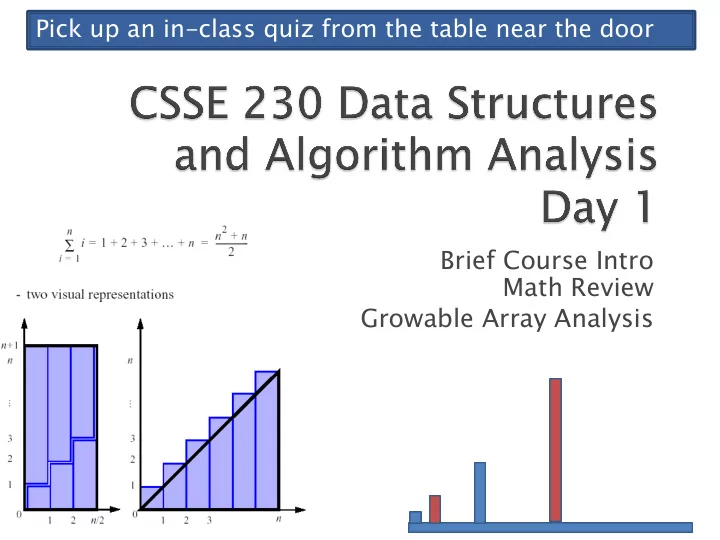
SLIDE 1
Brief Course Intro Math Review Growable Array Analysis
Pick up an in-class quiz from the table near the door
SLIDE 2 } Roll call
- Introduce yourself to the person next to you
- Outside of class, please share more with
classmates on the Piazza discussion forum, e.g., what’s your favorite food, what are your hobbies, types of work you’ve done, etc. (5pts toward homework grade)
And And int ntro to daily qui uizzes, worth h 5% of grade: Q1
SLIDE 3 To Topic I I do Yo You do do Yo You pr practice Yo You show
Analysis Explain, show, do Listen, follow, read, quiz Homework sets Tests Programming Major programs Tests, project
SLIDE 4
} Find serial number KB46279860I } If unsorted, you could look at all 10 million bills. } If sorted by serial number, binary search finds it by only
looking at _____ bills.
https://commons.wikimedia.org/wiki/File:Oenbilliondollar.jpg
Here’s $1,000,000,000:
SLIDE 5 } Work hard
- Re-do CSSE220 stuff as needed to make sure your
foundations (recursion and linked lists) are strong
} Take initiative in learning
Search Javadocs, Google, textbook, come for help
} Focus while in this class
- Laptops can distract from learning (11/26/2017 NYT)
} Start early and plan for no all-nighters
Two assignments each week: 1 homework set and 1 major program
} Talk to and work with others
- Don’t be the “lone ranger”
} But never give or use someone else’s answers Q2 Q2
SLIDE 6 } Course webpage
- Schedule, HW/program assignments, etc.
- Read the Sy
Sylla llabus: Tomorrow’s quiz will start with questions about it.
} Piazza
- Homework questions.
- Don’t email, use Piazza! If you email, I’ll usually reply, “Great
question! Please post it to Piazza”
- You can set it to auto-email you whenever there is a post.
} Moodle:
- gradebook, homework pdf turn-in, peer evaluations, solutions
} Eclipse
- Demo of checking out WarmUpAndStretching
Q3 Q3–5
SLIDE 7
} analyze runtimes of code snippets by
counting instructions.
} explain why arrays need to grow as data is
added.
} derive the average and worst case time to
insert an item into an array [GrowableArray exercise]
SLIDE 8
SLIDE 9 } Floor:
𝑦 = the largest integer ≤ 𝑦
} Ceiling:
𝑦 = the largest integer ≥ 𝑦
- java.lang.Math provides methods floor()and ceil()
} Summations
%
&'( )
𝑔 𝑗 = 𝑔 𝑡 + 𝑔 𝑡 + 1 + 𝑔 𝑡 + 2 + ⋯ + 𝑔 𝑢
- 𝑔 is a function
- 𝑡 is the start index
- 𝑢 is the end index
SLIDE 10 } Geometric sequence: each term is a constant
multiple of the previous term
- The sequence exhibits exponential growth
- 1, 𝑏, 𝑏4, 𝑏5, 𝑏6, …
} Geometric sum. Index is in the exponent
%
&'8 9
𝑏& = 1 + 𝑏 + 𝑏4 + ⋯ + 𝑏9 = 1 − 𝑏9;< 1 − 𝑏 = 𝑏9;< − 1 𝑏 − 1 (for 𝑜 ≥ 0, 𝑏 ≠ 1)
} Exercise. Compute
%
&'4 @
3&
Memorize this formula! Q6 Q6–7
SLIDE 11 } Arithmetic sequence: each term is a constant
(often 1) added to the previous term
- 2,6,10,14,18, …
- 1,2,3,4,5,6, …
} Arithmetic sum
%
&'< 9
𝑗 = 1 + 2 + 3 + ⋯ + 𝑜 = 𝑜(𝑜 + 1) 2
} Exercise. Compute
%
&'4< 68
𝑗
Memorize this formula! Q8 Q8-9
SLIDE 12
SLIDE 13 } Selection sort basic idea:
- Think of the array as having an unsorted part, then a sorted part
- Find the largest value
in the unsorted part
- Swap it to the beginning
- f the sorted part (making
the sorted part bigger and the unsorted part smaller)
} Pseudocode:
Repeat until unsorted part is empty
1 for (int i = n-1; i > 0; i--) { 2 int maxPos = 0; 3 for (int j = 0; j <= i; j++) { 4 if (a[j] > a[maxPos]) { 5 maxPos = j; 6 } 7 } 8 swap a[maxPos] with a[i] ; 9 }
SLIDE 14 1 for (int i = n-1; i > 0; i--) { 2 int maxPos = 0; 3 for (int j = 0; j <= i; j++) { 4 if (a[j] > a[maxPos]) { 5 maxPos = j; 6 } 7 } 8 swap a[maxPos] with a[i] ; 9 }
i j Co Count unt n–1 0,1,2,…,n–1 n n–2 0,1,2,…,n–2 n–1 n–3 0,1,2,…,n–3 n–2 … … … 2 0,1,2 3 1 0,1 2
How many times does the most-frequently-run line of code run, as a function of n? Add up counts! Tabulate all values of index variables. %
&'4 9
𝑗 = ? Note: not the same 𝑗 as before… Q1 Q10
SLIDE 15
An exercise in doubling, done by pairs of students
SLIDE 16 } Basis for ArrayLists, sorting, and hash tables } Why? O(1) access to any position, regardless of
the size of the array.
} Limitation of ArrayLists:
- Fixed capacity!
- If it fills, you need to re-allocate memory and copy items
How efficient is this? Consider two schemes: “add 1” and “double”
} GrowableArray demo
SLIDE 17
} Work with a partner } Hand in the document before you leave today
if possible. Otherwise due start of class on Day 2.
} Get help as needed from me
SLIDE 18
Properties of logarithms 𝑚𝑝L 𝑦𝑧 = 𝑚𝑝L 𝑦 + 𝑚𝑝L 𝑧 𝑚𝑝L N 𝑦 𝑧 = 𝑚𝑝L 𝑦 − 𝑚𝑝L 𝑧 𝑚𝑝L 𝑦O = 𝛽 𝑚𝑝L 𝑦 𝑚𝑝L 𝑦 = 𝑚𝑝Q 𝑦 𝑚𝑝Q 𝑐
𝑏STUV 9 = 𝑜STUV Q
Properties of exponents 𝑏 L;W = 𝑏L𝑏W 𝑏LW = 𝑏L W N 𝑏L 𝑏W = 𝑏 LXW 𝑐 = 𝑏STUY(L) 𝑐W = 𝑏W∗STUY(L)