
SLIDE 1
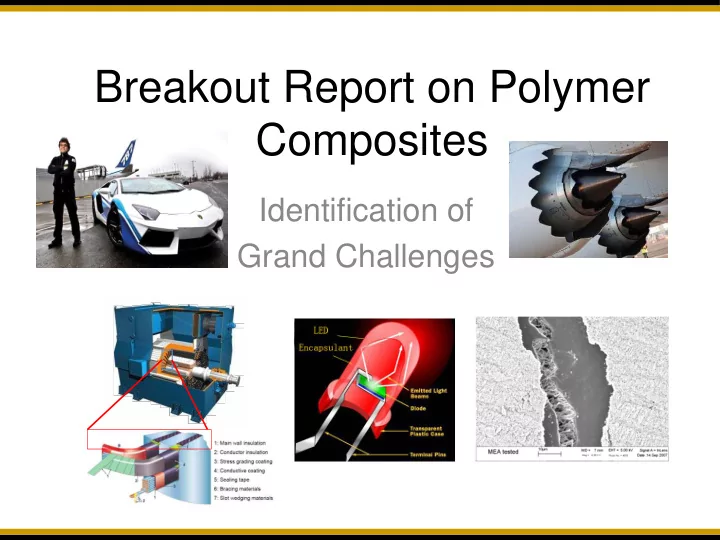
Breakout Report on Polymer Composites Identification of Grand - - PowerPoint PPT Presentation
Breakout Report on Polymer Composites Identification of Grand Challenges Breakout Polymer Composites Chairs: R. Byron Pipes, Purdue University Rani Richardson, Dassault Systemes Committee: Members Ted Lynch
– R. Byron Pipes, Purdue University – Rani Richardson, Dassault Systemes
Committee: Members
Ted Lynch SAMPE Greg Schoeppner AFRL Marisol Koslowski Purdue Steve Christensen Boeing Scott Henry ASM Greg Gemeinhardt GE Scott Case Virginia Tech Chaitra Nailadi GE Chuck Ward AFRL Linda Schadler Rensselaer Polytechnic Institute Carol Schutte DOE Sarah Morgan University of Southern Mississippi David Jack Baylor University Bill Avery Boeing Jeff Gilman NIST Tom Kurfess Georgia Tech Ozden Ochoa Texas A&M University
manufacturing and performance – replace the building block approach with simulation and test for validation – certify products in a manner that allows for composition and processing to be adjustable without recertification
validated simulation for a priori materials design
uncertainty in design and manufacturing
designers, materials suppliers and manufacturers
11/21/2013 3
Materials/product engineers need to be able to ______ Which materials scientists could enable by ______ Develop and validate composite simulation models. A serious UQ effort to quantify “model form error” in our simulations. Full 3-D imaging of 1000 cm3 cube real or full scale composites with resolution at level of constituents,
Simulate composite manufacturing processes to predict microstructure and variability Developing measurements and models to determine non- equilibrium , polymer molecular mass, and chemical functionality changes during cure in a 3-D part Validate simulation tools for composite performance Developing an open curated database of composite test and simulation data
If materials scientists could ________, then new pathways of materials discovery would be possible.
modeling into existing micro and macro scale simulations
relevant phenomena
interaction of polymer, constituent and interphase properties
discovery of optimum systems
development is still needed.
product certification (especially for aircraft) via experiment dominated “building-block-approach”.
costly
validated simulations using the MGI approach consisting
atomistic level and extending continuously to the macroscopic scale to enable accurate prediction of full scale performance.
technology readiness level system for measured validation and verification (tool maturity level).
polymer and reinforcement, therefore material discovery is required.
largest impact if efforts are focused on discovery of: – new polymer and constituent combinations to produce enhanced performance – conventional composites with multifunctional performance ((electrical conductivity) – tailorable polymer chemistries to enable enhanced processing – materials with improved life-cycle performance – recyclable and sustainable systems and methods – methods for control of nanoparticle-network meso-structure.
Describe microstructure more realistically. We often assume very regular materials, with perfect stoichiometry down to the few nanometers, no significant defects, gradients in composition, etc. This is particularly important near the fibers. Perform “reactive MD simulations” where chemical bonds are allowed to break and form as needed to predict ultimate properties. Reactive interatomic potentials (like ReaxFF) exist for this but have not been used in the field. Defect propagation will require very large-scale Simulations. A serious UQ effort to quantify “model form error” in our simulations. This would require very detailed experiments where the molecular structure is well known in samples small enough to simulated directly. Relaxation time scales of long-chain polymers is well over MD timescales and this continues to be a problem
11/21/2013 8
11/21/2013 9
11/21/2013 10
11/21/2013 11
Airbus 350 Boeing 787 Engine blades and shroud
11/21/2013 12
11/21/2013 13
explosion in the use of composite materials as the major aerospace players, namely Boeing, Airbus and general aviation, have finally fully committed to this technology:
technology will change dramatically, first in aerospace and then in all sectors as the technology permeates throughout the industry
untouched:
company can make their product in composites
11/21/2013 14
11/21/2013 15
BMW's Klaus Draeger says the i3 and larger i8 (pictured) will change the car making game forever Juxtaposition of the Boeing 787 and carbon fiber automotive prototype
– The number of possible combinations of polymers, constituents, interface designs and microstructures is huge – Edisonian approach to optimization – Product and material design is simultaneous – Ultra-conservative designs have been pervasive – Building block certification approach is very expensive – Certification is testing based ($millions/material) – Manufacturing is empirical, not science-based – Large scale integration of subassemblies to monocoque structures (too large to fail!) – Repair and joining technologies not robust
11/21/2013 16
11/21/2013 17
11/21/2013 18
19
Nanometrology Characterization & Informatics Finite Elements
s 13
Phase field micromechanics
Molecular Dynamics
11/21/2013 21
5µm 5µm 5µm 5µm 5µm 1µm 1µm 1µm 1µm 1µm 0.2%vol SWNT 0.5%vol SWNT 0.9%vol SWNT 2.7%vol SWNT 6.4%vol SWNT 6.4%vol SWNT 2.7%vol SWNT 0.9%vol SWNT 0.5%vol SWNT 0.2%vol SWNT
22 11/21/2013
bpipes@purdue.edu