Breaking Ground and Barriers: COMMUNITY LEADERSHIP CENTER Building - - PowerPoint PPT Presentation

breaking ground and barriers
SMART_READER_LITE
LIVE PREVIEW

Breaking Ground and Barriers: COMMUNITY LEADERSHIP CENTER Building - - PowerPoint PPT Presentation

Breaking Ground and Barriers: COMMUNITY LEADERSHIP CENTER Building a Legacy of Excellence Gloria Bonilla-Santiago Ph.D., Board of Governors Distinguished Service Professor of the Graduate Department of Public Policy and Administration at


slide-1
SLIDE 1

COMMUNITY LEADERSHIP CENTER

Breaking Ground and Barriers: Building a Legacy of Excellence

1

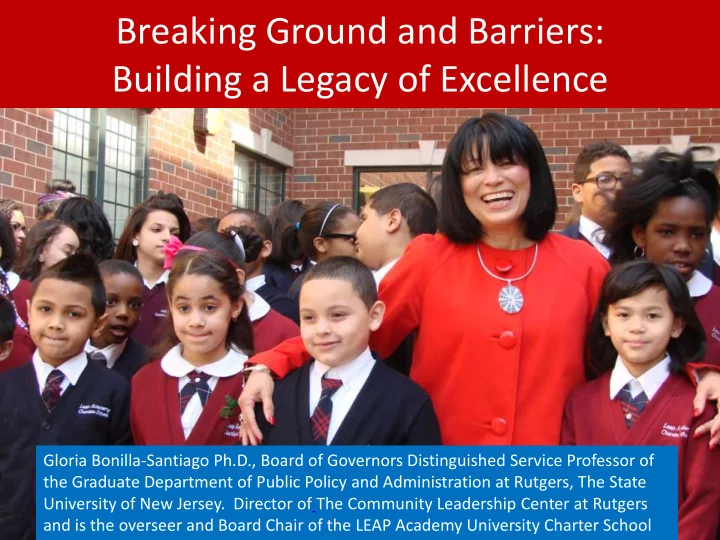
Gloria Bonilla-Santiago Ph.D., Board of Governors Distinguished Service Professor of the Graduate Department of Public Policy and Administration at Rutgers, The State University of New Jersey. Director of The Community Leadership Center at Rutgers and is the overseer and Board Chair of the LEAP Academy University Charter School

slide-2
SLIDE 2

COMMUNITY LEADERSHIP CENTER

Points to Ponder in my trajectory of Success

  • 1. Mapping my future -as a migrant child

navigating the road helping my father to arrive at a destination for work twice a year to Florida and New Jersey.

  • 2. Breaking the cycle of poverty through

education- School became my way

  • ut of poverty so perseverance,

resiliency and love for learning became a necessity to survival.

slide-3
SLIDE 3

COMMUNITY LEADERSHIP CENTER

Points to Ponder in my trajectory of Success

  • 3. Vision with purpose: learn the

unknown, build discipline, commitment and become an expert on the task at hand.

  • 4. Manage my fears and Master

confidence and savvy

  • 5. Reinvented oneself by staying

relevant, learning something new and meeting every challenge and

  • pportunity
slide-4
SLIDE 4

COMMUNITY LEADERSHIP CENTER

Points to Ponder in my trajectory of Success

  • 6. Choose battles carefully
  • 7. Stayed focus, every step of

the way on what matters

  • 8. Maintenance your kitchen

cabinet

  • 9. Master financial, social, human and

intellectual capital to support an agenda

slide-5
SLIDE 5

COMMUNITY LEADERSHIP CENTER

Points to Ponder in my trajectory of Success

  • 10. Optimism and faith when

managing dangerous leadership 11.Build capacity from within 12.Stay healthy physically , spiritually and emotionally

slide-6
SLIDE 6

COMMUNITY LEADERSHIP CENTER

Points to Ponder in my trajectory of Success

13.Is not what you deserve but what

  • ne negotiates
  • 14. Sustained healthy

relationships 15.Have courage to stand for justice

slide-7
SLIDE 7

COMMUNITY LEADERSHIP CENTER

Creating a comprehensive model for serving children and families from Birth through College and Beyond in a public school setting

slide-8
SLIDE 8

COMMUNITY LEADERSHIP CENTER

The Collective Mission Statement

The mission of the LEAP Academy is to enhance

  • pportunities for the children and families of

Camden through the collaborative design, implementation, and integration of education, health and human services, professional development, and community development.

slide-9
SLIDE 9

COMMUNITY LEADERSHIP CENTER

LEAP Historical Milestones

9

slide-10
SLIDE 10

10

1997 - 1999: LEAP Academy opens its and grows Elementary School. 2000 – 2003: LEAP graduates its first 8th grade class and begins a high school program. A Pre-School Program under the umbrella of the Rutgers Centers of Excellence is added to serve 90 children. 2004 – 2010: LEAP acquires a high school facility, and graduates its first 6 senior classes with 100% graduation and college placement. 60 ninth graders are recruited to participate in a STEM High School Program that will eventually serve 240 students. 2011-2014: LEAP

  • pens its STEM

Facility and plans for new school facility in at the Wilson

  • Building. 9 senior

classes with 100% graduation and college placement. Enrollment growth period.

slide-11
SLIDE 11

COMMUNITY LEADERSHIP CENTER

Strategic Planning

slide-12
SLIDE 12

Five Stage Planning Process

Stage 2 Building Trust Stage 3 Developing a Strategic Plan Stage 4 Taking Action Stage 5 Going to Scale Reflect & Celebrate Reflect & Celebrate Reflect & Celebrate Repeat the Process Getting Together

Building a New System: A Five - Stage Process For Change

Stage 1 Getting Together Reflect & Celebrate

Change

Milestones

excepted from Melaville, A.et al, Together We Can: A Guide for Crafting a Profamily System of Education and Human Services, 1993, Washington, DC: U.S.Government Printing Office

slide-13
SLIDE 13

Core Planning Areas

  • understanding the needs of the community
  • researching successful strategies and leveraging expertise
  • involving residents in all aspects of planning and program design

Research and Program Design

  • promoting a transformative vision to local stakeholders and the community
  • leveraging community leadership and participation through training and capacity building
  • assembling competent and committed staff team

Commitment Building

  • collecting and analyzing baseline data about the community
  • engaging diverse stakeholders in planning
  • develop a collective guiding product that incorporates broad input and ownership

Planning

  • secure funding for planning
  • design multi-year resource development plan
  • engage in partnerships that result in leveraged resources

Resource Development

  • design of innovative management and governance structures
  • design programs in direct response to community needs
  • identify and cultivate opportunities for continued community participation

Programming and Operations

  • document the process through multiple and varied archives
  • develop formative and outcome based evaluation mechanisms
  • ongoing communications

Documentation and Evaluation

slide-14
SLIDE 14

Structuring the Strategic Planning Effort

Planning/Implementation Coordination and Oversight Communications and Public Relations Funding Quality Assurance Governance Curriculum and Instruction Curriculum Development LEAP Academy/Camden School Relationships Time/Space Utilization Human Services Health Promotion and Education Social Services Legal/Business Services Community Service Volunteers Leadership and Professional Development Training and Development Community Leadership Development Community Outreach Celebrating Diversity Parent Involvement

slide-15
SLIDE 15

Stakeholder Analysis/Engagement

  • Parents
  • Neighborhood

leaders

  • Foundations/Funders
  • Business
  • Community based and

service organizations

  • Faculty and Staff
  • University President
  • Board of Governors
  • Students
  • Legislators (State and Local)
  • Governor
  • State and Local Officials
  • Camden Board of Education
  • Delaware River Port

Authority

Government and the Public Sector Rutgers University Parents and community residents Private and Non-profit Sectors

slide-16
SLIDE 16

LEAP Values

  • 1. Student Achievement – Comes

first

  • 2. We do what ever It takes to get

the job Done.

  • 3. We take the High Road
  • 4. We are a Family
  • 5. Positive and Caring Culture
  • 6. We are all Accountable
  • 7. Transparency with each other
  • 8. Improvement is ongoing
  • 9. Diversity is our Strength

10.We are one Team

slide-17
SLIDE 17

Five Core Elements

  • f the LEAP Model
  • 1. Accountability for People,

Time, Money and Programs

  • 2. Pipeline of College Access

for all students PreK- 16

  • 3. Teacher Development and

Support

  • 4. Parental Engagement
  • 5. Early Learning means later

Earning

slide-18
SLIDE 18
slide-19
SLIDE 19

A Focus on Pipeline Development The Rutgers/LEAP Pipeline to College

19

slide-20
SLIDE 20

COMMUNITY LEADERSHIP CENTER

Enrollment Profile of the Birth-12th Pipeline

  • 1,500 students Birth through 12th
  • LEAP Academy

– Lower Elementary Campus (K-3) – Upper Elementary (4-6) – Intermediate High School (7-9) – High School (10-12)

  • Early Learning Research Academy
  • Infants (6 months - 1 year)
  • Toddlers (age 1-3 )
  • Preschoolers (ages 3-4)

20

slide-21
SLIDE 21

Factors of LEAP Best Practices

21

slide-22
SLIDE 22

Family Engagement

slide-23
SLIDE 23

Core Elements of LEAP’s Family Engagement Framework

23

slide-24
SLIDE 24

LEAP Principles for Family Engagement

  • Parents are

encouraged to be introspective about their own parenting. Training

  • Parents are

encouraged to consider what roles they can play to improve the school and the community. School Participation

  • Parents are

trained to think about future possibilities and expectations, for both their children and themselves. Personal Growth

  • Parents are

encouraged to provide leadership for change that is beneficial to the school and the community. Civic Leadership

slide-25
SLIDE 25

Results

slide-26
SLIDE 26

COMMUNITY LEADERSHIP CENTER

High school graduation and College placement rate

  • 100% in 2005
  • 100% in 2006
  • 100% in 2007
  • 100% in 2008
  • 100% in 2009
  • 100% in 2010
  • 100% in 2011
  • 100% in 2012
  • 100% in 2013
  • 100% in 2014
slide-27
SLIDE 27

Comparative High School Graduation Rates for LEAP and Surrounding High Schools (2012-2013)

100% 91.21 97% 98% 87% 94% 45% 55% 83%

0% 10% 20% 30% 40% 50% 60% 70% 80% 90% 100% High School Graduation Rates 2012-2013 LEAP Cherry Hill West Haddonfield Cherry Hill East Collingswood Voorhees Camden High Woodrow Wilson State Average

slide-28
SLIDE 28
slide-29
SLIDE 29

Elementary Grades (PK-6): 639 Cooper Street

slide-30
SLIDE 30

High School Grades (7-12): 549 Cooper Street

slide-31
SLIDE 31

LEAP ACADEMY STEM Campus 528 Cooper Street

slide-32
SLIDE 32

Early Learning Research Academy 501 Cooper Street

slide-33
SLIDE 33

Wilson Building 130 North Broadway, Camden

slide-34
SLIDE 34

Structuring A Planning Effort For Puerto Rico

SCHOOLS AS NEXUS FOR COMMUNITY DEVELOPMENT

slide-35
SLIDE 35

Strong Early Childhood Programs High Performing Schools Effective K-12 programs Higher high school graduation rates Successful transitions from high school to college/career Academic enrichment programs Social, recreation and character building for children and youth Quality health services Social service programs Adult learning opportunities and Job readiness training Neighborhood based employment opportunities Legal services Safe schools and neighborhoods Business development Crime prevention Local/community based leadership development Better housing options and support for residents Community Building and Ownership Interagency Collaboration LEAP APPROACH TO COMMUNITY SCHOOL APPROACH: Serving the entire family

Better outcomes for children and youth

Children & Youth

Better outcomes for the community

Community

Better outcomes for families

Families