Brain Research through Advancing Innovative Neurotechnologies - - PowerPoint PPT Presentation

brain research through advancing innovative
SMART_READER_LITE
LIVE PREVIEW

Brain Research through Advancing Innovative Neurotechnologies - - PowerPoint PPT Presentation

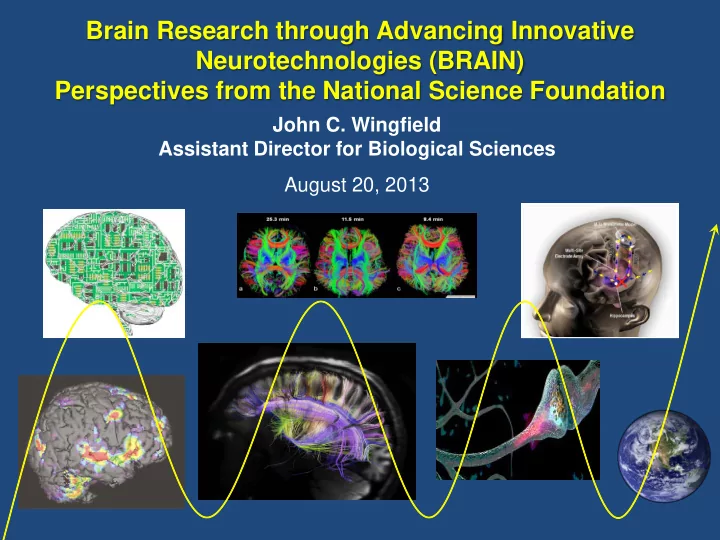
Brain Research through Advancing Innovative Neurotechnologies (BRAIN) Perspectives from the National Science Foundation John C. Wingfield Assistant Director for Biological Sciences August 20, 2013 Basic Research Challenges Required to Achieve

slide-1
SLIDE 1

Brain Research through Advancing Innovative Neurotechnologies (BRAIN) Perspectives from the National Science Foundation

John C. Wingfield Assistant Director for Biological Sciences August 20, 2013

slide-2
SLIDE 2

Basic Research Challenges Required to Achieve the BRAIN Initiative Goals

  • Foundational knowledge
  • Tools for high-resolution measurements
  • Computational models and theoretical frameworks
  • Data storage, management and analysis

The NSF Role

NSF is uniquely positioned to lead a multidisciplinary effort by scientists and engineers to advance the

  • riginal research and tool development and educate the

workforce needed for the BRAIN initiative to succeed.

slide-3
SLIDE 3

NSF Programs Support Research to:

  • 1. Determine the genomic architecture, synaptic activity,

and neural circuitry that gives rise to the emergent properties of the brain:

  • New molecular probes
  • Improved ability to sense and record neural network

activity

  • New imaging and related nanotechnologies
  • 2. Establish conceptual & theoretical frameworks to guide

future research:

  • Link brain activity patterns to cognitive and behavioral

functions in specific ecological, evolutionary, developmental and social contexts.

  • Apply social science theories and methods to link

brain activity patterns to individual human behaviors.

slide-4
SLIDE 4

Biomimetic Micro Electronic Systems (BMES) Engineering Research Center

  • First FDA-Approved Retinal

prosthesis (2013)

  • First implanted device used to

treat adult patients with advanced retinitis pigmentosa.

  • Images from external video

camera are transformed into electronic data that is wirelessly transmitted to the retinal prosthesis.

  • Letter recognition, word

reading, improved mobility,

  • bject localization, motion

detection. Second Sight Medical Products Argus II

Video images captured by a miniature camera, housed in the patient’s glasses are converted into a series of small electrical pulses that are transmitted wirelessly to an array of electrodes on the surface of the retina (epi-retinal).

John L. Wyatt Jr., MIT Co-Director, Boston Retinal Implant Project

slide-5
SLIDE 5

Ethical Questions To Consider

  • How do we manage or regulate rapidly evolving

technologies?

  • Do we need different principles to guide ethical

policies relating to different uses of neurotechnology? (i.e. intelligence, defense, medical, personal)

  • Should there be a distinction based on the intent
  • f the use? (treatment vs. enhancement)
  • Who will manage these policies?
  • When and where should neuroethics education

start?

slide-6
SLIDE 6

Bioethical Concerns

  • Dual Use Research of Concern (DURC)

– National Science Advisory Board for Biosecurity housed at HHS – U.S. Government Policy for Oversight: http://www.phe.gov/s3/dualuse/Documents/us-policy- durc-032812.pdf – U.S. Government Policy for Institutional Oversight: http://www.phe.gov/s3/dualuse/Documents/oversight- durc.pdf

  • Synthetic Biology

– The Commission released a report in December 2010: http://bioethics.gov/sites/default/files/PCSBI-Synthetic- Biology-Report-12.16.10.pdf

slide-7
SLIDE 7

Bioethical Concerns

  • Animal Science

– Guide for the Care and Use of Laboratory Animals: http://grants.nih.gov/grants/olaw/Guide-for-the- care-and-use-of-laboratory-animals.pdf

  • Protecting Human Subjects (Moral

Science)

– The Commission released a report in December 2011: http://bioethics.gov/node/558

slide-8
SLIDE 8

Bioethical Concerns

  • Brain-Machine Interface (BMI) Issues

– Invasive v. Non-invasive – Implants – Brain stimulation – Prosthetics – Mind control?

slide-9
SLIDE 9

Future Steps

  • Improving accountability
  • Ethical underpinnings of regulation should be

explicit

  • Investigator obligations should be explicit in

policies and regulations

  • Promote engagement by the communities

– Research – Industry – Students – Public-at-large

slide-10
SLIDE 10

Additional Resource

  • Nuffield Council on Bioethics’s latest report:

“Novel Neurotechnologies: Intervening in the Brain” published 24 June 2013 www.nuffieldbioethics.org/neurotechnology