
SLIDE 1
Bounce Back
Early Alert and Follow-up Program
Queen‟s University in Kingston, Canada Arig al Shaibah, Assistant Dean of Student Affairs, Ph.D.
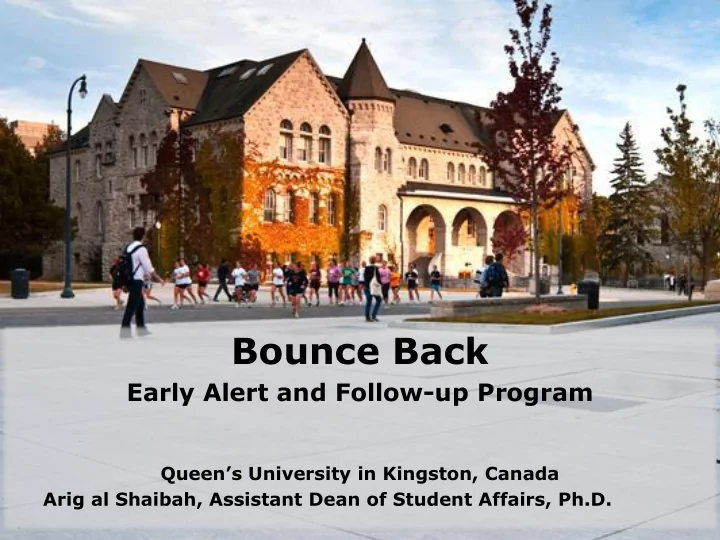
Bounce Back Early Alert and Follow-up Program Queens University in - - PowerPoint PPT Presentation
Bounce Back Early Alert and Follow-up Program Queens University in Kingston, Canada Arig al Shaibah, Assistant Dean of Student Affairs, Ph.D. Session Outline Case for Early Alert Assessment Program Early Alert on your and Questions
Early Alert and Follow-up Program
Queen‟s University in Kingston, Canada Arig al Shaibah, Assistant Dean of Student Affairs, Ph.D.
Case for Early Alert Program Program Overview Early Alert
Campus Assessment and Findings Questions
University-age highest risk for mental health problems NCHA (2013) undergraduate results
31% 21% 13%
0% 5% 10% 15% 20% 25% 30% 35%
Stress Anxiety and sleep difficulties Depression
Lack of Preparedness/Confidence
Evidenced in…
To support the persistence and progression
quality of their student experience by: 1. Identifying first year students at risk academically and reaching out to provide early intervention 2. Identifying and responding to personal/mental health issues affecting student engagement and academic success
Effective retention programs are intrusive and intentional Bounce Back
Based on University of Guelph model
– Carleton University also adapted Guelph model
Donor supported in first two years
– Jack Project major sponsor
Early Alert…hmm m?
Considering Early Alert Program
Bounce Back Facilitators (BBFs)
The Team
Peer-Based Academic Support
Anna, BBF MA „15
April, BBF BEd „15
Two-tiered structure
Buck, BBF Rugby player BA „15
Professional Network:
Mentoring Relationships Learning Strategies
(getting unstuck)
Physical & Mental Health Campus Resources
What do your interventions with academically “at-risk” students look like? How is student participation/uptake maximized?
Early Alert Program Models?
Assessment Plan and Tools
Participant Intake Survey Study Skills and Habits Questionnaire eRezLife BBF Mentor Logs *Analysis of Grades (GPA) and Retention Rates *Post-Program Evaluations
*Contrasted with eligible non-participants
ARTS & SCIENCE
ENGINEERING
NURSING
COMMERCE
course
Profile of Eligible Students
Arts & Science – Pilot Year
2649 Students 68% F 32% M Queen’s First Year ArtSci Cohort
2013-2014
Bounce Back Pilot Year
2013-2014
6% 2% 92%
First Generation Aboriginal Non-Aboriginal/Non-First Generation Student Cohort
262 Eligible 75% F 25% M
17% 1% 82%
First Generation Aboriginal Non-Aboriginal/Non-First Generation Student Cohort
4 in 10 eligible students
Uptake
Arts & Science – Pilot Year
Arts & Science Pilot Year
0.2 0.4 0.6 0.8 1 1.2 1.4 Participants Eligible Non-Participants 1.08 0.99 1.40 1.20 Mid-year Year-end
*Statistically significant
+0.21 +0.32
Arts & Science Pilot Year
66.3% 55.0% 0.0% 10.0% 20.0% 30.0% 40.0% 50.0% 60.0% 70.0% 80.0% 90.0% 100.0% Participants Eligible Non-Participants
+11.3%
*Statistically significant
Self-Reported Post-Program Results Pilot Year
Greater…
More…
advising, and writing Considerably more…
Nursing, Engineering, Commerce
Nursing
Engineering
Commerce
Enablers/Successes
Challenges/Issues
Lessons Learned (Year 1)
Enablers/Successes
most “at-risk” students (< 0.7) Challenges/Issues
Lessons Learning (Year 2) Challenges
Three things you learned Two things you want to explore further One thing you want to do
Arig al Shaibah arig.alshaibah@queensu.ca Cassandra Eberhardt cassandra.eberhardt@queensu.ca