Bollinger Valley Project Public Hearing Moraga Town Council - - PowerPoint PPT Presentation

bollinger valley project
SMART_READER_LITE
LIVE PREVIEW

Bollinger Valley Project Public Hearing Moraga Town Council - - PowerPoint PPT Presentation

Bollinger Valley Project Public Hearing Moraga Town Council November 14, 2018 2 3 4 Existing Site 5 Views north and west from upper ridgeline toward Lafayette and County 6 View south from central ridge 7 Mapped Landslides 8


slide-1
SLIDE 1

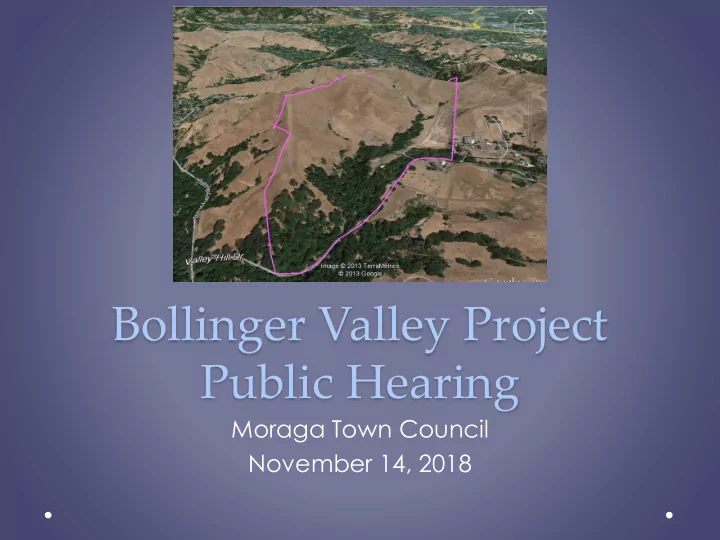
Bollinger Valley Project Public Hearing

Moraga Town Council November 14, 2018
slide-2
SLIDE 2

2

slide-3
SLIDE 3

3

slide-4
SLIDE 4

4

slide-5
SLIDE 5

Existing Site

5

slide-6
SLIDE 6

Views north and west from upper ridgeline toward Lafayette and County

6

slide-7
SLIDE 7

View south from central ridge

7

slide-8
SLIDE 8

Mapped Landslides

8

slide-9
SLIDE 9

Vegetation

9

slide-10
SLIDE 10

Onsite Drainage

10

slide-11
SLIDE 11

Slope Map

11

slide-12
SLIDE 12

Conceptual Development Plan

12

slide-13
SLIDE 13

13

slide-14
SLIDE 14

Grading Plan

14

slide-15
SLIDE 15

15

slide-16
SLIDE 16

Offsite EVA, looking West to East

16

slide-17
SLIDE 17

17

slide-18
SLIDE 18

Draft EIR

  • Published February 22, 2013
  • Addresses the Project and 5 alternatives.
  • Includes:
  • Introduction
  • Project Description
  • Summary of Findings
  • Impact analysis of:
  • Aesthetics
  • Noise
  • Air Quality & Greenhouse Gas Emissions
  • Population, Housing,
  • Biological Resources

and Employment

  • Cultural Resources
  • Public Services
  • Geology, Soils, and Seismicity
  • Schools
  • Hydrology and Water Quality
  • Transportation
  • Land Use and Agricultural Resources
  • Utilities and Hazards
  • CEQA Required Assessments
  • References
  • Appendices
  • NOP
  • Scoping Summary Report

18

slide-19
SLIDE 19

Six Alternatives

  • No Project (Alternative 1)
  • 8-lot subdivision (Alternative 2)
  • 37-lot subdivision (assumed in last G. Plan EIR for analysis

purposes) (1 unit/5 ac) (Alternative 3)

  • 100-lot subdivision (Alternative 4)
  • 121-lot subdivision (Alternative 5)
  • 85-lot subdivision (Alternative 6) (added to the 2018 Final

EIR) Proposed project is 126 single-family lots.

19

slide-20
SLIDE 20

Alternatives Evaluated in the EIR

85-Lot Alternative

20

slide-21
SLIDE 21

Alternative 2: 8 Lots

21

slide-22
SLIDE 22

Alternative 3: 37 Lots

22

slide-23
SLIDE 23

Alternative 3 with Ridgeline (lower angle of view)

23

slide-24
SLIDE 24

Alternative 4: 100 Lots

24

slide-25
SLIDE 25

Alternative 4 with Ridgelines

25

slide-26
SLIDE 26

Alternative 5: 121 Lots

26

slide-27
SLIDE 27

Alternative 5 with Ridgelines

27

slide-28
SLIDE 28

Alternative 6: 85 Lots

28

slide-29
SLIDE 29

2017 Final EIR

  • Originally published January 6, 2017
  • January 30, 2017 meeting on FEIR delayed per

request by applicant

  • Contents:

1. Introduction 2. Comment Letters and Responses 3. DEIR Text Changes and Errata 4. Mitigation Monitoring and Reporting Program 5. Appendices:

  • A. Numbered Comment Letters

B. 2014 Traffic Analysis

  • C. Amphibian and Reptile Survey
  • D. San Francisco Dusky-Footed Woodrat Survey

E. Special-Status Plant Survey F. Wetlands and Waters Assessment

29

slide-30
SLIDE 30

2018 Final EIR

  • July 18, 2017 - The applicant submits a new

alternative for consideration (Alternative 6)

  • Alternative 6 and submitted materials are

evaluated and analyzed

  • The 2018 FEIR is published on September 17, 2018
  • The 2018 FEIR includes:
  • 2017 FEIR
  • Integration of Alternative 6 into the comment responses, where

appropriate

  • Integration of Alternative 6 into the analysis (DEIR text changes)
  • Integration of new air quality modeling using CalEEMod
  • No change to impact conclusions occurs

30

slide-31
SLIDE 31

Significant and Unavoidable Impacts

Project (126 lots), Alternative 4 (100 lots), and Alternative 5 (121 lots):

  • Air quality (4): non-compliance with plans and increases emissions of

pollutants not currently in attainment

  • Greenhouse Gas Emissions (2): exceeds emissions thresholds
  • Land Use (1): Inconsistently increases density
  • Traffic (2): Significantly contributes to traffic on regional routes, and

signalized intersections in Orinda without mitigation implemented by those jurisdictions

Alternative 6 (85 lots):

  • Air quality (4): non-compliance with plans and increases emissions of

pollutants not currently in attainment

  • Land Use (1): Inconsistently increases density
  • Traffic (2): Significantly contributes to traffic on regional routes, and

signalized intersections in Orinda without mitigation implemented by those jurisdictions

31

slide-32
SLIDE 32

Significant and Unavoidable Impacts

Alternative 3 (37 lots):

  • Air quality (2): increases emissions of pollutants not currently in

attainment

  • Traffic (1): Significantly impacts signalized intersections in Orinda

without mitigation implemented by those jurisdictions

Alternative 2 (8 lots):

  • Air quality (2): increases emissions of pollutants not currently in

attainment

  • Public Services (3): Fails to provide adequate emergency response

access and safety protections

  • Traffic (1): Increases roadway hazard risk on Valley Hill Drive

Alternative 1 (No Project):

  • Water Quality (1): Existing bank erosion and sedimentation would

persist and degrade downstream surface water quality

32

slide-33
SLIDE 33

Impact Comparison

73 Impact Questions Analyzed

Project 1 2 3 4 5 6 No Impact 9 68 9 10 9 9 9 Less than Significant (LTS) 16 4 29 23 16 16 16 LTS with Mitigation 39 29 37 39 39 41 Significant and Unavoidable 9 1 6 3 9 9 7

33

slide-34
SLIDE 34

Comparisons

Alternative 1 (No Project):

  • Least impact, but existing water quality impacts persist.
  • General Plan implementation program IP-K7 isn’t

completed.

  • Development goals are not met.

Alternative 2 (8 lots):

  • 2 unavoidable impacts from air emissions.
  • Remaining 4 unavoidable impacts due to impaired access

for both regular and emergency traffic.

  • Much less impact as compared to the Project.
  • Impacts mostly reflect existing access deficiencies.

Alternative 3 (37 lots):

  • 3 unavoidable impacts related to air emissions and traffic

impacts in neighboring cities.

  • Note: Applicant indicates most improvements assumed are

economically infeasible

34

slide-35
SLIDE 35

Comparisons

Alternative 4 (100 units):

  • 9 unavoidable impacts.
  • Same impacts as the Project, but on a smaller scale/ reduced degree or

extent as compared to the Project (26 fewer lots) and Alternative 5.

Alternative 5 (121 units):

  • 9 unavoidable impacts.
  • Same impacts as the Project, but on a smaller scale/ reduced degree or

extent as compared to the Project with 5 fewer lots.

Alternative 6 (85 units):

  • 7 unavoidable impacts related to air impacts, traffic, and density
  • Impacts occur to a reduced degree or extent as compared to the Project

(41 fewer lots), and Alternatives 4 and 5.

35

slide-36
SLIDE 36

General Plan Amendment Findings

The Project is not consistent with the General Plan

  • Per Govt. Code Sec. 65300.5, the General Plan and parts thereof comprise an

integrated, internally consistent and compatible statement of policies.

Guiding Principle 1 of the General Plan

  • Preserve the Town’s natural setting and environmental resources, including its

undeveloped ridgelines and open space areas.

Community Design 1.1

  • Location of new development should be concentrated in areas that are least

sensitive in terms of environmental and visual resources.

  • Areas of flat or gently sloping topography outside flood plains or natural

drainage areas.

Community Design 1.5

  • Protect ridgelines from development. In hillside areas, require new developments

to conform to the site’s natural setting, retaining the character of existing landforms, preserving significant native vegetation, and encourage building sites so that visual impacts are minimized.

36

slide-37
SLIDE 37

Open Space 2.9

  • Preserve or substantially maintain in their present form certain tree-covered

areas, especially with respect to their value as wildlife habitats, even if development in those areas is permitted.

  • Bollinger Canyon is specifically mentioned in this policy.

Public Safety 1.3 and 1.4

  • These policies call for the minimization of development density in areas

prone to geologic hazards, and prohibit development of those areas defined as “high risk” and avoid building in “moderate risk” areas.

Public Safety 3.3

  • Provides a maximum emergency response driving time of 3 minutes, and/or

a travel distance of not more than 1.5 miles from the closest fire station.

Public Safety 3.6

  • Provide access for fire-fighting vehicles to all new developments in

accordance with fire access standards of the MOFD and Town of Moraga Ordinance.

37

General Plan Amendment Findings

slide-38
SLIDE 38

Zoning Amendment Findings

  • Findings required before making a change in zoning

classification (MMC Sec. 8.12.100).

  • Zoning must be consistent with the General Plan.
  • Rezone must be compatible with the land use district

which is proposed.

  • A community need must be demonstrated.
  • Rezone would be in conformity with public convenience,

general welfare, and good zoning practices.

38

slide-39
SLIDE 39

Conceptual Development Plan Findings

  • Summary of Findings required before approving a

Conceptual Development Plan (MMC Sec. 8.48.100).

  • Development conforms with the General Plan.
  • Development can exist as an environment of sustained

desirability and stability and will not be detrimental to present and potential surrounding uses.

  • Street proposed is suitable and adequate to carry traffic.
  • Areas surrounding the development can be planned and

zoned in coordination and compatibility with proposed development.

  • Utilities will be adequate for the densities proposed.

39

slide-40
SLIDE 40

CEQA

  • CEQA Guidelines Sec. 15270(a)
  • CEQA does not apply to projects which a public

agency rejects or disapproves.

  • The Town Council should take no action to certify

the EIR.

40

slide-41
SLIDE 41

Response to Applicant’s 11-13-18 Correspondence

  • The Applicant asserts that the Town has taken its property by

virtue the property’s “Study” land use designation, in the General Plan for 40 years. However, this “Study” designation has never precluded the Applicant from pursuing a General Plan Amendment and other approvals for any number of proposed projects, besides the current proposal.

  • The Town is not averse to amending the General Plan and to

approving a residential housing alternative project that better takes into account the site constraints and health and safety concerns with emergency vehicle access.

  • Staff is recommending the Council direct staff to pursue re-designating the

property to Residential (one dwelling per five acres) and working with the property owners on a project to fit that use. Thus, a denial of the project would not “prevent any development on the site in perpetuity” as claimed by Applicant.

  • Council has approved General Plan Amendments for other development

projects.

  • Hillsides and Ridgelines Regulations would not preclude development in the

Bollinger Valley area.

41

slide-42
SLIDE 42

Response to Applicant’s 11-13- 18 Correspondence (Cont.)

  • Contrary to Applicant’s claim, the EIR will not be thrown out.

The Applicant and the Town could use the analysis in the EIR to pursue a modified project application or a new project.

  • Town has complied with the Reimbursement Agreement. The

Reimbursement Agreement requires that the Bruzzones pay for the costs incurred by the Town to process the application and to prepare an EIR, but it does not require the Town to certify the EIR, nor could it, as discussed in the Staff Report. Indeed, paragraph 7 expressly states that the Agreement does not commit the Town to grant any approvals.

  • If Council denies project, there is no obligation to certify EIR.
  • Town has made good faith effort to support timely processing

and review of project application.

42

slide-43
SLIDE 43

Staff Recommendation

  • Adopt Resolution No. ___-2018,
  • Deny the Appeal.
  • Deny the General Plan Amendment.
  • Deny the change in Zoning District Classification
  • Deny the Conceptual Development Plan
  • Not certify the EIR.
  • Direct staff to determine the estimated cost of

preparing a General Plan Amendment and Rezone of the property and return within 120- days with funding recommendations.

43