Boardroom Briefing: Sustainable Centres of Tomorrow - - PowerPoint PPT Presentation

boardroom briefing sustainable centres of tomorrow
SMART_READER_LITE
LIVE PREVIEW

Boardroom Briefing: Sustainable Centres of Tomorrow - - PowerPoint PPT Presentation

Boardroom Briefing: Sustainable Centres of Tomorrow https://sbenrc.com.au/research-programs/1-62/ Project 1.62 Leaders Townsville Case Study Team: A/Professor Sacha Reid Project Leader, Development Cities Research Institute, Griffith


slide-1
SLIDE 1

Boardroom Briefing: Sustainable Centres of Tomorrow

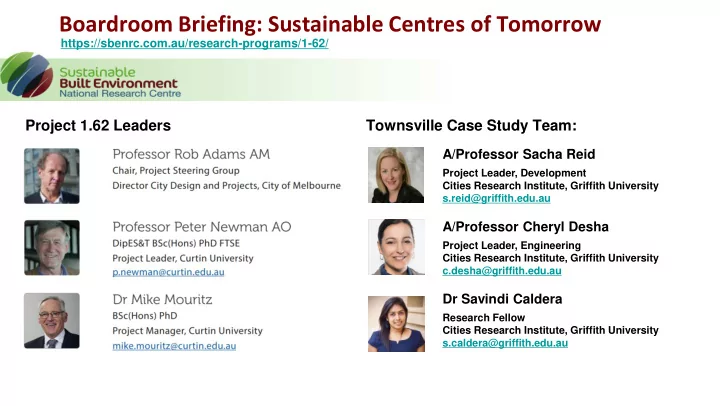
Project 1.62 Leaders Townsville Case Study Team:

A/Professor Sacha Reid

Project Leader, Development Cities Research Institute, Griffith University s.reid@griffith.edu.au

A/Professor Cheryl Desha

Project Leader, Engineering Cities Research Institute, Griffith University c.desha@griffith.edu.au

Dr Savindi Caldera

Research Fellow Cities Research Institute, Griffith University s.caldera@griffith.edu.au

https://sbenrc.com.au/research-programs/1-62/

slide-2
SLIDE 2
  • Context – Project 1.55
  • Delivering integrated transit, land development & finance
  • Manual (5 parts, 50 steps)
  • Overview – Project 1.62
  • Objectives (Business Case, City Deals)
  • Expected industry outcomes
  • 1.62 Context (Literature Review)
  • Centres Design Framework
  • Governance challenges and opportunities
  • 1.62 JCU/Townsville case study (what’s next)
  • Applying the framework
  • Addressing the built environment needs

Boardroom Briefing: Sustainable Centres of Tomorrow

https://sbenrc.com.au/research-programs/1-62/

slide-3
SLIDE 3

The Lead-Up: Project 1.55 (2017-19)

slide-4
SLIDE 4

The conversation that has reached out …

http://theconversation.com/why-trackless-trams-are-ready-to-replace-light-rail-103690

slide-5
SLIDE 5

The 1-Minute video that has gone viral …

  • Launched by Greenpeace Intl
  • 3.7M Views in 7 months
  • 89% “Hell Yeh” for Trackless

Trams in my city … according to the Facebook poll

  • $5M/km rather than $50M/km for

light rail

  • 13% gradient rather than 5% for

light rail

  • 15m radius turning capability
slide-6
SLIDE 6

More Information to raise awareness:

Integrating Land Development, Finance and Transit: Trackless Trams SBEnrc Project 1.55 Highlights

(10 minute presentation, August 2018) https://vimeo.com/278969345

The Trackless Tram: Fixed or Flexible? Reflections on a Visit to China SBEnrc Project 1.55 Conversation with Professor Peter Newman

(26 minutes with PowerPoint, November 2018) https://vimeo.com/290106133

World's first unmanned smart electric bus trials in south China People’s Daily, China

(32 seconds, 23 October 2017) https://youtu.be/bXB87NWHvDg

slide-7
SLIDE 7

The Current Project 1.62 (2018-20)

slide-8
SLIDE 8

The Current Project 1.62 (2018-20)

slide-9
SLIDE 9

Opportunities:

  • 3 levels of government housing
  • Private investment
  • Community vision
  • Structural reform
  • Innovation

Provides ideal base for Superannuation investments

City Deals

slide-10
SLIDE 10

Framework of Principles & Practices

slide-11
SLIDE 11

8/29/2019

Core Principles Core Practices

  • 1. Precinct safety and accessibility

The development should be safe and healthy for people waiting to access transport nodes

  • Human centred design
  • Walkable urban design
  • Place and movement design
  • 2. Carbon neutral - positive approach

The development should aim for carbon positive, being at least zero carbon, in both power and transport

  • Solar passive design
  • Solar active design
  • Carbon neutral analysis
  • 3. Local shared mobility

The development should encourage diverse local modal services to access the transit service, with defined spaces

  • Local mobility design
  • Feeder transport design
  • Mobility as a service
  • 4. Property diversity

The density and urban mix should contribute to urban regeneration

  • Community engaged planning
  • Agglomeration economy analysis
  • Financial modelling
  • 5. Property affordability

The development should include diverse property options to provide affordable living as well as affordable housing

  • Social housing analysis
  • Life cycle assessment
  • Sustainability operational analysis
  • 6. Nature-loving and biodiverse spaces

The development should include and connect biophilic and biodiverse greenspaces, supporting endemic species and habitat

  • Biophilic design
  • Water sensitive design
  • Landscape oriented design
  • 7. Inclusive, integrated place-based planning

Planning, design and implementation (operation, maintenance) should involve diverse stakeholders and all tiers of government to provide an integrated place-based approach

  • Joined up governance analysis
  • Partnership analysis
  • Procurement option analysis

Framework for Sustainable Centres of Tomorrow: Core Principles and Practices

slide-12
SLIDE 12

8/29/2019

Practices informing the Framework:

  • 1. Precinct safety and accessibility

 Human centred design Design Kit (IDEO.org)  Walkable urban design Pedestrians First (ITDP.org)  Place and movement design Movement and Place Framework (Transport Victoria)

  • 2. Carbon neutral - positive approach

 Solar passive design A focus on Greening our Precincts (Aurecon)  Solar active design Solar Energy (International Energy Agency)  Carbon neutral analysis Carbon Value Analysis Tool (World Resources Institute)

  • 3. Local shared mobility

 Local mobility design Pedestrian Access and Mobility Plan (NSW RTA)  Feeder transport design Principles of Network Planning (Griffith University)  Mobility as a service Rise of Mobility as a Service (Deloittes)

  • 4. Property diversity

 Community engaged planning Resources (Internat. Assoc. for Public Participation)  Agglomeration economy analysis Spatiotemporal Analysis Framework (Jin et al 2018)  Financial modelling Toolkit for rapid economic assessment of cities (ADB)

  • 5. Property affordability

 Social housing analysis Conceptual Analysis (AHURI)  Life cycle assessment Applied to Urban Fabric Planning (Gabbarell et al, 2015)  Sustainability operational analysis Sustainable affordable housing (Wiesel et al, 2012)

  • 6. Nature-loving and biodiverse spaces

 Biophilic design Biophilic Design Initiative (Living-Future.org)  Water sensitive design Scenario Tool (CRC Water Sensitive Cities)  Landscape oriented design Foreground Forum (Inst. of Landscape Architects)

  • 7. Inclusive, integrated, place-based planning

 Joined up governance analysis A Joined Up Policy Guide (South Aust. Government)  Partnership analysis Partnerships Analysis Tool (Vic Health)  Procurement option analysis National Guideline (Australian Government)
slide-13
SLIDE 13

Project 1-62: Case study locations

Townsville (Queensland) Liverpool (NSW) Inner West (Victoria) Wyndham (Victoria) Perth Consortium (WA)

slide-14
SLIDE 14

Townsville Case study

Project partners

slide-15
SLIDE 15

Phase 1: Assess transport and urban centres context Phase 2: Assess the socio-economic impact of proposed project Phase 3: Evaluate potential for redevelopment and how previous work fits into a City Deal style partnership

Research Approach

slide-16
SLIDE 16

Phase 1: Assess transport and urban centres context

  • 1. Destinations and origins
  • Review background planning and

transport information

  • Identify and map key attributes of centres,

sub-centres and destinations in the corridors.

  • 2. Applying a Place-Making Framework
  • Create a Framework from global best

practice

  • Provide the principles for use
slide-17
SLIDE 17

Phase 2: Assess the socio-economic impact of proposed project, including two dimensions

  • 1. Transient population dynamics

Assess of the enablers and barriers to growing international student market in Townsville.

  • 2. Transit orientated corridor Value Uplift study
  • Assess value Uplift potential along and

surrounding the proposed corridor

  • Applying geographic and econometric

modelling

slide-18
SLIDE 18

Phase 3: Evaluate the potential for redevelopment opportunities along the route and how all the previous work fits into a City Deal style partnership

  • 1. Redevelopment Potential

Evaluate the potential to integrate medium density, transit-oriented development

  • 2. Place Making Assessment

Inform any other planning and design work that might be commissioned as part of City Deal

  • 3. Risk Assessment

To feed into a Business Case for the City Deal discussions

slide-19
SLIDE 19

Work Plan

Townsville visit dates