Bloor West Village Avenue Study Design Charrette Phase 2: Explore - - PowerPoint PPT Presentation

bloor west village avenue study
SMART_READER_LITE
LIVE PREVIEW

Bloor West Village Avenue Study Design Charrette Phase 2: Explore - - PowerPoint PPT Presentation

Bloor West Village Avenue Study Design Charrette Phase 2: Explore Ideas Saturday, April 08, 2017 DTAH | RE Millward Associates | WSP/MMM Group Swerhun | Taylor Hazell Architects | JC Williams Group Charrette Agenda No. Item Duration 1.0


slide-1
SLIDE 1

Bloor West Village Avenue Study

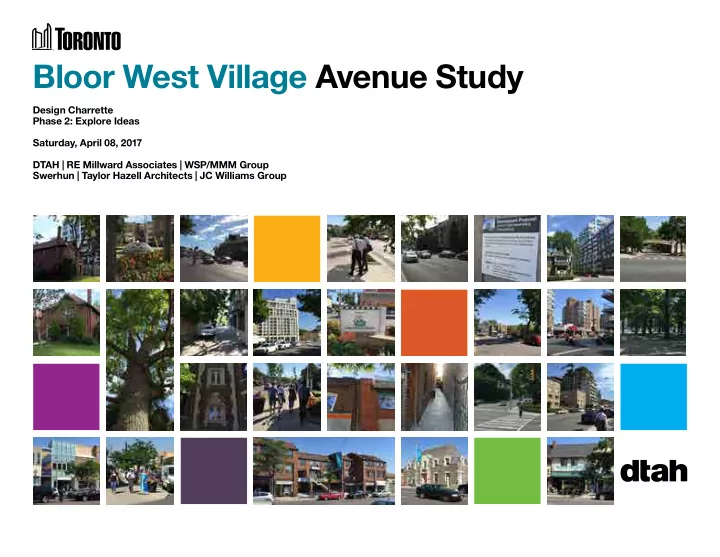
Design Charrette Phase 2: Explore Ideas Saturday, April 08, 2017 DTAH | RE Millward Associates | WSP/MMM Group Swerhun | Taylor Hazell Architects | JC Williams Group
slide-2
SLIDE 2

Charrette Agenda

No. Item Duration 1.0 Welcome and Introductions 10 minutes (9:30am - 9:40am) 2.0 Introductory Presentation 20 minutes (9:40am - 10:00am) 3.0 Planning and Design Exercises 2.25 hours (10:00am - 12:15pm) Lunch / Break 45 minutes (12:15pm - 1:00pm) 4.0 Synthesis Exercise 1 hour (1:00pm- 2:00pm) 5.0 Reporting Back 45 minutes (2:00pm - 2:45pm) 6.0 Wrap-Up and Next Steps 15 minutes (2:45pm - 3:00pm)

2

slide-3
SLIDE 3

Study Schedule

BACKGROUND OPPORTUNTIES + CONSTRAINTS

Jan- March 2017

01 02

FUTURE CONDITIONS + DESIGN ALTERNATIVES

April - June 2017

03

SYNTHESIS + FINAL AVENUE STUDY REPORT

July - Oct 2017

Understand Context and Existing Conditions Property Owners Meeting #1 Feb 8, 2017 Community Stakeholder Meeting Feb 9, 2017 Public Meeting #1 Feb 27, 2017 Design Review Panel #1 March 23, 2017 Councillor Briefing #1 (Feb 6, 2017) City Project Team Meeting (CPMT #2) (Feb 2, 2017) CPMT #3 (April, 2017) Evaluate and Test Design Alternatives Local Advisory Committee Meeting (LAC) #1 CPMT #4 (May 2017) Identify Preferred Alternative Design Charrette (April 8, 2017) Councillor Briefing #2 (May 2017) LAC #2 (May 2017) Public Meeting #2 (June 2017)

We Are Here

Design Review Panel #2 (August 2017) Avenue Study Draft CPMT #3 (April 2017) Avenue Study Final Councillor Briefing #3 (Sept 2017) LAC #3 (Sept 2017) Public Meeting #3 (Sept 2017) Community Council Presentation (Oct 17, 2016)

3

slide-4
SLIDE 4 TORONTO INNER HARBOUR TORONTO OUTER HARBOUR HUMBER BAY SHEPPARD EGLINTON BURNHAMTHORPE THE QUEENSWAY GARDINER EXPWY LAKE SHORE ROYAL YORK ST.CLAIR VAUGHAN DUPONT DAVENPORT BLOOR DANFORTH COLLEGE WELLESLEY YORK MILLS WILSON KEELE LAWRENCE DUFFERIN LANSDOWNE RONCESVALLES BLACK CREEK DUNDAS M T . P L E A S A N T OVERLEA AVENUE JARVIS PARLIAMENT SHERBOURNE UNIVERSITY SPADINA PARKSIDE RUNNYMEDE
  • S. KINGSWAY
LAIRD QUEEN KING GARDINER EXPWY QUEENS QUAY H W Y 4 1 HWY 404 D O N V A L L E Y P K W Y D U N D A S SCARLETT W E S T O N T R E T H E W E Y L A K E SHORE ALLEN GERRARD EASTERN OSSINGTON BROADVIEW PAPE GREENWOOD DONLANDS DAWES COXWELL WOODBINE MAIN GERRARD O'CONNOR CONSUMERS THE WESTWAY TH QUEEN P A R K L A W N ROGERS ANNETTE HARBORD MOORE DAVISVILLE GLENCAIRN BRIDGELAND T R A N S I T BARTOR ARROW OAKDALE C L A Y S O N CALEDONIA DOVERCOURT ORIOLE
  • ST. DENNIS
COSBURN LUMSDEN MORTIMER WILLOWDALE WILSON HEIGHTS SENLAC CHURCH BAY CARLAW JONES BEDFORD CHRISTIE ROSEDALE VALLEY STRACHAN RICHMOND ADELAIDE SHUTER WELLINGTON BERMON D S E Y C H E S WILMINGTON S L O A N E ST.GEORGE LAKE SHORE F R O N T W Y N F O R D

What is an Avenue?

Defined by City of Toronto Official Plan

  • Selected corridors along

major transit routes defined as “Avenues”

  • Transit-supportive

intensification is intended to create new jobs and housing while improving local streetscapes, infrastructure and amenities

Green Space System Downtown and Central Waterfront Avenues Employment Districts Centres

4

slide-5
SLIDE 5

What is an Avenue Study?

  • Each Avenue is different.

No “One Size Fits All” Program

  • A Framework for Change

tailored to each Avenue

  • A Vision and Implementation

Plan developed with local residents, businesses, and

  • ther stakeholders

Dufferin Street Avenue Study (2014) Bloor-Dundas ‘Avenue’ Study (2009)

8

1 2 4

tj tj tj tj tj tj tj tj  tj tj tj tj tj  tj tj  tj tj  ffi tj    tj tj tj es and approved developments tj

3 5 6 7 8

5

slide-6
SLIDE 6

Why this Avenue Study?

  • Bloor West Village is changing
  • Parallel initiatives underway

(eg: Heritage Conservation District Study)

  • The area has redevelopment interest

(High Park Area, Jane Area, corner sites, etc.)

  • The scale of individual re-development

projects is increasing

  • There is a need to establish a specific

framework to guide change

  • Bloor West Village was identified by City

Council and Staff as a priority for an Avenue Study

Two significant natural features (High Park + the Humber River) New development by High Park Village character 6

slide-7
SLIDE 7

How is this Avenue Study different?

  • Bloor West Village is already an

established and vibrant main street

  • The first Business Improvement

Area in the world - 1970

  • Significant topography and natural

features: High Park and the Humber River

  • Subway transit with 5 stations and

connecting bus lines: » Old Mill » Jane » Runnymede » High Park » Keele

7

slide-8
SLIDE 8

Study Area

  • From Humber River to

Keele Street

  • 2.7 kilometres in length
  • Over 240 properties that address

Bloor Street West » both sides of street » High Park address

  • BIA: Over 400 members
  • 5 TTC Stations (Old Mill, Jane,

Runnymede, High Park, & Keele)

  • Study will consider (but not make

recommendations for) adjacent Neighbourhoods, Apartment Neighbourhoods, Parks, Open Spaces, and Natural Systems

Quebec Avenue High Park Avenue Clendenan Avenue Glendonwynne Road Runnymede Road Jane Street Armadale Avenue Willard Avenue Windermere Avenue Durie Street Keele Street Harcroft Rd. Durie Street Old Mill Drive Bloor Street West Humber River K e n n e d y P a r k R d High Park S Kingsway

8

slide-9
SLIDE 9

Draft Character Areas

High Park Frontage East Village Village Main Street West Village Humber Gateway

Bloor Street West

Quebec Avenue High Park Avenue Clendenan Avenue Glendonwynne Road Runnymede Road Jane Street Armadale Avenue Willard Avenue Windermere Avenue Durie Street Keele Street H a r c r
  • f
t R d . Durie Street Old Mill Drive

Humber River

Kennedy Park Rd

High Park

S Kingsway
  • Five character areas have been identified
  • n the basis of prominent uses/activity,

built form, heritage and public realm

  • Helpful to structure discussion and future

Avenue Study recommendations

9

slide-10
SLIDE 10

What We’ve Heard So Far

  • Questions and concerns about

balancing growth with the area’s village feel » Redevelopment Potential » Future of Independent Retailers

  • Concern about High Park

» Cumulative impact of future development of High Park (especially hydrogeology)

  • Questions about the Avenue Study

scope/infmuence » Demonstrate the infmuence the Avenue Study will have » Define the role of heritage in the Avenue Study/upcoming HCD Study

  • Support for Main Street Retail

» Anchor tenant desired (another grocery store) » Parking supply and demand » Excellent pedestrian environment

  • Study the Impacts of

Intensification » Built Form » Public Realm Quality » Transportation » Site Access » Servicing » Community Services » Natural Heritage » Subsurface Hydrogeology

10

slide-11
SLIDE 11

Bloor West Village Avenue Study / Phase 2 Charrette

Existing Conditions Summary

slide-12
SLIDE 12

North Side: Today

  • Consistent fabric of

narrow, mixed-use row buildings

  • Small scale storefronts
  • Consistent height
  • Presenting a solid and

consistent streetwall

12

slide-13
SLIDE 13

South Side: Today

  • Mixture of row buildings,

detached apartments, service stations, and other larger structures

  • Streetwalls, commercial

frontages, and lot sizes contrast with the north side of Bloor West

13

slide-14
SLIDE 14
  • Developed with detached

apartment buildings and larger homes

High Park: Bloor Frontage

14

slide-15
SLIDE 15

1913 1960s to 2015

High Park: Apartment Neighbourhood

15

slide-16
SLIDE 16

Current Zoning

  • Current zoning generally permits Commercial-Residential buildings with

residential buildings opposite High Park and adjacent to the Humber

  • valley. Several parcels are a “hole” in the zoning (i.e. remain under the

former municipal zoning by-laws).

Quebec A High Park A Glendenan A Glendowyne Road Runnymede Jane Str Armadale A Willard A Windermer Durie Str Harcroft Rd. Durie Street O l d M i l l D r i v e Bloor Street West High Park Humber Kennedy Park Rd

R Zone “Residential” CR Zone “Commercial Residential” R Zone “Residential”

  • 9m height limit
  • 1.0-2.0 floor space index
  • Detached, Semi-

Detached, Townhouse, Duplex, Triplex, Fourplex, Apartments

  • 14m height limit
  • 2.5 floor space index
  • Commercial Max = 2.0
  • Residential Max = 1.5
  • 23m height limit
  • 2.0 floor space index
  • Detached, Semi-Detached,

Townhouse, Duplex, Triplex, Fourplex, Apartments

16

slide-17
SLIDE 17 Approved Since 2009 Application Under Review

Development Activity

Approved Rezonings and Applications Under Review

Quebec Avenue High Park Avenue Clendenan Avenue Glendonwynne Road Runnymede Road Jane Street Armadale Avenue Willard Avenue Windermere Avenue Durie Street Keele Street Harcroft Rd. Durie Street Old Mill Drive Bloor Street West Humber River Kennedy Park Rd High Park S K i n g s w a y One and Two Old Mill (2490 -2500 Bloor Street West) 2452 Bloor Street West 2265 Bloor Street West 2115-2117 Bloor Street West 2114-2130 Bloor Street West 12 High Park High Park Residences The High Park 1990 Bloor Street West

The High Park (1990 Bloor West) One and Two Old Mill (2490 & 2500 Bloor West) High Park Residences 17

slide-18
SLIDE 18 Quebec Avenue High Park Avenue Clendenan Avenue Glendonwynne Road Runnymede Road Jane Street Armadale Avenue Willard Avenue Windermere Avenue Durie Street Keele Street Harcroft Rd. Durie Street Old Mill Drive Bloor Street West Humber River K e n n e d y P a r k R d High Park S Kingsway

Existing Properties

  • 247 properties that front Bloor

Street West

  • Mix of narrow (7m and less),

medium (<7m-20m) and wide lots (<20m)

  • 128 of the 247 properties in study

area 7m or less. Majority on north side between Jane and Kennedy

  • Rear lanes related to traditional

Main Street properties

  • Great majority of parcels are

considered shallow lots (22-41m depth)

Wide lots (>20m) Narrow lots (7m or less) Medium (>7m-20m)

18

slide-19
SLIDE 19

Existing Building Types

Main Street Mixed Use Heritage Townhouses Mixed Use Commercial Office Mid-Rise Apartments House Forms Taller Buildings Low-Rise Apartments 19

slide-20
SLIDE 20

Building Height_Existing

  • Predominantly low rise buildings

throughout (1-4 storeys)

  • Mid-rise buildings concentrated

in area just northwest of High Park (5-8 storeys)

  • Taller buildings located west of

Jane and across from High Park (+8 storeys)

taller (approx. +8 storey) mid-rise (approx. 5-8 storey) low rise (approx. 1-4 storey)

Quebec Avenue High Park Avenue Clendenan Avenue Glendonwynne Road Runnymede Road Jane Street Armadale Avenue Willard Avenue Windermere Avenue Durie Street Keele Street Harcroft Rd. Durie Street Old Mill Drive Kennedy Park Rd S K i n g s w a y Humber River High Park Bloor Street West

20

slide-21
SLIDE 21

Building Height_ Current Maximum (Zoning)

Bloor Street West Quebec Avenue High Park Avenue Clendenan Avenue Glendonwynne Road Runnymede Road Jane Street Armadale Avenue Willard Avenue Windermere Avenue Durie Street Keele Street Harcroft Rd. Durie Street Old Mill Drive Humber River Kennedy Park Rd High Park S K i n g s w a y

14.0m 23.0m 9.0m 14.0m

  • West: 9.0m
  • Village Main Street: 14.0m
  • High Park Frontage: 10.0 to 23.0m
  • Several parcels have site specific zoning

that defines height (i.e, recent approved developments)

21

slide-22
SLIDE 22

Building Height_Midrise Building Performance Standards_2016

  • Two Character Areas Defined

» Bloor West: Max Building Height 80% of Right-of-Way » High Park: Max Building Height 100% of Right-of-Way

  • Anticipated Maximum Heights

» Humber to Riverside: Neighbourhoods (low rise) » Riverside to Jane: 30m ROW=30.0m (8-10 storeys) » Jane to Armadale: 30m ROW at 80%=24.0m (6-8 storeys) » Armadale to Clendenan: 27m ROW at 80%=21.6m (5-7 storeys) » Clendenan to Keele: 27.0m ROW=27.0m (7-9 storeys)

Bloor Street West Quebec Avenue High Park Avenue Clendenan Avenue Glendonwynne Road Runnymede Road Jane Street Armadale Avenue Willard Avenue Windermere Avenue Durie Street Keele Street Harcroft Rd. Durie Street Old Mill Drive Humber River Kennedy Park Rd High Park S K i n g s w a y

21.6m 27.0m 30.0m24.0m Neighbourhoods

22

slide-23
SLIDE 23

Views + Vistas

Bloor Street West Quebec Avenue High Park Avenue Clendenan Avenue Glendonwynne Road Runnymede Road Jane Street Armadale Avenue Willard Avenue Windermere Avenue Durie Street Keele Street Harcroft Rd. Durie Street Old Mill Drive Humber River K e n n e d y P a r k R d High Park S Kingsway

* * *

* * * *

*

* * * * ** * * * ** * *

Offset street grid / Views of Natural Heritage Areas and Heritage Resources Heritage Buildings Topography 23

slide-24
SLIDE 24 Quebec Avenue High Park Avenue Clendenan Avenue Glendonwynne Road Runnymede Road Jane Street Armadale Avenue Willard Avenue Windermere Avenue Durie Street Keele Street Harcroft Rd. Durie Street Old Mill Drive Humber River K e n n e d y P a r k R d High Park S Kingsway Bloor Street West Parks/Open Spaces Natural Heritage System Ravine and Natural System Protection Bylaw Environmentally Significant Area Redevelopment within 120m of Life Science (ANSI) may require a Natural Heritage Impact Study

Parks, Open Spaces, and Natural Features

  • Bloor Street West links two of the

City’s largest, most prominent and environmentally significant green spaces - Humber River Valley and High Park

  • Series of linear parks north of

Bloor Street West

  • Bloor Street is the dividing line

between two areas with differing levels of parkland provision

24

slide-25
SLIDE 25

Bloor West Village Avenue Study / Phase 2 Charrette

Built Form Exercises

slide-26
SLIDE 26

Built Form Exercises: 3 x 30 minutes

26

slide-27
SLIDE 27

Built Form Exercises: Study Segments

Quebec Avenue High Park Avenue Clendenan Avenue Glendonwynne Road Runnymede Road Kennedy Avenue Beresford Avenue Jane Street Armadale Avenue Willard Avenue Windermere Avenue Durie Street Keele Street Harcroft Rd. Durie Street Old Mill Drive Bloor Street West Humber River K e n n e d y P a r k R d High Park S Kingsway Riverview Gardens

Village and West Village Village and East Village High Park Frontage

27

slide-28
SLIDE 28

28

slide-29
SLIDE 29

29

slide-30
SLIDE 30

30

slide-31
SLIDE 31

31

slide-32
SLIDE 32

32

slide-33
SLIDE 33

33

slide-34
SLIDE 34

34

slide-35
SLIDE 35

Sample Questions: Built Form Exercises

  • Testing the basic guideline of mid-

rise buildings along the Bloor West Village properties. What works? What needs to be changed?

  • Where might additional height

work and not work?

  • How should new built form

transition to adjacent areas?

  • How do the sites on either side of

the street differ? How are they the same?

  • What opportunities are possible

to enhance placemaking and the quality of the public realm?

35

slide-36
SLIDE 36

Bloor West Village Avenue Study / Phase 2 Charrette

Street Design Exercise

slide-37
SLIDE 37

Street Design Exercise: 30 minutes

37

slide-38
SLIDE 38

High Park Frontage

38

slide-39
SLIDE 39

Avenue / Main Street (26m ROW)

39

slide-40
SLIDE 40

Avenue / Main Street (30m ROW)

40

slide-41
SLIDE 41

Existing Streetscape Character

  • Public Right-of-way

» Armadale to Humber: 30m » Keele to Armadale: 26m (OP 27m)

  • Streetscape character

varies along the length

  • f the Study Area
  • Different pedestrian

experiences on north and south side of street

  • Long blocks north of

Bloor Street West

Retail, commercial 2-3 storey Retail, commercial NORTH BLOOR STREET WEST (26m ROW) SOUTH 26m Right-of-Way Setback Varies Setback Varies Boulevard 4.5-6m Boulevard 4.5-6m Layby Roadway 14-16.5m BLOOR STREET WEST (30m ROW) NORTH SOUTH 30m Right-of-Way Setback Varies Setback Varies Boulevard 5-7m Boulevard 5-7m Roadway 16-20m Retail, commercial
  • r residential
at grade Retail, commercial
  • r residential
at grade

41

slide-42
SLIDE 42

Sidewalks

Furnishing and Planting Zone Pedestrian Clearway Zone Frontage and Marketing Zone Setback <1.2m 2.1min 1-2m Varies

42

slide-43
SLIDE 43

Current State

Flanking Streets: underutilized Street Trees Bump outs Multiple entrances and canopies Flanking Streets: Spill out spaces Clutter 43

slide-44
SLIDE 44

THEN Auto-Mobility Automobile Safety NOW Multi-modal Mobility + Access Public Health/Safety Economic Development Environmental Quality Livability/Quality of Life Equity

Outside In Centre Line Out

Street Design Goals Have Changed

Source: Toronto Complete Streets Guidelines (2017: Draft) 44

slide-45
SLIDE 45 Toronto Complete Streets Guidelines Toronto Complete Streets Guidelines 121 Street Design for Roadways Roadway Design Principles 8.1 Street Design for Roadways Roadway Design Principles 8.1 120

8.1

ROADWAY DESIGN PRINCIPLES

  • 1. Multi-modal transportation. Give
reliable, convenient and attractive mobility choices to people and support more efficient, active and healthier forms of travel (by foot, bicycle, transit) to reduce vehicular
  • congestion. Provide emergency
access and operations. Support goods movement and delivery by different modes. Identify and support existing and planned priority networks for each mode.
  • 2. Safety. Fully consider road users
who are particularly vulnerable in a crash or in interactions with other road users, such as pedestrians (especially children, older adults and persons with disabilities) and cyclists. Seek ways to reduce their exposure to risk (e.g., rightsize travel lanes, repurpose underused road space and separate pedestrians from cyclists). Provide visible, clear and predictable travel paths for all road users.
  • 3. Context-sensitive target speed
and reliable travel. Create a safer environment for everyone by using design to facilitate the intended speed of travel for drivers based on the street’s context. Safer speeds and driver behaviours result in fewer incidents on the roadway that can cause delays and vehicular congestion, which negatively impact emergency access and goods
  • movement. Coordinated signals,
along with target speed, can help improve consistency in travel times. Peak-hour restrictions for stopping, parking and turn movements can improve travel times along key
  • routes. This helps to manage
demand and road capacity during peak travel times.
  • 4. Placemaking. Consider existing
and planned land uses, urban form, and the different uses of the street (e.g., social and economic activities) when making decisions about competing demands for space on the
  • street. Seek ways to provide space,
for example, through building setbacks and/or repurposing underused roadway space for streetscaping, street trees, street furniture, café or marketing areas, parklets, bicycle parking, pedestrian lighting, snow storage and removal, etc.
  • 5. Greening and stormwater
  • management. Limit the area of
impervious materials. Seek ways to integrate street trees, landscape features, as well as water retention and treatment strategies and snow
  • storage. Promote non-motorized
modes to reduce greenhouse gas emissions and air and noise pollution. Use materials that contribute to sustainability, life-cycle performance and reduce the urban heat island
  • effect. See Chapter 7 on Green
Infrastructure for design guidance. 2 3 4 5 1

Aspiration : A More Complete Street

45

slide-46
SLIDE 46

Aspiration : A More Complete Street

Toronto Complete Streets Guidelines Toronto Complete Streets Guidelines 75 74 4.1 Street Design for Pedestrians Sidewalk Design Principles Street Design for Pedestrians Sidewalk Design Principles 4.1

PEDESTRIAN DESIGN PRINCIPLES

4.1

  • 1. Accessibility and Mobility. A top
priority is to provide accessible sidewalks and facilities for all users regardless of physical abilities or age. Ensure clear, direct, unobstructed continuous paths of a suitable context-sensitive width to serve existing and anticipated pedestrian
  • flows. Minimize or remove clutter.
  • 2. Provide a Network of
Continuous Sidewalks. Places that support walking are healthier, more vibrant, and resilient. Create a network of continuous sidewalks with dedicated space for pedestrians safely separated from cyclists and motorized vehicles.
  • 3. Design for Safe Crossings.
Pedestrian-friendly design takes into account the frequency of crossing
  • pportunities, target speed, street
width, intersection geometry, visibility, signal timing and walk speeds for vulnerable pedestrians, such as seniors and persons with
  • disabilities. See also Chapter 9 on
Intersections for guidance.
  • 4. Placemaking. Sidewalks are public
spaces where people interact. Design sidewalks to invite, with seating, trees, cafés, public art, lighting, and places to gather. Create
  • pportunities suited to the street’s
  • context. Design to evolve with
changing demands. Consider current and future pedestrians and uses.
  • 5. Design for Comfort. Provide
sidewalks of adequate width for the
  • context. Design sidewalks and
boulevards for uses all year long. Street trees offer shade and relief from sun, rain, wind and snow. Carefully arrange street elements to support pedestrian activities, and to provide a safe buffer between pedestrians and moving traffic.
  • 6. Greening Infrastructure and
Stormwater Management. Incorporate passive stormwater measures in boulevards where
  • possible. Divert stormwater into rain
gardens, planting beds, or permeable paving in the boulevard to reduce potential for ponding. Green infrastructure enhances the quality of the street environment, and contributes to mental and psychological health. Consider sufficient soil and water for street trees to reach maturity. See Chapter 7 on Green Infrastructure for guidance.
  • 7. Design for Efficient
  • Maintenance. Consider materials
and designs that are durable and easier to maintain. Use City Standard
  • Materials. Provide adequate access
to utilities for maintenance. Consider snow storage and waste and recycling collection. Coordinate repairs and upgrades, if feasible, to minimize impact to pedestrians.
  • 8. Coordination with Utilities. The
location, use, and maintenance of utilities needs to be coordinated early on in street projects. Ensure pedestrian clearway needs are met for universal accessibility. Seek ways to minimize conflicts among utilities, street furnishings, trees, and landscaping. 2 3 4 5 6 8 7 1

46

slide-47
SLIDE 47

Green Infrastructure Opportunities

Toronto Complete Streets Guidelines Toronto Complete Streets Guidelines 111 110 Street Design for Green Infrastructure Green Infrastructure Design Principles Street Design for Green Infrastructure Green Infrastructure Design Principles 7.1 7.1

GREEN INFRASTRUCTURE DESIGN PRINCIPLES

7.1

  • 1. Street trees and landscaping.
Seek ways to incorporate and provide healthy growing conditions for trees and/or landscaping to improve air quality, mitigate urban heat-island effect, enhance ecosystem health, and contribute to community character. Select planting locations, spacing and design details (e.g., adequate soil volume, water and sun access) so that trees and landscaping will flourish. Trees can frame and define streets, calm traffic by visually narrowing the roadway, and add texture, shade and visual interest.
  • 2. Stormwater management.
Use a variety of “Low Impact Development” techniques to minimize stormwater load on Toronto’s sewer system and improve water quality through natural
  • filtration. Reduce stormwater runoff
and potential flooding of streets and natural areas. Strategies include minimizing impervious surfaces, and promoting infiltration of rainwater and stormwater runoff.
  • 3. Visibility and safety. Ensure
adequate visibility is maintained, especially at street corners, traffic lights, traffic signs, transit stops and
  • driveways. Where there is vegetation,
ensure maintenance programs maintain appropriate sightlines. Clear sightlines are important to the safety of all road users.
  • 4. Universal accessibility. Design to
promote universal accessibility, such as through the selection of materials and elements, to accommodate people of all ages and abilities. Tree pits, openings and grates on the sidewalk are not considered part of the pedestrian clearway.
  • 5. Operations and maintenance.
Design for ease of maintenance, such as through passive irrigation, selecting context-sensitive native plant species and planning for safe access to maintain green
  • infrastructure. Coordinate green
infrastructure with utilities during design, construction and for the long
  • term. Seek opportunities to partner
with BIAs and other local stakeholders to assist with the design and maintenance of green elements.
  • 6. Achieving multiple
environmental objectives. Consider ways to combine environmental design, such as tree canopy expansion, stormwater retention, and microclimate moderation into single street features like roadside rain gardens.
  • 7. Sustainable energy. Consider
energy generation, use and management by selecting, designing and siting street elements such as solar lighting, parking machines, Bike Share Stations and street furniture to contribute to an energy efficient city.
  • 8. Sustainable transportation.
Provide greener, healthier mobility choices so that more people walk, bicycle, take public transit and
  • carpool. Reduce vehicular
congestion, greenhouse gas emissions and air pollution. 2 3 4 5 6 7 8 8 1

47

slide-48
SLIDE 48

Sample Questions: Street Design Exercise

  • What cross section elements do

you think are most important to support the kind of place Bloor West Village is today and in the future?

  • What are the possible

arrangements of elements to best support overall transportation needs and placemaking?

  • What opportunities are possible to

enhance the quality of the public realm?

  • What opportunities do you think

are possible on the side streets that intersect with Bloor West?

48

slide-49
SLIDE 49

Charrette Agenda

No. Item Duration 1.0 Welcome and Introductions 10 minutes (9:30am - 9:40am) 2.0 Introductory Presentation 20 minutes (9:40am - 10:00am) 3.0 Planning and Design Exercises 2.25 hours (10:00am - 12:15pm) Dinner Break 45 minutes (12:15pm - 1:00pm) 4.0 Synthesis Exercise 1 hour (1:00pm- 2:00pm) 5.0 Reporting Back 45 minutes (2:00pm - 2:45pm) 6.0 Wrap-Up and Next Steps 15 minutes (2:45pm - 3:00pm)

slide-50
SLIDE 50

Bloor West Village Avenue Study / Phase 2 Charrette

Synthesis Exercise

slide-51
SLIDE 51
  • Four Groups
  • A Common Vision for

Entire Study Area » Built Form » Street Design » Placemaking

  • Nominate a speaker and note

taker for reporting back

Synthesis Exercise: 60 minutes

51

slide-52
SLIDE 52

Charrette Agenda

No. Item Duration 1.0 Welcome and Introductions 10 minutes (9:30am - 9:40am) 2.0 Introductory Presentation 20 minutes (9:40am - 10:00am) 3.0 Planning and Design Exercises 2.25 hours (10:00am - 12:15pm) Dinner Break 45 minutes (12:15pm - 1:00pm) 4.0 Synthesis Exercise 1 hour (1:00pm- 2:00pm) 5.0 Reporting Back 45 minutes (2:00pm - 2:45pm) 6.0 Wrap-Up and Next Steps 15 minutes (2:45pm - 3:00pm)

slide-53
SLIDE 53

Next Steps

  • Develop Draft Alternatives

Informed by Charrette and other input recieved to date

  • Design Review Panel

Friday April 21

  • Local Advisory Committee Meeting #1:

Draft Design Alternatives Monday April 24

  • Local Advisory Committee Meeting #2:

Draft Preferred Design Alternative Late May (TBD)

  • Public Meeting #2:

Draft Preferred Design Alternative Mid-late June (TBD)

53

slide-54
SLIDE 54

Further Information and Contacts

Greg Byrne Senior Planner 416-394-8238 Greg.Byrne@toronto.ca Allison Reid Senior Urban Designer 416-392-1295 Allison.Reid@toronto.ca Councillor Sarah Doucette 416-392-4072 councillor_doucette@toronto.ca www.toronto.ca/bwv-avenuestudy

54

slide-55
SLIDE 55

[FINI]