Blackbird Creek Preservation and Action Charter (BCPAC) Darrel ell - - PowerPoint PPT Presentation

blackbird creek preservation and action charter bcpac
SMART_READER_LITE
LIVE PREVIEW

Blackbird Creek Preservation and Action Charter (BCPAC) Darrel ell - - PowerPoint PPT Presentation

Blackbird Creek Preservation and Action Charter (BCPAC) Darrel ell Ken enned edy J oe oe Kow owalski Sha hawn n St . Amand nd O utline Watershed Overview Current Status Issues Policies Watershed


slide-1
SLIDE 1

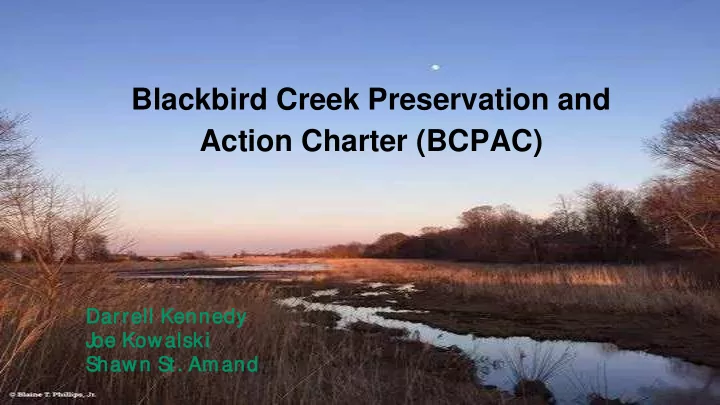
Blackbird Creek Preservation and Action Charter (BCPAC)

Darrel ell Ken enned edy J

  • e
  • e Kow
  • walski

Sha hawn n St . Amand nd

slide-2
SLIDE 2

O utline

  • Watershed Overview
  • Current Status
  • Issues
  • Policies
  • Watershed Improvements
  • Water Quality
  • Ecological Preservation
  • Soil Erosion
  • Conclusion
  • Questions
slide-3
SLIDE 3

M i M is s ion S S tatem e m ent

BCPAC’s mission is to continue restoration of newly acquired land, increase the area of the natural reserve, reduce pollutant loads, and uphold current water quality standards of the Blackbird Creek Watershed in lower New Castle County, Delaware. This will be for immediate short-term efforts and provide an action plan for the years 2018 – 2023.

slide-4
SLIDE 4

O utline

  • Wat er

ershed ed O Over erview ew

  • Current Status
  • Issues
  • Policies
  • Watershed Improvements
  • Water Quality
  • Ecological Preservation
  • Soil Erosion
  • Conclusion
  • Questions
slide-5
SLIDE 5

W ater ers hed ed O O ver erview ew

  • BCR vs BCW
  • 0.6mi2 vs 31mi2
  • Some data from BCR
  • BCR representative
  • f BCW
  • Majority of BCW

drains through BCR

slide-6
SLIDE 6

W ater ers hed ed O O ver erview ew

  • Few Roads
  • Small impervious areas
  • First/second order streams

in west

  • Tidal marsh/wetlands in

east

slide-7
SLIDE 7

W ater ers hed ed O O ver erview ew

  • Population: 5465
  • Land use:
  • 43%

% Agr gricult ural

  • 35% Forest
  • 17% Wetlands
  • 4% Urban/residential
  • 1% Other
slide-8
SLIDE 8

O utline

  • Watershed Overview
  • Cur

urrent nt St at us us

  • Issues
  • Policies
  • Watershed Im provem ents
  • Water Quality
  • Ecological Preservation
  • Soil Erosion
  • Conclusion
  • Questions
slide-9
SLIDE 9

C urrent S t S ta tatu tus

  • 2012-2015 Study by Delaware

State University

Parameter Standard Existing Levels Dissolved Oxygen 5.5 mg/L average 5.1-6.4 mg/L* Phosphate 0.2 mg/L 0.51-0.60 mg/L Nitrate 3.0 mg/L 0.20-0.35 mg/L* Enterococcus 185 col/100mL 2000 col/100mL highest

slide-10
SLIDE 10

C urrent I Issu ssues

  • Water quality
  • Pho

hospha hat e - m ost likely from agriculture

  • Ba

Bact eria - 17% Wetlands, 35% Forest

  • Eros
  • sion
  • n - from overland flow
slide-11
SLIDE 11

C urren ent P P

  • lic

ies es

  • Delaware National Estuarine Research

Reserve (DNERR) Management Plan - Rv.2013

  • DNERR is a partnership between NOAA and DNREC
  • DNERR protects the Reserve and surrounding areas

under the Coastal Zone Management Act

  • This Management Plan is for Blackbird Creek for the

years 2013-2018. It has framework for:

  • Public access plan
  • Regulations on facility maintenance and public

use areas

  • Resource protection including land acquisition

policy

slide-12
SLIDE 12

C urren ent P P

  • lic

ies es

  • Ecological Restoration Master Plan -

March 2007

  • Prepared by the Independent company,

Biohabitat, Inc.

  • Created after DNERR recent purchase of 4

new tracts of land.

  • “Ensure environmental quality is preserved,

to minimize detrimental impacts, and to mitigate invasive species”.

  • Provide long term research, educational

insight, and promote BMPs for the Reserve's natural resources.

slide-13
SLIDE 13

Total al M ax axim um D D ai aily Load ads

  • DNREC 2006
  • Data from 1994-2003, mostly from 2002-2003
  • HydroQual model
  • 40% reduction in NPS nitrogen and phosphorous, 80% reduction in NPS enterococcus

WLA: Wasteload Allocation

slide-14
SLIDE 14

O utline

  • Watershed Overview
  • Current Status
  • Issues
  • Policies
  • Wat er

ershed ed I Improvem emen ent s

  • Water Quality
  • Ecological Preservation
  • Soil Erosion
  • Conclusion
  • Questions
slide-15
SLIDE 15

W ater ers hed ed I Im provem em en ents

slide-16
SLIDE 16

W ater ers hed ed I Im provem em en ents - W at ater Q ual ality

  • Phosphorus
  • Most likely from agriculture
  • Create or restore riparian buffer zones
  • Area around the stream and or creek
  • Plant native species
  • Soil testing to avoid overfertilization
  • Semi-annual: Consider before planting season and after harvesting season.
  • Nutrient timing strategies
  • Only apply fertilizer and pesticides when needed. (winter ban)
  • Bacteria
  • Concentrations are typical of a natural environment.
  • Acts as a natural biological barrier from pollutants for the surrounding environment.
slide-17
SLIDE 17

W ater ers hed ed I Im provem em en ents - E co cologica cal P P res e s ervation

  • Assess current conditions, treat poorly conditioned areas, and monitor

change in environment over time

  • Start with DNREC owned properties and expand out
  • Oversee and Monitor future change in ownerships of real estate property
  • Land Restrictions
  • Restricted to no development on agricultural lands 5-10 years from purchase date
  • No new industrial development without consent of DNREC and DNERR
  • Habitat restoration
  • Providing funding to the DNREC-Delaware Natural Heritage and Endangered Species

Program Bald Eagle

  • Research habitat creating techniques and conduct habitat building projects
slide-18
SLIDE 18

W ater ers hed ed I Im provem em en ents - S

  • i
  • il E

E ros

  • sion
  • n
  • Problems:
  • Soil erosion as a result of heavy overland runoff from agricultural fields
  • Over foraging of geese
  • Sea level rise reducing marsh lands
  • Creates high TSS in water
  • Solutions:
  • Implement better stormwater management techniques
  • Water bars to dissipate kinetic energy of overland flow before entering stream
  • Plant species that slow shallow concentrated and open channel flow
  • Plant vegetation that geese won't eat & promote geese hunting
  • Make wetlands preservation a high area of focus
  • Sea level rise is inevitable
slide-19
SLIDE 19

C

  • n
  • nc

lus usion

  • n
  • Watershed Overview
  • Current Status
  • Water Quality
  • Policies
  • Watershed Improvements
  • Water Quality
  • Ecological Preservation
  • Soil Erosion
  • Con
  • nclusion
  • n
  • Questions
slide-20
SLIDE 20

Q ue ues tion

  • ns