Biota Modelling Working Group (WG4) Biota Modelling Working Group - - PowerPoint PPT Presentation

biota modelling working group wg4 biota modelling working
SMART_READER_LITE
LIVE PREVIEW

Biota Modelling Working Group (WG4) Biota Modelling Working Group - - PowerPoint PPT Presentation

Biota Modelling Working Group (WG4) Biota Modelling Working Group (WG4) Objectives Objectives To improve Member States capabilities for protection of the environment by comparing and validating models being used, or developed, for biota


slide-1
SLIDE 1

Biota Modelling Working Group (WG4) Biota Modelling Working Group (WG4) Objectives Objectives

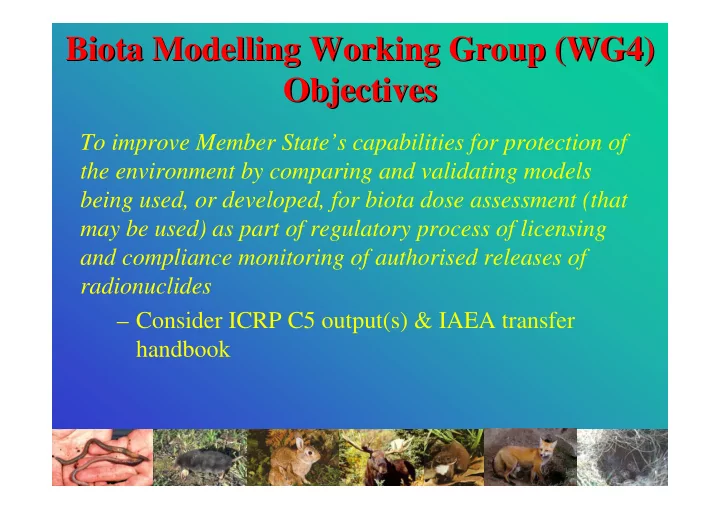
To improve Member State’s capabilities for protection of the environment by comparing and validating models being used, or developed, for biota dose assessment (that may be used) as part of regulatory process of licensing and compliance monitoring of authorised releases of radionuclides – Consider ICRP C5 output(s) & IAEA transfer handbook

slide-2
SLIDE 2

Workplan Workplan & agreed activities & agreed activities (Jan (Jan’ ’09) 09)

  • Interim 2 d meeting July 2009 (IAEA Vienna)
  • Scenarios/exercises:

– U mine, Canada – scenario to be presented to BMG July 2009 (interim results for Jan. 2010) – Waste trenches, Australia – scenario to be presented to BMG

  • Jan. 2010

– Wetland, Sweden – outline scenario to be presented to BMG

  • Jan. 2010

– DCC benchmarking exercise – results July 2010

  • Overview of dynamic modelling – requirements &

capabilities [chapter for final report]

  • Assessment of heterogeneous distribution of

radionuclides in media

slide-3
SLIDE 3

‘ ‘Exercise 3 Exercise 3’ ’

Purpose: Compare unweighted internal and external absorbed dose rates assuming 1 Bq kg-1 in organism & 1 Bq unit-1 media respectively Radionuclides considered – those from ICRP ‘RAP’ report (+55Fe) Did not include noble gases (Ar, Kr Rn) which had been requested by some group members

slide-4
SLIDE 4

Susumu Ryufuku (VIC) VIC Laura Newsome (EA, UK) EA R&D128 [analogue approach] Laura Newsome (EA, UK) EA R&D128 [available spreadsheets] Mat Johansen (ANSTO) ERICA [create organism] Laura Newsome (EA)/Hildegarde Vandenhove (SCK·CEN) ERICA [default] Geert Olyslaegers (SCK·CEN) DosDimEco Jan Horyna (SUJB) SUJB Dong-Kwon Keum (KAERI) K-Biota Nick Beresford (CEH) ICRP RAP report Ali Hosseini (NRPA, Norway) EPIC DOSES3D Karine Beaugelin-Seiller (IRSN, France) EDEN Jordi Vives i Battle (WSC, UK) EA R&D128 [‘basics’] Mike Wood (Liverpool, UK) RESRAD-BIOTA [available software] Sunita Kamboj (ANL, USA) RESRAD-BIOTA [‘basics’]

Participant Model

slide-5
SLIDE 5

Beaverlodge Beaverlodge uranium mine (CNSC) uranium mine (CNSC)

slide-6
SLIDE 6

Beaverlodge Beaverlodge

  • Sediment, water & fish data available over a

number of years [enables model-data comparison]

  • Reduced invertebrate populations/effects in

fish/multi-contaminants – interaction with WG6

  • Provide informed opinion on real issue
slide-7
SLIDE 7

Beaverlodge Beaverlodge

Ra-226 Bq/l water % composition benthic inverts

slide-8
SLIDE 8
  • Phase 1:

– Model-data comparison for fish (Po, Ra) – Model:model benthic invertebrates & fish

slide-9
SLIDE 9

Little Forest Burial Ground (ANSTO) Little Forest Burial Ground (ANSTO)

  • Waste trenches (1960’s)
  • Radionuclides include: U,

3H, Pu Am, Cs, Sr, Co

  • On-going research

programme

slide-10
SLIDE 10

Wetland (Stockholm Univ.) Wetland (Stockholm Univ.)

slide-11
SLIDE 11

Agenda overview Agenda overview

  • Tuesday

– DCC benchmarking – Beaverlodge

  • Wednesday pm

– Little Forest scenario – Wetlands scenario – Combined assessments (WG 1 interaction)

slide-12
SLIDE 12

BWG outputs BWG outputs

Yankovich, T.L., Vives i Batlle, J., Vives-Lynch, S., Beresford, N.A., Barnett, C.L., Beaugelin-Seiller, K., Brown, J.E., Cheng, J-J., Copplestone, D., Heling, R., Hosseini, A., Howard, B.J., Kryshev, A.I., Nedveckaite, T., Smith, J.T., Wood, M.D. International model validation exercise on radionuclide transfer and doses to freshwater

  • biota. J. Radiological Prot.

Beresford, N.A., Barnett, C.L., Brown, J.E., Cheng, J-J., Copplestone, D., Gaschak, S., Hosseini, A., Howard, B.J., Kamboj, S., Nedveckaite, T., Olyslaegers, G., Smith, J.T., Vives I Batlle, J., Vives-Lynch, S., Yu, C. Predicting the radiation exposure of terrestrial wildlife in the Chernobyl exclusion zone: an international comparison of approaches. J. Radiological Prot.