Biosimilars: Draft FDA Guidance and Emerging Legal Challenges - - PowerPoint PPT Presentation

biosimilars draft fda guidance and emerging legal
SMART_READER_LITE
LIVE PREVIEW

Biosimilars: Draft FDA Guidance and Emerging Legal Challenges - - PowerPoint PPT Presentation

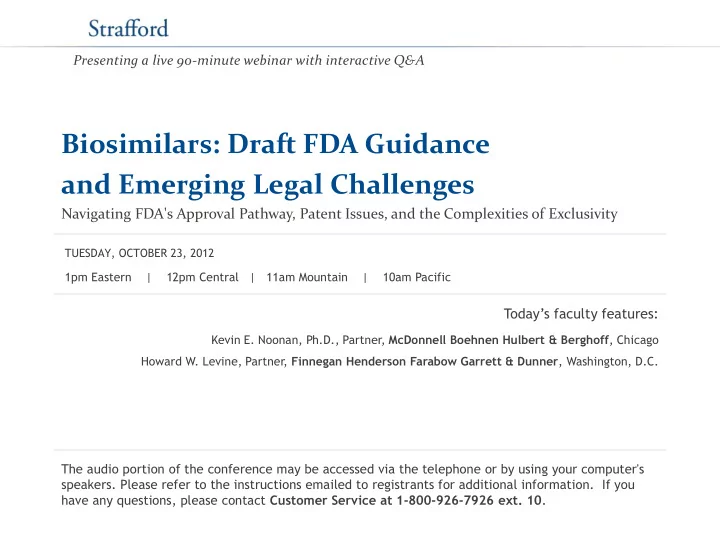
Presenting a live 90-minute webinar with interactive Q&A Biosimilars: Draft FDA Guidance and Emerging Legal Challenges Navigating FDA's Approval Pathway, Patent Issues, and the Complexities of Exclusivity TUESDAY, OCTOBER 23, 2012 1pm


slide-1
SLIDE 1

Biosimilars: Draft FDA Guidance and Emerging Legal Challenges

Navigating FDA's Approval Pathway, Patent Issues, and the Complexities of Exclusivity

Today’s faculty features:

1pm Eastern | 12pm Central | 11am Mountain | 10am Pacific

The audio portion of the conference may be accessed via the telephone or by using your computer's

  • speakers. Please refer to the instructions emailed to registrants for additional information. If you

have any questions, please contact Customer Service at 1-800-926-7926 ext. 10.

TUESDAY, OCTOBER 23, 2012

Presenting a live 90-minute webinar with interactive Q&A

Kevin E. Noonan, Ph.D., Partner, McDonnell Boehnen Hulbert & Berghoff, Chicago Howard W. Levine, Partner, Finnegan Henderson Farabow Garrett & Dunner, Washington, D.C.

slide-2
SLIDE 2

Sound Quality If you are listening via your computer speakers, please note that the quality of your sound will vary depending on the speed and quality of your internet connection. If the sound quality is not satisfactory and you are listening via your computer speakers, you may listen via the phone: dial 1-866-328-9525 and enter your PIN when prompted. Otherwise, please send us a chat or e-mail sound@straffordpub.com immediately so we can address the problem. If you dialed in and have any difficulties during the call, press *0 for assistance. Viewing Quality To maximize your screen, press the F11 key on your keyboard. To exit full screen, press the F11 key again.

slide-3
SLIDE 3

For CLE purposes, please let us know how many people are listening at your location by completing each of the following steps:

  • In the chat box, type (1) your company name and (2) the number of

attendees at your location

  • Click the word balloon button to send

FOR LIVE EVENT ONLY

slide-4
SLIDE 4

Biosimilars: Draft FDA Guidance and Emerging Legal Challenges

October 23, 2012

Presented by Kevin E. Noonan and Howard W. Levine

slide-5
SLIDE 5

BPCIA Legislation & FDA Guidance

5

slide-6
SLIDE 6

The Biologics Price Competition and Innovation Act of 2009 (“BPCIA”)

  • The BPCIA signed into law on March 23, 2010,

amended

– § 351 of the PHSA (42 U.S.C. § 262) – § 271(e) of the Patent Act – Created a statutory framework for FDA approval of new product as “biosimilar” to or “interchangeable” with “reference” products – Grants agency discretion in implementing approval pathway – Specifies procedures for filing patent infringement actions, preliminary injunctions and declaratory judgment actions

6

slide-7
SLIDE 7

Outline of the BPCIA

  • Changes to PHSA § 351(i) (42 U.S.C. § 262(i))

– Provides new and amended definitions

  • New PHSA § 351(k) (42 U.S.C. § 262(k))

– Provides regulatory pathway for biosimilar/ interchangeable products – Provides RP exclusivity

  • New PHSA § 351(l) (42 U.S.C. § 262(l))

– Provides patent litigation process

7

slide-8
SLIDE 8

BPCIA Benefits

  • Allows for “biosimilar” products
  • Allows for “interchangeable” products
  • Provides ~ 1 year exclusivity period for first

approved “interchangeable” product

  • Provides 12 year exclusivity period for RP
  • Allows biosimilar applicant to file application 4

years after RP is first licensed

  • Potential for FDA guidance

8

slide-9
SLIDE 9

BPCIA Definition of “Biological Product”

  • A virus, therapeutic serum, toxin, antitoxin, vaccine, blood, blood

component or derivative, allergenic product, protein (except any chemically synthesized polypeptide), or analogous product, or arsphenamine or derivative of arsphenamine (or any

  • ther trivalent organic arsenic compound), applicable to the

prevention, treatment, or cure of a disease or condition of human beings

  • FDA definition of “protein” (FDA Q&A at 13):

– “[A]ny alpha amino acid polymer with a specific defined sequence that is greater than 40 amino acids in size” – “Compounds greater than 40 amino acids in size will be scrutinized to determine whether they are related to a natural peptide of shorter length and, if so, whether the additional amino acids raise any concerns about the risk/benefit profile of the product.”

9

slide-10
SLIDE 10

“Biosimilar” Products

  • “Biosimilar” defined in statute:

– “(A) that the biological product is highly similar to the reference product notwithstanding minor differences in clinically inactive components; and (B) there are no clinically meaningful differences between the biological product and the reference product in terms of the safety, purity, and potency of the product.”

42 U.S.C. § 262(i)(2)

– “Clinically meaningful differences could include a difference in the expected range of safety, purity, and potency of the proposed and reference products” (Scientific Considerations at 8.) – Non-clinically meaningful differences could include “slight differences in rates of occurrence of adverse events between the two products.” (Scientific Considerations at 8.)

10

slide-11
SLIDE 11

Factors FDA Will Consider to Determine Whether Biosimilar Is “Highly Similar”

  • Expression System
  • Manufacturing Process
  • Assessment of Physiochemical Properties
  • Functional Activities
  • Receptor Binding and Immunochemical Properties
  • Impurities
  • Reference Product and Reference Standards
  • Finished Drug Product
  • Stability

11

slide-12
SLIDE 12

Factors FDA Will Consider to Determine Whether Biosimilar Is “Highly Similar”

  • Comparison between the putative biosimilar and one

reference biologic drug including:

– Analytical studies that demonstrate putative biosimilar is "highly similar" to reference biologic – Animal studies on (at least) toxicity – Human clinical trials to assess immunogenicity, pharmacodynamics/ pharmacokinetics

  • Data supporting biosimilarity includes:

– "[A] clinical study or studies [] that are sufficient to demonstrate safety, purity, and potency in 1 or more appropriate conditions of use for which the reference product is licensed and intended to be used and for which licensure is sought for the biological product."

12

slide-13
SLIDE 13

Factors FDA Will Consider to Determine Whether Biosimilar Is “Highly Similar”

  • In addition to biosimilarity

– Biosimilar and reference product use the same mechanism of action (if known) – Conditions of use for biosimilar be the same as those previously approved for reference product – Identical route of administration, dosage form and strength as approved reference product – Biosimilar prepared in a facility that meets standards that insure biosimilar is safe, effective and pure

13

slide-14
SLIDE 14

FDA Guidance on Establishing Biosimilarity

14

slide-15
SLIDE 15

FDA Guidance on Establishing Biosimilarity

  • Communication With FDA is Essential

– “FDA encourages sponsors to consult extensively with the Agency after completion of comparative structural and functional analysis (before finalizing the clinical program), and throughout development as needed.” (Scientific Considerations at 7-8.) – “FDA also advises sponsors intending … to meet with FDA to present their product development plans and establish a schedule of milestones that will serve as landmarks for future discussions with the Agency. FDA anticipates that early discussions with FDA about product development plans and about the appropriate scientific justifications will facilitate biosimilar development.” (Scientific Considerations at 21.)

15

slide-16
SLIDE 16

FDA Guidance on Establishing Biosimilarity

  • “FDA intends to use a risk-based, totality-of-the

evidence approach to evaluate all available data and information submitted in support of the biosimilarity of the proposed product.” (Scientific Considerations at 8.)

  • “The type and amount of analyses and testing that will

be sufficient to demonstrate biosimilarity will be determined on a product-specific basis.” (Scientific Considerations at 8.)

– “[M]any product-specific factors can influence the components of a product development program intended to establish that a proposed product is biosimilar to a reference product. Therefore, FDA will ordinarily provide feedback on a case-by-case basis on the components of a development program for a proposed product.” Scientific Considerations at 21.

16

slide-17
SLIDE 17

FDA Guidance on Establishing Biosimilarity

  • Structural and Functional Characterization

– “The more comprehensive and robust the comparative structural and functional characterization . . . the more useful such characterization will be in determining what additional studies may be needed.” Scientific Considerations at 7. – Primary structures, such as amino acid sequence – Higher order structures, including secondary, tertiary, and quaternary structure (including aggregation) – Enzymatic post-translational modifications, such as glycosylation and phosphorylation – Other potential variants, such as protein deamidation and

  • xidation

– Intentional chemical modifications, such as PEGylation sites and characteristics” (Scientific Considerations at 9.)

17

slide-18
SLIDE 18

FDA Guidance on Establishing Biosimilarity

  • Animal data: “The sponsor should then consider the role of animal

data in assessing toxicity and, in some cases, in providing additional support for demonstrating biosimilarity and in contributing to the immunogenicity assessment.” (Scientific Considerations at 7.)

– Animal Toxicity Studies: “As a scientific matter, animal toxicity data are considered useful when, based on the results of extensive structural and functional characterization . . . Animal toxicity studies are generally not useful if there is no animal species that can provide pharmacologically relevant data for the protein product.” (Scientific Considerations at 11.) – Animal Immunogenicity Studies: “Animal immunogenicity assessments generally do not predict potential immunogenic responses to protein products in humans. However, when differences in manufacturing (e.g., impurities or excipients) between the proposed product and the reference product may result in differences in immunogenicity, measurement of anti-protein antibody responses in animals may provide useful information relevant to patient safety.” (Scientific Considerations at 12.) – Animal PK and PD Measures: “Under certain circumstances, a single-dose study in animals comparing the proposed product and reference product using PK and PD measures may contribute to the totality of evidence that supports a demonstration of biosimilarity.” (Scientific Considerations at 12.)

18

slide-19
SLIDE 19

FDA Guidance on Establishing Biosimilarity

  • Human Studies

– “In general, the clinical program for a 351(k) application must include a clinical study or studies (including an assessment of immunogenicity and PK or PD) sufficient to demonstrate safety, purity, and potency in one or more appropriate conditions of use for which the reference product is licensed and intended to be used and for which licensure is sought for the biological product, as set forth in the PHS Act. The scope and magnitude of clinical studies will depend on the extent of residual uncertainty about the biosimilarity of the two products after conducting structural and functional characterization and possible animal studies.” (Scientific Considerations at 12.)

19

slide-20
SLIDE 20

FDA Guidance on Establishing Biosimilarity

  • Human Studies (cont.)

– PK / PD studies: “We have determined that both PK

and PD studies . . . generally will be expected to establish biosimilarity, unless a sponsor can scientifically justify that an element is unnecessary.” (Scientific Considerations at 13.)

– Clinical immunogenicity studies: “[A]t least one

clinical study that includes a comparison of the immunogenicity of the proposed product to that of the reference product will generally be expected.” (Scientific Considerations at 14.)

20

slide-21
SLIDE 21

FDA Guidance on Establishing Biosimilarity

  • Human Studies (cont.)

– Comparative clinical safety and effectiveness data

  • “If there are residual uncertainties about the

biosimilarity of the two products after conducting structural and functional studies, animal toxicity studies, human PK and PD studies, and clinical immunogenicity assessment, the sponsor should then consider what comparative clinical safety and effectiveness data may be adequate.” (Scientific Considerations at 7.)

  • “Clinical studies should be designed such that they can

demonstrate that the proposed product has neither decreased nor increased activity compared to the reference product.” (Scientific Considerations at 17.)

21

slide-22
SLIDE 22

FDA Guidance on Establishing Biosimilarity

  • What must be assessed:
  • Immunogenicity assays developed and validated for

biosimilar and reference product

22

Binding Antibody

  • Titer
  • Specificity
  • Relevant Isotype Distribution
  • Time Course of Development
  • Persistence
  • Disappearance
  • Association with clinical sequelae

Neutralizing Antibody

  • (all Binding Antibody points)
  • Plus neutralizing capacity to all

relevant functions

  • Uptake and catalytic activity
  • Neutralization for replacement

enzyme therapeutics

slide-23
SLIDE 23

Canonical Timeline

  • Bioanalytical assay for PK analysis (5 – 8 months)

– Reagent preparation (3 – 4 months) – May have reagents from release testing – Method development and validation (2 – 4 months)

  • Immunogenicity testing assay (6 – 9 months)

– Reagent preparation (3 – 4 months) – may have reagents from release testing – Method development and validation (3 – 5 months)

23

slide-24
SLIDE 24

Canonical Timeline

  • Cell based assays for functional activity (11 – 15 months)

– Selection of the assay procedure (1 month) – Breeding of cell lines and feasibility study (2 – 3 months) – Final selection of cell line and reference antibodies (2 – 3 months) – Optimization and final development of assay (4 – 6 months) – GLP validation (2 months) (If reagents and cell lines are available, applicant could save up to 6 months)

24

slide-25
SLIDE 25

“Interchangeable” Products

  • “Interchangeable” means:

– Biosimilar to RP and – Can be expected to produce the same clinical result as the RP in any given patient, and – For a biological product that is administered more than

  • nce to an individual, the risk in terms of safety or

diminished efficacy of alternating or switching between use of the biological product and the RP is not greater than the risk of using the RP without such alteration or switch.

42 U.S.C. § 262(k)(4)

25

slide-26
SLIDE 26

“Interchangeable” Products

  • What’s the benefit for “interchangeability”?

– The interchangeable product “may be substituted for the reference product without the intervention of the health care provider who prescribed the reference product.” – A biosimilar product cannot be switched for RP without doctor intervention

42 U.S.C. § 262(i)(3)

  • FDA has not yet issued guidance on Interchangeability

– “At this time it would be difficult as a scientific matter for a prospective biosimilar applicant to establish interchangeability in an

  • riginal 351(k) application. . . . FDA is continuing to consider the

type of information sufficient to enable FDA to determine that a biological product is interchangeable with the reference product.” Q & A at 11-12.

26

slide-27
SLIDE 27

“Interchangeable” Products

  • Exclusivity for first approved “interchangeable” product

– No subsequent FOB can be found to be interchangeable until earlier of

  • 1 year after first commercial marketing of first

interchangeable FOB

  • 18 months after final court decision or dismissal with or

without prejudice on patents involved in suit against first interchangeable FOB

  • 42 months after approval of first interchangeable FOB if

patent litigation is still ongoing within the 42 month period or 18 months after such approval if no patent suit was filed against first interchangeable FOB

42 U.S.C. § 262(k)(6)

27

slide-28
SLIDE 28

FDA Guidance Misc. Issues

  • Reliance on Non-US Licensed Product Comparisons

– “In general, a sponsor needs to provide information to demonstrate biosimilarity based on data directly comparing the proposed protein product with the reference product. . . However, under certain circumstances, a sponsor may seek to use data derived from animal or clinical studies comparing a proposed protein product with a non-U.S. licensed product . . . In such a case, the sponsor should provide adequate data or information to scientifically justify the relevance of this comparative data to an assessment of biosimilarity and to establish an acceptable bridge to the U.S.-licensed reference product.” (Quality Considerations at 9.)

28

slide-29
SLIDE 29

FDA Guidance Misc. Issues

  • Extrapolating to Other Indications

– “If the proposed product meets the statutory requirements for licensure as a biosimilar product under section 351(k) . . . the potential exists for the proposed product to be licensed for one or more additional conditions of use for which the reference product is

  • licensed. However, the sponsor will need to provide sufficient

scientific justification for extrapolating clinical data to support a determination of biosimilarity for each condition of use for which licensure is sought.” (Scientific Considerations at 19; Q & A at 9.)

29

slide-30
SLIDE 30

RP Exclusivity

  • 12 year exclusivity for RP

– The RP is entitled to 12 years exclusivity starting from the date when the RP was first licensed by the FDA – Potential for 6 additional months of pediatric exclusivity

  • No additional exclusivity for:

– Supplemental BLA – A new BLA filed by same RPS (or related entity) for

  • A change that results in a new indication, route of

administration, dosing schedule, dosage form, delivery system, delivery device or strength; or

  • A modification to the structure of the biological

product that does not result in a change in safety, purity, or potency

42 U.S.C. § 262(k)(7)

30

slide-31
SLIDE 31

RP Exclusivity

  • Potential additional exclusivity for new BLA if

– Change involves a modification in structure that results in a change in safety, purity or potency compared to the previously approved biologic product

  • If modified BLA results in new RP

– Pending FOB applicant may have to resubmit application (FOB may only be evaluated against 1 RP)

42 U.S.C. § 262(k)(5)(A)

– Offers real opportunity for additional exclusivity

  • Investigate potential avenues for structural change
  • How much of a change in safety (including side

effects), purity or efficacy is required?

31

slide-32
SLIDE 32

Litigating Under the BPCIA

32

slide-33
SLIDE 33

BPCIA Litigation Overview

  • 1. Biosimilar applicant provides application to RPS
  • 2. RPS and Biosimilar applicant identify potentially

relevant patents

  • 3. RPS and Biosimilar applicant “negotiate” final list
  • f patents to actually litigate
  • 4. 180 days before 1st commercial marketing

Biosimilar applicant must notify RPS, who may file for preliminary injunction

  • 5. RPS and Biosimilar can negotiate alternative to

patent exchange process

33

slide-34
SLIDE 34

BPCIA Litigation ≠ Hatch Waxman

  • No orange book listing

– Biosimilar applicant has burden of identifying relevant patents during development work – Negotiated list of patents in suit

  • No limitation on types of patents to assert

– Hatch-Waxman limited to listing patents covering the active ingredient, formulations, and method of use patents – BPCIA allows RPS to assert any patent that a claim of patent infringement “could reasonably be asserted”

  • No 30 month stay upon filing suit
  • No 180 day exclusivity period for 1st filed biosimilar

application

34

slide-35
SLIDE 35

Patent Litigation and FDA Approval

  • Patent litigation process cannot start until four

years after RP is first licensed

  • Patent litigation process does not stay FDA

approval of biosimilar application

– Even if Biosimilar applicant indicates it will not market until after patent expiry, FDA can still approve application

  • Only way to stop biosimilar product from coming
  • nto the market is injunction from the court

35

slide-36
SLIDE 36

Patent Exchange Process Under 42 U.S.C. § 262(l)

Biosimilar files Application Biosimilar Application accepted by FDA Biosimilar provides confidential info to RPS RPS provides patent list to Biosimilar Biosimilar provides RPS with patent list and detailed statement RPS provides Biosimilar with detailed statement RPS & Biosimilar negotiate final list of patents to litigate Agreement reached Biosimilar identifies number of patents that can be asserted RPS files complaint Simultaneous exchange

  • f patent lists

RPS files complaint 180 days before Biosimilar commercialization must notify RPS ? 20 days 60 days 60 days 60 days 15 days no yes 30 days 5 days 30 days 36

slide-37
SLIDE 37

Confidential Disclosure of Biosimilar Application

  • Confidential information

– Within 20 days after Biosimilar applicant receives notice that application has been accepted for review, Biosimilar applicant “shall provide”:

  • Copy of the application
  • Information that describes the process used to manufacture the

biological product and

  • “May provide” other information requested by the RPS

42 U.S.C. § 262(l)(2)

37

slide-38
SLIDE 38

Confidential Disclosure of Biosimilar Application

  • Access to confidential information 42 U.S.C. § 262(l)(1)(B)

– One in-house RPS lawyer who does not prosecute patents related to RP – Outside counsel who do not prosecute patents related to RP – Owner of patent if not RPS and agrees to be bound by confidentiality provisions

  • Limitation on disclosure 42 U.S.C. § 262(l)(1)(C),(D), (F)

– No disclosure to anyone else without prior written consent

  • Includes RPS employees, outside experts, or other outside counsel

– Information only used to determine identify relevant patents that “a claim of patent infringement could reasonably be asserted” – Confidentiality provisions govern until court enters protective order

38

slide-39
SLIDE 39

Confidential Disclosure of Biosimilar Application

  • Penalties for improper disclosure 42 U.S.C. § 262(l)(1)(H)

– Improper disclosure is presumed to cause Biosimilar applicant “irreparable harm” – Court “shall enter” immediate injunctive relief appropriate and necessary to remedy violation

39

slide-40
SLIDE 40

Patent Exchange Process

40 Biosimilar files Application Biosimilar Application accepted by FDA Biosimilar provides confidential info to RPS RPS provides patent list to Biosimilar Biosimilar provides RPS with patent list and detailed statement RPS provides Biosimilar with detailed statement RPS & Biosimilar negotiate final list of patents to litigate Agreement reached Biosimilar identifies number of patents that can be asserted RPS files complaint Simultaneous exchange

  • f patent lists

RPS files complaint 180 days before Biosimilar commercialization must notify RPS ? 20 days 60 days 60 days 60 days 15 days no yes 30 days 5 days 30 days

slide-41
SLIDE 41

RPS List of Patents

  • Within 60 days after receiving copy of Biosimilar

application RPS “shall provide”:

– “A list of patents for which the reference product sponsor believes a claim of patent infringement could reasonably be asserted ” and – “Identification of the patents . . . that the reference product sponsor would be prepared to license to the” Biosimilar applicant

  • RPS must list their own patents as well as patents
  • wned by third parties that could reasonably be

asserted 42 U.S.C. § 262(l)(3)(A)

41

slide-42
SLIDE 42

RPS List of Patents

  • Duty to supplement patent lists

– Reference product sponsor must notify Biosimilar applicant of newly issued /licensed patents (for which a claim of patent infringement could be reasonably asserted) within 30 days of issuance/licensing

42 U.S.C. § 262(l)(7)

  • RPS’s failure to list patents

– If RPS fails to list patents or supplement list then owner of that patent “may not bring an action under this section for infringement of the patent with respect to the biological product ” 35 U.S.C. § 271(e)(6)(C) – Could RPS file an action under 35 USC § 271(a) after Biosimilar product on market or a DJ action if launch is imminent?

42

slide-43
SLIDE 43

Patent Exchange Process

43 Biosimilar files Application Biosimilar Application accepted by FDA Biosimilar provides confidential info to RPS RPS provides patent list to Biosimilar Biosimilar provides RPS with patent list and detailed statement RPS provides Biosimilar with detailed statement RPS & Biosimilar negotiate final list of patents to litigate Agreement reached Biosimilar identifies number of patents that can be asserted RPS files complaint Simultaneous exchange

  • f patent lists

RPS files complaint 180 days before Biosimilar commercialization must notify RPS ? 20 days 60 days 60 days 60 days 15 days no yes 30 days 5 days 30 days

slide-44
SLIDE 44

Biosimilar Applicant List of Patents and Detailed Statement

  • Within 60 days after receiving patent list from RPS,

Biosimilar applicant “shall provide”:

– A detailed statement that describes, on a claim by claim basis, the factual and legal basis of the opinion . . . that [each listed] patent is invalid, unenforceable, or will not be infringed” or – “A statement that the [Biosimilar] applicant does not intend to begin commercial marketing of the biological product before the date that such patent expires;” and – Response regarding any licensing offer

  • Biosimilar applicant “may provide”:

– “A list of patents for which the . . . [Biosimilar] applicant believes a claim of patent infringement could reasonably be asserted ”

42 U.S.C. § 262(l)(3)(B)

44

slide-45
SLIDE 45

Patent Exchange Process

45 Biosimilar files Application Biosimilar Application accepted by FDA Biosimilar provides confidential info to RPS RPS provides patent list to Biosimilar Biosimilar provides RPS with patent list and detailed statement RPS provides Biosimilar with detailed statement RPS & Biosimilar negotiate final list of patents to litigate Agreement reached Biosimilar identifies number of patents that can be asserted RPS files complaint Simultaneous exchange

  • f patent lists

RPS files complaint 180 days before Biosimilar commercialization must notify RPS ? 20 days 60 days 60 days 60 days 15 days no yes 30 days 5 days 30 days

slide-46
SLIDE 46

RPS Detailed Statement

  • Within 60 days after receiving list and detailed

statement from Biosimilar applicant RPS “shall provide”:

– “A detailed statement that describes . . . on a claim by claim basis, the factual and legal basis of the opinion of the [RPS] that [each listed] patent will be infringed” by the Biosimilar and – “A response” to any allegation by the Biosimilar applicant that patents are invalid or unenforceable

42 U.S.C. § 262(l)(3)(C)

46

slide-47
SLIDE 47

Patent Exchange Process

47 Biosimilar files Application Biosimilar Application accepted by FDA Biosimilar provides confidential info to RPS RPS provides patent list to Biosimilar Biosimilar provides RPS with patent list and detailed statement RPS provides Biosimilar with detailed statement RPS & Biosimilar negotiate final list of patents to litigate Agreement reached Biosimilar identifies number of patents that can be asserted RPS files complaint Simultaneous exchange

  • f patent lists

RPS files complaint 180 days before Biosimilar commercialization must notify RPS ? 20 days 60 days 60 days 60 days 15 days no yes 30 days 5 days 30 days

slide-48
SLIDE 48

Duty to Negotiate Prior to Filing Suit

  • 15 days for RPS and Biosimilar applicant to

negotiate in good faith upon list of patents for litigation

– Patents to litigate selected from patents identified during exchange period

42 U.S.C. § 262(l)(4)

  • If RPS and Biosimilar agree, RPS must file suit on

agreed upon patents within 30 days

42 U.S.C. § 262(l)(6)

  • If no agreement reached follow alternative

procedures 42 U.S.C. § 262(l)(5)

48

slide-49
SLIDE 49

Patent Exchange Process

49 Biosimilar files Application Biosimilar Application accepted by FDA Biosimilar provides confidential info to RPS RPS provides patent list to Biosimilar Biosimilar provides RPS with patent list and detailed statement RPS provides Biosimilar with detailed statement RPS & Biosimilar negotiate final list of patents to litigate Agreement reached Biosimilar identifies number of patents that can be asserted RPS files complaint Simultaneous exchange

  • f patent lists

RPS files complaint 180 days before Biosimilar commercialization must notify RPS ? 20 days 60 days 60 days 60 days 15 days no yes 30 days 5 days 30 days

slide-50
SLIDE 50

Duty to Negotiate Prior to Filing Suit

  • No agreement on patent list

– If the RPS and Biosimilar applicant do not agree on patents for litigation within 15 days then:

  • Biosimilar applicant “shall notify” RPS of number of patents it

will provide to RPS

  • Five days later RPS and Biosimilar simultaneously exchange

− List of patents RPS believes should be in suit − List of patent Biosimilar believes should be in suit

– RPS list cannot exceed number of patents identified by Biosimilar

  • Except if Biosimilar provides no patents, then RPS can list one

patent

42 U.S.C. § 262(l)(5)

50

slide-51
SLIDE 51

Infringement Actions

  • Infringement action when no agreement on patent

list

– Upon completion of exchange RPS “shall bring an action for patent infringement with respect to each patent that is included on such lists”

42 U.S.C. § 262(l)(6)(B)

  • How often will RPS and Biosimilar not agree on

the list of patents to be litigated?

51

slide-52
SLIDE 52

Remedies for Timely Lawsuit

  • RPS is entitled to mandatory permanent injunction

against infringement if:

(a) Suit filed within 30 days, (b) Final judgment of infringement from which no appeal can be taken (excluding certiorari to the Supreme Court), and (c) FDA has yet to approve Biosimilar because of 12 year exclusivity

  • Depending on when Biosimilar filed application RPSs may

need to litigate quickly

35 U.S.C. § 271(e)(4)(D)

  • Might obtain permanent injunction under eBay if (a)-(c) not

met

52 52

slide-53
SLIDE 53

Limitations on Remedies

  • RPS’s remedy for infringement shall be limited to a

reasonable royalty if:

– Suit was filed after the 30 day period, or – Suit was filed within 30 day period, but was dismissed without prejudice or was not prosecuted to judgment in good faith

35 U.S.C. § 271(e)(6)(A)-(B)

  • Airtight complaint and personal jurisdiction are of

paramount importance

53

slide-54
SLIDE 54
  • Biosimilar applicant must give RPS 180-day notice before

date of first commercial marketing of Biosimilar

  • After receiving 180-day notice, and before commercial

marketing by Biosimilar, RPS may seek a preliminary injunction with respect to any patent

– Identified during patent exchange but Biosimilar applicant excluded from the list of patents to litigate

  • RPS and Biosimilar applicant have a duty to cooperate in

expediting discovery for purposes of preliminary injunction

42 U.S.C. § 262(l)(8)

Preliminary Injunctions

54 54

slide-55
SLIDE 55

Declaratory Judgment Actions-Permitted

  • Declaratory judgment actions are permitted in very specific

circumstances

  • Timing:

– RPS and Biosimilar applicant cannot file DJ actions until 180 days before 1st commercial marketing if Biosimilar applicant provides RPS with copy of Biosimilar application 42 U.S.C. § 262(l)(9)(A) – If Biosimilar applicant does not provide copy of Biosimilar application, RPS may file DJ action before the 180 day period

42 U.S.C. § 262(l)(9)(A),(C)

55 55

slide-56
SLIDE 56

Declaratory Judgment Actions-Permitted

  • RPS can file DJ on any patent on list it provided to

Biosimilar applicant if Biosimilar applicant fails to:

– Complete exchange of patent information or – Provide detailed statement, or – Notify FDA that RPS filed suit, or – Provide the required notice of first commercial marketing

42 U.S.C. § 262(l)(9)(B)

  • RPS can file DJ on any patent that “claims the biological

product or a use of the biological product” if Biosimilar applicant fails to provide the Biosimilar application to the RPS

– No DJ on process patents

42 U.S.C. § 262(l)(9)(C)

56 56

slide-57
SLIDE 57

Could There Be Three Rounds of Litigation?

  • Round 1: Initial suit after the patent exchange

process

  • Round 2: Preliminary injunction 180 days before

1st commercial marketing on patents exchanged but not litigated

  • Round 3: Traditional 271(a),(b), and/or (c) suit

after commercial launch of Biosimilar product on new patents

57 57

slide-58
SLIDE 58

Take Home Points

  • RPS and Biosimilar should create an “advance

team”

– In-house lawyer – In-house technical expert – Outside counsel – Outside technical expert

  • Don’t skimp on your detailed statement

– Draft with your “advance team” a thorough detailed statement

58 58

slide-59
SLIDE 59

Take Home Points-RPS

  • Identify ahead of time designated in-house counsel to

receive confidential information

  • Identify ahead of time patents you own and third parties
  • wn that a claim of patent infringement could reasonable

be asserted – create “internal” Orange Book

  • Communicate with Third Party patent owners before you

receive Biosimilar application

– Do you take a license – Do you renegotiate license terms – Determine if you are you obligated to assert licensed patents against infringers

59 59

slide-60
SLIDE 60

Take Home Points-RPS

  • Do you want to propose alternative to patent exchange

process

  • Identify “best” patent to litigate in event Biosimilar applicant

tries to limit infringement suit

  • Request relevant information from Biosimilar applicant,

including samples or site visit

  • Consider negotiating personal jurisdiction with Biosimilar

applicant

  • File a properly pled complaint to avoid dismissal
  • Plan for preliminary injunction well in advance of 180-day

trigger

– Which patents will you assert at PI stage

60 60

slide-61
SLIDE 61

Take Home Points-Biosimilar Applicant

  • Identify ahead of time patents owned by RPS and

third parties that a claim of patent infringement could reasonable be asserted

– Can you license from a third party before you file application

  • Do you file application early or late in 12-year

exclusivity period

– If file early, you may have the opportunity to be 1st approved interchangeable – If file late, you may preclude RPS from obtaining injunction

61 61

slide-62
SLIDE 62

Take Home Points-Biosimilar Applicant

  • Do you want to propose alternative to patent

exchange process

  • Develop “detailed statement” of non-infringement,

invalidity, and unenforceability well before patent exchange starts

  • Consider contesting personal jurisdiction
  • Weigh pros and cons of litigating only one patent,

some patents, or all patents

  • Comply with all regulations to avoid DJ action

62 62

slide-63
SLIDE 63

Long Term Predictions

  • Changing biosimilar patent strategy: drift towards

trade secrets to avoid disclosing manufacturing secrets and enjoy statutory exclusivity instead

  • Prior User Rights defense from AIA also incentives

trade secret protection for manufacturing methods

  • Prometheus v. Mayo – way too early impact

predictions, but may foreclose certain method claims

  • Myriad – broad "product of nature" preclusion

could have negative effects on biologic drugs

63 63

slide-64
SLIDE 64

Less Reliance on Patent Exclusivity

  • Strong likelihood that the combination:

– Non-specific guidances; – Reduced scope of patent protection; – Possibility of protecting manufacturing methods by asserting prior user rights defense; and – Complex litigation provisions of the law

  • provide incentives for biologic drug innovators to

rely more heavily on the market exclusivity provisions of the Act than on patents

64 64

slide-65
SLIDE 65

Statutory Exclusivity

65

  • Prohibits biosimilar filings until 4 years after

reference product is licensed

  • Prohibits biosimilar approval until 12 years

after reference product is licensed

slide-66
SLIDE 66

Exclusivity Strategy

Safeguarding intellectual property and maximizing biologic patent life through a robust biosimilars patent portfolio strategy

66 66

slide-67
SLIDE 67

Less Reliance on Patent Exclusivity

  • What will be the relevance of patents in the future of

Biosimilars?

  • If innovators eschew patenting altogether
  • What must be shared:
  • How the biologic was made
  • Characterization of the biologic (with the FDA)
  • But NOT the cell itself
  • Advantages:
  • Obstacles to biosimilar applicants
  • Avoiding biosimilars litigation under the statute

67 67

slide-68
SLIDE 68

Universities and Startups

  • "If Patents Become Irrelevant in a Biosimilars Future, What

About University Patents and Startups?"

  • Statutes:
  • BPCIA
  • Hatch-Waxman Act
  • Bayh-Dole
  • Biotech patenting plays a vital role in early development, especially

licensing, but then is de-emphasized for later state development

  • Startups have become the feeder for new technologies for large

pharmaceutical companies

  • Startups could flounder if patents become less important in biologics

development

www.patentdocs.org, Dec. 21, 2011

68 68

slide-69
SLIDE 69

Of course…

  • The importance of patent protection cannot be

understated or minimized

  • But patent exclusivity might not hold the preeminent

role it does with small molecule drugs

69 69

slide-70
SLIDE 70

Questions?

70

slide-71
SLIDE 71

Kevin E. Noonan, Ph. D. is a partner with McDonnell Boehnen Hulbert & Berghoff LLP in Chicago. His practice encompasses biotechnology and pharma patent prosecution and ANDA litigation. He is also a founding author of the Patent Docs weblog. 312.913.2145/noonan@mbhb.com

Thank You!

71

Howard W. Levine is a Partner in Finnegan’s Washington D.C. office focuses his practice on biotechnology and pharmaceutical patent litigation and appeals before the Federal Circuit. 202.408.4259 Howard.Levine@finnegan.com