Biomechanics BIOEN 520 | ME 527 Mini-Lab 4 Mee>ng - - PowerPoint PPT Presentation
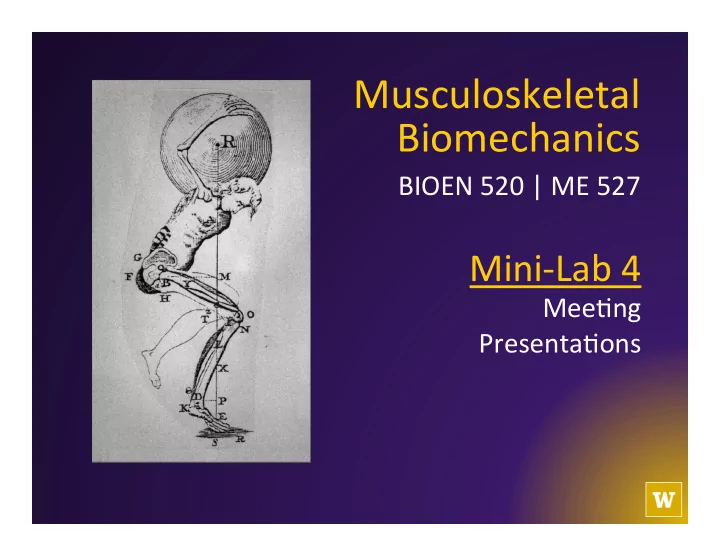
Musculoskeletal Biomechanics BIOEN 520 | ME 527 Mini-Lab 4 Mee>ng Presenta>ons Laboratory 4 Overview... Tradi>onally, two types of presenta>ons:
Laboratory ¡4 ¡Overview... ¡
- Tradi>onally, ¡two ¡types ¡of ¡presenta>ons: ¡
- Posters ¡and ¡podiums ¡
- Thema>c ¡posters ¡
- Poster ¡>ps ¡
- Podium ¡>ps ¡
Poster ¡vs. ¡podium ¡
- Podium ¡is ¡more ¡pres>gious, ¡usually ¡beLer ¡
scoring ¡abstracts ¡
- Podiums ¡definitely ¡more ¡stressful ¡
- Similar ¡amounts ¡of ¡work ¡
- Posters ¡afford ¡more ¡1-‑on-‑1 ¡discussions ¡
¡
Thema>c ¡posters ¡
- best ¡of ¡both ¡worlds ¡
¡ ¡poster ¡in ¡room ¡ ¡ ¡1 ¡or ¡2 ¡or ¡3 ¡slides ¡ ¡ ¡open ¡forum ¡discussion ¡ ¡ ¡really ¡depends ¡on ¡having ¡a ¡good ¡moderator ¡
Posters ¡
- follow ¡instruc>ons! ¡ ¡
§ especially ¡on ¡the ¡dimensions ¡
- use ¡university ¡colors ¡
- add ¡university ¡/ ¡ins>tu>on ¡logos ¡
- follow ¡abstract ¡format ¡
§ intro, ¡methods, ¡results, ¡discussion ¡
- acknowledge ¡your ¡funding ¡sources ¡
- prepare ¡a ¡1-‑minute ¡elevator ¡talk, ¡as ¡well ¡as ¡a ¡
5-‑minute ¡overview ¡
- think ¡of ¡poten>al ¡ques>ons ¡
Posters ¡
- format ¡well ¡– ¡make ¡sure ¡things ¡are ¡symetric, ¡
tabs ¡line ¡up, ¡etc. ¡
- bring ¡printed ¡copies ¡of ¡posters ¡to ¡hand ¡out ¡
¡
Poster ¡Tips ¡
- light ¡(+) ¡vs. ¡dark ¡(-‑) ¡backgrounds ¡
Posters ¡
Posters ¡
Poster ¡Tips ¡
- light ¡(+) ¡vs. ¡dark ¡(-‑) ¡backgrounds ¡vs. ¡ugly ¡
backgrounds ¡(-‑-‑-‑-‑) ¡
Posters ¡
Poster ¡Tips ¡
- light ¡(+) ¡vs. ¡dark ¡(-‑) ¡backgrounds ¡
- bullets ¡(+) ¡vs. ¡paragraphs ¡(-‑) ¡
Posters ¡
Posters ¡
Poster ¡Tips ¡
- light ¡(+) ¡vs. ¡dark ¡(-‑) ¡backgrounds ¡
- bullets ¡(+) ¡vs. ¡paragraphs ¡(-‑) ¡
- large ¡(+) ¡vs. ¡small ¡(-‑) ¡text ¡
§ 100% ¡size, ¡read ¡4 ¡feet ¡away ¡
Posters ¡
Posters ¡
Podium ¡presenta>ons ¡
- follow ¡instruc>ons! ¡ ¡
§ especially ¡on ¡the ¡>ming ¡
- use ¡university ¡colors ¡
- add ¡university ¡/ ¡ins>tu>on ¡logos ¡
- follow ¡abstract ¡format ¡
§ intro, ¡methods, ¡results, ¡discussion ¡
- acknowledge ¡your ¡funding ¡sources ¡
- prac>ce, ¡prac>ce, ¡prac>ce ¡– ¡get ¡>ming ¡down ¡
- do ¡not ¡read ¡from ¡hand ¡held ¡notes! ¡
Podium ¡presenta>ons ¡
- laser ¡pointer ¡ ¡
- number ¡of ¡slides ¡– ¡1 ¡to ¡3 ¡per ¡minute ¡
§ how ¡fast ¡do ¡you ¡want ¡to ¡talk? ¡
- think ¡of ¡poten>al ¡ques>ons ¡
- format ¡well ¡– ¡make ¡sure ¡things ¡are ¡symetric, ¡
tabs ¡line ¡up, ¡etc. ¡
- Ums, ¡ahs, ¡etc. ¡
- Jokes? ¡Baby ¡pictures? ¡Nature ¡pictures? ¡
¡
Podium ¡Tips ¡
- dark ¡(+) ¡vs. ¡light ¡(-‑) ¡backgrounds ¡
Podium ¡
Podium ¡
Podium ¡Tips ¡
- dark ¡(+) ¡vs. ¡light ¡(-‑) ¡backgrounds ¡vs. ¡ugly ¡
backgrounds ¡(-‑-‑-‑) ¡
Podium ¡
Podium ¡
Podium ¡Tips ¡
- dark ¡(+) ¡vs. ¡light ¡(-‑) ¡backgrounds ¡
- bullets ¡(+) ¡vs. ¡text ¡(-‑) ¡
Podium ¡
Podium ¡
Podium ¡Tips ¡
- dark ¡(+) ¡vs. ¡light ¡(-‑) ¡backgrounds ¡
- bullets ¡(+) ¡vs. ¡text ¡(-‑) ¡
- proper ¡(+) ¡vs. ¡improper ¡(-‑) ¡text ¡to ¡image ¡ra>o ¡
Podium ¡
Podium ¡
Podium ¡
Podium ¡Tips ¡
- dark ¡(+) ¡vs. ¡light ¡(-‑) ¡backgrounds ¡
- bullets ¡(+) ¡vs. ¡text ¡(-‑) ¡
- proper ¡(+) ¡vs. ¡improper ¡(-‑) ¡text ¡to ¡image ¡ra>o ¡
- choose ¡colors ¡wisely ¡(+) ¡vs. ¡unwisely ¡(-‑) ¡
Podium ¡
Podium ¡
Podium ¡Tips ¡
- dark ¡(+) ¡vs. ¡light ¡(-‑) ¡backgrounds ¡
- bullets ¡(+) ¡vs. ¡text ¡(-‑) ¡
- proper ¡(+) ¡vs. ¡improper ¡(-‑) ¡text ¡to ¡image ¡ra>o ¡
- choose ¡colors ¡wisely ¡(+) ¡vs. ¡unwisely ¡(-‑) ¡
- small ¡(+) ¡vs. ¡big ¡(-‑) ¡tables ¡
Podium ¡
Podium ¡
Podium ¡
Poster ¡and ¡Podium ¡Presenta>ons ¡ ¡
- No silly fonts!!!!
- And never,
- never,
- never, use…
- Comic sans!!!!!!
Student ¡selected ¡presenta>ons ¡
- good ¡and ¡bad ¡ones ¡ ¡
- why… ¡
Student ¡selected ¡presenta>ons ¡
- Prof. ¡Sam ¡Burden's ¡(UW ¡EE) ¡presenta>on ¡for ¡
the ¡UW ¡Robo>cs ¡Colloquium ¡2015 ¡
Predictable behavior from internal models
forward model inverse model
– theoretical and empirical evidence for pairing of
forward + inverse models
Bhushan, Shadmehr Bio. Cybern. 1999; Sanner, Kosha Bio. Cybern. 1999
+
– parallels in control theory, robotics, artificial intelligence:
adaptive control, internal model principle, learning
Francis, Wonham Automatica 1976; Sastry, Bodson Prentice Hall 1989 Sutton, Barto, Williams IEEE CSM 1992; Atkeson, Schaal ICML 1997 Papavassiliou, Russell IJCAI 1999
Student ¡selected ¡presenta>ons ¡
- 18th ¡European ¡Congress ¡of ¡Physical ¡& ¡
Rehabilita>on ¡Medicine ¡in ¡2012 ¡
Student ¡selected ¡presenta>ons ¡
- Arizona ¡Physiological ¡Society ¡Annual ¡Mee>ng ¡
(2014) ¡
Student ¡selected ¡presenta>ons ¡
- TED ¡talk ¡
Student ¡selected ¡presenta>ons ¡
- University ¡of ¡Minnesota ¡Design ¡of ¡Medical ¡
Devices ¡Compe>>on ¡
Student ¡selected ¡presenta>ons ¡
- ORS ¡2015 ¡
- Cross sectional area smallest 45-55% of the insertion-insertion distance
- ATT loading caused thinner/wider ACL (p=0.01)
- Aspect ratio ranged between: 1.4-2.8; highest near femur
- Aspect ratio increased 0.31 with ATT load (p=0.04)
Specimen group
- 9 fresh-frozen human knees
- All male, mean age: 57 yrs (range: 47-68)
- No signs of previous injury or degeneration
- Bone shafts embedded in epoxy resin
- Carefully dissected by surgeon using loupes
Robotic positioning system
- CASPAR Staubli RX90 (Ortho MAQUET, Germany)
- 6 degrees of freedom manipulation
- Repeatability: 0.02mm
- Model 4015 Universal force sensor (JR3, USA)
- Accuracy ± 0.2 N, ± 0.1 Nm
Statistical analysis
- All data normalized as 0-100% of the femoral-tibial
insertion site distance
- Morphology as a function of flexion/anterior load
assessed using repeated-measures ANOVA (knee position * cross-sectional slice location)
In situ analysis of anterior cruciate ligament shape and morphology
Eric Thorhauer1, Yoshimasa Fujimaki2, Ruben O’Hara-Plotnik1, Scott Tashman1, Freddie Fu1
1 Department of Orthopaedic Surgery, University of Pittsburgh, Pittsburgh, PA, USA 2 Department of Orthopaedic Surgery, Showa University, Tokyo, Japan Benedum Engineering Laboratory, University of Pittsburgh
The shape of the ACL has been highly contested: described as a series of bundles, a band, or a ribbon1,2,3. Understanding the true nature of the ligament is key to the design and selection of grafts that adequately restore the anatomy. Previous assessments of ACL shape and morphology have been conducted in a destructive manner using non-physiological anatomical positions. Purpose: 1.) Develop a method for accurately and objectively classifying ligament shape and morphology. 2.) Explore ACL morphology as a function of applied load and flexion angle
Introduction
ACL in situ shape and morphology were quantified using objective, non-contacting measures in multiple loading/flexion positions.
- ACL shape is load/flexion angle dependent
- All aspect ratios were smaller than 3: the ACL is not a “ribbon”
- Cross-sectional shapes were mostly elliptical
- Native ACL shape varies along the ligament axis unlike standard grafts
These results may aid surgeons in graft design and placement decisions.
Summary
Acknowledgements Corresponding Author
Eric Thorhauer, edt4@pitt.edu Department of Orthopaedic Surgery, University of PittsburghMethods Results
Shape varied along the ACL axis and with different knee positions/loading
- Elliptical shapes detected in 48% of unloaded ACL cross sections, 67% loaded
- Bean/C-shapes were more common near the femoral insertion (34% of all unloaded and
26% of all loaded cross sections)
- Triangle shapes were least common (18% unloaded, 7% loaded)
References
- 1. Siebold, KSSTA, 2014
- 2. Triantafyllidi, J. Arth. Rel. Surg., 2013
- 3. Smigielski, KSSTA, 2014
Student ¡selected ¡presenta>ons ¡
- International summer program from
Nagoya University ¡
Student ¡selected ¡presenta>ons ¡
- hLp://www.k2.t.u-‑tokyo.ac.jp/percep>on/