Biomaterials Research Centres Annual Day 2014 "3-D Printing in - - PDF document

biomaterials research centre s annual day 2014
SMART_READER_LITE
LIVE PREVIEW

Biomaterials Research Centres Annual Day 2014 "3-D Printing in - - PDF document

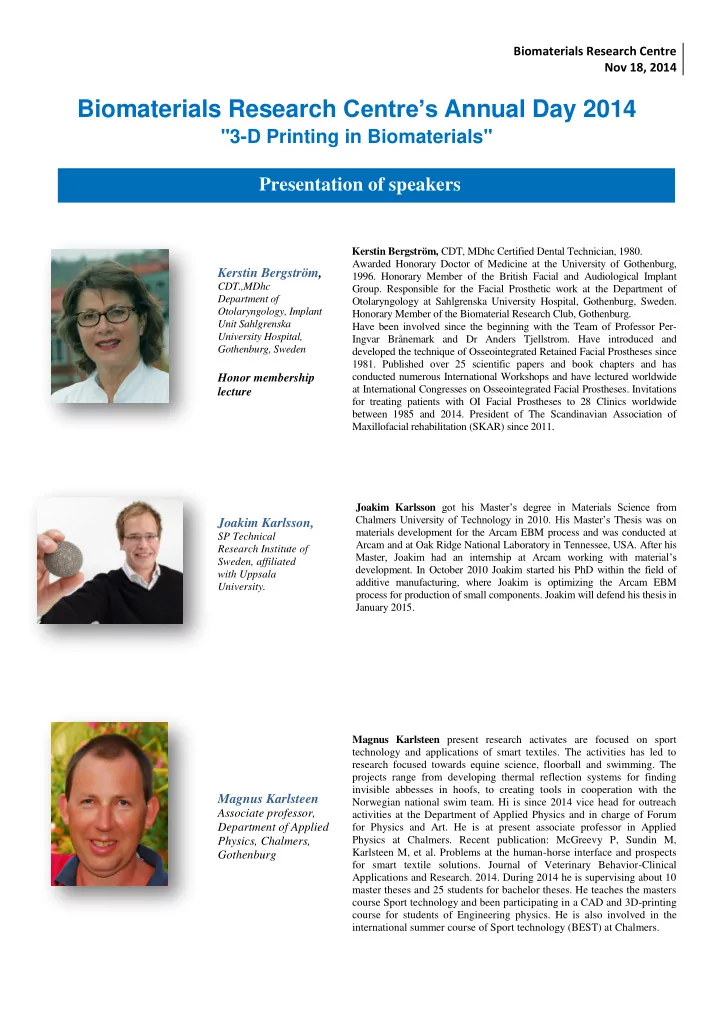
Biomaterials Research Centre Nov 18, 2014 Biomaterials Research Centres Annual Day 2014 "3-D Printing in Biomaterials" Presentation of speakers Kerstin Bergstrm, CDT, MDhc Certified Dental Technician, 1980. Awarded Honorary Doctor


slide-1
SLIDE 1

Biomaterials Research Centre Nov 18, 2014

Biomaterials Research Centre’s Annual Day 2014

"3-D Printing in Biomaterials" Presentation of speakers

Kerstin Bergström, CDT, MDhc Certified Dental Technician, 1980.

Awarded Honorary Doctor of Medicine at the University of Gothenburg,

  • 1996. Honorary Member of the British Facial and Audiological Implant
  • Group. Responsible for the Facial Prosthetic work at the Department of

Otolaryngology at Sahlgrenska University Hospital, Gothenburg, Sweden. Honorary Member of the Biomaterial Research Club, Gothenburg. Have been involved since the beginning with the Team of Professor Per- Ingvar Brånemark and Dr Anders Tjellstrom. Have introduced and developed the technique of Osseointegrated Retained Facial Prostheses since

  • 1981. Published over 25 scientific papers and book chapters and has

conducted numerous International Workshops and have lectured worldwide at International Congresses on Osseointegrated Facial Prostheses. Invitations for treating patients with OI Facial Prostheses to 28 Clinics worldwide between 1985 and 2014. President of The Scandinavian Association of Maxillofacial rehabilitation (SKAR) since 2011. Joakim Karlsson got his Master’s degree in Materials Science from Chalmers University of Technology in 2010. His Master’s Thesis was on materials development for the Arcam EBM process and was conducted at Arcam and at Oak Ridge National Laboratory in Tennessee, USA. After his Master, Joakim had an internship at Arcam working with material’s

  • development. In October 2010 Joakim started his PhD within the field of

additive manufacturing, where Joakim is optimizing the Arcam EBM process for production of small components. Joakim will defend his thesis in January 2015. Magnus Karlsteen present research activates are focused on sport technology and applications of smart textiles. The activities has led to research focused towards equine science, floorball and swimming. The projects range from developing thermal reflection systems for finding invisible abbesses in hoofs, to creating tools in cooperation with the Norwegian national swim team. Hi is since 2014 vice head for outreach activities at the Department of Applied Physics and in charge of Forum for Physics and Art. He is at present associate professor in Applied Physics at Chalmers. Recent publication: McGreevy P, Sundin M, Karlsteen M, et al. Problems at the human-horse interface and prospects for smart textile solutions. Journal of Veterinary Behavior-Clinical Applications and Research. 2014. During 2014 he is supervising about 10 master theses and 25 students for bachelor theses. He teaches the masters course Sport technology and been participating in a CAD and 3D-printing course for students of Engineering physics. He is also involved in the international summer course of Sport technology (BEST) at Chalmers.

Kerstin Bergström,

CDT.,MDhc Department of Otolaryngology, Implant Unit Sahlgrenska University Hospital, Gothenburg, Sweden

Honor membership lecture

Magnus Karlsteen

Associate professor, Department of Applied Physics, Chalmers, Gothenburg

Joakim Karlsson,

SP Technical Research Institute of Sweden, affiliated with Uppsala University.

slide-2
SLIDE 2

Biomaterials Research Centre Nov 18, 2014

Biomaterials Research Centre’s Annual Day 2014

"3-D Printing in Biomaterials" Presentation of speakers

3D Center http://3dcenter.se/

  • Dr. Ola L. A. Harrysson joined the ISE Department at North Carolina

State University in Raleigh, North Carolina in 2002 after receiving his Ph.D. in Industrial Engineering from the University of Central Florida in Orlando, Florida. Prior to attending the University of Central Florida he was born and raised in Sweden and received his bachelor’s degree in Mechanical Engineering from Dala University. He has been conducting research in Rapid Prototyping and Additive Manufacturing for over 15

  • years. His main areas of research are medical application of additive

manufacturing technologies, custom design and fabrication of orthopedic implants, medical device development, and materials development for the Electron Beam Melting technology. Dr. Harrysson is currently a professor, a Fitts Faculty Fellow in Biomedical Manufacturing, and the co-director of the Center for Additive Manufacturing and Logistics in the Fitts Department of Industrial and Systems Engineering at NC State University. ARCAM http://www.arcamgroup.com/ Founded in 1989 and headquartered in Germany, EOS is the technology and market leader for design-driven, integrated e-Manufacturing solutions for Additive Manufacturing (AM), an industrial 3D printing process. EOS

  • ffers a modular solution portfolio including systems, software, materials

and material development as well as services (maintenance, training, specific application consulting and support). As an industrial manufacturing process it allows the fast and flexible production of high- end parts based on 3D CAD data at a repeatable industry level of quality. As a disruptive technology it paves the way for a paradigm shift in product design and manufacturing. It accelerates product development,

  • ffers freedom of design, optimizes part structures, and enables lattice

structures as well as functional integration. As such, it creates significant competitive advantages for its customers. For more information please visit our website under http://www.eos.info/.

Casper Rosén,

Technology and Sales, Västervik, Sweden

Ola LA Harrysson

Professor & Fitts Fellow in Biomedical Manufacturing Co- Director of Center for Additive Manufacturing and Logistics Fitts Department of Industrial and Systems Engineering North Carolina State University, USA

Stefan Thundal,

Product Manager/ Area Sales Manager, Mölndal, Sweden

Björn Björnström,

Regional Manager Nordic & Baltic, Gothenburg

slide-3
SLIDE 3

Biomaterials Research Centre Nov 18, 2014

Biomaterials Research Centre’s Annual Day 2014

"3-D Printing in Biomaterials" Presentation of speakers

For more than 10 years in charge of the reconstructive team at the department of Oral and Maxillofacial Surgery in Gothenburg. Previously, a former research focused on bone and bone healing/regeneration resulting in a Ph. D. thesis in 1998. Presently, research focuses on development of oral cancer, especially cancer originating from premalignant oral mucosal

  • lesions. Co-author on some recent papers on different biological markers

and their expression during development of oral cancer. Also running projects on rehabilitation of function in patients treated for oral cancer with focus on the use of dental implants and individually produced prostheses. Another project “under construction” is the management of patient suffering from osteoradionecrosis as a result of radiotherapy to the head- and-neck region. This is project with multiple aspects from which patient develop osteoradionecrosis to how to best treat these patients. At present time, one Ph.D.-student is involved in this project but another one to two persons are to be engaged. Erik Adolfssson is working as Researcher at Swerea IVF since 2005 and was earlier at Swedish Ceramic Institute in Gothenburg for 6 years. He got his PhD in Inorganic Chemistry 1999 at Stockholm University. Erik´s area

  • f expertise is Ceramic materials. Ceramic materials can be processed with

standard process techniques, if this is done before the material is sintered. The CAD model can then be used to create a ceramic component with the required geometric form from several different materials such as zirconium

  • xide, aluminium oxide, hydroxylapatite or any other material specified by

the customer. Important aspects are; 1) Mechanical properties of the machined material -The method with which the machining is carried out is important for the component’s surface and also for the component’s mechanical performance. If the machining is not adapted to the material used, the mechanical characteristics can be drastically reduced due to surface defects. 2) Dimensional stability -The ceramic material will shrink during sintering. Therefore, the form of the component created needs to be scaled up correspondingly to compensate for this shrinkage, so that it has the correct dimensions after sintering. The precision received varies with the type of material used, but is usually within a range of 0.1%. 3) Components- Ceramic components can be created from many different materials to improve characteristics for different applications. Some examples of characteristics for which improvements could be desirable are mechanical, thermal, chemical, biological, tribiological or aesthetic.

  • Dr. Gatenholm is professor of Biopolymer Technology at Chalmers

University of Technology, Director of BBV Laboratory, Coordinator of EAREG program and Director of Graduate School at Wallenberg Wood Science Center, WWSC. He is also Adjunct Professor at Joint School of Biomedical Engineering and Sciences at Virginia Tech and Wake Forest University and Adjunct Professor of Biomaterials at Wake Forest Institute for Regenerative Medicine in Winston-Salem, North Carolina, USA. He has been professor of Bioprocessing and Biomaterials at the Virginia Tech, Department

  • f Materials Science and Engineering between August 2007 and April 2009.
  • Dr. Gatenholm is a material scientist with interest in the biomimetic design of
  • materials. His research includes biological fabrication through the use of

enzymes, cells, and the coordination of biological systems. Dr. Gatenholm is particularly interested in designing and preparing new biomaterials which can replace or regenerate tissue and organs. He has published more than 270 peer review papers and edited several books. He is elected member of Royal Academy of Engineering Sciences.

Paul Gatenholm,

Ph.D., Professor. Department of Chemical and Biological Engineering Biopolymer Technology, Chalmers, Gothenburg, Sweden

Göran Kjeller,

Associate Professor Department of Oral & Maxillofacial Surgery, Sahlgrenska Academy, University of Gothenburg, Sweden

Erik Adolfsson,

Researcher, Swerea/IVF, Mölndal, Sweden

slide-4
SLIDE 4

Biomaterials Research Centre´s Annual Day 2014-11-18

“3D Printing in Biomaterials”

Abstracts

Kerstin Bergstrom CDT., MDhc. Anaplastologist, Department of Otolaryngology, Sahlgrenska University Hospital, Gothenburg Osseointegrated Facial Prostheses – History / Developments/ Future Bone-Anchored prosthetics have advanced the rehabilitation of patients with defects from cancer therapy, malformation or

  • trauma. 1979 the first patient was provided with an auricular osseointegrated craniofacial prosthesis in Gothenburg, Sweden.

During 35 years the technique has developed and new possibilities for reconstruction has opened. 1983 the first child got

  • sseointegrated fixtures for an auricular prosthesis. 31 years follow up and what happens when children grows up will be

presented Everyday life, phsycological and functional aspects will be discussed. Teamwork and treatment planning is important for the final functional and aesthetic outcome of the restoration. Computer - aided surgical and prosthetic planning and design using 3D models has further increased the possibility of optimizing the results in combination with artistic approach. Application

  • f digital methods and technologies represents an alternative to traditional ways of fabrication of custom-made facial silicone
  • prostheses. Future developments to further improve the rehabilitation and quality of life for our patients is what we are striving

for. Joakim Karlsson, SP Technical Research Institute of Sweden affiliated with Uppsala University. Overview of different 3D-printing techniques and the latest trends in the field. The interest in 3D-printing, also commonly called additive manufacturing (AM), has exploded during the recent years. Various additive manufacturing machines have evolved, aimed for everything from home users of plastic printing to serial production of metallic components and advanced cell and organ printing. In this presentation, an overview will be given on how different additive manufacturing processes work, and their benefits and drawbacks will be discussed. The presentation will also cover some examples of available techniques and their specific features. Some examples of successful applications of additive manufactured parts will be given, both within medical devices as well as other fields. Since the field of additive manufacturing is constantly evolving, and right now at a tremendous pace, examples will be given of the current research within this field. Magnus Karlsteen, Associate Professor, Department of Applied Physics, Chalmers, Gothenburg 3D printing in undergraduate education How do we take advantage of, stimulate and develop our students' creative potential during the education at Chalmers as well as for their future profession? At the Department of Applied Physics five 3D printers have been installed for the bachelor program Engineering Physics, where students now get to work on design and 3D-CAD during their first year of study. In this way, students can develop initial knowledge of design and prototyping which are important steps in the product development process where engineering graduates may end up in future careers. Students in Engineering Physics are very creative. Alongside the traditional math and physics courses students encounter during their first year, it is important to seize and develop this creative side further. The positive response from the students show that there is a huge unknown demand for creative work The venture with 3D-printers and design insights are just part of a larger effort for an improved and more creative lab assignments for physics programs in Gothenburg. This investment also means that students have access to open workshops with 3D-printers, as well as an open forum where they over a coffee develop creative ideas

slide-5
SLIDE 5

Biomaterials Research Centre´s Annual Day 2014-11-18

“3D Printing in Biomaterials”

Abstracts

Ola LA Harrysson Professor & Fitts Fellow in Biomedical Manufacturing, Co-Director of Center for Additive Manufacturing and Logistics, Fitts Department of Industrial and Systems Engineering, North Carolina State University, USA Printed metallic implants and their validation in vitro The Research group at North Caroline State University acquired the very first Electron Beam Melting (EBM) machine in 2003 and has been actively involved in custom design and direct metal fabrication of implants ever since. Over the years a number of implants have been designed and fabricated and different implant surfaces have been validated in vitro for various tissue types. Our research indicates that printed metal implants work very well for various applications but the surface morphology needs to be tailored to the tissue type. Both laser based and electron beam based powder bed systems are being used by the group to fabricate custom implants out of Ti6Al4V and CoCrMo alloys. The design freedom offered by these 3D printing technologies allows us to design unique implants with both solid and porous sections as well as implants with tailored properties to better fit a patient. Design and fabrication of tissues by bioplotter Tissue engineering and regenerative Medicine (TERM) is an emerging field which integrates the principles of engineering and life sciences to develop biological substitutes for therapeutic (restoring or repairing defective tissues and organs) as well as diagnostic (e.g., disease modeling, pharmacological screening) applications. Three-dimensional (3D) scaffolds play a central role in TERM; because cells lack the ability to grow in favored 3D orientations by themselves, the porous scaffolds define the anatomical shape of the tissue, and guide cell growth and new tissue formation. 3D-Bioplotting is a melt-extrusion based additive manufacturing process that has the capability to reproducibly produce scaffolds of physiological thickness and patient- specific geometry while offering superior control over the resultant architecture and mechanical characteristics. The process involves the pneumatic extrusion of biomaterials (e.g., polymers, biomolecules, hydrogel-encapsulated cells) in the form of strands through a nozzle in a toolpath that is controlled via a digital file. We have been investigating the material-process- structure-function relationships involved in the 3D-Bioplotting of polycaprolactone (PCL) and PCL-tricalcium phosphate composites for applications in human adipose-derived stem cells (hASC)-based tissue engineering. We have developed predictive models that establish the relationship between 3D-Bioplotting process parameters and resultant scaffold structural and mechanical characteristics. We have also studied the effect of 3D bioplotted scaffold architecture on the viability, proliferation and differentiation of hASC. Some of our key results will be presented in this talk. Göran Kjeller, Associate Professor, Dept. of Oral and Maxillofacial Sugery, Institute of Odontology, Sahlgrenska Academy, Gothenburg University, Sweden. 3D-Printing in Reconstructive Maxillofacial Surgery Reconstruction of maxillofacial deficiencies after ablative tumor surgery or excessive maxillofacial trauma is a challenge for the

  • surgeons. During many years these patients were considered rehabilitated when the cancer was removed and the patient
  • survived. However, with a better survival among cancer patients the demands from the patients increased regarding function,

resulting in development of different reconstructive techniques involving transfer of free tissue flaps. All patients are not suitable for these procedures due to their general health. I.e., there is a need for alternatives to these major procedures. In addition, an increased awareness among patients has increased the demands on both functional as well as on esthetic outcome. The use of 3D-printing techniques is a promising alternative for may of these patients in order to improve their daily living.

slide-6
SLIDE 6

Biomaterials Research Centre´s Annual Day 2014-11-18

“3D Printing in Biomaterials”

Abstracts

Paul Gatenholm, Professor, Department of Chemical and Biological Engineering, Biopolymer Technology, Chalmers, Gothenburg, Sweden 3D BIOPRINTING OF LIVING SOFT TISSUES WITH NANOCELLULOSE INK Kajsa Markstedtb, Athanasios Mantasa, Hector Martineza, Daniel Hägga and Paul Gatenholmab

a3DBioprinting Center, Department of Chemical and Biological Engineering, Chalmers bWallenberg Wood Science Center

The introduction of 3D bioprinting is expected to revolutionize the field of tissue engineering and regenerative medicine, which enables the reconstruction of living tissue and organs preferably using the patient’s own cells. The 3D bioprinter is a robotic arm able to move in the X,Y,Z directions with a resolution of 10μm while dispensing fluids. The 3D bioprinter can position several cell types and thus reconstruct the architecture of complex organs. We have developed a new supporting material, CELLINK, for printing living soft tissue with cells. CELLINK is composed of a nanofibrillated cellulose dispersion and alginate which is crosslinked after printing. The rheology of the inks shows shear thinning behaviour and depending on their viscosity different parameters are required for optimizing the printing resolution: pressure, needle diameter, printing speed, temperature, etc. Cytotoxicity and cell viability have been tested in order to print CELLINK with living cells. Human chondrocytes have been successfully printed with CELLINK in complex 3D shape of human ear and cells show good viability after printing and crosslinking. Long term evaluation of cartilage regeneration in 3D Bioprinted tissue is ongoing. We are establishing a center to provide the infrastructure necessary for 3D bioprinting of living tissue. This technology is undergoing a rapid and expansive phase, and it is important that the Västra Götalands Region in Sweden is at the frontier. The 3D bioprinting technology is demanding when it comes to material development, programming and handling of the cells; and it is not feasible that every research group will purchase their own equipment set. Therefore, we are developing a core facility where clinicians and researchers within life science can print the cells and tissues needed for their purposes, and where material scientists can develop their own materials for 3D bioprinting. This resource center is scheduled to open in January 1, 2015 for external projects.