BIOLUMINESCENCE IN WATASENIA SCINTILLANS (FIREFLY SQUID) Presented - - PowerPoint PPT Presentation

bioluminescence in watasenia scintillans firefly squid
SMART_READER_LITE
LIVE PREVIEW

BIOLUMINESCENCE IN WATASENIA SCINTILLANS (FIREFLY SQUID) Presented - - PowerPoint PPT Presentation

BIOLUMINESCENCE IN WATASENIA SCINTILLANS (FIREFLY SQUID) Presented by: Timothy Goh Biol 428 Winter 2015 Some things which are not fire nor forms of fire seem to produce light by nature Aristotle (~2,500 years ago) OUTLINE 1.


slide-1
SLIDE 1

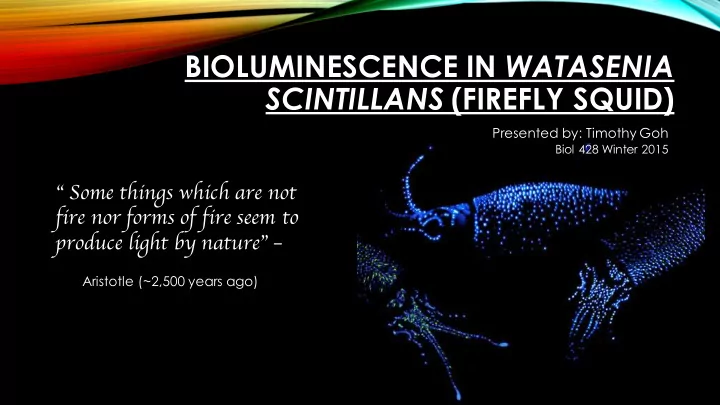
BIOLUMINESCENCE IN WATASENIA SCINTILLANS (FIREFLY SQUID)

Presented by: Timothy Goh

Biol 428 Winter 2015

“ Some things which are not fire nor forms of fire seem to produce light by nature” –

Aristotle (~2,500 years ago)
slide-2
SLIDE 2

OUTLINE

1. Introduction 2. Light generating mechanism 3. Adaptation 4. The origin of bioluminescence 5. Conclusion and future of bioluminescence

slide-3
SLIDE 3

INTRODUCTION

  • Commonly known as “hotaru-ika” or

the firefly squid

  • Found only in Japan – Toyoma Bay
  • 1-year life cycle
  • Large array of photophores throughout

the body

  • Emits blue light
slide-4
SLIDE 4

CHALLENGES

  • They cannot be kept alive for more

than 3-5 days in captivity

  • The animal dies in about 10-20 min

when taken out of water causing irreversible damage to the photophores

  • The luminescence system is highly

unstable even when the photophores are kept in an ice bath

slide-5
SLIDE 5
  • 1. LIGHT GENERATING MECHANISM
  • 2 ways to generate light:

(a) internal biochemical reaction à my species! (b) symbiotic luminous bacteria

  • Luciferin-luciferase reaction:

Light generating mechanism à adaptation à origin of bioluminescence à conclusion and future

slide-6
SLIDE 6

üATP üOxygen üpH 8.8 CONCLUSION: ATP or Oxygen alone is not sufficient. Both are

  • necessary. (Tsuji, 2002)

Light generating mechanism à adaptation à origin of bioluminescence à conclusion and future

slide-7
SLIDE 7
  • 2. ADAPTATION
  • Most cephalopods are color blind because they only have one visual

pigment in their retina (Brown & Brown, 1958)

  • Instead of perceiving color, most cephalopods are found to utilize

contrast

  • Cephalopods contrast difference à 15%
  • Humans contrast difference à 2%

WHY BOTHER BIOLUMINESCENCE WHEN THEY CANNOT EVEN SEE COLOR ???!!

Light generating mechanism à adaptation à origin of bioluminescence à conclusion and future

slide-8
SLIDE 8

WATASENIA IS AN EXCEPTION

  • They have 3 visual pigments in their retina

(Michinomae et al., 1994)

  • 2 of the photopigments (470nm & 500 nm) are

present in the proximal part of the retina

  • The other photopigment (484nm) is present in the

both distal and proximal part of the retina.

HERE COMES ANOTHER PROBLEM! Chromatic defocus à different wavelength

  • f light focusing on different parts of the

retina creating a blurry image

Light generating mechanism à adaptation à origin of bioluminescence à conclusion and future

slide-9
SLIDE 9

A: Chromatic defocus B: Chromatic defocus solved

Problem solved:

  • A bank of photoreceptors

sensitive to short and long

  • wavelength. (Kröger & Gislén, 2004)

This allows visualization of well focused images

Bank of photoreceptors + layered organization à maximizes sensitivity and sharpness Light generating mechanism à adaptation à origin of bioluminescence à conclusion and future

slide-10
SLIDE 10
  • 3. ORIGIN OF BIOLUMINESCENCE
  • Complex diversity of mechanism use to generate light

suggests that perhaps multiple independent origins of bioluminescence arose over the course of evolution. (Buck, 1978)

  • Current hypothesis:

(a) luciferin à shape the evolution of bioluminescence (b) luciferase à serves to express the chemiluminescent properties of luciferin

Light generating mechanism à adaptation à origin of bioluminescence à conclusion and future

slide-11
SLIDE 11
  • Research has shown that photogenic substrate (luciferin) has a strong

antioxidative property à highly reactive with ROS (Suzuki, 1993)

  • Proposed that luciferin (Rees et al., 1998):

Original function à detoxify the deleterious effect of ROS

Animals started colonizing deeper layers of the ocean

1) Low penetration by sunlight. lower ROS 2) Decrease in metabolic activity, decrease ROS

Evolved function: functional shift from detoxification to light-emitting

Light generating mechanism à adaptation à origin of bioluminescence à conclusion and future

slide-12
SLIDE 12
  • 4. FUTURE

Agriculture Medicine

Light generating mechanism à adaptation à origin of bioluminescence à conclusion and future

slide-13
SLIDE 13

SUMMARY

1. Light is generated via the luciferin-luciferase complex for Watasenia scintillans. 2. BOTH oxygen and ATP are necessary for the generation of light in Watasenia scintillans. 3. Most cephalopods are color blind BUT Watasenia scintillans evolve retina that contains 3 types of photopigments. 4. Bank of photoreceptors + layered organization à maximizes sensitivity and sharpness 5. It is suggested that bioluminescence might have arose multiple times independently across various phyla 6. Photogenic substrate (luciferin) might have undergone a functional shift from detoxification of ROS to the production of light.

Light generating mechanism à adaptation à origin of bioluminescence à conclusion and future

slide-14
SLIDE 14

Brown, P. K, and P. S Brown. "Visual Pigments of the Octopus and Cuttlefish." Nature 182 (1958): 1288–1290. Buck, J. B. "Functions and Evolution of Bioluminescence. In Bioluminescence in Action (ed.

  • P. J. H. Herring)." London: Academic Press (1978): 419-60.

Kröger, Ronald H.H., and Anna Gislén. "Compensation for Longitudinal Chromatic Aberration in the Eye of the Firefly Squid, Watasenia Scintillans." Vision Research 44 (2004): 2129–2134. Michinomae, M., H. Masuda, M. Seidou, and Y. Kito. "Structural Basis for Wavelength Discrimination in the Banked Retina of the Firefly Squid Watasenia Scintillans." Journal of Experimental Biology 193 (1994): 1-12. Rees, Jean-François, Bertrand De Wergifosse, Olivier Noiset, Marlene Dubuisson, Bernadette Janssens, and Eric M. Thompson. "The Origins of Marine Bioluminescence: Turning Oxygen Defence Mechanisms into Deep-sea Communication Tools." The Journal of Experimental Biology 201 (1998): 1211–1221. Suzuki, N. "Antioxidative Activity of Some Biologically Active Compounds with Active Oxygen Species." Spectrum 6 (1993): 21-26. Tsuji, Frederick. "Bioluminescence Reaction Catalyzed by Membrane-bound Luciferase in the ‘‘firefly Squid,’’ Watasenia Scintillans." Biochimica Et Biophysica Acta 1564: 189– 197.

Bibliography