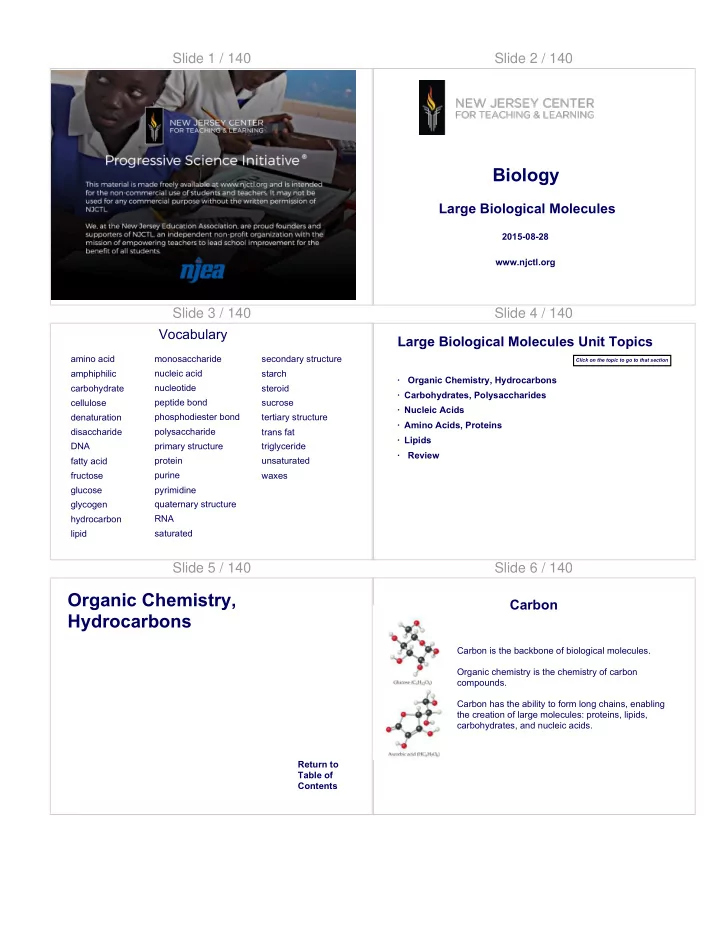
Biology Large Biological Molecules 2015-08-28 www.njctl.org Slide - - PDF document

biology
SMART_READER_LITE
LIVE PREVIEW

Biology Large Biological Molecules 2015-08-28 www.njctl.org Slide - - PDF document

Slide 1 / 140 Slide 2 / 140 Biology Large Biological Molecules 2015-08-28 www.njctl.org Slide 3 / 140 Slide 4 / 140 Vocabulary Large Biological Molecules Unit Topics amino acid monosaccharide secondary structure Click on the topic to go


slide-1
SLIDE 1

Slide 1 / 140 Slide 2 / 140

Biology

Large Biological Molecules

2015-08-28 www.njctl.org

Slide 3 / 140

amino acid carbohydrate amphiphilic cellulose denaturation disaccharide DNA fatty acid fructose glucose glycogen hydrocarbon lipid monosaccharide nucleic acid nucleotide peptide bond phosphodiester bond polysaccharide primary structure protein purine pyrimidine quaternary structure RNA saturated secondary structure starch steroid sucrose tertiary structure trans fat triglyceride unsaturated waxes

Vocabulary Slide 4 / 140 Large Biological Molecules Unit Topics

· Organic Chemistry, Hydrocarbons · Amino Acids, Proteins · Nucleic Acids

Click on the topic to go to that section

· Lipids · Carbohydrates, Polysaccharides · Review

Slide 5 / 140

Organic Chemistry, Hydrocarbons

Return to Table of Contents

Slide 6 / 140

Carbon is the backbone of biological molecules. Organic chemistry is the chemistry of carbon compounds. Carbon has the ability to form long chains, enabling the creation of large molecules: proteins, lipids, carbohydrates, and nucleic acids.

Carbon

slide-2
SLIDE 2

Slide 7 / 140

Organic Compounds

Organic compounds range from simple molecules to colossal

  • nes.

H C

Organic compounds contain: Always Often Occasionally

N O S P

Si

Halogens

Slide 8 / 140 Organic Chemistry

Carbon atoms can form diverse molecules by bonding to four other atoms which are in different directions. This allows the molecule to take on a 3D configuration. It is this 3D structure that defines the molecule's function.

Slide 9 / 140 Electron Configuration

You should remember from chemistry, electron configuration is the key to an atom’s characteristics. Electron configuration determines the kinds and number of bonds an atom will form with other atoms. Carbon has four valence electrons to make covalent bonds.

Slide 10 / 140

1 Organic chemistry is a science based on the study

  • f _____.

A functional groups. B carbon compounds. C water and its interaction with other kinds of molecules. D inorganic compounds.

Slide 10 (Answer) / 140

1 Organic chemistry is a science based on the study

  • f _____.

A functional groups. B carbon compounds. C water and its interaction with other kinds of molecules. D inorganic compounds.

[This object is a pull tab]

Answer B

Slide 11 / 140

2 Which property of the carbon atom gives it compatibility with a greater number of different elements than any

  • ther type of atom?

A Carbon has 6 to 8 neutrons. B Carbon has a valence of 4. C Carbon forms ionic bonds. D A and C only. E A, B, and C.

slide-3
SLIDE 3

Slide 11 (Answer) / 140

2 Which property of the carbon atom gives it compatibility with a greater number of different elements than any

  • ther type of atom?

A Carbon has 6 to 8 neutrons. B Carbon has a valence of 4. C Carbon forms ionic bonds. D A and C only. E A, B, and C.

[This object is a pull tab]

Answer B

Slide 12 / 140

3 What type(s) of bond(s) does carbon form? A ionic B hydrogen C covalent D A and B only E A, B and C

Slide 12 (Answer) / 140

3 What type(s) of bond(s) does carbon form? A ionic B hydrogen C covalent D A and B only E A, B and C

[This object is a pull tab]

Answer C

Slide 13 / 140

4 How many electron pairs does carbon share to complete its valence shell?

Slide 13 (Answer) / 140

4 How many electron pairs does carbon share to complete its valence shell?

[This object is a pull tab]

Answer 4

Slide 14 / 140

5 Which of the following is an organic compound? A H2O B NaCl C C6H12O6 D O2

slide-4
SLIDE 4

Slide 14 (Answer) / 140

5 Which of the following is an organic compound? A H2O B NaCl C C6H12O6 D O2

[This object is a pull tab]

Answer C

Slide 15 / 140 Hydrocarbons

These molecules consist of only carbon and hydrogen atoms. Each carbon atom makes 4 bonds. Each hydrogen atom makes 1 bond. Carbon- hydrogen bonds are non-polar, so those bonds are hydrophobic. Fossil fuels are examples of hydrocarbons that are formed from decaying organic matter.

Slide 16 / 140 Saturated Hydrocarbons

In saturated hydrocarbons: · every carbon atom is bonded to four different atoms · no new atoms can be added along the chain

Slide 17 / 140 Unsaturated Hydrocarbons

double bond

In unsaturated hydrocarbons: · some of the carbon-carbon bonds are double or triple bonds · those can be broken and replaced with a single bond · at that point, additional atom(s) can be added

H C C C C H H H H H H H

Slide 18 / 140

6 Hydrocarbons _____. A are polar B are held together by ionic bonds C contain nitrogen D contain only hydrogen and carbon atoms

Slide 18 (Answer) / 140

6 Hydrocarbons _____. A are polar B are held together by ionic bonds C contain nitrogen D contain only hydrogen and carbon atoms

[This object is a pull tab]

Answer D

slide-5
SLIDE 5

Slide 19 / 140

7 What is the reason why hydrocarbons are not soluble in water? A The majority of their bonds are polar covalent carbon to hydrogen linkages B The majority of their bonds are nonpolar covalent carbon to hydrogen linkages C They are hydrophilic D They are lighter than water

Slide 19 (Answer) / 140

7 What is the reason why hydrocarbons are not soluble in water? A The majority of their bonds are polar covalent carbon to hydrogen linkages B The majority of their bonds are nonpolar covalent carbon to hydrogen linkages C They are hydrophilic D They are lighter than water

[This object is a pull tab]

Answer B

Slide 20 / 140

8 Hydrocarbons containing only single bonds between the carbon atoms are called __________. A saturated B polar C non-polar D unsaturated

Slide 20 (Answer) / 140

8 Hydrocarbons containing only single bonds between the carbon atoms are called __________. A saturated B polar C non-polar D unsaturated

[This object is a pull tab]

Answer A

Slide 21 / 140

9 Hydrocarbons containing double or triple bonds between some of the carbon atoms are called __________. A saturated B polar C non-polar D unsaturated

Slide 21 (Answer) / 140

9 Hydrocarbons containing double or triple bonds between some of the carbon atoms are called __________. A saturated B polar C non-polar D unsaturated

[This object is a pull tab]

Answer D

slide-6
SLIDE 6

Slide 22 / 140

10 Gasoline and water do not mix because gasoline is __________. A less dense than water B non-polar and water is polar C volatile and water is not D polar and water is non-polar

Slide 22 (Answer) / 140

10 Gasoline and water do not mix because gasoline is __________. A less dense than water B non-polar and water is polar C volatile and water is not D polar and water is non-polar

[This object is a pull tab]

Answer B

Slide 23 / 140

Hydrocarbons form the framework from which the 4 different classes of macromolecules (large molecules) have been

  • derived. We have mentioned these 4 types of molecules before .

List them below.

Biological Macromolecules

· _____________ · _____________ · _____________ · _____________ (See the first slide in this chapter for a hint)

Slide 24 / 140

Three of the classes of life’s organic molecules are polymers: carbohydrates, nucleic acids, and proteins. Although organisms share the same limited number of monomer types, each organism is unique based on the arrangement of how their monomers are used to make polymers. An immense variety of polymers can be built from a small set of monomers.

Polymers

Polymer : Monomer they're made from: Proteins Amino acids Carbohydrates Simple sugars (monosaccharides) Nucleic acids Nucleotides

Slide 25 / 140 Review: Dehydration Synthesis

longer polymer monomer short polymer

OH OH

H H

water

Slide 26 / 140

11 ____________ are to carbohydrates as ___________ are to proteins. A nucleic acids; amino acids B monosaccharides; amino acids C amino acids; nucleic acids D monosaccharides; nucleic acids

slide-7
SLIDE 7

Slide 26 (Answer) / 140

11 ____________ are to carbohydrates as ___________ are to proteins. A nucleic acids; amino acids B monosaccharides; amino acids C amino acids; nucleic acids D monosaccharides; nucleic acids

[This object is a pull tab]

Answer B

Slide 27 / 140

12 Dehydration synthesis reactions join monomers to form polymers. Which of the following illustrates a dehydration synthesis reaction? A C6H12O6 + C6H12O6 --> C12H22O11 + H2O B C3H6O3 + C3H6O3 --> C6H12O6 C C6H12O6 + H2O --> C3H6O3 + C3H6O3 D C3H6O3 + H2O --> C3H6O4

Slide 27 (Answer) / 140

12 Dehydration synthesis reactions join monomers to form polymers. Which of the following illustrates a dehydration synthesis reaction? A C6H12O6 + C6H12O6 --> C12H22O11 + H2O B C3H6O3 + C3H6O3 --> C6H12O6 C C6H12O6 + H2O --> C3H6O3 + C3H6O3 D C3H6O3 + H2O --> C3H6O4

[This object is a pull tab]

Answer A

Slide 28 / 140

Carbohydrates, Polysaccharides

Return to Table of Contents

Slide 29 / 140

Carbohydrates are compounds consisting of carbon, hydrogen and oxygen. Simple carbohydrates

also called

sugars

also called

saccharides.

Carbohydrates Slide 30 / 140

The general formula for a carbohydrate is C x H 2x O x So some possible formulas for carbohydrates are: C 6H 12O 6 C 8H 16O 8 C9H 18O 9

Formula for Carbohydrates

Carbohydrates have equal amounts of carbon and oxygen atoms, but twice as many hydrogen atoms.

slide-8
SLIDE 8

Slide 31 / 140

13 In the carbohydrate described by the formula

C8HxO8 x = ?

Slide 31 (Answer) / 140

13 In the carbohydrate described by the formula

C8HxO8 x = ?

[This object is a pull tab]

Answer 16

Slide 32 / 140

14 In the carbohydrate described by the formula

CxH14Ox x = ?

Slide 32 (Answer) / 140

14 In the carbohydrate described by the formula

CxH14Ox x = ?

[This object is a pull tab]

Answer 7

Slide 33 / 140

15 In the carbohydrate described by the formula

CxH6Ox x = ?

Slide 33 (Answer) / 140

15 In the carbohydrate described by the formula

CxH6Ox x = ?

[This object is a pull tab]

Answer 3

slide-9
SLIDE 9

Slide 34 / 140

Monosaccharides are the simplest carbohydrates. They are the monomers that are used to build more complex

  • carbohydrates. The most common of these are glucose and

fructose. Disaccharides are formed by combining two

  • monosaccharides. Table sugar, (sucrose) is made up of

glucose and fructose. Polysaccharides are formed by combining chains of many monosaccharides.

Carbohydrates Slide 35 / 140

Monosaccharides are the simplest sugars. Examples include glucose and fructose In solution, they form ring-shaped molecules. The basic roles of simple sugars are as: · fuel to do work, · the raw materials for carbon backbones · the monomers from which larger carbohydrates are synthesized.

Monosaccharides Slide 36 / 140

Sugars all have several hydroxyl (OH-) groups in their structure that makes them soluble in water.

C

Glucose Fructose (monosaccharides)

Carbohydrate Solubility

Note: the names of sugars typically end in "ose"

Slide 37 / 140

In solution, sugars form cyclic structures. These can form chains of sugars.

Carbohydrate Structures Slide 38 / 140

Cells link 2 simple sugars together to form disaccharides Disaccharide formation is another example of a dehydration synthesis reaction.

Disaccharides

The most common disaccharide is sucrose (glucose + fructose) What other molecule is produced when sucrose is formed?

Slide 39 / 140

16 Which of the following is an example of a monosaccharide? A sucrose B glucose C fructose D B & C

slide-10
SLIDE 10

Slide 39 (Answer) / 140

16 Which of the following is an example of a monosaccharide? A sucrose B glucose C fructose D B & C

[This object is a pull tab]

Answer D

Slide 40 / 140

17 Disaccharides are formed by combining how many monosaccharides? A 2 B 3 C 4 D 5

Slide 40 (Answer) / 140

17 Disaccharides are formed by combining how many monosaccharides? A 2 B 3 C 4 D 5

[This object is a pull tab]

Answer A

Slide 41 / 140

18 What is another name for a simple carbohydrates? A sugars B saccharides C monosaccharides D all of the above

Slide 41 (Answer) / 140

18 What is another name for a simple carbohydrates? A sugars B saccharides C monosaccharides D all of the above

[This object is a pull tab]

Answer D

Slide 42 / 140

Polysaccharides are polymers of glucose. Different organisms link monosaccharides together, using dehydration reactions, to form several different polysaccharides. The most important 3 are starch, glycogen, and cellulose.

Polysaccharides

slide-11
SLIDE 11

Slide 43 / 140 Polysaccharides: Starch

Starch is used for long term energy storage in plants. A starch can be branched or unbranched.

Slide 44 / 140 Polysaccharides: Glycogen

Glycogen has the same kind of bond between monomers as starch but it is always highly branched. It is used for long term energy storage in animals. It's used in muscles to provide a local supply of energy when needed. Glycogen is broken down to

  • btain glucose.

What kind of reaction is used?

Slide 45 / 140 Polysaccharides: Cellulose

Cellulose has a different kind of bond between monomers, forming chains that are cross- linked by hydrogen bonds. Cellulose is a carbohydrate used to make cell walls in plants.

Slide 46 / 140 Breakdown of Cellulose

Because cellulose is the principle structural molecule in cell walls

  • f plants, it needs to

be strong. Animals cannot break down cellulose without the help of intestinal bacteria. It is commonly referred to as fiber.

Slide 47 / 140

In order for cells to obtain energy from polysaccharides, they must be first broken down into monosaccharides. ____________ occurs, breaking the polysaccharide into glucose molecules.

Getting Energy Slide 48 / 140

19 The fundamental unit of a polysaccharide is A fructose B glucose C sucrose D A and B

slide-12
SLIDE 12

Slide 48 (Answer) / 140

19 The fundamental unit of a polysaccharide is A fructose B glucose C sucrose D A and B

[This object is a pull tab]

Answer B

Slide 49 / 140

20 Simple sugars do not include A monosaccharides B disaccharides C polysaccharides D glucose

Slide 49 (Answer) / 140

20 Simple sugars do not include A monosaccharides B disaccharides C polysaccharides D glucose

[This object is a pull tab]

Answer C

Slide 50 / 140

21 Starch and glycogen are similar molecules because A they are both disaccharides B they are both structural molecules C they are both used to storage energy D they are both highly branched

Slide 50 (Answer) / 140

21 Starch and glycogen are similar molecules because A they are both disaccharides B they are both structural molecules C they are both used to storage energy D they are both highly branched

[This object is a pull tab]

Answer C

Slide 51 / 140

22 A necropsy (an autopsy on an animal) is performed by a

  • veterinarian. The stomach contents contain large

amounts of cellulose. We can conclude that this animal is a/an ________________. A carnivore B herbivore C omnivore D decomposer

slide-13
SLIDE 13

Slide 51 (Answer) / 140

22 A necropsy (an autopsy on an animal) is performed by a

  • veterinarian. The stomach contents contain large

amounts of cellulose. We can conclude that this animal is a/an ________________. A carnivore B herbivore C omnivore D decomposer

[This object is a pull tab]

Answer B

Slide 52 / 140

23 In plants ____________ is used to for energy storage and ______________ is found in cell walls. A glucose; starch B starch; glycogen C starch; cellulose D cellulose; starch

Slide 52 (Answer) / 140

23 In plants ____________ is used to for energy storage and ______________ is found in cell walls. A glucose; starch B starch; glycogen C starch; cellulose D cellulose; starch

[This object is a pull tab]

Answer C

Slide 53 / 140

Nucleic Acids

Return to Table of Contents

Slide 54 / 140

Nucleic acids are compounds consisting of carbon, hydrogen,

  • xygen, nitrogen, and phosphorus.

Nucleic Acids

The two main types of nucleic acids are DNA and RNA

Slide 55 / 140

Nucleic acids are chains of nucleotides.

Nucleic Acids

nucleotide nucleotide nucleotide Nucleic Acid

slide-14
SLIDE 14

Slide 56 / 140

Nucleic Acid 24 In this diagram, the _______ is the monomer. A Nucleic Acid B Nucleotide

Slide 56 (Answer) / 140

Nucleic Acid 24 In this diagram, the _______ is the monomer. A Nucleic Acid B Nucleotide

[This object is a pull tab]

Answer B

Slide 57 / 140

The bonds between nucleotides are called phosphodiester bonds. Like bonds between saccharides, they are formed by dehydration synthesis.

Phosphodiester bond Slide 58 / 140

Nucleotides have three parts: a sugar a base (a nitrogen compound) a phosphate

Parts of a Nucleotide Slide 59 / 140 Sugars

Ribonucleic Acid (RNA) uses the sugar ribose, while Deoxyribonucleic Acid (DNA) uses the sugar deoxyribose. Here's the difference. Ribose Deoxyribose

Slide 60 / 140

slide-15
SLIDE 15

Slide 61 / 140 Slide 62 / 140

Each strand is unique due to its sequence of

  • bases. In this way, genetic information is stored

in the sequence of nucleotides. Since the bases are not part of the sugar or the bond, the base sequence is independent of

  • them. Any base sequence is possible.

Nucleotides Slide 63 / 140

25 The creation of a phosphodiester bond involves the

removal of ____ from the nucleotides: A phosphates B glucose C water D nucleic acids

Slide 63 (Answer) / 140

25 The creation of a phosphodiester bond involves the

removal of ____ from the nucleotides: A phosphates B glucose C water D nucleic acids

[This object is a pull tab]

Answer C

Slide 64 / 140

26 Which of the following is not a component of a nucleotide? A phosphate group B nitrogenous base C 5-carbon sugar D glucose

Slide 64 (Answer) / 140

26 Which of the following is not a component of a nucleotide? A phosphate group B nitrogenous base C 5-carbon sugar D glucose

[This object is a pull tab]

Answer D

slide-16
SLIDE 16

Slide 65 / 140

27 Which base is found in RNA but not DNA? A Cytosine B Uracil C Guanine D Adenine

Slide 65 (Answer) / 140

27 Which base is found in RNA but not DNA? A Cytosine B Uracil C Guanine D Adenine

[This object is a pull tab]

Answer B

Slide 66 / 140

28 The only structural difference between RNA and DNA is in their nitrogenous bases. True False

Slide 66 (Answer) / 140

28 The only structural difference between RNA and DNA is in their nitrogenous bases. True False

[This object is a pull tab]

Answer FALSE

Slide 67 / 140

29 Adenine would be characterized as a purine. True False

Slide 67 (Answer) / 140

29 Adenine would be characterized as a purine. True False

[This object is a pull tab]

Answer TRUE

slide-17
SLIDE 17

Slide 68 / 140

30 Uracil is a purine. True False

Slide 68 (Answer) / 140

30 Uracil is a purine. True False

[This object is a pull tab]

Answer FALSE

Slide 69 / 140

31 Pyrimidines are bases with single carbon rings. True False

Slide 69 (Answer) / 140

31 Pyrimidines are bases with single carbon rings. True False

[This object is a pull tab]

Answer TRUE

Slide 70 / 140 Slide 70 (Answer) / 140

slide-18
SLIDE 18

Slide 71 / 140 RNA

RNA is a single strand of nucleotides. This strand folds in on itself, hydrogen bonds forming between the bases, and between bases and surrounding water. These bonds cause RNA to form different shapes. Different sequence of bases = different shapes

Slide 72 / 140 RNA base pair bonding

Bonds form between bases in a predictable pattern. A nucleotide with an adenine base (A) will hydrogen bond with a nucleotide with a uracil (U) base. A nucleotide with a guanine (G) base bonds with a nucleotide with a cytosine (C) base.

A U C G Slide 73 / 140 RNA

In early life, RNA played many roles that have now been taken

  • ver by more specific molecules. RNA's role is still essential, but

more limited than it once was. Think back to last chapter and fill in the molecules which control these functions now.

Function Then Now catalyze reactions

RNA

store energy

RNA

store genetic information

RNA

Slide 74 / 140

DNA is double-stranded. It only forms one shape: the double-helix. Pair bonding between nucleotides still occurs, but in DNA it is between guanine (G) and cytosine (C) and between adenine (A) and thymine (T)

DNA

Adenine Thymine Cytosine Guanine

A T C G Slide 75 / 140

Instead of nucleotides being attracted to other bases in the same strand, to create shapes, they bond to matching nucleotides in a second strand, to create the double stranded helix.

Double Helix Slide 76 / 140

But it also means that DNA can't directly work in the cell. It is a library of information, but the only way that information can be used is via RNA. RNA is chemically active in the cell, DNA is not.

DNA v. RNA

This makes DNA a better archive for genetic information since the bases are on the inside of the helix, protected. Thymine is also more stable than uracil.

slide-19
SLIDE 19

Slide 77 / 140 Storage and Implementation of the Genetic Code

So DNA is more useful and stable as an archive, while RNA is more useful working in the cells. RNA carries genetic information from DNA to where it can be used. DNA is maintained in a safe environment to maintain the integrity

  • f the genetic code.

RNA is used throughout the cell to implement the genetic code that's stored within DNA.

Slide 78 / 140 DNA and RNA

RNA strands are shorter and less durable than DNA strands, but they are critical to communicate the instructions of the DNA code to the cell where they can be executed. Without RNA, the information stored in DNA could not be used. And without DNA, the information would not be as stable.

Slide 79 / 140

33 DNA is more stable than RNA because _____. A it can form a double helix B it contains the base uracil C it can form a double helix and contains the base uracil D it can form a double helix and contains the base thymine

Slide 79 (Answer) / 140

33 DNA is more stable than RNA because _____. A it can form a double helix B it contains the base uracil C it can form a double helix and contains the base uracil D it can form a double helix and contains the base thymine

[This object is a pull tab]

Answer D

Slide 80 / 140

34 DNA _______________. RNA _____________ A is a polymer of nucleic acid; is a polymer of glucose B is always a double helix; forms many shapes C has hydrogen bonds between its bases; bases do not form bonds D acts as an enzyme; stores genetic code

Slide 80 (Answer) / 140

34 DNA _______________. RNA _____________ A is a polymer of nucleic acid; is a polymer of glucose B is always a double helix; forms many shapes C has hydrogen bonds between its bases; bases do not form bonds D acts as an enzyme; stores genetic code

[This object is a pull tab]

Answer B

slide-20
SLIDE 20

Slide 81 / 140

DNA

RNA

DNA

RNA

and

double- stranded double helix ribose sugar single stranded phosphate group found inside and

  • utside the

nucleus guanine base multiple shapes uracil base thymine base remains in nucleus cytosine base deoxyribose sugar adenine base made up of nucleotides

Slide 82 / 140

Proteins

Return to Table of Contents

Slide 83 / 140

Proteins are compounds consisting of carbon, hydrogen and

  • xygen, nitrogen, and sometimes sulfur.

Proteins

also called

peptides also called polypeptides.

Proteins Slide 84 / 140

Proteins are chains of amino acids . There are 20 amino acids used to construct the vast majority of proteins. While there are a few others that are sometimes used, these 20 are the "standard" amino acids. All life on Earth uses virtually the same set of amino acids to construct its proteins.

Amino Acids Slide 85 / 140

amine group (NH3) side chain carboxyl group (COOH) Amino Acids always include an amine group (NH3), a carboxyl group (COOH) and a side chain that is unique to each amino acid.

Components of Amino Acids

The side chain (sometimes called the R-group) determines the unique properties of each amino acid. Here it is symbolized by the letter "R".

Slide 86 / 140

The chemical bond that is formed between amino acids is called a peptide bond. Hydroxyl group H atom Water

Peptide Bonds

Like bonds between saccharides and nucleotides, they are formed by dehydration synthesis.

slide-21
SLIDE 21

Slide 87 / 140

Peptide chain with 50 or more amino acids can form an individual protein.

Peptide bonds

1 1 2 2

Slide 88 / 140

The 3 in the light blue box are basic ("amine" group in the side chain). The 2 in the magenta box are acidic ("carboxyl" group in the side chain). The 8 amino acids in orange are nonpolar and hydrophobic.The

  • thers are polar and hydrophilic.

The unique side chains are shown in blue. The common "amine" group (NH3) and "carboxyl" group (COOH) are shown in black.

Amino Acids Slide 89 / 140

35 Glucose molecules are to starch as ___________ are to proteins. A

  • ils

B fatty acids C amino acids D nucleic acids

Slide 89 (Answer) / 140

35 Glucose molecules are to starch as ___________ are to proteins. A

  • ils

B fatty acids C amino acids D nucleic acids

[This object is a pull tab]

Answer C

Slide 90 / 140

36 Which of the following is not a component of amino acids? A R-group B Amine Group C Hydroxyl Group D Carboxyl Group

Slide 90 (Answer) / 140

36 Which of the following is not a component of amino acids? A R-group B Amine Group C Hydroxyl Group D Carboxyl Group

[This object is a pull tab]

Answer C

slide-22
SLIDE 22

Slide 91 / 140

37 Which component of amino acids varies between the 20 different kinds? A Amine group B Carboxyl group C Hydroxyl group D R-group

Slide 91 (Answer) / 140

37 Which component of amino acids varies between the 20 different kinds? A Amine group B Carboxyl group C Hydroxyl group D R-group

[This object is a pull tab]

Answer D

Slide 92 / 140 Protein Shape and Structure

Shape is critical to the function of a protein. A protein's shape depends on four levels of structure: · Primary · Secondary · Tertiary · Quaternary

Slide 93 / 140

The primary structure of a protein is the sequence of amino acids that comprise it. Each protein consists of a unique sequence.

Proteins: Primary Structure

Alanine Lysine Valine Leucine Serine Leucine Leucine Alanine Lysine Alanine Serine Lysine

  • r
  • r
  • r...

Slide 94 / 140 Changes in Primary Structure

Changes in the primary structure of a protein are changes in its amino acid sequence. Changing an amino acid in a protein changes its primary structure, and can affect its overall structure and ability to function. Sickle Cell disease is an example of a single amino acid defect

Slide 95 / 140 Sickle Cell Disease

Sickle Cell Disease is a blood disorder specifically involving hemoglobin, which carries oxygen in the blood. A single glutamate amino acid is replaced in the primary sequence by a valine.The result changes the

  • verall shape of the hemoglobin molecule and does

not allow it to properly carry oxygen.

slide-23
SLIDE 23

Slide 96 / 140 Secondary Structure

Secondary Structure is a result of hydrogen bond formation between amine and carboxyl groups of amino acids in each polypeptide chain. Depending on where the groups are relative to one another, the secondary structure takes the shape

  • f an alpha helix or a pleated

sheet. Note: R-groups do not play a role in secondary structure.

Slide 97 / 140

alpha helix pleated sheets

Secondary Structure Slide 98 / 140 Tertiary Structure

Tertiary Structure is the

  • verall 3-D shape of the

polypeptide. It results from the clustering

  • f hydrophobic and

hydrophilic R-groups and bonds between them along the helices and pleats.

Slide 99 / 140 Structure Determines Function

The function of proteins is determined by their shape: it's tertiary structure. It's shape is driven by chemistry, but it is the shape, not the chemistry, that dictates function. Each sequence of amino acids folds in a different way as each amino acid in the chain interacts with water and the

  • ther amino acids in the protein uniquely.

For instance, upon contacting water, a protein can fold into grooves that function as binding sites for other molecules.

Slide 100 / 140 Denaturation

Changes in heat, pH, and salinity can cause proteins to unfold and lose their functionality, known as denaturation. This egg's protein has undergone denaturation and loss of solubility, caused by the high rise in the temperature of the egg during the cooking process.

Slide 101 / 140

38 The tertiary structure of a protein refers to: A its size B the presence of pleated sheets C its over all 3D structure D the number of R-groups it contains

slide-24
SLIDE 24

Slide 101 (Answer) / 140

38 The tertiary structure of a protein refers to: A its size B the presence of pleated sheets C its over all 3D structure D the number of R-groups it contains

[This object is a pull tab]

Answer C

Slide 102 / 140

39 The __________ structure of a protein consists of a chain of amino acids assembled in a specific order. A primary B secondary C tertiary D quaternary

Slide 102 (Answer) / 140

39 The __________ structure of a protein consists of a chain of amino acids assembled in a specific order. A primary B secondary C tertiary D quaternary

[This object is a pull tab]

Answer A

Slide 103 / 140

40 Hydrophobic interactions have occurred between R groups of adjacent amino acids in a protein. This is the ___________ structural level and forms a/an _____________. A secondary; alpha helix B secondary; pleated sheet C tertiary; 3D shape D primary; alpha helix

Slide 103 (Answer) / 140

40 Hydrophobic interactions have occurred between R groups of adjacent amino acids in a protein. This is the ___________ structural level and forms a/an _____________. A secondary; alpha helix B secondary; pleated sheet C tertiary; 3D shape D primary; alpha helix

[This object is a pull tab]

Answer C

Slide 104 / 140 Quaternary Structure

Some proteins have a Quaternary Structure. Quaternary structure consists

  • f more than one

polypeptide chain interacting with each other through hydrogen bonds and hydrophobic/hydrophilic interactions.

slide-25
SLIDE 25

Slide 105 / 140

Level Structure Notes Primary bonds between amino acids single chain of amino acids Secondary hydrogen bonds between amine and carboxyl groups alpha helix, pleated sheet Tertiary clustering of hydrophobic

  • r hydrophilic R

groups disulfide bonds Quaternary attractions between multiple peptide chains not present in all proteins

Slide 106 / 140

41 Denaturation causes a protein to A lose its shape B lose its function C both A and B D none of the above

Slide 106 (Answer) / 140

41 Denaturation causes a protein to A lose its shape B lose its function C both A and B D none of the above

[This object is a pull tab]

Answer C

Slide 107 / 140

42 At which structural level does a protein get its function? A Primary B Secondary C Tertiary D Quaternary

Slide 107 (Answer) / 140

42 At which structural level does a protein get its function? A Primary B Secondary C Tertiary D Quaternary

[This object is a pull tab]

Answer C

Slide 108 / 140

Types of Proteins

Structural hair, cell cytoskeleton Contractile as part of muscle and other motile cells Storage sources of amino acids Defense antibodies, membrane Transport hemoglobin, membrane Signaling hormones, membrane Enzymatic/ regulate speeds of chemical reactions Type Function Proteins have 7 different roles in an organism.

slide-26
SLIDE 26

Slide 109 / 140

43 Hormones are an example of what class of protein? A structural B defense C transport D signaling

Slide 109 (Answer) / 140

43 Hormones are an example of what class of protein? A structural B defense C transport D signaling

[This object is a pull tab]

Answer D

Slide 110 / 140

44 Hemoglobin is an example of what class of proteins? A Transport B Signaling C Enzymatic D Structural

Slide 110 (Answer) / 140

44 Hemoglobin is an example of what class of proteins? A Transport B Signaling C Enzymatic D Structural

[This object is a pull tab]

Answer A

Slide 111 / 140

Lipids

Return to Table of Contents

Slide 112 / 140

Lipids are the one class of large biological molecules that do not consist of polymers.

Lipids

Main functions of lipids include · energy storage · the major component of cell membrane · involved with metabolic activities

slide-27
SLIDE 27

Slide 113 / 140

Recall the definitions of hydrophobic and hydrophilic.

Review: molecules and water

water

Hydrophilic molecules

water

Hydrophobic molecules

Slide 114 / 140

Lipids are either hydrophobic or amphiphilic.

Amphiphilic

hydrophobic hydrophilic

Amphiphilic molecules have a hydrophobic "tail" and a hydrophilic "head". So one of its ends is attracted to water, while the other end is repelled. What molecule did we already learn about that was amphiphilic?

Slide 115 / 140

Triglicerides are hydrophobic. They are constructed from two types of smaller molecules: a single glycerol and three fatty acids Fatty acids are carboxylic acids with a very long chain of carbon atoms. They vary in the length and the number and locations of double bonds they contain.

Triglicerides: Hydrophobic Lipids

a fatty acid

CH2OH

CH2OH CH2OH

glycerol C C C C C H H H H H H H H H H C C C COOH C H H H H H H H

Slide 116 / 140

3 fatty acids added to glycerol produce a trigliceride.

Triglicerides Slide 117 / 140

Phospholipids have 2 fatty acids and 1 phosphate group. The phosphate end is polar and hydrogen bonds with water. The fatty acids are made of long chains of carbon and hydrogen, making them non-polar. As a result, the phosphate end is hydrophilic and the fatty-acid end is

  • hydrophobic. Overall, phospholipids are

amphiphilic.

Phospholipids: Amphiphilic Lipids Slide 118 / 140

45 How are lipids different from other large biological molecules? A they do not contain carbon B they contain oxygen C they are hydrophillic D they are not polymers

slide-28
SLIDE 28

Slide 118 (Answer) / 140

45 How are lipids different from other large biological molecules? A they do not contain carbon B they contain oxygen C they are hydrophillic D they are not polymers

[This object is a pull tab]

Answer D

Slide 119 / 140

46 Lipids can be _____. A hydrophobic B hydrophilic C amphiphilic D hydrophobic and amphiphilic E hydrophilic and amphiphilic

Slide 119 (Answer) / 140

46 Lipids can be _____. A hydrophobic B hydrophilic C amphiphilic D hydrophobic and amphiphilic E hydrophilic and amphiphilic

[This object is a pull tab]

Answer D

Slide 120 / 140

47 A phospholipid is an example of a/an _____. A hydrophobic molecule B hydrophilic molecule C amphiphilic molecule D hydrophobic and amphiphilic molecule

Slide 120 (Answer) / 140

47 A phospholipid is an example of a/an _____. A hydrophobic molecule B hydrophilic molecule C amphiphilic molecule D hydrophobic and amphiphilic molecule

[This object is a pull tab]

Answer C

Slide 121 / 140

Have the maximum number of hydrogen atoms possible Have no double bonds in their carbon chain They are solid at room temperature

Saturated Lipids

slide-29
SLIDE 29

Slide 122 / 140

Have one or more double bonds. Oils are liquids at room temperature. When hydrogenated (by adding more hydrogen) they become solid and saturated.

Unsaturated Lipids Slide 123 / 140

Saturated fatty acids

Fatty Acid Bonding Structure

Unsaturated fatty acids double bond

Slide 124 / 140 Trans Fats

Trans unsaturated fatty acids (transfats) The chemical process that's used to saturate unsaturated fatty acids can lead to transfats. These have a double bond that is rotated, resulting in a linear chain. These do not function well in biological systems and are a health hazard. twisted double bond click here to see a video on lipids

Slide 125 / 140 Trans Fat: Margarine

Margarine is a trans fat which which developed during World War II Due to a milk and butter shortage, scientists took corn oil and hydrogenated it. The double bonds became single bonds and a solid was formed

Slide 126 / 140 Health Hazards of Trans Fats

Trans fats tend to stay in the bloodstream much longer than saturated or unsaturated fats. Trans fats are much more prone to arterial deposition and plaque formation. Trans fats are thought to play a role in the following diseases and disorders: cancer, alzheimers disease, diabetes, obesity, liver dysfunction, and infertity.

Slide 127 / 140 Amphiphilic Lipids: Soaps and Detergents

The hydrophobic end of a soap or detergent is repelled by water, but attracted to

  • ther non-polar molecules,

like grease and oil. The hydrophilic end of the soap or detergent hydrogen bonds with water.

slide-30
SLIDE 30

Slide 128 / 140 Soaps and Detergents

So the soap or detergent bonds with many stains (oil, grease, etc.) and pulls them from the surface being cleaned and into the surrounding water. The water then goes down the drain, along with the oil or grease, leaving the surface clean.

fabric being washed DIRT

DIRT REMOVED

detergent hydrophobic end hydrophilic end

Slide 129 / 140

Waxes are effective hydrophobic coatings formed by many

  • rganisms (insects,

plants, humans) to ward off water. They consist of 1 long fatty acid attached to an alcohol.

Waxes Slide 130 / 140

Steroids are lipids with backbones which form rings. Cholesterol is an important steroid as are the male and female sex hormones, testosterone and estrogen.

Steroids Slide 131 / 140

48 Fatty acids with double bonds between some

  • f their carbons are said to be:

A saturated B unsaturated C triglycerides D monoglycerides

Slide 131 (Answer) / 140

48 Fatty acids with double bonds between some

  • f their carbons are said to be:

A saturated B unsaturated C triglycerides D monoglycerides

[This object is a pull tab]

Answer B

Slide 132 / 140

49 Which of the following is not a lipid? A wax B cellulose C cholesterol D triglyceride

slide-31
SLIDE 31

Slide 132 (Answer) / 140

49 Which of the following is not a lipid? A wax B cellulose C cholesterol D triglyceride

[This object is a pull tab]

Answer B

Slide 133 / 140

50 Cellulose is a lipid found in cell membranes. True False

Slide 133 (Answer) / 140

50 Cellulose is a lipid found in cell membranes. True False

[This object is a pull tab]

Answer FALSE

Slide 134 / 140

51 Which of the following is not one of the four major groups of molecules found in living organisms? A glucose B carbohydrates C lipids D proteins E nucleic acids

Slide 134 (Answer) / 140

51 Which of the following is not one of the four major groups of molecules found in living organisms? A glucose B carbohydrates C lipids D proteins E nucleic acids

[This object is a pull tab]

Answer A

Slide 135 / 140

Review

Return to Table of Contents

slide-32
SLIDE 32

Slide 136 / 140

carbon-hydrogen-oxygen 1:2:1 plants (autotrophs) primary source of energy monosaccharides monosaccharides polysaccharides simple sugar long chains of monosaccharides Glucose Fructose ring shaped table sugar Starch Cellulose Glycogen

Slide 137 / 140

types found in

carbon, hydrogen, nitrogen, oxygen, phophorus

sugar phosphate Nitrogenous base DNA make proteins nucleotides RNA store genetic information uracil deoxyribose ribose thymine guanine adenine cytosine

Slide 138 / 140

have and sometimes amino acids

body to function properly

enzymes control the rate

  • f chemical

reactions

carbon, hydrogen,

  • xygen, nitrogen,

sulfur

muscle, hair cartilage, nails, meat we eat amine group carboxyl group r group primary structure

secondary structure

tertiary structure quaternary structure

Slide 139 / 140

a r e are

energy storage hydrophobic hormones and cell membranes saturated OR unsaturated carbon-hydrogen-oxygen- phosphorus triglicerides glycerol, fatty acid, phosphate head and tail phospholipids amphilic

Slide 140 / 140