BIOE 301 Lecture Thirteen HIV/AIDS Vaccine Update Health Care - - PDF document

bioe 301
SMART_READER_LITE
LIVE PREVIEW

BIOE 301 Lecture Thirteen HIV/AIDS Vaccine Update Health Care - - PDF document

HIV/AIDS Vaccine Update BIOE 301 Lecture Thirteen HIV/AIDS Vaccine Update Health Care Reform Update http://www.npr.org/templates/story/story. php?storyId= 113781751&ps= rs Creating Leaders; Science of Meeting Global Needs Review of


slide-1
SLIDE 1

BIOE 301

Lecture Thirteen HIV/AIDS Vaccine Update HIV/AIDS Vaccine Update Health Care Reform Update

http://www.npr.org/templates/story/story.

php?storyId= 113781751&ps= rs

Review of Cancer Lectures

What is the goal of cancer screening? Successful cancer screening examples? Can screening hurt more people than it helps? What are the challenges in cancer screening? Is cancer screening a good investment?

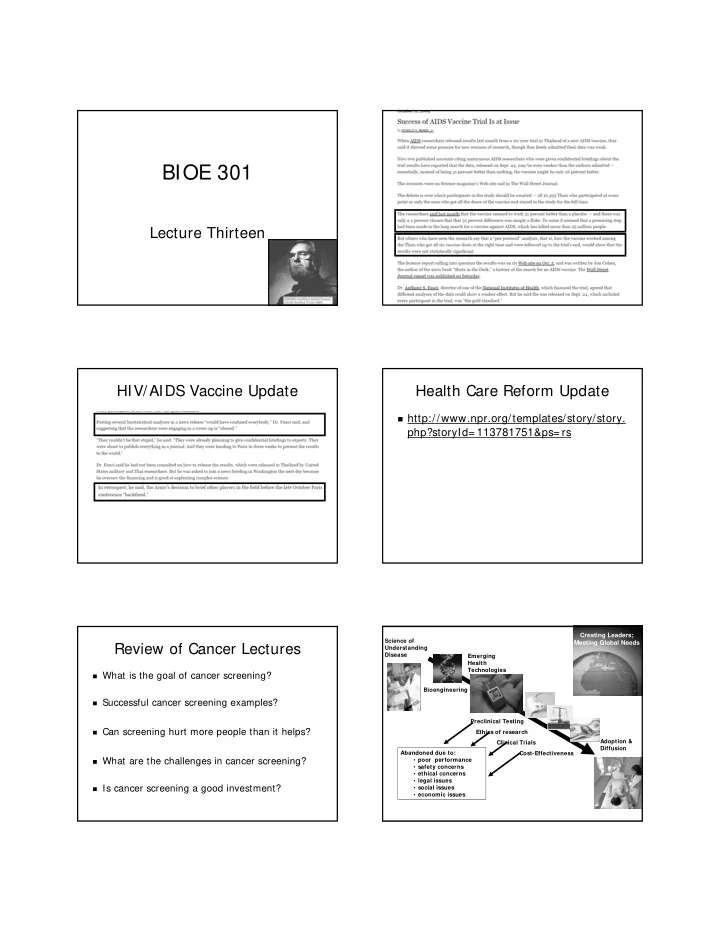
Science of Understanding Disease Emerging Health Technologies Preclinical Testing Clinical Trials Adoption & Diffusion Abandoned due to:

  • poor performance
  • safety concerns
  • ethical concerns
  • legal issues
  • social issues
  • economic issues

Bioengineering Ethics of research Cost-Effectiveness Creating Leaders; Meeting Global Needs

slide-2
SLIDE 2

Health

$$$ Worsens Health Saves Money I mproves Health Costs Money I mproves Health Saves Money Worsens Health Costs Money

Vaccines Most Interventions Difficult Debate

Health Policy Space Health Care Reform in Oregon

Health services ranked according to cost-

effectiveness Benefit Durationof dBenefit NetExpecte tment CostofTrea ting priorityra × =

$$/DALY or $$/QALY

What does a DALY measure? How much are we willing to spend to gain

a year of life?

Name two health interventions that result

in cost SAVINGS.

League Table

I ntervention Cost-Effectiveness Ratio Pneumococcal vaccine for adults over 65 years of age Cost saving Tobacco cessation counseling Cost saving to $2,000/QALY saved Chlamydia screening for women 15-24 years old $2,500/QALY saved Colorectal cancer screening for people > 50 years old $13,000/QALY saved

What is Society’s Threshold Ratio?

No correct answer Common guesses:

$20,000-$100,000 / QALY Median estimate = about $150,000/QALY

  • [Hirth RA, et al. What should society be willing to pay for a QALY? Evidence

from the value of life literature (abstract). Medical Decision Making 1999;18:459.]

0% 10% 20% 30% 40% 50% 60% 70% 80% 90% 100% $0 $500 $1,000 $1,500 $2,000 $2,500 $3,000

Lifetime Screening Cost Reduction in Cervical Cancer Risk

South Africa

Screening 1X/Life Cost saving to <$50/YLS

South Africa

Screening 2X/Life $50-$250/YLS

South Africa

Screening 3X/Life $250-$500/YLS

United States

Pap + HPV Every 3 yrs. $60,000/YLS

United States

Pap + HPV Every 2 yrs. $174,000/YLS

United States

Pap + HPV Every Year $795,000/YLS

15 Weeks 1,000 Years!

How Much Life Can $50,000 Buy?

slide-3
SLIDE 3

What is Society’s Threshold Ratio?

No correct answer Common guesses:

$20,000-$100,000 / QALY Median estimate = about $150,000/QALY

  • [Hirth RA, et al. What should society be willing to pay for a QALY? Evidence

from the value of life literature (abstract). Medical Decision Making 1999;18:459.]

What about in developing countries?

Very cost-effective:

amount to gain one QALY is < per person GDP

Cost-effective:

amount to gain one QALY is < 3 x per capita GDP

Cost-Effectiveness Assessment

Define the problem Identify the perspective Identify the alternatives Analyze the effectiveness Analyze the costs Perform discounting Perform sensitivity analysis Address ethical issues Interpret the results

Example: Cervical Cancer Screening for Elderly Women

1988:

Medicare did not cover cervical cancer

screening

Elderly accounted for 40% of cervical CA

deaths

Question:

Should Medicare pay?

Cost-Effectiveness Assessment

Define the problem:

Is cervical cancer screening for elderly women

cost-effective?

Identify the perspective

Societal perspective

Identify the alternatives

No screening

Analyze the costs & effectiveness

Real clinical trial Projected costs and benefits

Cost-Effectiveness Assessment

Perform discounting

5% discount rate

Perform sensitivity analysis

Screening would be cost-saving in elderly

women who had never been screened

Address ethical issues

Is it ethical for Medicare to pay for smears

  • nly for women who have never been

screened?

Interpret the results

Summary of Study

New Technology:

Pap screening in low-income, elderly women

Alternative:

No screening

Number of tests performed:

816 25% had never had a Pap smear 11 abnormal Paps, 2 patients with cancer

Costs of Screening + Treatment:

$59,733

slide-4
SLIDE 4

Markov Model

  • Would have cost more to treat women in

the absence of screening

  • Would have cost $107,936 to treat if cancers

detected when symptomatic

  • Gained 30.33 years of life by screening
  • Gained 36.77 QALYs by screening

Normal HPV LGSIL HGSIL EICC DEATH LICC

Summary of Study

Benefits of Technology:

30.33 life years gained 36.77 QALYs gained

Net Costs of Intervention:

$59,733-$107,936 = -$48,203 Intervention SAVES money

Cost-effectiveness:

SAVE $1311/QALY

Impact of Study

1990:

Medicare extended to cover triennial

screening with Pap smears for all women with no upper age limit

Study was a one-time screen in population

with limited prior access to screening!

Should results be generalized?

$2,254/QALY gained for triennial screening in

elderly women in US

Cost-Effectiveness Study of Cervical Cancer Screening for Low-Income, Elderly Women: “I previously worked in the Harlem community and other New York City neighborhoods that were very poor in resources: housing, healthcare, and other resources. The issue I wanted to address was whether we should screen older women for cervical cancer. The reason I, as opposed to someone else, did this is that I was the only person in the primary care clinic who knew how to do gynecologic examinations, and I was the first person in 10 years to observe that the examination tables had stirrups! This was the beginning of my life’s work. In the first few years of our screening program, the nurse practitioner and I screened more than 800 women. They were on average 74 years old and had largely been unscreened previously. As a result, we found that screening these women actually saved lives as well as health care costs (3.72 lives and $5907 saved for every 100 Pap smears done)-an ideal program. But then serendipity came into play. We were doing this work at a time when there was an explosion in the growth of the older population and members of congress were receiving a lot of pressure from their older constituents to include preventive services. Along I came with my Pap smear analysis and showed that if we were to screen the average elderly population at that point Pap smear screening would be a good buy. It would cost about $2,200 per year of life saved. Of great importance was that we could save money if we targeted screening to women who had not been screened previously, but the cost-effectiveness would worsen by more than 10-fold if screening were applied to women who had already been regularly screened. What were our responsibilities and what were the issues that came out of this work? When we presented this work to the OTA, we proposed considering cervical cancer screening as a targeted benefit and perhaps even including benefits to do outreach to women who have never been

  • screened. The OTA said that under Medicare, benefits must be included for all (or no) women, so
  • ur recommendation could not be implemented….The actual cost-effectiveness for Medicare might

not be as favorable as it could have been if targeted to the highest-risk women.”

New Technologies for Cervical CA Screening

Technology Sensitivity Specificity Cost per Test Liquid Cytology 84% 88% $71 Pap 69% 97% $58 HPV 88% 95% $49 HPV + cytology 94% 93%

New Technologies for Cervical CA Screening

slide-5
SLIDE 5

New Technologies for Cervical CA Screening

Intervention Sensitivity Specificity VIA 76% 81% Pap 63% 94% HPV DNA 88% 93%

New Technologies for Cervical CA Screening Summary

Cost-effectiveness analysis can aid in

decision making in all countries

Can answer clinical questions Can answer policy questions

New cost-effective technologies can:

Improve health globally Reduce disparities in health

Project Proposal

Thursday, October 22nd Schedule & rubric are posted on Owlspace Max of 5 slides, 5 minutes

Design Criteria Brainstorming Decision Matrix Proposed Solution Schedule for rest of semester