Billing and Collecting Client Fees: Ethical Considerations Avoiding - - PowerPoint PPT Presentation

billing and collecting client fees ethical considerations
SMART_READER_LITE
LIVE PREVIEW

Billing and Collecting Client Fees: Ethical Considerations Avoiding - - PowerPoint PPT Presentation

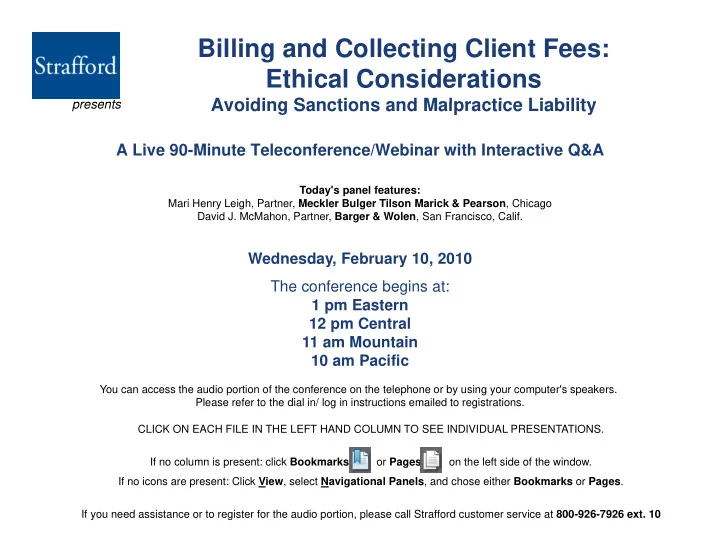
Billing and Collecting Client Fees: Ethical Considerations Avoiding Sanctions and Malpractice Liability Avoiding Sanctions and Malpractice Liability presents presents A Live 90-Minute Teleconference/Webinar with Interactive Q&A Today's


slide-1
SLIDE 1

Billing and Collecting Client Fees: Ethical Considerations

Avoiding Sanctions and Malpractice Liability

presents

Avoiding Sanctions and Malpractice Liability

presents

A Live 90-Minute Teleconference/Webinar with Interactive Q&A

Today's panel features: Mari Henry Leigh, Partner, Meckler Bulger Tilson Marick & Pearson, Chicago David J. McMahon, Partner, Barger & Wolen, San Francisco, Calif.

Wednesday, February 10, 2010 The conference begins at: 1 pm Eastern p 12 pm Central 11 am Mountain 10 am Pacific

CLICK ON EACH FILE IN THE LEFT HAND COLUMN TO SEE INDIVIDUAL PRESENTATIONS. You can access the audio portion of the conference on the telephone or by using your computer's speakers. Please refer to the dial in/ log in instructions emailed to registrations. If no column is present: click Bookmarks

  • r Pages
  • n the left side of the window.

If no icons are present: Click View, select Navigational Panels, and chose either Bookmarks or Pages. If you need assistance or to register for the audio portion, please call Strafford customer service at 800-926-7926 ext. 10

slide-2
SLIDE 2

For CLE purposes, please let us know how many people are listening at your location by

  • closing the notification box
  • and typing in the chat box your

company name and the number of attendees.

  • Then click the blue icon beside the box

to send.

slide-3
SLIDE 3

Ethical Pitfalls in Client Ethical Pitfalls in Client Billing and Fee Collection: Billing and Fee Collection:

A idi S i d M l i A idi S i d M l i Avoiding Sanctions and Malpractice Avoiding Sanctions and Malpractice

Mari Henry Leigh Mari Henry Leigh Meckler Bulger Tilson Marick & Pearson LLP Meckler Bulger Tilson Marick & Pearson LLP Chicago, Illinois Chicago, Illinois www mbtlaw com www mbtlaw com www.mbtlaw.com www.mbtlaw.com David McMahon David McMahon Barger & Wolen LLP Barger & Wolen LLP San Francisco, California San Francisco, California www.bargerwolen.com www.bargerwolen.com

slide-4
SLIDE 4

Overview of Program Overview of Program Overview of Program Overview of Program

In this program, participants will learn about: In this program, participants will learn about:  The professional and ethical rules governing attorney fee The professional and ethical rules governing attorney fee arrangements arrangements  Drafting tips for fee agreements and retainers Drafting tips for fee agreements and retainers  Types of fee agreements that are permissible Types of fee agreements that are permissible  Types of fee agreements that are permissible Types of fee agreements that are permissible  Timekeeping, expenses and the billable hour Timekeeping, expenses and the billable hour  Resolving billing disputes and attorney liens Resolving billing disputes and attorney liens  C fid i li i i f C fid i li i i f  Confidentiality concerns in pursuing fees Confidentiality concerns in pursuing fees

2 2

slide-5
SLIDE 5

The Ethical Landscape The Ethical Landscape The Ethical Landscape The Ethical Landscape

  • ABA Model Rule of Professional Conduct, 1.2

ABA Model Rule of Professional Conduct, 1.2

  • ABA Model Rule of Professional Conduct, 1.4

ABA Model Rule of Professional Conduct, 1.4

  • ABA Model Rule of Professional Conduct, 1.5(a)

ABA Model Rule of Professional Conduct, 1.5(a)

  • ABA Model Rule of Professional Conduct, 1.8(a)

ABA Model Rule of Professional Conduct, 1.8(a)

  • ABA Model Rule of Professional Conduct, 1.8(f) and 5.4

ABA Model Rule of Professional Conduct, 1.8(f) and 5.4

  • ABA Model Rule of Professional Conduct, 1.16 (a)(b)(c)(d)

ABA Model Rule of Professional Conduct, 1.16 (a)(b)(c)(d)

  • ABA Model Rule of Professional Conduct, 1.6

ABA Model Rule of Professional Conduct, 1.6

3 3

slide-6
SLIDE 6

The Ethical Landscape The Ethical Landscape The Ethical Landscape The Ethical Landscape

Rule 1.2 Rule 1.2

(a) Subject to paragraphs (c) and (d), a lawyer shall abide by a client's decisions concerning the objectives of representation and, as required by Rule 1.4, shall consult with the client as to the means by which they are to be pursued. A lawyer may take such action on behalf of the client as is impliedly authorized to carry out the representation.

4 4

slide-7
SLIDE 7

The Ethical Landscape The Ethical Landscape The Ethical Landscape The Ethical Landscape

Rule 1.4 Rule 1.4

(a (a) A lawyer shall:

) A lawyer shall:

(a (a) A lawyer shall:

) A lawyer shall: (1) promptly inform the client of any decision or circumstance with respect to (1) promptly inform the client of any decision or circumstance with respect to which the client's informed consent, as defined in Rule 1.0(e), is required by which the client's informed consent, as defined in Rule 1.0(e), is required by these Rules; these Rules; these Rules; these Rules; (2) reasonably consult with the client about the means by which the client's (2) reasonably consult with the client about the means by which the client's

  • bjectives are to be accomplished;
  • bjectives are to be accomplished;

(3) keep the client reasonably informed about the status of the matter; (3) keep the client reasonably informed about the status of the matter; (4) promptly comply with reasonable requests for information; and (4) promptly comply with reasonable requests for information; and (5) l i h h li b l li i i h l ' (5) l i h h li b l li i i h l ' (5) consult with the client about any relevant limitation on the lawyer's (5) consult with the client about any relevant limitation on the lawyer's conduct when the lawyer knows that the client expects assistance not conduct when the lawyer knows that the client expects assistance not permitted by the Rules of Professional Conduct or other law. permitted by the Rules of Professional Conduct or other law. (b) A l h ll l i h bl i (b) A l h ll l i h bl i (b) A lawyer shall explain a matter to the extent reasonably necessary to permit (b) A lawyer shall explain a matter to the extent reasonably necessary to permit the client to make informed decisions regarding the representation. the client to make informed decisions regarding the representation.

5 5

slide-8
SLIDE 8

The Ethical Landscape The Ethical Landscape Reasonable Fees Reasonable Fees

Rule 1.5(a) Rule 1.5(a)

A lawyer shall not make an agreement for, charge, or collect an unreasonable fee A lawyer shall not make an agreement for, charge, or collect an unreasonable fee

  • r an unreasonable amount for expenses. The factors to be considered in
  • r an unreasonable amount for expenses. The factors to be considered in

determining the reasonableness of a fee include the following: determining the reasonableness of a fee include the following:

(1) the time and labor required, the novelty and difficulty of the questions involved, (1) the time and labor required, the novelty and difficulty of the questions involved, and the skill requisite to perform the legal service properly; and the skill requisite to perform the legal service properly; (2) the likelihood, if apparent to the client, that the acceptance of the particular (2) the likelihood, if apparent to the client, that the acceptance of the particular employment will preclude other employment by the lawyer; employment will preclude other employment by the lawyer; (3) the fee customarily charged in the locality for similar legal services; (3) the fee customarily charged in the locality for similar legal services; (4) the amount involved and the results obtained; (4) the amount involved and the results obtained; ( ) ( ) (5) the time limitations imposed by the client or by the circumstances; (5) the time limitations imposed by the client or by the circumstances; (6) the nature and length of the professional relationship with the client; (6) the nature and length of the professional relationship with the client; (7) the experience, reputation, and ability of the lawyer or lawyers performing the (7) the experience, reputation, and ability of the lawyer or lawyers performing the services; and services; and (8) whether the fee is fixed or contingent. (8) whether the fee is fixed or contingent.

6 6

slide-9
SLIDE 9

The Ethical Landscape The Ethical Landscape The Ethical Landscape The Ethical Landscape

Rule 1.8(a) Rule 1.8(a)

A lawyer shall not enter into a business transaction with a client or knowingly A lawyer shall not enter into a business transaction with a client or knowingly acquire an ownership, possessory, security or other pecuniary interest adverse to a acquire an ownership, possessory, security or other pecuniary interest adverse to a client unless: client unless: client unless: client unless: (1) the transaction and terms on which the lawyer acquires the interest are (1) the transaction and terms on which the lawyer acquires the interest are fair and reasonable to the client and are fully disclosed and transmitted in fair and reasonable to the client and are fully disclosed and transmitted in writing in a manner that can be reasonably understood by the client; writing in a manner that can be reasonably understood by the client; writing in a manner that can be reasonably understood by the client; writing in a manner that can be reasonably understood by the client; (2) the client is advised in writing of the desirability of seeking and is given (2) the client is advised in writing of the desirability of seeking and is given a reasonable opportunity to seek the advice of independent legal counsel on a reasonable opportunity to seek the advice of independent legal counsel on the transaction; and the transaction; and the transaction; and the transaction; and (3) the client gives informed consent, in a writing signed by the client, to the (3) the client gives informed consent, in a writing signed by the client, to the essential terms of the transaction and the lawyer's role in the transaction, essential terms of the transaction and the lawyer's role in the transaction, i l di h th th l i ti th li t i th t ti i l di h th th l i ti th li t i th t ti including whether the lawyer is representing the client in the transaction. including whether the lawyer is representing the client in the transaction.

7 7

slide-10
SLIDE 10

The Ethical Landscape The Ethical Landscape Third Third-

  • Party Payment

Party Payment

Rule 1.8(f) Rule 1.8(f) ( ) ( )

A lawyer shall not accept compensation for representing a client from A lawyer shall not accept compensation for representing a client from

  • ne other than the client unless:
  • ne other than the client unless:

(1) the client gives informed consent; (1) the client gives informed consent; (2) there is no interference with the lawyer's independence of (2) there is no interference with the lawyer's independence of professional judgment or with the client professional judgment or with the client-

  • lawyer relationship; and

lawyer relationship; and (3) information relating to representation of a client is protected as (3) information relating to representation of a client is protected as required by Rule 1 6 required by Rule 1 6 required by Rule 1.6. required by Rule 1.6.

8 8

slide-11
SLIDE 11

The Ethical Landscape The Ethical Landscape Third Third-

  • Party Payment

Party Payment

Rule 5.4 Rule 5.4

(c) A lawyer shall not permit a person who recommends, employs, or (c) A lawyer shall not permit a person who recommends, employs, or pays the lawyer to render legal services for another to direct or pays the lawyer to render legal services for another to direct or regulate the lawyer's professional judgment in rendering such legal regulate the lawyer's professional judgment in rendering such legal services. services.

9 9

slide-12
SLIDE 12

The Ethical Landscape The Ethical Landscape Right to Withdraw Right to Withdraw

Rule 1.16 Rule 1.16

(a) Except as stated in paragraph (c), a lawyer shall not represent a client or, (a) Except as stated in paragraph (c), a lawyer shall not represent a client or, where representation has commenced, shall withdraw from the representation where representation has commenced, shall withdraw from the representation f li if f li if

  • f a client if:
  • f a client if:

(1) the representation will result in violation of the rules of professional (1) the representation will result in violation of the rules of professional conduct or other law; conduct or other law; (2) the lawyer's physical or mental condition materially impairs the (2) the lawyer's physical or mental condition materially impairs the lawyer's ability to represent the client; or lawyer's ability to represent the client; or (3) the lawyer is discharged. (3) the lawyer is discharged.

10 10

slide-13
SLIDE 13

The Ethical Landscape The Ethical Landscape Right to Withdraw Right to Withdraw

Rule 1.16 Rule 1.16

(b) Except as stated in paragraph (c), a lawyer may withdraw from representing a client if:

b) Except as stated in paragraph (c), a lawyer may withdraw from representing a client if: (1) withdrawal can be accomplished without material adverse effect on the interests of the (1) withdrawal can be accomplished without material adverse effect on the interests of the client; client; client; client; (2) the client persists in a course of action involving the lawyer's services that the lawyer (2) the client persists in a course of action involving the lawyer's services that the lawyer reasonably believes is criminal or fraudulent; reasonably believes is criminal or fraudulent; (3) the client has used the lawyer's services to perpetrate a crime or fraud; (3) the client has used the lawyer's services to perpetrate a crime or fraud; (3) the client has used the lawyer s services to perpetrate a crime or fraud; (3) the client has used the lawyer s services to perpetrate a crime or fraud; (4) the client insists upon taking action that the lawyer considers repugnant or with which the (4) the client insists upon taking action that the lawyer considers repugnant or with which the lawyer has a fundamental disagreement; lawyer has a fundamental disagreement; (5) the client fails substantially to fulfill an obligation to the lawyer regarding the lawyer's (5) the client fails substantially to fulfill an obligation to the lawyer regarding the lawyer's (5) the client fails substantially to fulfill an obligation to the lawyer regarding the lawyer s (5) the client fails substantially to fulfill an obligation to the lawyer regarding the lawyer s services and has been given reasonable warning that the lawyer will withdraw unless the services and has been given reasonable warning that the lawyer will withdraw unless the

  • bligation is fulfilled;
  • bligation is fulfilled;

(6) the representation will result in an unreasonable financial burden on the lawyer or has (6) the representation will result in an unreasonable financial burden on the lawyer or has been rendered unreasonably difficult by the client; or been rendered unreasonably difficult by the client; or been rendered unreasonably difficult by the client; or been rendered unreasonably difficult by the client; or (7) other good cause for withdrawal exists. (7) other good cause for withdrawal exists.

11 11

slide-14
SLIDE 14

The Ethical Landscape The Ethical Landscape Right to Withdraw Right to Withdraw

Rule 1.16 Rule 1.16

(c) A lawyer must comply with applicable law requiring notice to or (c) A lawyer must comply with applicable law requiring notice to or permission of a tribunal when terminating a representation. When permission of a tribunal when terminating a representation. When

  • rdered to do so by a tribunal, a lawyer shall continue representation
  • rdered to do so by a tribunal, a lawyer shall continue representation

notwithstanding good cause for terminating the representation. notwithstanding good cause for terminating the representation.

12 12

slide-15
SLIDE 15

The Ethical Landscape The Ethical Landscape Right to Withdraw Right to Withdraw

Rule 1.16 Rule 1.16

(d) Upon termination of representation, a lawyer shall take steps to (d) Upon termination of representation, a lawyer shall take steps to the extent reasonably practicable to protect a client's interests, such as the extent reasonably practicable to protect a client's interests, such as giving reasonable notice to the client, allowing time for employment giving reasonable notice to the client, allowing time for employment

  • f other counsel, surrendering papers and property to which the client
  • f other counsel, surrendering papers and property to which the client

is entitled and refunding any advance payment of fee or expense that is entitled and refunding any advance payment of fee or expense that h b d i d h l i h b d i d h l i has not been earned or incurred. The lawyer may retain papers has not been earned or incurred. The lawyer may retain papers relating to the client to the extent permitted by other law. relating to the client to the extent permitted by other law.

13 13

slide-16
SLIDE 16

The Ethical Landscape The Ethical Landscape Confidentiality Confidentiality

Rule 1.6 Rule 1.6

(a) A lawyer shall not reveal information relating to the representation of a client unless the client gives informed consent, the disclosure is impliedly authorized in order to carry out the representation or the disclosure is permitted by paragraph (b).

14 14

slide-17
SLIDE 17

The Ethical Landscape The Ethical Landscape Confidentiality Confidentiality

Rule 1.6 Rule 1.6

(b) A lawyer may reveal information relating to the representation of a client to the extent the lawyer reasonably believes necessary: (1) to prevent reasonably certain death or substantial bodily harm; (2) to prevent the client from committing a crime or fraud that is reasonably certain to result in substantial injury to the financial interests or property of another and in furtherance of which the client has used or is using the lawyer's services; (3) to prevent, mitigate or rectify substantial injury to the financial interests or ( ) p , g y j y property of another that is reasonably certain to result or has resulted from the client's commission of a crime or fraud in furtherance of which the client has used the lawyer's services; (4) to secure legal advice about the lawyer's compliance with these Rules; (5) to establish a claim or defense on behalf of the lawyer in a controversy between the lawyer and the client, to establish a defense to a criminal charge or civil claim against the lawyer based upon conduct in which the client was involved, or to respond to allegations in any proceeding concerning the lawyer's representation of the client; or the client; or (6) to comply with other law or a court order.

15 15

slide-18
SLIDE 18

The Fee Agreement The Fee Agreement The Fee Agreement The Fee Agreement

  • Written agreements are preferable:

g p “A written statement concerning the terms of the engagement reduces the possibility of misunderstanding ” engagement reduces the possibility of misunderstanding. ABA Model Rule of Professional Conduct, Comment 2.

  • In some states, written fee agreements are mandatory
  • In most states, contingency fee agreements must be in writing

16 16

slide-19
SLIDE 19

The Fee Agreement The Fee Agreement The Fee Agreement The Fee Agreement

Typical components: Typical components:

  • The nature and scope of representation

The nature and scope of representation

  • Any limits on the representation

Any limits on the representation – – compensation from third parties compensation from third parties

  • The basis for the fee

The basis for the fee e g e g hourly contingency etc ; hourly contingency etc ;

  • The basis for the fee,

The basis for the fee, e.g. e.g., hourly, contingency, etc.; , hourly, contingency, etc.;

  • The hourly rate of the attorney and others expected to bill on the file

The hourly rate of the attorney and others expected to bill on the file

  • Request for a retainer and application of retainer

Request for a retainer and application of retainer

  • Disclosure of any referral fee

Disclosure of any referral fee

  • Consequence of late payment

Consequence of late payment – – interest charges interest charges

  • Client’s right to terminate the relationship

Client’s right to terminate the relationship g p g p

  • Payment after termination

Payment after termination

  • Attorneys lien on proceeds of litigation or on file contents

Attorneys lien on proceeds of litigation or on file contents

  • Mediation/arbitration

Mediation/arbitration

  • State Rules and Codes requiring specific clauses

State Rules and Codes requiring specific clauses

17 17

slide-20
SLIDE 20

The Fee Agreement The Fee Agreement Retainers Retainers

Types of retainers: Types of retainers: yp yp

  • Classic
  • Security
  • Advance

Non-refundable retainers are unethical in many jurisdictions, but c.f. fixed fees.

18 18

slide-21
SLIDE 21

The Fee Agreement The Fee Agreement Interest Interest

  • Simple interest permissible

Simple interest permissible

  • Must not be unconscionable

Must not be unconscionable

  • Must not be unconscionable

Must not be unconscionable

  • Cannot be usurious

Cannot be usurious

  • Words like “finance charge,” “late fees” and “penalty

Words like “finance charge,” “late fees” and “penalty payments” may invoke federal and state truth payments” may invoke federal and state truth-

  • in

in-

  • lending

lending p y y p y y g laws laws

19 19

slide-22
SLIDE 22

The Fee Agreement The Fee Agreement Perils of Ignoring the Rules Perils of Ignoring the Rules

  • The fee agreement may be voided

The fee agreement may be voided

  • Fee ma be forfeited

Fee ma be forfeited

  • Fee may be forfeited

Fee may be forfeited

  • Quantum measure may still be available

Quantum measure may still be available

20 20

slide-23
SLIDE 23

Permissible Fee Agreements Permissible Fee Agreements Permissible Fee Agreements Permissible Fee Agreements

Types of fee agreements: Types of fee agreements: yp g yp g

  Hourly

Hourly

  Contingency

Contingency

  Risk sharing

Risk sharing

  Fixed Fee

Fixed Fee

  Asset based

Asset based

  Value based

Value based

21 21

slide-24
SLIDE 24

Permissible Fee Agreements Permissible Fee Agreements Perils Perils

  • Must always be reasonable

Must always be reasonable y

  • Attorney may be stuck if unprofitable

Attorney may be stuck if unprofitable

  • Must always provide competent counsel

Must always provide competent counsel

  • Settlements cannot be controlled by attorney

Settlements cannot be controlled by attorney

  • Termination may thwart asset based agreements

Termination may thwart asset based agreements y g y g

  • Mid

Mid-

  • engagement changes require greater disclosure

engagement changes require greater disclosure

22 22

slide-25
SLIDE 25

Timekeeping, Expenses and the Billable Hour Timekeeping, Expenses and the Billable Hour Timekeeping, Expenses and the Billable Hour Timekeeping, Expenses and the Billable Hour

  • Records should be kept contemporaneously

Records should be kept contemporaneously p p y p p y

  • Minimum time increments should be disclosed

Minimum time increments should be disclosed

  • Bills should adequately describe work performed

Bills should adequately describe work performed

  • Expenses should be billed without mark

Expenses should be billed without mark-up up

23 23

slide-26
SLIDE 26

Ti k i E d th Bill bl H Ti k i E d th Bill bl H Timekeeping, Expenses and the Billable Hour Timekeeping, Expenses and the Billable Hour

Consequences of inaccurate timekeeping: Consequences of inaccurate timekeeping: q p g q p g

  • Regulatory Discipline

Regulatory Discipline

  • Court sanctions if included in fee petitions

Court sanctions if included in fee petitions

  • Claims for breach of fiduciary duty

Claims for breach of fiduciary duty

  • Other civil claims

Other civil claims – – fraud fraud

  • Fee forfeiture/disgorgement

Fee forfeiture/disgorgement

  • Fee forfeiture/disgorgement

Fee forfeiture/disgorgement

  • State consumer protection act claims

State consumer protection act claims

24 24

slide-27
SLIDE 27

Timekeeping, Expenses and the Billable Hour Timekeeping, Expenses and the Billable Hour Timekeeping, Expenses and the Billable Hour Timekeeping, Expenses and the Billable Hour

Double Double-

  • billing is prohibited:

billing is prohibited:

“A lawyer who spends four hours of time on behalf of three clients has not earned twelve billable hours. A lawyer who flies for six hours for one client, while working for five hours on behalf of another, has not earned eleven billable hours. A lawyer who is able to reuse old work product has not re-earned the hours reuse old work product has not re earned the hours previously billed and compensated when the work product was first generated.”

ABA C O E hi d P f’l R ibili F l ABA Comm. On Ethics and Prof’l Responsibility, Formal

  • Op. 93-379 (1993).

25 25

slide-28
SLIDE 28

Timekeeping, Expenses and the Billable Hour Timekeeping, Expenses and the Billable Hour Timekeeping, Expenses and the Billable Hour Timekeeping, Expenses and the Billable Hour

Expenses should be billed without mark Expenses should be billed without mark-up: up: p p

“…in the absence of an agreement to the contrary, it is impermissible for a lawyer to y, p y create an additional source of profit for the law firm … The lawyer’s stock in trade is the sale of legal services, not photocopy paper tuna fish sandwiches computer time paper, tuna fish sandwiches, computer time

  • r messenger services.

ABA Comm. On Ethics and Prof’l Responsibility, Formal Op. 93-379 (1993).

26 26

slide-29
SLIDE 29

Resolving Billing Disputes Resolving Billing Disputes Resolving Billing Disputes Resolving Billing Disputes

 Key to resolving billing disputes is not to have them in the Key to resolving billing disputes is not to have them in the first place! first place!  Most disputes arise out of attorney neglect and Most disputes arise out of attorney neglect and unresponsiveness unresponsiveness p  Client perceives attorney not working but getting paid Client perceives attorney not working but getting paid

27 27

slide-30
SLIDE 30

Resolving Billing Disputes Withdrawal Resolving Billing Disputes Withdrawal Resolving Billing Disputes Withdrawal Resolving Billing Disputes Withdrawal

Just cause: Just cause:

 Threatened perjury Threatened perjury  Accusations the lawyer is dishonest Accusations the lawyer is dishonest  Filing of a disciplinary complaint against the lawyer Filing of a disciplinary complaint against the lawyer  Refusal to pay fees rightfully owed to the lawyer Refusal to pay fees rightfully owed to the lawyer  Refusal to communicate with the lawyer Refusal to communicate with the lawyer y  A complete breakdown of the lawyer A complete breakdown of the lawyer-

  • client relationship

client relationship  E l t f E l t f l ith h th ithd i l l ith h th ithd i l  Employment of co Employment of co-

  • counsel with whom the withdrawing lawyer

counsel with whom the withdrawing lawyer cannot cordially cooperate cannot cordially cooperate

28 28

slide-31
SLIDE 31

Resolving Billing Disputes Resolving Billing Disputes Fired = Forfeiture Fired = Forfeiture

A A clear and serious violation of duty clear and serious violation of duty may result in a forfeiture of may result in a forfeiture of y y

  • fees. Factors to consider:
  • fees. Factors to consider:

 The gravity and timing of the violation The gravity and timing of the violation  Willfulness of the violation Willfulness of the violation  The violation’s effect on the value of the lawyer’s work The violation’s effect on the value of the lawyer’s work  The violation s effect on the value of the lawyer s work The violation s effect on the value of the lawyer s work for the client for the client  Any other threatened or actual harm to the client Any other threatened or actual harm to the client  Any other threatened or actual harm to the client Any other threatened or actual harm to the client  The adequacy of other remedies The adequacy of other remedies Restatement (Third) of the Law Governing Lawyers Restatement (Third) of the Law Governing Lawyers § § 37. 37.

29 29

slide-32
SLIDE 32

Resolving Billing Disputes Resolving Billing Disputes Effect of Ethical Violations on Fees Effect of Ethical Violations on Fees

A “serious violation” of the RPC can diminish or eliminate fees. A “serious violation” of the RPC can diminish or eliminate fees.

  • A.I. Credit v. Aguilar

A.I. Credit v. Aguilar, 113 Cal.App.4th 1072 (2003) , 113 Cal.App.4th 1072 (2003)

  • C l P k

UPS C l P k UPS 52 Cal App 4th 1 (1997) 52 Cal App 4th 1 (1997)

  • Cal Pak v. UPS

Cal Pak v. UPS, 52 Cal.App.4th 1 (1997) , 52 Cal.App.4th 1 (1997)

  • Mardirossian v. Ersoff

Mardirossian v. Ersoff, 153 Cal.App.4th 257 (2008) , 153 Cal.App.4th 257 (2008) Serous violations may include: Serous violations may include:

  • Adverse interests

Adverse interests

  • Conflicts

Conflicts

  • Confidentiality

Confidentiality

  • Confidentiality

Confidentiality

30 30

slide-33
SLIDE 33

Resolving Billing Disputes Resolving Billing Disputes Who Should Collect Who Should Collect

  • Relationship partner

Relationship partner

  • Someone else at the firm

Someone else at the firm

  • C ll

ti C ll ti

  • Collection agency

Collection agency

31 31

slide-34
SLIDE 34

Resolving Billing Disputes Resolving Billing Disputes Confidentiality and Fee Collections Confidentiality and Fee Collections

Duty of confidentiality is broad Duty of confidentiality is broad Disclosure requires: Disclosure requires: Disclosure requires: Disclosure requires:

  • Informed consent; or

Informed consent; or

  • M

b i li dl h i d i d h M b i li dl h i d i d h

  • Must be impliedly authorized in order to carry out the

Must be impliedly authorized in order to carry out the representation. representation.

32 32

slide-35
SLIDE 35

Resolving Billing Disputes Resolving Billing Disputes Attorney Liens Attorney Liens

  • Lien on settlement proceeds or judgment

Lien on settlement proceeds or judgment

  • Lien on file

Lien on file

33 33