Bill Naughtons Bolton Life 1914 - 1945 Dave Burnham, April 2018 - - PowerPoint PPT Presentation

bill naughton s bolton life 1914 1945
SMART_READER_LITE
LIVE PREVIEW

Bill Naughtons Bolton Life 1914 - 1945 Dave Burnham, April 2018 - - PowerPoint PPT Presentation

Bill Naughtons Bolton Life 1914 - 1945 Dave Burnham, April 2018 On the notes inside the sleeves of his books published in the 1950s, 60s and 70s, all it says about this man is often born in a slum, coal heaver, writer. Despite his success


slide-1
SLIDE 1

Bill Naughton’s Bolton Life – 1914 - 1945

Dave Burnham, April 2018

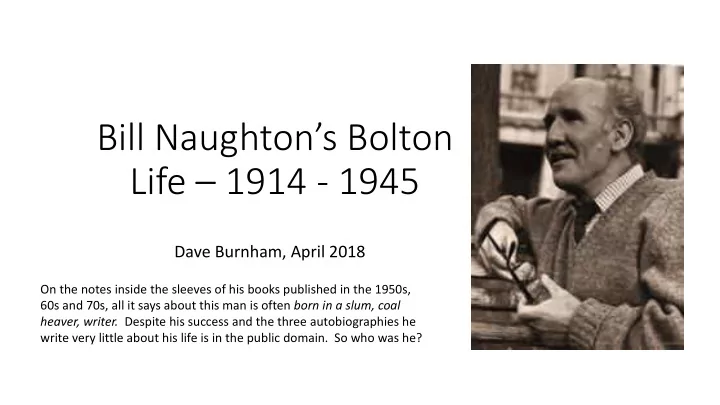
On the notes inside the sleeves of his books published in the 1950s, 60s and 70s, all it says about this man is often born in a slum, coal heaver, writer. Despite his success and the three autobiographies he write very little about his life is in the public domain. So who was he?

slide-2
SLIDE 2

Aghamore, Maria Fleming – an ‘American’ Ballyhaunis, Thomas Naughton, shopkeeper, platelayer Willy Fleming, Maria’s brother – came over to Bolton earlier, reputed to have been stuck in a cage at the Pretoria pit disaster Brackley Pit

slide-3
SLIDE 3

8 Unsworth Street, off Derby Road, between Peace Street and Cannon Street. 32 families, working people in regular employment – miners, spinners, weavers. Two up two down, front kitchen and back kitchen, two rooms upstairs. Tom on night shift slept upstairs in the day. Marie and James slept in the front kitchen. Edward shared a bed upstairs at the back with cousin John and Bill slept top to toe with May in the front... tippler toilet, ashpit

slide-4
SLIDE 4

Saints Peter and Paul Elementary School - 1915 – 1924? Mr Smith, head. Bill fell in love with Miss Conway. But Miss Veronica Brown and Miss Newsham (Fat Alice), were unpredictable and

  • violent. (1, Pig’s Back)

Jackie Seddon was ‘fair’ Scholarship Exam for St Bede’s? (Bill says he felt ‘different’, he was a reader (Jane Eyre), but so were plenty. He wanted to be the best, but at things he chose – physical fitness became an

  • bsession: dancing: writing)
slide-5
SLIDE 5

Marie, Bill’s mother, was devout, jolly, soft and giving - a template for Daisy Crompton? Or was that Nan? She lived in her heart in Mayo and was the family peacemaker. Saintly Billy tells of Bill’s desire to be a saint – regular prayer, confession and ‘puffed up with humility’, (2, Billy)

slide-6
SLIDE 6

Big Corner – Birkdale Street and

Can Row Boys from 13 up to mid twenties, gathered at Big Corner. It’s here that pals met - Spadger, Spit Nolan, Noggy, Nelson. Games of Piggy, pitch and toss, bike ride to Blackpool. Boys on the corner (3, Roof) Once the boys started dancing or got a girlfriend, they withdrew.

slide-7
SLIDE 7
slide-8
SLIDE 8

No ideas above his station… No to ‘dirty snuffies’, no to the pit, no to an engineering apprenticeship… in the end he took a job as an apprentice ‘loom fettler’ at Kershaw’s Weaving Shed (4, Weaver’s knot) He and the tackler were the only men in a maelstrom of clattering looms and women. Fell for Hetty Bibby - name of wronged woman in Weaver’s Knot. Hetty had a boyfriend caled Charlton Barnes and died if TB. He hated it – given a chance to take an exam for an office job, but his hand shook and he failed it.

slide-9
SLIDE 9

Bill applied to RN at the age of 15. Old Tom was an ardent nationalist…and so was Bill (?) The priest tore him off a strip for abandoning his mother….Bill went to the RN recruiting office in Moncrieffe Street and took a medical at Deansgate Manchester but failed – his heart was not regular enough. But he had left the weaving shed, burning his bridges...what was he to do? Did he then spend a short time working in a pub? Soon after he was at the Ainsworth Mercerising Company…phew, what a job! Dancing...he tried to excel, dressed well: Barrell jacket, double breasted waistcoat, 4 nought hair clippers, 21 inch trouser ends and long thin sideburns. Nickname was ‘Rudy’ (5, Roof)

slide-10
SLIDE 10

So far, So good – the story becomes a little more difficult to follow from 1930

  • Bill was one of the lads and wrote about growing

awareness of his sexuality (Feeling up Clothes, The Girl in the Monkey Coat, Taking a Beauty Queen Home).

  • ‘Never take a girl home twice. It gives them ideas’
  • Sometime 1928 (I think) he met Annie Wilcock,

‘Nan’ brought up at 34 Rawsthorne Street. Worked in a cardroom – one of the ‘Dolly Sisters’.

  • But Nan became Bill’s girlfriend…Bill and Nan did

more than ‘smoodge’

  • She fell pregnant in December 1929, at – Smithill’s
  • Dene. Panic!
slide-11
SLIDE 11
slide-12
SLIDE 12

They ran away...late March/April? From Trinity Street Station – an escape not a planned elopement. (6, Roof) Married on May 3rd in Liverpool, Nan’s mum (or sister) and dad witnesses Returned to Bolton sometime in the summer Marie born September 18 1930 living at 34 Rawsthorne Street,

  • Halliwell. (The Family Way).

Bill a ‘hardware salesman’, selling vacuum cleaners?

slide-13
SLIDE 13

Flitting from room to room, pawning everything, cutting vegetables with a safety razor, having 4/- removed from benefit by a Transitional Benefit Tribunal because Bill and Nan were living with Nan’s sister. Grim, grey, soulless poverty – Bill, advised by Jimmy Wilcock, his father in law, took to waiting for a day’s work at Co-op’s Lark Street stables for a day’s work loading coal and delivering it. Lawrence was born in 1932.

slide-14
SLIDE 14

Odd days coal bagging, turned into full time job. The horse drawn cart was replaced by a lorry and by 1937. Courtesy of ‘Woody’s teaching Bill learned to drive, got a full time job as a driver, with a pension. Desperate hard work delivering coal to 400 homes to every week, but good fun with pals, fiddles and a woman who gave Bill a love letter every Monday! Like in the weaving shed singing at the end of the day and a good drink on pay day. Co-op Coal Waharf was at Crook Street sidings where Decathlon is today opposite Bolton One.

slide-15
SLIDE 15

1935 Sean came, died of pneumonia Did this change Bill? Did this stop him pubbing it with his mates? Still reading – swore by Marcus Aurelius aphorisms. And Thomas a Kempis. ‘Not much in common’ with Nan, ‘she could not manage‘ – and he found her

  • ut by chance in a debt (clothing

payments). Grumbling and criticism led her to leave him one night with the

  • children. Devastated, though she was

away only 36 hours. (episode in Spring and Port Wine) 1934/5 allocated house on Johnson Fold, possibly from a cottage in Tong Fold. He bought a bike.

slide-16
SLIDE 16

Late 1936 Tom Harrisson arrived in Bolton and with Charles Madge, set up Mass Observation. THH wanted to create an ‘anthropology of ourselves’ finding out how ordinary people

  • lived. Formal surveys on

happiness, holidays, cinema, saving, but also a lot of observing people, listening, ‘follows’. HQ was a big terrace 85 Davenport Street. We’ve identified 80 volunteer

  • bservers between 1937 and

1940: upper class mostly, but some were local workers – Tom Honeyford, Joyce Mangnall, Ernie Letchford, Eric Bennett… and Bill Naughton.

slide-17
SLIDE 17

Harrisson expected observers to set down precisely what they saw and heard, no

  • commentary. He also required insane detail:

numbers of people in the pub at 15 minute intervals, who paid, what they drank – the order in which women donkey stoned the flags outside their door, what people did with pets when they went on holiday, the layout of working class front kitchens at tea time, what people looked at while window shopping.. Bill produced brief reports (wrestling report, Aug 1938) …and spent many evenings at Davenport Street and went at least once to Blackheath in August 1938 (Bank Holiday I think) travelled overnight by lorry to help Madge.

slide-18
SLIDE 18

What THH wanted has so much in common with the detail Bill Naughton used – (10, nose blowing and cigarettes) Bill Naughton’s precise observational style must have been influenced by MO and it was in 1938 that he bought a typewriter and started his journal which he kept for 50 years. Bill was fascinated by the students and writers and affluent people he met. Bored in his marriage he started an affair with Gertrud Wagner (I suspect it was not his first ,but the atmosphere at Davenport Street was feverish, like an endless student party). September 1939, MO packed up and Gertrud went to Liverpool. All had to register and on the form Bill put CO. Why – he was in a reserved occupation? June 1940 Co-ops sacked COs. Bill took PPU advice and went to work as a civil defence driver in London…following Gertrud.

slide-19
SLIDE 19

Bill had periods in Taunton and Manchester, but mostly lived and worked in Lewisham. Worried about Nan’s attitude to the children’s education Bill looked after Marie and Larry. They lived with other families for the duration (mostly with the Weisselbergs in Newbury, refugees from Nazi Austria, friends of Gertrud’s). Hmm…so Nan, working at Horwich loco works was left alone, sharing Marld Crescent with Channel Island family – but was hounded out by neighbours who didn’t like COs. At least one his pals, Joe Gildea, is said to have fallen

  • ut with Bill over his betrayal of Nan.

Bill had his typewriter and in 1943 submitted a story ,‘Ghost Driver’, to the London Evening

  • News. It was accepted and he was paid seven Guineas – nearly three week’s wages! They

asked for more. He had about 25 short stories published in Lilliput magazine alone into the

  • 1950s. BBC asked him to read a story after ten o’clock news one night. Charles Madge

heard it and asked Bill to write a novel about ‘marriage’.

slide-20
SLIDE 20

A Roof Over Your Head (1945) is about his working life,

elopement, poverty, unemployment and marriage. It is candid, raw and tormented giving away much more about himself than anything he write later on. It was a huge success – social commentary had a brief vogue in 1945 – 1948. Charles Madge also published novels Pony Boy (1946)and Rafe Granite (1947). Several themes emerge at this time.

  • A vast amount of his later ideas/characters appear between 1943

and 1952. Many characters in early short stories appear again

  • later. Rafe Granite is an example. It is a family tragedy. Reworked

as a stage play My Flesh, My Blood in the later 1950s, it became Spring and Port Wine, the film by 1970

  • It is as if he:
  • lived a life between 1910 and 1943,
  • wrote about it between 1943 and 1952
  • And reworked it ever after.
  • He found London different to Bolton. He discovered the ‘spiv’ and

turned John Harris into Alfie Elkins.

  • He chose to live his life in London, visited Ireland in ‘45 then ‘48 –

but used Bolton as the canvass for much of his work for the

rest of his life.
slide-21
SLIDE 21

Bill divorced Nan in 1950, married Erna in 1952. By 1960 his writing about working class suddenly became fashionable (kitchen sink!) and during the 1960s, was one of the writers who epitomised the shift in UK culture towards honouring working class culture – though Bill’s writing was never about ‘escape’. During the war Bill and Gertrud did not live together, but they were a couple. She had Bill’s son Barney in October 1941. The father’s name was given as Gertrud’s husband…except that they had divorced in 1938, he was in Sweden and then the USA. He never came to the UK. In 1947 Gertrud fell pregnant again. To help her with the children and work (she had also cared on off for Marie and Larry) Gertrud employed an au-pair. This was Ernestina Pirolt, a twenty year old from Austria, who had escaped the chaos of home to marry a British Tommy, but that had fallen through. Before Bill’s second son with Erna was born in September Bill had started an affair with Ernestina, Erna. Gertrud left the country to go back to Austria in October 1948. Did she know about Bill and Erna, well, what do you think?

slide-22
SLIDE 22

Ezra Fitton, a curmudgeonly old bugger, like Bill’s dad, ‘cranky’, overbearing. Young Arthur a ‘book reader’ Arthur and Jenny courting ‘outside’. BN knew all about sharing a bed with his new wife in his in laws house. But Honeymoon Postponed only appeared in 1961 as a TV play, before it became All in Good Time then the film The Family Way

slide-23
SLIDE 23

Meet the Spiv, News Chronicle, Sept 1945, from an article, The Spiv, in Pilot Papers. Spiv in Love, The Little Welsh Girl, Taking a Beauty Queen Home all appeared in the 1940s. Several driving short stories have male characters with cynical attitudes to women, dress sharply and fiddle. Alfie Elkins and His Little Life Bill Owen Jan 1961 radio play, combines themes and is the template for the stage play and

  • film. (Alfie only piece that was really successful in US)
slide-24
SLIDE 24

The journey between Rafe Granite, My Flesh My Blood and Spring and Port Wine is a strange one. Rafe Carter is King Lear, the tale is a

  • tragedy. Spring and Port Wine is a Family

comedy drama – story, characters, events are 85% the same. Rafe is a cross between BN’s dad, BN himself and ‘Honest Tom’, a co-op carter. Mary Anne next door in Unsworth Street – borrowing, slipping into the pawn shop Hilda becoming pregnant, not realising it and running away. Nan being a poor manager, hiding things from dad - Nan’s clothing debt and her leaving him – just like ‘Daisy’. (BN did not like herrings)

slide-25
SLIDE 25

Live from Worktown Bi

Bill Naugh Naughton S n Seas ason, n, Oct

Nov 2017, 25 years after his death – Octagon, Council, Bolton at Home, University

  • Film show and exhibition of Bolton scenes
  • Young and old working together on memories inspired by his work
  • Short biographical note about Bill Naughton’s Life
  • Access to the Naughton Archive and lecture about his work
  • A piece of Music, the Bill Naughton Suite, to be written by local Jazz

Musician

  • Readings of two short stories in a ‘soundscape’
  • Performance
  • Neo Arts work available on a Naughton Theme
  • Short Story Competition about growing up in Bolton since 2000
  • Bill Naughton ‘Ale’