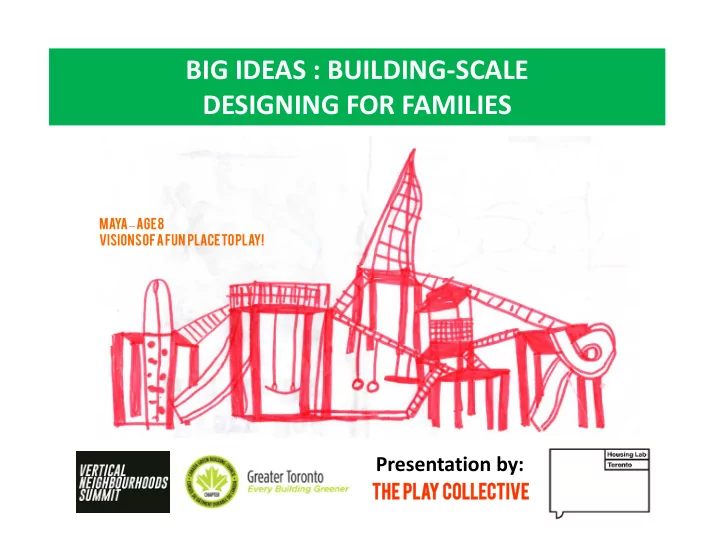
SLIDE 1 Maya–Age 8 Visions of a fun place to play!
BIG IDEAS : BUILDING-SCALE DESIGNING FOR FAMILIES
Presentation by:
THE PLAY COLLECTIVE
SLIDE 2 Skill-Testing Question: How are Babies Made?
CITYPLACE ENTERTAINMENT DISTRICT KING WEST NIAGARA
Downtown West Population Growth 2001 to 2016
FORT YORK
Age Group 2001 2016 Net Change % Change Total 16,290 73,584 +57,294 +352% 20-39 yrs 8,820 50,330 +41,510 +471% 0-4 yrs 645 2,450 +1,805 +280%
SLIDE 3
City of Toronto – 2017 Growing Up Guidelines: Planning for Children in New Vertical Communities
toronto.ca/growingupto
SLIDE 4
Feedback from Parents/Families living in condos:
SLIDE 5
SLIDE 6
"Children are a kind of indicator species. If we can build a successful city for children, we will have a successful city for all people.“ Enrique Peñalosa, former Mayor of Bogatá, Colombia "Children are a kind of indicator species. If we can build a successful city for children, we will have a successful city for all people.“ Enrique Peñalosa, former Mayor of Bogatá, Colombia
SLIDE 7
Cities are where over 50% of our children grow up,
and play is fundamental to how children learn and grow into capable, confident, creative and caring adults. So building a successful city for children means the city must be a great place to PLAY.
Cities are where over 50% of our children grow up,
and play is fundamental to how children learn and grow into capable, confident, creative and caring adults. So building a successful city for children means the city must be a great place to PLAY.
SLIDE 8
But the type of play increasingly offered in our 21st
century cities today is not necessarily the type of play that our children need (or even want). Whereas play by its nature should be as free, unstructured, imaginative, self-challenging, fun and spontaneous as possible…
But the type of play increasingly offered in our 21st
century cities today is not necessarily the type of play that our children need (or even want). Whereas play by its nature should be as free, unstructured, imaginative, self-challenging, fun and spontaneous as possible…
SLIDE 9
Instead, play is increasingly relegated to carefully
curated & fenced playgrounds designed by adults, neatly separated from other uses, full of ‘safe’ playground equipment, installed on ‘safe’ rubber surfaces, often devoid of complexity, thrill and imaginative elements needed for real play, and worryingly disconnected from nature.
Instead, play is increasingly relegated to carefully
curated & fenced playgrounds designed by adults, neatly separated from other uses, full of ‘safe’ playground equipment, installed on ‘safe’ rubber surfaces, often devoid of complexity, thrill and imaginative elements needed for real play, and worryingly disconnected from nature.
SLIDE 10
RISK AND DANGER are apparently everywhere now.
Lawyers and insurance companies seem to have taken over community and public spaces… even rocks, ponds, and trees are no longer ‘safe’.
SLIDE 11
SLIDE 12
MOREOVER, Our 21st century cities are still primarily
designed and built around cars, in both suburban and urban communities, and fails to provide a sufficiently enriched or safe environment for play and independent mobility for children.
Only 21% of 5-19 year olds use active travel modes to and from school (eg. walk or bike) - 2018 ParticipACTION Report Card
SLIDE 13
SLIDE 14
We have a growing Urban Play Deficit and this is an
increasingly serious problem for our children who are experiencing more physical, social and mental health challenges than ever before. This urban play deficit is also a serious and growing challenge for adults, particularly as the experience of 21st century modern city living is becoming increasingly stressful, congested, polluted and isolating.
We have a growing Urban Play Deficit and this is an
increasingly serious problem for our children who are experiencing more physical, social and mental health challenges than ever before. This urban play deficit is also a serious and growing challenge for adults, particularly as the experience of 21st century modern city living is becoming increasingly stressful, congested, polluted and isolating.
SLIDE 15
So weaving play into the fabric of our 21st century cities, including more outdoor play that re- connects modern living with nature, is critical to providing much needed opportunities for daily rejuvenation, respite, relaxation and inspiration, for both young and old, of all abilities. So weaving play into the fabric of our 21st century cities, including more outdoor play that re- connects modern living with nature, is critical to providing much needed opportunities for daily rejuvenation, respite, relaxation and inspiration, for both young and old, of all abilities.
SLIDE 16 BIG IDEAS : PLANT A LOT OF TREES… LIKE A COPSE FOR CLIMBING, PLAYING AND ‘SHINRIN-YOKU’
7 Benefits of Tree Climbing & Playing:
- Problem Solving & Creative Thinking
- Social Skills
- Physical Development
- Self-Esteem & Confidence
- Concentration & Patience
- Reducing Stress & Anxiety
- Scientific Discovery
7 Benefits of Tree Climbing & Playing:
- Problem Solving & Creative Thinking
- Social Skills
- Physical Development
- Self-Esteem & Confidence
- Concentration & Patience
- Reducing Stress & Anxiety
- Scientific Discovery
Japanese forest bathing (shinrin-yoku) is a practice that involves spending time in nature, among trees.
SLIDE 17
BIG IDEAS : USE MORE REAL GRASS SO BABIES, KIDS & ADULTS CAN ENJOY REAL NATURE
SLIDE 18
BIG IDEAS : MAKE IT ‘FUN’ TO PLAY OUTSIDE AND EXPLORE THE OUTDOORS ALL YEAR AROUND
SLIDE 19
BIG IDEAS : MAKE IT ‘EASY’ FOR KIDS & FAMILIES TO ALWAYS BE ‘BEHAVING GREEN’
SLIDE 20
BIG IDEAS : READ THE LORAX
SLIDE 21
BIG IDEAS : BUILDING-SCALE DESIGNING FOR FAMILIES
We would love to hear your big ideas! Jeanhy Shim President & Founder Housing Lab Toronto 416 738 0448 jshim@housinglabtoronto.com We would love to hear your big ideas! Jeanhy Shim President & Founder Housing Lab Toronto 416 738 0448 jshim@housinglabtoronto.com