Bibliometry as a measure of impact ? INRIA Evaluation Committee: - - PowerPoint PPT Presentation

bibliometry as a measure of impact
SMART_READER_LITE
LIVE PREVIEW

Bibliometry as a measure of impact ? INRIA Evaluation Committee: - - PowerPoint PPT Presentation

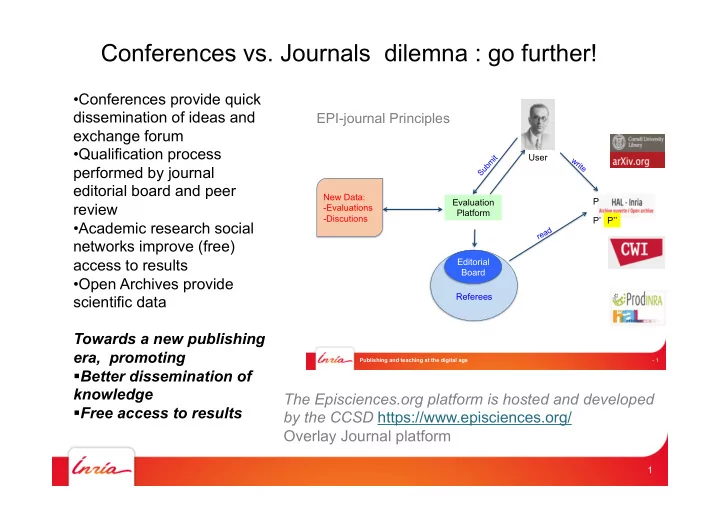
Conferences vs. Journals dilemna : go further! Conferences provide quick dissemination of ideas and EPI-journal Principles exchange forum Qualification process User performed by journal editorial board and peer New Data: P


slide-1
SLIDE 1

Conferences vs. Journals dilemna : go further!

1

Referees Editorial Board

Publishing and teaching at the digital age

  • 1

Evaluation Platform User New Data:

  • Evaluations
  • Discutions

P’ P’’

EPI-journal Principles

P

  • Conferences provide quick

dissemination of ideas and exchange forum

  • Qualification process

performed by journal editorial board and peer review

  • Academic research social

networks improve (free) access to results

  • Open Archives provide

scientific data Towards a new publishing era, promoting § Better dissemination of knowledge § Free access to results The Episciences.org platform is hosted and developed by the CCSD https://www.episciences.org/ Overlay Journal platform

slide-2
SLIDE 2

Evaluation criteria (in France: Inria - CNRS, CNU)

  • Scientific achievement : assessed in terms of

ü contributions to the progress of knowledge (publications) ; ü advance of technology (research software and other developments).

  • Innovation and technology transfer : assessed in terms of

technology development activities towards applications and innovations. ü grants from industry and their outcome ; ü involvements into industrial partnership activities and their impact ; ü transfer of research software ; patents ; ü contributions to industrial standards ; ü contributions to startup companies.

  • Science outreach : scientific events, conferences, talk in a school, in a

public library, radio or TV interview. Ø Criteria for Software Self-Assessment (Inria) Ø Criteria for a Self-Assessment of Science Outreach (Inria)

slide-3
SLIDE 3

Bibliometry as a measure of impact ?

INRIA Evaluation Committee: What do bibliometric indicators measure? Sources : ISI, WoS/Thomson Reuters, Scopus, Google Scholar - CiteSeer, CiteBase Conclusions: Indicators are important metrics, but they must be used in an enlightened manner and according to some basic rules:

  • Current indicators such as Journal Impact Factor are not dedicated to quality.
  • One must simply look at orders of magnitude for indicators because even using various

sources does not allow a high degree of accuracy.

  • Expert opinion must be used to correct indicators.
  • Several indicators must be used. Crosschecking various sources is necessary to
  • btain relevant information.
  • Rather than measuring the quality of journals with quantitative indicators, it may be

better to categorise them into groups based on the qualitative criteria suggested by researchers themselves.

  • Comparisons between fields should not be made.

How to measure impact ? alternatives for measuring impact : § look at 10 years before (most influencial papers), § look at papers related to licences or cited in relation with successful software.

slide-4
SLIDE 4

The Leiden Manifesto for research metrics

(Nature, 520, 429-431)

Diana Hicks, Paul Wouters, Ludo Waltman, Sarah de Rijcke, Ismael Rafols Ten principles to guide research evaluation

  • 1. Quantitative evaluation should support qualitative, expert assessment
  • 2. Measure performance against the research missions of the institution,

group or researcher

  • 3. Protect excellence in locally relevant research
  • 4. Keep data collection and analytical processes open, transparent and

simple

  • 5. Allow those evaluated to verify data and analysis
  • 6. Account for variation by field in publication and citation practices
  • 7. Base assessment of individual researchers on a qualitative judgement of

their portfolio.

  • 8. Avoid misplaced concreteness and false precision
  • 9. Recognize the systemic effects of assessment and indicators
  • 10. Scrutinize indicators regularly and update them