Beyond the Wounded Healer: Henri Nouwen, Mental Health, and the - - PowerPoint PPT Presentation

beyond the wounded healer henri nouwen mental health and
SMART_READER_LITE
LIVE PREVIEW

Beyond the Wounded Healer: Henri Nouwen, Mental Health, and the - - PowerPoint PPT Presentation

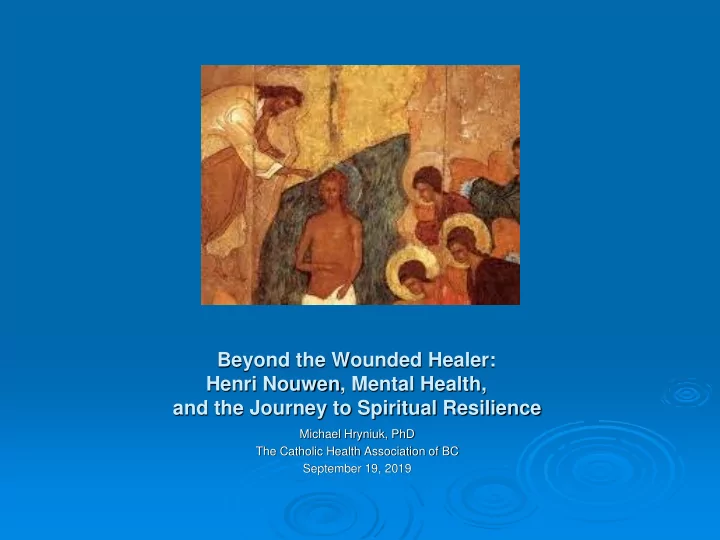
Beyond the Wounded Healer: Henri Nouwen, Mental Health, and the Journey to Spiritual Resilience Michael Hryniuk, PhD The Catholic Health Association of BC September 19, 2019 An Overview of the Core Questions How are we called to be

slide-1
SLIDE 1

Beyond the Wounded Healer: Henri Nouwen, Mental Health, and the Journey to Spiritual Resilience

Michael Hryniuk, PhD The Catholic Health Association of BC September 19, 2019

slide-2
SLIDE 2

An Overview of the Core Questions

  • How are we called to be present to intense

human suffering in ourselves and in others?

  • What can we learn from the journeys of great

caregivers such as Henri Nouwen?

  • A Renewed Spirituality of Caregiving: How do

we apply these learnings personally and professionally in our own context of caregiving?

slide-3
SLIDE 3

A Topical Itinerary

  • 1. A Spiritual Recovery: Reflections on Henri

Nouwen’s journey of healing and ministry

  • 2. Our Current Context: Facing Intense

Caregiver Stress

  • 3. From Spiritual Recovery to Spiritual

Resilience: Lessons from Nouwen’s Journey

slide-4
SLIDE 4

My Own Context as a Caregiver

  • Spiritual Care Supervisor at a Catholic Child

Welfare agency in the heart of Hamilton, Ontario

  • Registered psychotherapist and spiritual director

in faith-based group practice in Toronto

  • Forty years of engagement with the communities
  • f l’Arche as an assistant, community leader and

researcher

  • Educator and consultant to churches, schools

and denominational bodies in ministry leadership development and spiritual formation

slide-5
SLIDE 5

My Theoretical Sources

  • Formed in the Trinitarian theology of the

Ukrainian-Greek Catholic Church and its spirituality of deification

  • Influenced heavily by the works of Jean Vanier,

Henri Nouwen, and Thomas Merton

  • Research in the dynamics of psycho-spiritual

transformation with particular attention to the experience of caregivers.

slide-6
SLIDE 6

Henri Nouwen (1932-1996): Priest, Pastor and Spiritual Guide

slide-7
SLIDE 7

Nouwen’s Journey of Healing

  • The Clinical Years – Pastoral Psychology and

the “Wounded Healer”

  • The Academic Years – Authorial “Superstar” in

Christian spirituality, Anguish and Alienation

  • The l’Arche Years – Caring for Adam, Christian

Community and awakening to the life of the “Beloved”

slide-8
SLIDE 8

Professor Henri Nouwen on Ministry and Spirituality: The “Wounded Healer”

“Ministry can indeed be a witness to the living truth that the wound that causes us to suffer now, will be revealed to us later as the place where God intimated his new creation.” – p.96

slide-9
SLIDE 9

The Context of the “Wounded Healer”

  • Secularization of American culture and healthcare
  • Marginalization of religion and the pastoral role - the

“loneliness of the minister”

  • Clericalization – the hiding of the wound behind the

vestments and distancing of the pastor from people

  • Professionalization of pastoral care through the

“triumph of the therapeutic”

slide-10
SLIDE 10

The Great Awakening: Henri Nouwen and Adam Arnett

slide-11
SLIDE 11

Henri Nouwen’s Awakening to His “Belovedness”

“Adam’s wonderful presence and his incredible worth would enlighten us to comprehend that we, like him, are also precious, graced, and beloved children of God, whether we see ourselves as rich

  • r poor, intelligent or disabled, good looking or

unattractive…In relationship with him we would discover our deeper, truer identity.” – Adam: God’s Beloved, 31.

slide-12
SLIDE 12

Henri’s Breakdown

  • Extreme anxiety and disorientation in his first

year at l’Arche Daybreak

  • Confusion and insecurity as Adam’s care-giver
  • A painful “interruption” in his relationship to a

close friend triggers profound anxiety, shame, grief and depression

  • A progressive loss of his capacity to cope in

community life leads to a period of intensive treatment

slide-13
SLIDE 13

Dark Night: The Roots of Nouwen’s Anguish

“What is your pain? It is the experience of not receiving what you most need. It is the place of emptiness where you feel sharply the absence of the love you most desire. To go back to that place is hard because you are confronted there with your wounds as well as your powerlessness to heal

  • yourself. You are so afraid of that place that you think of it

as a place of death.” ― Henri J.M. Nouwen, The Inner Voice of Love, 26

slide-14
SLIDE 14

Spiritual Recovery: From Brokenness to Radical Self-Embrace in God

“God has given you a beautiful self. There God dwells and loves you with the first love, which precedes all human love. You carry your own beautiful, deeply loved self in your

  • heart. You can and must hold on to the truth
  • f the love you were given and recognize

that same love in others who see your goodness and love you.” – Inner Voice of Love, 29.

slide-15
SLIDE 15

Nouwen on the Life of the Beloved

“Self-rejection is the greatest enemy of the spiritual life because it contradicts the sacred voice that calls us the "Beloved". Being the Beloved expresses the core truth of

  • ur existence.”

― Life of the Beloved: Spiritual Living in a Secular World, 28.

slide-16
SLIDE 16

Henri Nouwen on “Being Beloved”

  • https://www.youtube.com/watch?v=SFWfY

pd0F18

slide-17
SLIDE 17

Nouwen’s Spiritual Recovery: Tracing the Movements

  • Resting humbly in the field of contemplative

awareness of and trust in God’s love

  • Opening to and allowing the feelings of pain and

brokenness to emerge

  • Responding freely to those feelings with self-

compassion, self-embrace and self-nurture

slide-18
SLIDE 18

From Spiritual Recovery to Spiritual Reslience:

Clinical and Pastoral Implications for Caregivers

slide-19
SLIDE 19

Surveying Caregiver Stress

  • Personal stress – home, family, and social life
  • Professional stress- Emotional labour and

empathic strain

  • Workplace stress – ordinary and extreme
  • Systemic stress – barriers, dysfunction, moral

injury, “compliance trauma”

  • Technological stress – digital overload and

adaptive challenges

  • Political and economic stress – austerity,

indifference, policy failures

slide-20
SLIDE 20

Signs of Intense Caregiver Stress

  • The case of Gayle
  • Overwhelm
  • Helplessness
  • Powerlessness
  • Sadness and Grief
  • Anger and frustration
  • Fatigue
  • Numbing
slide-21
SLIDE 21

Common Mental Health Risks for Caregivers

  • Burnout – “A persistent state of exhaustion, cynicism,

and inefficacy as a result of work-related stress.”

  • Compassion Fatigue – “Empathic strain and general

exhaustion resulting from caring for persons in distress.”

  • Vicarious or Secondary Trauma - “Negative changes

in the clinician’s view of self, others, and the worlds resulting from repeated empathic engagement with patients’ trauma-related thoughts, memories and emotions.” (Quitlangon, Psychiatric Times, July 2019)

slide-22
SLIDE 22

Risk Factors for CF and Vicarious Trauma

  • Past history of trauma
  • Overwork
  • Poor sense of limits and boundaries
  • Too high caseload of trauma survivors

(especially children)

  • Too much exposure
  • Too many negative outcomes
  • Less experience of adapting and coping
slide-23
SLIDE 23

Addiction and Mental Health Care: Risk Assessment

  • Assessing the “burden of care” through the Zarit

Caregiver Burden Interview (ZCBI)

  • Assessing secondary traumatic stress in

caregivers through the Secondary Traumatic Stress Scale (STSS) or

  • The Professional Quality of Life Scale (ProQOL)
slide-24
SLIDE 24

Thought Experiment: How would Nouwen respond?

  • Imagining his response to the extreme

conditions of caring for victims of the fentanyl crisis or opioid addiction

  • To the alarming increase in depression,

anxiety, and developmental trauma especially among the young

  • To the mounting challenging of coping with

the increasing demands and pressures as care-givers in the face of extreme suffering

slide-25
SLIDE 25

Learning from Nouwen: Self-Care and “Spiritual Resilience”

  • Moving from compulsion to contemplation and mindfulness
  • Becoming “high-receivers” instead of “high-achievers”
  • Moving from the “wounded healer” to the “beloved healer”
  • “Re-Sourcing” compassion for others in compassion for self
slide-26
SLIDE 26

The First Discipline of Spiritual Resilience: Contemplative Prayer

  • “To live a life that is not

dominated by the desire to be relevant but is instead safely anchored in the knowledge of God’s first love, we have to be

  • mystics. A mystic is a person

whose identity is deeply rooted in God’s first love.” – In the Name of Jesus, p.28

slide-27
SLIDE 27

Receiving The Fruits of Contemplative Prayer

  • Grounding in receptivity to God’s presence and

love

  • Discovering and humbly claiming our

woundedness as a source of healing for others and ourselves

  • Rediscovering our identity - Coming to know and

receive ourselves radically as God’s “beloved”

slide-28
SLIDE 28

The Second Discipline of Spiritual Resilience: Community Support

  • “In this world, so many people live with

the burden of self-rejection: “I’m not

  • good. I’m useless. People don’t really

care for me…” Underneath a successful and highly praised career can live a fearful person who doesn’t think much of himself or herself. In a community comes that mutual vulnerability in which we forgive each

  • ther and celebrate each other’s gifts.”
  • Leadership Magazine, Spring 1995
slide-29
SLIDE 29

The Fruits of Community Support

  • Receiving the “second love” that names and

claims us as beloved

  • Receiving the emotional support, care and

healing that we need to embody compassionate presence – no more “lone-ranger” care

  • Receiving the professional support that we need

to remain competent and to develop as caregivers

slide-30
SLIDE 30

The Third Discipline of Spiritual Resilience: Self-Compassion

“The change of which I speak is the change from living life as a painful test to prove that you deserve to be loved, to living it as an unceasing “Yes” to the truth of that Belovedness.”

– Life of the Beloved, 106.

slide-31
SLIDE 31

The Fruits of Self-Compassion

  • Awakening to our “enoughness”
  • Receiving the fruits of the Spirit: love, joy, peace,

patience and kindness to self and others…(Galatians 5:22-23)

  • Receiving the inner freedom to discern what is right and

good for us and those in our care (Romans 12)

  • Receiving the capacity to extend compassion to others

from a deeper source (Luke 6:36-38)

slide-32
SLIDE 32

Self-Compassion: The Source of Contemporary Mindfulness-Based Therapeutic Interventions

  • MB-CBT – Mindfulness-based Cognitive Behavioral Therapy
  • MBCT – Mindfulness-based Compassion Therapy
  • Focusing and Somatically-oriented Trauma Therapy
  • ACT – Acceptance and Commitment Therapy
  • AEDP – Accelerated Experiential Dynamic Psychotherapy
slide-33
SLIDE 33

What would Henri say about caregiving under intense stress?

It’s about becoming the beloved…

slide-34
SLIDE 34

Maintaining Compassionate Presence in the Face of Caregiver Stress

Henri Nouwen would point to Jesus as the Wounded and Beloved Healer whose compassionate presence always flows from His rootedness in the First Love of the Father. He would encourage us first and foremost to

  • 1. Rest continually in and receive the Divine presence of God’s First

Love in prayer naming and claiming us as Beloved.

  • 2. Allow that Love to free us gradually from our own fear and

suffering and to become present to and extend that Love to

  • urselves first.
  • 3. Become present to the suffering of others with the

compassion and mercy of Christ

slide-35
SLIDE 35

Belovedness: The Ultimate Source of our Strength and Resilience

Listening to that voice with great inner attentiveness, I hear at my center words that say: I have called you by name, from the very beginning . You are mine and I am yours. You are my beloved. On you my favor rests… I look at you with infinite tenderness and care for you with a care more intimate than that of a mother for her child…Wherever you go, I go with you, and wherever you rest, I keep watch. I will give you food that will satisfy all of your hunger and drink that will quench all of your thirst….Nothing will ever separate us. We are one.” – Life of the Beloved, p. 30-31.