Best Management Practices Verification: Results from a Huron County - - PowerPoint PPT Presentation

best management practices
SMART_READER_LITE
LIVE PREVIEW

Best Management Practices Verification: Results from a Huron County - - PowerPoint PPT Presentation

Best Management Practices Verification: Results from a Huron County Watershed A presentation to: National Farmers Union November 28, 2015 Mari Veliz Ausable Bayfield Conservation Authority, RR 3 Exeter, ON N0M 2G0 Communities in Action Build

slide-1
SLIDE 1

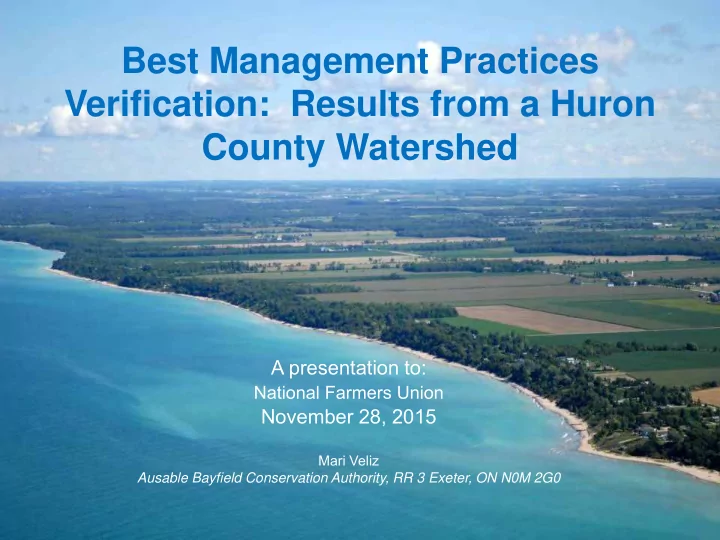
Best Management Practices Verification: Results from a Huron County Watershed

A presentation to:

National Farmers Union

November 28, 2015

Mari Veliz Ausable Bayfield Conservation Authority, RR 3 Exeter, ON N0M 2G0

slide-2
SLIDE 2

Communities in Action

Build Awareness

Take actions to protect and enhance

Measure Community Involvement

slide-3
SLIDE 3

Water Quality Issues = Runoff Issues

South Pine Garvey Glenn Gully Trick's Shashawandah

Total Phosphorus (mg·l

  • 1)

0.00 0.20 0.40 0.60 0.80 1.00

Low Flow

South Pine Garvey Glenn Gully Trick's Shashawandah

Total Phosphorus (mg·l-1)

0.00 0.20 0.40 0.60 0.80 1.00

High Flow

slide-4
SLIDE 4

Stormwater

  • Why Do We See Differences?
  • The ephemeral channels are important to water, sediment and nutrient transport
  • There is an hierarchy of urban and agricultural BMPs to address storm events
  • To evaluate the effectiveness of BMPs we need to monitor during storm events

During an event Typical conditions

slide-5
SLIDE 5
  • Management BMPs:
  • Cover crop
  • Nutrient management
  • Conservation tillage
  • Structural BMPs:
  • Water and Sediment

Control Basins

  • (Grassed Filter Strip)

BMP Evaluation

slide-6
SLIDE 6

Cover Crop Rainfall Simulation

Treatment Antecedent conditions Runoff (mm) Runoff (%) Total Suspended Solids (mg/L) no cover cropA workable 0.8 6.4 406 no cover cropB wet 1.1 8.8 482 cover cropA workable cover cropB wet 0.9 7.2 130 light cultivationC very wet 3.6 28.8 2260

Treatment

  • n a field that was post no-till wheat harvest, straw baled with a portion

that had red clover cover crop

  • 1 X 1m plots
  • simulationA: 12.5 mm/10 min simulates a 2 year10 minute storm
  • simulationB: 12.5 mm/10 min a 2nd time - 3 h later
  • simulationC: PLUS 12.5 mm/10 min a 3rd time - 0.5 h later
slide-7
SLIDE 7

Field BMP Monitoring Water and Sediment Control Basin

Duration of most outflow ~9 h Duration of most inflow <1.5 h

slide-8
SLIDE 8

Linking Landscape and Water Quality

  • Grass filter strip reduced:

– TSS, TP, and SRP – did not change nitrate-N

  • Change in cropping system:

– landowner extended hay field – no concentrated flow path – no water samples – some BMPs can be measured at the site scale and some cannot

slide-9
SLIDE 9

1955 1966 1975 1978 1989 1999 2006

slide-10
SLIDE 10

ACTion BMPs and the Treatment Train

(Avoid, Control, Trap/Treat)

Urban BMPs

Trap Treat

Control

(at/near source)

Avoid

(improve filtration)

Rural BMPs

  • No/Minimum Till
  • Cover Crops
  • Nutrient/manure

Management

  • Natural Cover
  • Less Pavement
  • Permeable

Pavement

  • Natural Cover
  • Controlled

Drainage

  • Grassed

Waterways

  • Berms
  • Wetlands
  • Rain Gardens
  • Rain Barrels
  • Bioswales
  • Stormwater Ponds
  • Buffers
  • Two-Stage

Ditches

Based on Tomer et al. 2013

slide-11
SLIDE 11

Soil Health Recommendations

1. Cover soil (with vegetation not pavement) 2. Reduce tillage 3. Rotate crops 4. Test soil

– Fertility – Organic matter – Erosion risk

slide-12
SLIDE 12

Acknowledgements

  • Other collaborators on the Watershed Based BMP Evaluation:

– University of Guelph – Ontario Ministry of Agriculture, Food and Rural Affairs – Ontario Ministry of the Environment and Climate Change – Huron County Federation of Agriculture – Landowners in the Gully Creek watershed

Many of the photos by Daniel Holm Photography, courtesy of Healthy Lake Huron: Clean Water, Clean Beaches Initiative

Funding for the work presented today is from Ontario Ministry of Agriculture, Food and Rural Affairs, the Agricultural Research Institute of Ontario, the Ministry of Environment and Climate Change and Environment Canada. The views expressed are the views of the presenter and do not necessarily reflect those of the funders.

slide-13
SLIDE 13

Temporal and Spatial Scale Considerations

  • Measuring the effectiveness of this grassed ditch

– Cannot be measured in the downstream channel or at watershed outlet or in the Lake during routine water sampling