BEIPC QUARTERLY MEETING 2019 FIELD SEASON & BUDGET UPDATE JEFF - - PDF document

beipc quarterly meeting 2019 field season amp budget
SMART_READER_LITE
LIVE PREVIEW

BEIPC QUARTERLY MEETING 2019 FIELD SEASON & BUDGET UPDATE JEFF - - PDF document

BEIPC QUARTERLY MEETING 2019 FIELD SEASON & BUDGET UPDATE JEFF PHILIP EPA REGION 10 MAY 22, 2019 1 Picture: This is a picture of Success Mine in the Ninemile Basin. What you are seeing is hydrostraw sprayed on remediated slopes to


slide-1
SLIDE 1

1

BEIPC QUARTERLY MEETING

1

2019 FIELD SEASON & BUDGET UPDATE

JEFF PHILIP EPA REGION 10 MAY 22, 2019

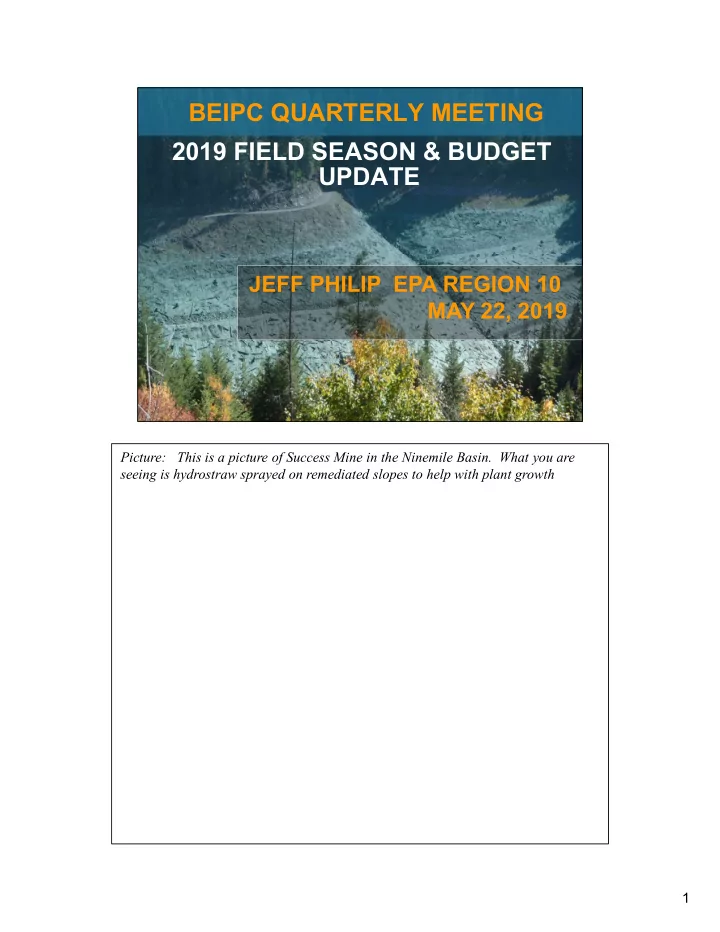
Picture: This is a picture of Success Mine in the Ninemile Basin. What you are seeing is hydrostraw sprayed on remediated slopes to help with plant growth

slide-2
SLIDE 2

Budget

2

 UPPER BASIN

  • NINEMILE CREEK
  • CANYON CREEK
  • PINE CREEK

 REMEDY PROTECTION

PROJECTS

 BASIN PROPERTY

REMEDIATION PROGRAM

 ROADS PROGRAM  DISPOSAL FACILITIES  CENTRAL IMPOUNDMENT

AREA/GROUNDWATER COLLECTION SYSTEM UPGRADES

 CENTRAL TREATMENT

PLANT UPGRADES

 LOWER BASIN  BUDGET UPDATE

ORDER OF PRESENTATION

2

slide-3
SLIDE 3

Budget

3

NINEMILE BASIN

3

slide-4
SLIDE 4

4

4

Ninemile Basin (Figure: Identifies the locations of the various mine and mill sites, tailings piles, rock dumps, repository/waste consolidation areas, and creek channels/riparian areas that have already been cleaned up, currently being investigated and/or cleaned up, or to be investigated and cleaned up in the future.)

  • Cleanup Completed
  • Rex Mine and Mill Complex includes the Rex No. 1 site and the Rex No. 2/Sixteen-to-

One Mine site.

  • The Rex No. 1 site remedy was completed in 2010; however, additional

monitoring is being conducted and may need additional remediation.

  • The Rex No. 2/Sixteen-to-One Mine site remedy was completed in 2007.
  • Interstate-Callahan Mine/Rock Dumps and Interstate-Callahan Lower Rock Dumps (aka IC Rock

Dumps) were cleaned up in 2015.

  • Investigation/Cleanup Underway – Talk About in Next Slides
  • East Fork Ninemile (EFNM) Waste Consolidation Area
  • Success Complex
  • Tamarack Complex
  • Lower EFNM Creek
  • Dayrock Mine
  • Ninemile Fishing Pond
slide-5
SLIDE 5

5

5

EAST FORK NINEMILE WASTE CONSOLIDATION AREA

East Fork Ninemile (EFNM) Waste Consolidation Area (WCA)

  • Provides location to consolidate mine waste materials, including waste rock and tailings, from

cleanup activities throughout the Ninemile Creek watershed.

  • In 2013, the CDA Trust constructed the EFNM WCA.
  • In 2014 it received its first wastes from the Interstate-Callahan Mine/Rock Dumps and the

Interstate-Callahan Lower Rock Dumps (collectively referred to as the IC Rock Dumps) cleanup.

  • A total of 215,928 cubic yards was excavated from the IC Rock Dumps and hauled to the

WCA.

  • In 2016, wastes from the Success Complex cleanup were first placed in the EFNM WCA.
  • In 2019, the following will happen:
  • Last of the wastes from the Success Complex cleanup, approximately 40,000 cubic

yards, will be placed in the at the EFNM WCA. Total wastes from Success = 363,787 cubic yards.

  • First waste from the Interstate Millsite cleanup, approximately 40,000 cubic yards, will

be consolidated at the WCA.

  • The 500,000 cubic yard expansion of the EFNM WCA will continue in order to prepare

for wastes from the Interstate Complex, the Tamarack Complex, and the Dayrock Mine

  • cleanups. The expansion is estimated to be completed in 2020.
  • Groundwater and surface water sampling will continue as part of the CDA Trust’s water

monitoring program.

  • A final cap will be placed on the lower portion of the WCA.
slide-6
SLIDE 6

SUCCESS COMPLEX

6

Success Complex

  • In 2016, the CDA Trust began the cleanup at the Success Complex. In 2019,

the cleanup will be completed.

  • Activities in 2019:
  • Cleanup activities include excavation of approximately 40,000 cubic

yards of waste rock and tailings, realignment of the EFNM Creek channel, and relocation of the main Ninemile access road to the west side

  • f the creek.
  • As excavation is completed, the site is capped with a

revegetated soil cover in areas where the final slopes are not too steep. A mixture of soil and riprap is used as the final cover in overly steep areas.

  • All excavated wastes are being hauled to the EFNM WCA.
  • Total waste excavated and hauled to the EFNM WCA at the end of

the project is estimated at 360,000 cubic yards. 6

slide-7
SLIDE 7

7

7

INTERSTATE MILLSITE

Interstate Millsite

  • 2019 is the first year of construction with an estimated 40,000 cubic yards to be

hauled to the EFNM WCA.

  • The project involves excavation of waste rock and tailings from the site,

followed by capping and revegetation in areas where the final slopes are not too steep to place cover soil and support vegetation. A mixture of soil and riprap will be used as the final cover in overly steep areas. Mine waste materials from the site will be placed at the EFNM WCA. The project also includes realignment of the EFNM Creek channel and installation of a temporary creek crossing. Restoration of the stream segment is anticipated to be like the design at the Success complex.

  • Construction is estimated to be completed in 2020.
  • The estimate of wastes excavated and hauled to the EFNM WCA by project

end is 140,000 cubic yards.

slide-8
SLIDE 8

8

8

TAMARACK COMPLEX

Tamarack Complex

  • The Tamarack Complex consists of six sites in the East Fork Ninemile Creek

area and has been identified as a significant source of lead loading to the EFNM Creek during peak flow conditions, threatening human health and the environment.

  • In 2018, the CDA Trust completed a study on the options for cleaning up the

Tamarack Complex and determined that the best course of action was the full removal of mine waste.

  • In 2019, the CDA Trust will complete the final design for the Tamarack

Complex.

  • In 2020, a construction contractor will be procured.
  • In 2021, the cleanup of the Tamarack Complex is anticipated to being.
  • In 2024, cleanup is to be completed.
  • An estimated 535,000 cubic yards of wastes will have been excavated and

hauled to the EFNM WCA by the end of the project.

slide-9
SLIDE 9

LOWER EAST FORK NINEMILE CREEK

9

Lower East Fork Ninemile Creek

  • This site extends from Success Mine down to confluence with Ninemile Creek
  • It is the largest loader of lead to Ninemile Creek. It is the 2nd highest loader of

zinc.

  • In 2019
  • Continue design investigations including soil borings, sampling of

soils, sediments, groundwater, and surface water, and installing monitoring wells.

  • Cleanup activities are estimated to begin in 2024.

9

slide-10
SLIDE 10

DAYROCK MINE

10

Dayrock Mine

  • Operated between 1924-1977
  • Includes adits, waste rock pile, structures and settling ponds.
  • In 2019
  • Design investigations continue including soil borings, excavating and sampling

test pits, taking of adit samples, and installation of new monitoring wells.

  • Cleanup activities are estimated to begin in 2026.

10

slide-11
SLIDE 11

NINEMILE FISHING POND

11

NINEMILE FISHING POND

Ninemile Fishing Pond

  • Recreation Area up Ninemile Road.
  • Starting in July 2019, will begin second phase of a small cleanup at Ninemile

Fishing Pond.

  • Cleanup includes digging up lead-contaminated soil down to one foot around

areas of the pond and replacing it with clean soil or gravel. The cleanup will make the pond area safer for families.

  • Cleanup will be completed in 2019.

11

slide-12
SLIDE 12

Budget

12

CANYON CREEK BASIN

12

slide-13
SLIDE 13

13

13

Canyon Creek Sites

slide-14
SLIDE 14

14

14

CANYON COMPLEX REPOSITORY

WASTE CONSOLIDATION AREA

Canyon Complex Repository/Waste Consolidation Area

  • In 2019, start construction based on revised design
  • Revised design based on 2017 public comment:
  • Changed the orientation of the WCA to the north instead of to the east

which allows hauling to bypass Woodland Park community and adds capacity for 8 additional acres

  • Cleanup activities include:
  • Moving approximately 600,000 cubic yards of waste from the nearby

“leaking” Silver Valley Natural Resource Trustee repository (seeps from the SVNRT repository contribute 36 pounds/day of zinc to Canyon Creek

  • Add mine waste from up to 10 Canyon Creek mine and mill site cleanups
  • New WCA will have capacity for 1.5 million cubic yards of mine waste
  • Construction estimated to be cleaned up in 2021.
slide-15
SLIDE 15

15

HECLA STAR COMPLEX

Hecla Star Complex:

  • Follow-up investigations
  • Soil borings
  • Excavate and sample test pits
  • Install new monitoring wells

15

slide-16
SLIDE 16

TAMARACK #7

16

Tamarack #7

  • Design investigations
  • Sample Adit (has year round flow)
  • Soil borings
  • Excavate and sample test pits

16

slide-17
SLIDE 17

EPA_FF_10/12/2011 17

PINE CREEK BASIN

17

slide-18
SLIDE 18

DOUGLAS MINE

18

DOUGLAS MINE

Pine Creek Basin/Douglas Mine Design Investigation

  • 40-acre Douglas Mine & Millsite
  • Initially opened in 1916; closed in 1972
  • Consists of two mine adits, mill remnants, concrete foundations, and several

mine rock dumps at Douglas and along Pine Creek

  • 24,762 cubic yards of tailings excavated from Pine Creek and moved to the

Douglas Mine site repository

  • In 2019, design investigation to start consisting of:
  • Soil borings
  • Test pits at structure footprints, repository, and Pine Creek (where tailings

were originally kept)

  • Adit water sampling
  • Surface water sampling at Pine Creek
  • In 2021, cleanup estimated to start
  • In 2022, cleanup estimated to be complete.

18

slide-19
SLIDE 19

Budget

19

REMEDY PROTECTION PROJECTS

19

slide-20
SLIDE 20

Budget

EPA_FF_10/12/2011 20

 MULLAN TIGER CREEK PROJECT:

New Eighth Street storm drain system (upgrade inlet and subsurface pipe, repave Eighth Street).

 NINEMILE BLACKCLOUD CREEK:

Upgrade culvert under Ninemile Road.

 CANYON CREEK

  • Star Complex Parking Area: New storm drain

system & parking area paving.

  • Gem Area Drainage: Upgrade drainage inlet

& subsurface pipe.

REMEDY PROTECTION PROJECTS CONSTRUCTION COMPLETED IN 2019!

Remedy Protection Projects (Photo is of 2018 Phase 1 of Tiger. Seventy-two inch manhole at River and Eighth Streets.)

  • A total of 26 Remedy Protection projects were selected by EPA for

construction.

  • In 2019, the final four projects will be completed:
  • Tiger Creek – upper half (2nd of two phases) will be constructed in 2019.

Eighth St will be paved at project completion.

  • Blackcloud Creek (~2.4 miles up Ninemile Rd) – upgrade culvert under

Ninemile Rd.

  • Star Complex Parking Area – surface & subsurface storm drain system &

paving to be completed in the area where Shoshone County stores snow and school buses turn-around.

  • Gem Area Drainage – upgrade inlet for unnamed drainage & subsurface

pipe to Canyon Creek. 20

slide-21
SLIDE 21

Budget

EPA_FF_10/12/2011 21

BASIN PROPERTY REMEDIATON PROGRAM

21

slide-22
SLIDE 22

Budget

22

BPRP SUBSTANTIALLY COMPLETED IN 2019!

 2019 ACTIVITIES

  • Cleanup of about 32 parcels and ROWS
  • Sampling of about 6 parcels (4 properties)
  • Continue maintaining drinking water filtration

systems at 7 homes

 REMAINING ACCESS ISSUES

  • Not all parcels can be sampled & cleaned up

at this time

 PROCESS FOR FUTURE TRACKING

  • Sale of unsampled & un-remediated properties

Basin Property Remediation Program (Photo is of the Shoshone County Sportsman Association fish hatchery outside of Mullan. Taken after the CDA Trust cleanup the hatchery in 2018. The Association operates the hatchery along with Idaho Fish and Game).

  • 2019 Activities:
  • Will continue maintaining under sink reverse osmosis filtration systems at 7 homes

(public water supply connections are not available for these homes).

  • Remaining Access Issues:
  • Not all parcels have been cleaned up due to access issues:
  • Upper Basin – 65 parcels
  • Box – 8 parcels
  • Lower Basin – 148 parcels
  • Parcels for which access has not been granted fall into two categories:
  • Property owner refuses access
  • Property owner has not responded to repeated mailings, phone calls, and door knocking

(if parcel has a residence)

  • Future Tracking
  • EPA, DEQ, PHD & CDA Trust have worked together to establish a process for tracking

sale of unsampled and un-remediated properties. The agencies and the CDA Trust will continue to work together to familiarize new owners with the BPRP and to obtain access from new property owners for sampling and cleanup.

22

slide-23
SLIDE 23

Budget

23

ROADS PROGRAM

23

slide-24
SLIDE 24

Budget

24

ROADS PROGRAM

PROGRAMS COMPLETE

Smelterville, Wardner, Eastside Hwy Dist., Pinehurst, Osburn, Wallace and Mullan

2019 BOX

Construction in Kellogg (McKinley Avenue) & Shoshone County (Pine Creek Road from bridge to Box/Basin line) Kellogg in concert with city- wide utility work

2019 BASIN

Shoshone County (11 road segments spread

  • ver Kingston, Big Creek, Woodland Park, &

Nine Mile)

24

slide-25
SLIDE 25

Budget

25

DISPOSAL FACILITIES

25

slide-26
SLIDE 26

Budget

26

DISPOSAL FACILITIES

 UPPER BASIN

  • Lower Burke Canyon
  • Big Creek & Big Creek Annex

 BOX

  • Page Repository
  • Page Limited Use Repository

 LOWER BASIN

  • East Mission Flats

Disposal Facilities (Photo is of Lower Burke Canyon Repository [LBCR] vehicle decontamination pad)

  • The CDA Trust operates, monitors & maintains Upper & Lower Basin

repositories.

  • The IDEQ does the same for the Box repository and LUR.
  • 5 Repositories each with Institutional Control Program (ICP) deposition areas:

 East Mission Flats Repository (EMFR)  Big Creek Repository (BCR)  Big Creek Repository Annex (BCRA)  Lower Burke Canyon Repository (LBCR)  Page Repository

  • One stand alone ICP area in the town of Mullan (not operated in 2018)
  • Limited Use Repositories (LUR): Materials from Paved Roadways

Remediation Program only  East Zanetti LUR: Closed at end of 2018 with 23,158 CY  Shoshone County Transfer Station LUR: Closed at end of 2018 26

slide-27
SLIDE 27

with 21,001 CY  Government Gulch LUR: Expected to be will be filled to capacity and closed in 2019

  • In 2018 repositories received:

 EMFR: 32,302 CY  BCR: 4,721 CY  BCRA: 7,259 CY  LBCR: 18,120 CY  Page: 33,000 CY 2019 Projections:  EMFR: 4,500 CY  BCR and BCRA: 9,000 CY  LBCR: 4,050 CY  Page: 30,000 CY Volume Remaining:  EMFR: 180,800 CY  BCR: 121,812 CY  BCRA: 175,531 CY  LBCR: 121,812 CY  Page: 550,00 CY 26

slide-28
SLIDE 28

Budget

27

CENTRAL IMPOUNDMENT AREA

GROUNDWATER COLLECTION SYSTEM UPGRADES

27

slide-29
SLIDE 29

Budget

28

Central Impoundment Area Groundwater Collection System Upgrades

  • Between June and October 2018, the 7,000 foot SBCW was completed. Gaps

left in wall along western end to allow groundwater flow.

  • In April 2019, installation and well development of 12 extraction wells south of

wall will be completed.

  • December 2019, extraction wells and conveyance system over top of CIA to

upgraded CTP estimated to be completed. 28

slide-30
SLIDE 30

Budget

29

EMERGENCY RESPONSE

INTERSTATE-90 SUBSIDENCE & TURBIDITY SEEP ISSUES

29

slide-31
SLIDE 31

Budget

30

EMERGENCY RESPONSE TIMELINE

 December 20, 2018: Turbidity seeps observed & sampled in South Fork Coeur d’Alene River  December 28, 2018 - January 28, 2019: Federal Government (EPA) Shutdown  February 5/6, 2019: Settlement observed in I-90  February 14, 2019: Idaho Transportation Department completes Interstate-90 grind & fill at settling locations  February 7, 2019 - early April 2019: EPA Emergency Response

  • Investigation north of wall
  • Temporary conveyance system to route pumped water to Central Treatment Plant
  • Install extraction wells north of wall

 March 22, 2019: Community Leader Meeting  March 31, 2019: Last paved. Turbidity and highway settling have significantly decreased.  April 8, 2019: Two sonic/CTP borings in settlement area EB lanes. No voids but softer zones where groundwater erosion may have occurred over time, similar to past events.  Path Forward: EPA monitoring of South Fork CDA River & around I-90. ITD monitoring highway. Complete construction and start-up of Groundwater Collection System.

I-90 Emergency Response Update

  • EPA emergency response program mobilized in abundance of caution due to
  • bserved settling in I-90.. Daily Briefings with ITD, IDEQ, EPA, ACOE and

contractor

  • Formed Planning team to investigate conditions and respond with pumping

north of the wall, if necessary. : Ktr, ACOE, EPA (RPM and Technical)

  • No conclusive ties to GWCS. Settling of highway has occurred before.

30
slide-32
SLIDE 32

Budget

31

TURBIDITY SEEP ADJACENT TO I-90

31

slide-33
SLIDE 33

Budget

32

CENTRAL TREATMENT PLANT UPGRADES

32

slide-34
SLIDE 34

Budget

33

CENTRAL TREATMENT PLANT UPGRADES

CENTRAL TREATMENT PLANT UPGRADES (Photo: Noteworthy at Right = Filter building exterior panels are being installed, new thickener legs and frame is installed (behind/left of Silos), on left - reactor forms/steel reinforcement installed, 3 red/1 white tanks are the temporary treatment system)

  • September 2018: Shifted to Temporary Treatment System
  • November 2018: Completed demolition of dilapidated components (rapid mix

tank, Floc Basin, Aeriation Basin)

  • November 2018: Initial concrete placement commenced
  • April 2019: Building Construction commenced
  • By August 2019: Completion of upgrades is scheduled to be completed by

August 2019 to allow for upgrades to existing clarifier 33

slide-35
SLIDE 35

34

LOWER BASIN

34

slide-36
SLIDE 36

RECREATIONAL AREAS

35

Recreational Areas

(Photo is of Cataldo Boat Launch)

  • Recreational Site Team = PHD, DEQ, CDA Tribe, EPA
  • Panhandle Health District working with U of I grad student to evaluate

use of select recreation areas

  • Work is being done in phases because of heavy summer use

35

slide-37
SLIDE 37

RECREATIONAL AREA HAND WASHING STATIONS

36

Lower Basin Recreational Areas (Photo: Black Rock Trailhead)

  • Continue the installation of hand washing stations at 4 recreation sites.

36

slide-38
SLIDE 38

37

SIGN

Lower Basin Recreational Area Signage

  • New signs at 20+ locations
  • Types of Signs:
  • The sign on the left = General Information
  • The sign on the right = Location-specific. Example is Rose Lake Boat Launch
  • Some signs have history of area on them.

37

slide-39
SLIDE 39

 Soil Amendment Evaluation: Starting bench scale study/ORD support  Thin Layer Capping Pilot Project: Continue monitoring. Veg responding well.  Sediment Transport Model: Development complete. Documentation under review.  Data Collection to Support CSM: Flood sampling reports on EPA website.  Structured Decision-Making Process: Prioritize pilot projects (not RODA)

  • Select Pilot Projects for Trust to do planning, design, implementation
  • All habitat projects scored well
  • Selected Greys Meadow (aka Black Lake Ranch)
  • Conduct Pilot Project Alternatives Analysis for Dudley Reach. Working with Lower Basin

Project Focus Team (LBPFT). Will identify projects in 2020.

 Characterization & Cultural Resource Assessment: Greys Meadow & Gleasons Field completed in 2018

  • May 14 LBPFT meeting to discuss process & results.

OTHER LOWER BASIN ACTIVITIES

Notes -

  • Beginning bench scale to test different amendments to immobilize lead and

make it less bioavailable.

  • Beginning second year of monitoring after placement thin layer cap using

native material. Vegetation recovery is very good. 38

slide-40
SLIDE 40

BUDGET UPDATE

39

39

slide-41
SLIDE 41

40

Three Funding Sources

 STATE LEGISLATIVE APPROPRIATIONS  FEDERAL CONGRESSIONAL APPROPRIATIONS

  • Requesting funds for Basin in 2019

 SETTLEMENTS WITH RESPONSIBLE PARTIES

  • Special Accounts
  • Coeur d’Alene Work Trust
  • Negotiated agreements dictate use of funds

Three Funding Sources

  • State Legislative Appropriates.
  • Designated for specific uses, e.g., Basin Commission Director salary.
  • Federal Congressional Appropriations
  • Taxpayer dollars
  • Compete for these funds from across EPA and within Region 10
  • Requested funds for the Basin this year.
  • Settlements with Responsible Parties
  • Negotiated Settlement Agreements dictate use of funds.
  • Box special actions, currently with Hecla and Asarco monies, can only

be used in the Box, e.g., for Central Treatment Plant Upgrades.

  • Basin special accounts, currently with Asarco monies, can only be used in

the Basin, e.g., oversight of CDA Trust Work

  • CDA Work Trust funds can only be used in the Basin – other restrictions

discussed in next slide 40

slide-42
SLIDE 42

41

TRUST

COEUR D’ALENE WORK TRUST

 2009 ASARCO BANKRUPTCY SETTLEMENT

  • Court established the Coeur d’Alene Custodial and Work Trust
  • $437 million deposited into CDA Work Trust Account
  • Other proceeds went to EPA Box & Basin Special Accounts

 USES OF CDA WORK TRUST FUNDS

  • Can only be used to fund EPA-selected Basin cleanup actions
  • Cannot be used to fund Box cleanup actions.
  • Cannot be used to fund oversight of the CDA Trust
  • Cannot be used to fund State, Tribe, local governments or
  • ther Federal agencies work in the Box or Basin.

The Coeur d’Alene Work Trust

  • The Trust was established as part of a settlement agreement between the United

States and Asarco LLC and its subsidiaries in the United States Bankruptcy Court for the Southern District of Texas, Corpus Christi Division.

  • The court order approving the Coeur d'Alene Work Trust requires that the Trust
  • nly be used to perform EPA-selected cleanup actions (as identified in a

Record of Decision) in the Basin. Thus, the Coeur d'Alene Work Trust cannot be used for cleanup actions in the Box. 41

slide-43
SLIDE 43

42

2019 ESTIMATED PROJECT SPENDING PLAN

Account Currently Available Estimated 2019 Spending Plan Balance Box Special Account $17.3 million $6.7 million $10.7 million Basin Special Account $2.8 million $3.3 million ($0.5 million) CDA Work Trust $535.4 million $17 - $19 million $518.4 - $516.4* *Doesn’t include interest earned

FY 2019 Estimated Project Spending Plan

  • Just estimates!
  • Basin special account will be exhausted this fiscal year. Have requested $500K

in Congressionally-appropriated funds. Will continue to request Basin funds that cannot be covered by the CDA Trust.

  • The CDA Work Trust has a $20 million spending cap in order to grow monies

for the long-term. On average, the CDA Trust has spent approximately $19 million a calendar year since fully ramped up in 2014.

  • EPA reviews and approves the CDA Trust Work Plan and Budget each year as

well as oversees their work (we just don’t use their monies to do so!). 42

slide-44
SLIDE 44

Questions

43