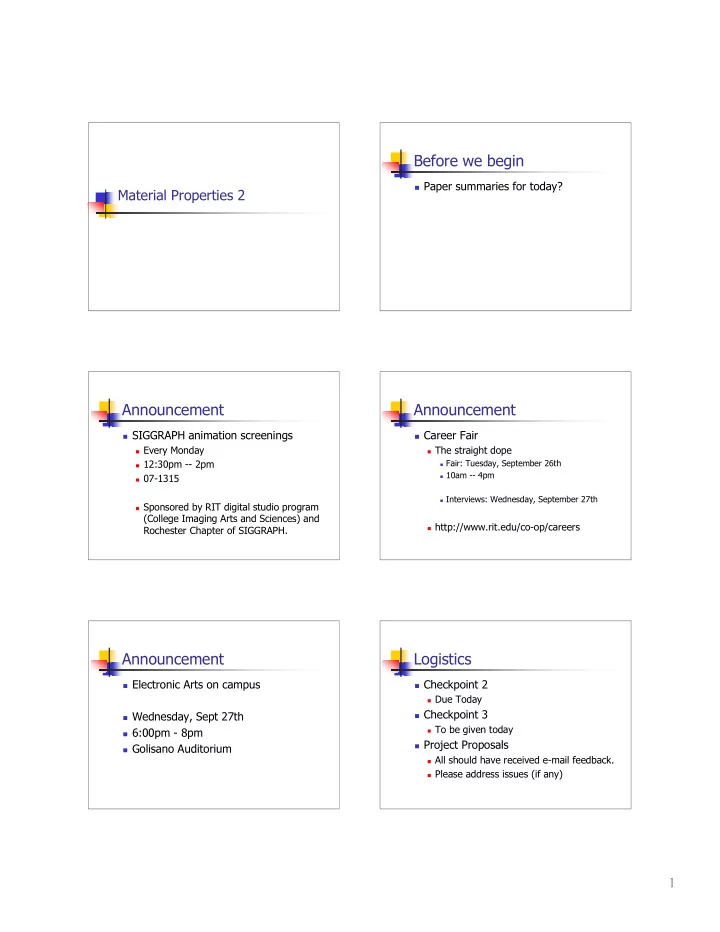
Before we begin Paper summaries for today? Material Properties 2 - - PDF document

before we begin
SMART_READER_LITE
LIVE PREVIEW

Before we begin Paper summaries for today? Material Properties 2 - - PDF document

Before we begin Paper summaries for today? Material Properties 2 Announcement Announcement SIGGRAPH animation screenings Career Fair Every Monday The straight dope 12:30pm -- 2pm Fair: Tuesday, September 26th 10am


slide-1
SLIDE 1

1 Material Properties 2

Before we begin

 Paper summaries for today?

Announcement

 SIGGRAPH animation screenings

 Every Monday  12:30pm -- 2pm  07-1315  Sponsored by RIT digital studio program

(College Imaging Arts and Sciences) and Rochester Chapter of SIGGRAPH.

Announcement

 Career Fair

 The straight dope

 Fair: Tuesday, September 26th  10am -- 4pm  Interviews: Wednesday, September 27th

 http://www.rit.edu/co-op/careers

Announcement

 Electronic Arts on campus  Wednesday, Sept 27th  6:00pm - 8pm  Golisano Auditorium

Logistics

 Checkpoint 2

 Due Today

 Checkpoint 3

 To be given today

 Project Proposals

 All should have received e-mail feedback.  Please address issues (if any)

slide-2
SLIDE 2

2

Plan for today

 Material Properties

 Bi-directional reflectance distribution functions

(BRDFs)

 Advanced Illumination Models  Beyond BRDFs

 Checkpoint 3 of the ray tracer  Ray tracer help

Computer Graphics as Virtual Photography

camera (captures light) synthetic image camera model (focuses simulated lighting)

processing

photo processing tone reproduction real scene 3D models Photography: Computer Graphics: Photographic print

Shading

 Computing the light that leaves a point  Shading point - point under investigation  Illumination model - function or algorithm

used to describe the reflective characteristics of a given surface.

 Shading model – algorithm for using an

illumination model to determine the color of a point on a surface.

 For efficiency’s sake, most illumination models

are approximations.

BRDF

 Bi-directional Reflectance Function

) , , , (

r r i i r

f BRDF

  • =

At a given point, gives relative reflected illumination in any direction with respect to incoming illumination coming from any direction; Note: The θ’s are elevation, ϕ’s are measured about the surface normal. The i’s refer to the incident ray; the r’s to the reflected ray.

BRDF Geometry BRDF

 Can return any positive value.  Generally wavelength specific.

) , , , , (

  • r

r i i r

f BRDF =

slide-3
SLIDE 3

3

Anisotropic Models

 Anisotropy

 Isotropic - surfaces reflect equally from any

direction of view

 Anisotropic - reflection varies not only with angle

  • f incidence, but also with the angle of the

incident light w.r.t some viewing angle.

 Surfaces considered to possess an intrinsic grain  Examples: satin, velvet, hair, brushed aluminum

Ansiotropic Models

 anisotropic (adj.) an·i·so·trop·ic 1.

  • Physics. of unequal physical properties

along different axes.

 http://www.neilblevins.com/cg_educatio

n/aniso_ref/aniso_ref.htm

Anisotropic Models

 Anisotropic reflection -- example

Ward Blevins

Why does ansiotropic reflection occur?

 Occurs on objects with fine grain in a

given direction.

Blevins

Anisotropic Models

 Ward Model [Ward92]

 Designed for both accuracy and ease of

use

 Includes model for anisotropic reflection

Anisotropic Models

 Ward Model - Isotropic

specular 2 / ) (tan diffuse

) 4 cos cos 1 (

2 2

πα δ θ ρ π ρ ρ

α γ −

  • +

= e

s d

slide-4
SLIDE 4

4

Anisotropic Model

 Ward Model

 ρd - Diffuse reflectance coefficient (can

vary with wavelength)

 ρs - Specular reflectance coefficient (can

vary with wavelength)

 α - Standard deviation of surface slope

Anisotropic Models

 Ward Model -- anisotropic

specular )) / sin / (cos (tan diffuse

) 4 cos cos 1 (

2 2 2 2 2

y x s d

y x

e α πα δ θ ρ π ρ ρ

α φ α φ γ + −

  • +

=

Anisotropic Models

 Ward Model w/ ansiotropy

 αx - Standard deviation of surface slope in

x-direction

 αy - Standard deviation of surface slope in

y-direction

Ward’s Anisotropic Model Anisotropic Models

 Ward Model - example

Photo Isotropic Anisotropic

Anisotropic Models

 Other anisotropic models (all based on

physics)

 [Kajia85]  [Poulin90]  [He91]

slide-5
SLIDE 5

5

BRDF

 Simplifying Assumptions wrt the BRDF

 Light enters and leaves from the same point.

 Not necessarily true  Subsurface scattering  Skin, marble

 Light of a given wavelength will only reflect back light

  • f that same wavelength

 Not necessarily true  Light Interference  Oily patches, peacock feathers

Subsurface Scattering

Jensen, et al 2001

Subsurface Scattering

 Example: Skin

Blevins,2001

bidirectional surface scattering distribution function (BSSDF)

 Relates outgoing reflectance in a given

direction (at a given point) to the incoming luminance arriving at another point.

bidirectional surface scattering distribution function (BSSDF)

Outgoing luminance at xo in the direction

  • f wo

incoming luminance at xi in the direction

  • f wi

BSSDF When xo == xi the BSSDF is simply a BRDF

BSSDF -- Examples

Jensen, et al 2001

Using BRDF Using BSSDF

slide-6
SLIDE 6

6

BSSDF -- Examples

Jensen, et al 2001

Using BRDF Using BSSDF

BSSDF -- Examples

Jensen, et al 2001

Using BRDF Using BSSDF

BSSDF Modeling

 Won Henrik Wann Jensen an academy

award in 2004.

 Practical model described in [Jensen, et.

  • al. 2001]

Light transport functions

 BSSRDF (Bidirectional surface scattering

reflectance distribution function) describes the relation between outgoing radiance and the incident flux, including the phenomena like subsurface scattering (SSS).

 BRDF (Bidirectional reflectance distribution

function) is a simplified BSSRDF, assuming that light enters and leaves at the same point

Light Transport Functions

Wikipedia

Light transport functions

 BTDF (Bidirectional transmittance distribution

function) is similar to BRDF but for the

  • pposite side of the surface. (see the top

image).

 BSDF (Bidirectional scattering distribution

function) is the most general function.

slide-7
SLIDE 7

7

Light transport functions Summary

 Advanced models of reflection

 Anisotropic Models  BSSDF – subsurface scattering  Complete transport functions.  Adding to ray tracer.  Break.